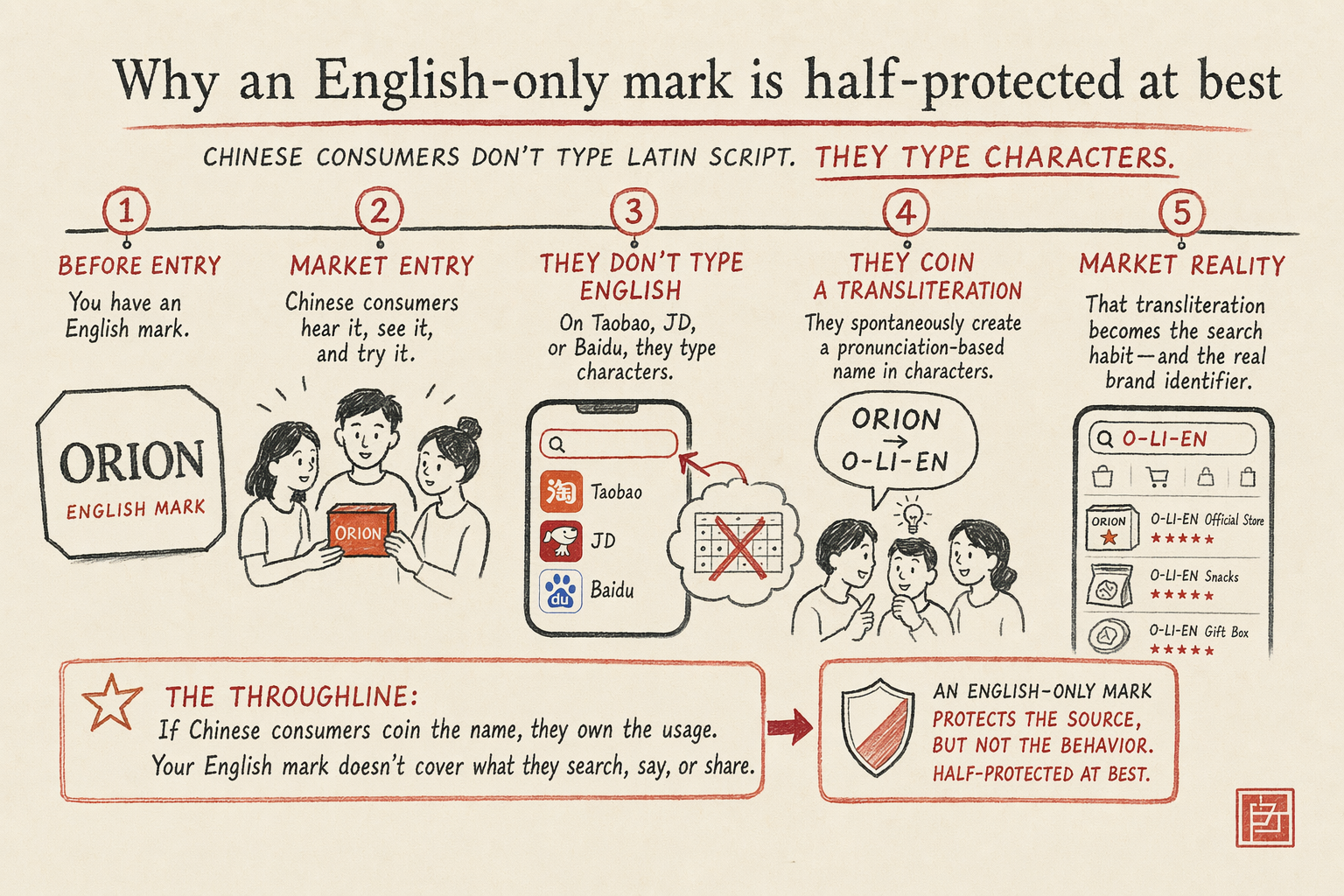
Why an English-only mark is half-protected at best
Chinese consumers do not type Latin script into Taobao, JD, or Baidu. They type Chinese characters. The handful of Western brands that have entered China with only an English mark — and held the position — share a single quality: their English name is so phonetically clean and culturally neutral that Chinese consumers spontaneously coined a transliteration, and the brand adopted it after the fact. This is a rare path. Most brands either pick their Chinese name on purpose or watch consumers and squatters pick it for them.
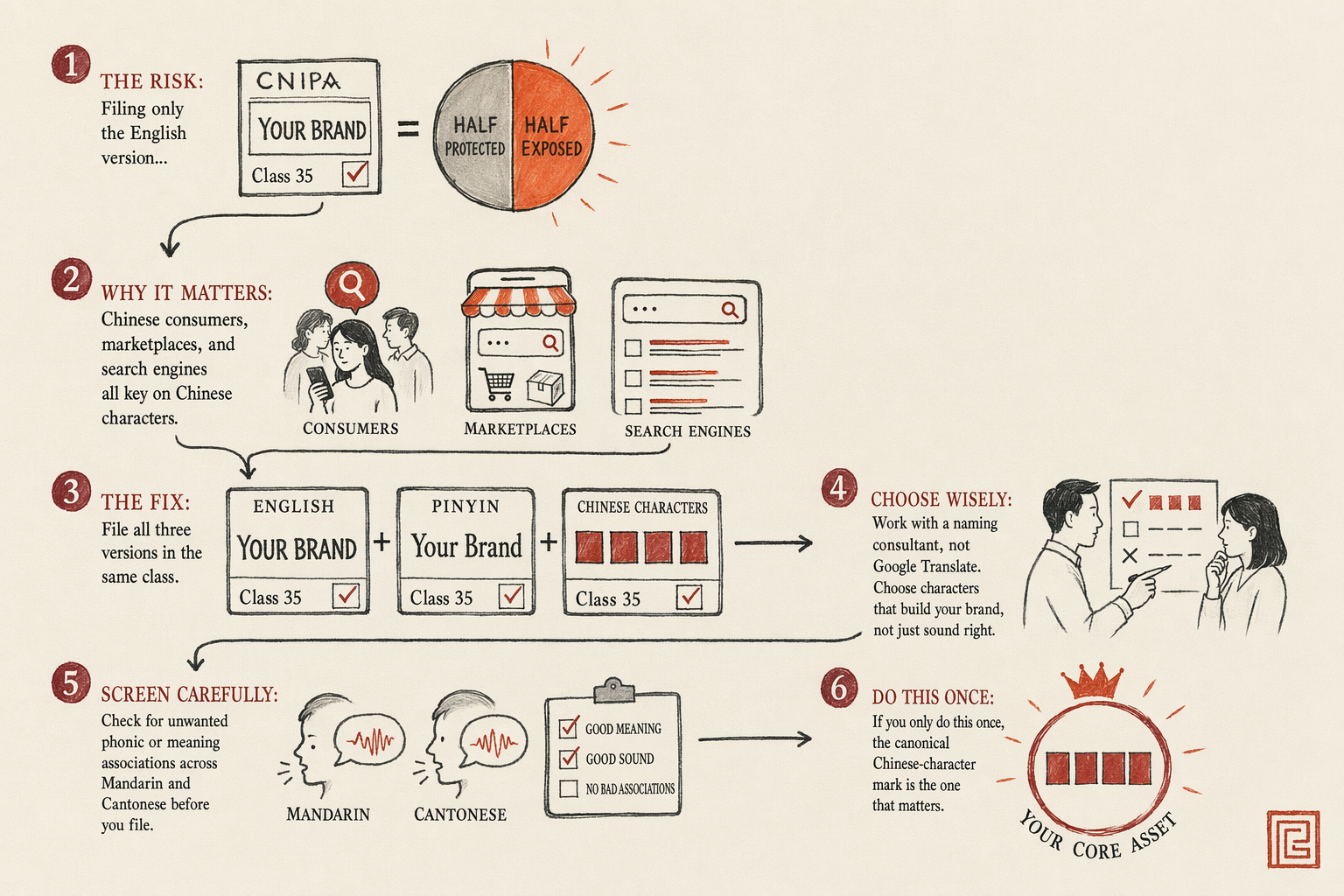
If you file only the English mark at CNIPA (China National Intellectual Property Administration), three problems follow. First, a squatter can register the Chinese transliteration for $1,500 and lock you out of any Chinese-language marketing that uses that transliteration. Second, marketplaces require a registered mark for both the brand surface that appears in their interface (often Chinese characters) and the brand surface on packaging. Third, the trademark certificate you eventually need for WeChat Official Account verification, Xiaohongshu Blue V verification, and Tmall storefront registration is checked against the brand name as it appears on the channel — Chinese characters in every case.
The practical rule: file the English mark, the Chinese-character mark, and the pinyin mark together as three separate filings in the same class. Total fees run roughly $5,000-$8,000 for the trio across five classes. The alternative is to spend $40,000 buying back the Chinese-character mark from a squatter in year two.
Phonetic vs semantic vs hybrid transliteration choices
There are three families of transliteration, and the choice changes how Chinese consumers receive the brand.
Phonetic transliteration picks characters whose Mandarin pronunciation approximates the English name, without regard to the literal meaning of the characters. Tesla is rendered as 特斯拉 (Te-Si-La) — three characters that mean special, this, pull when read literally, but which sound like the English name. McDonald's is 麦当劳 (Mai-Dang-Lao). The strength of phonetic transliteration is name recognition continuity with foreign coverage; the weakness is that the character-level meaning is usually empty or neutral, which gives the brand no semantic lift in Mandarin.
Examples cited above are illustrative of the phonetic family; actual brand decisions vary across markets and over time.
Semantic transliteration picks characters whose meaning conveys the brand's positioning, ignoring phonetic similarity to the English. General Electric is 通用电气 (Tong-Yong-Dian-Qi) — literally universal electric, which describes the business rather than echoing the English. Microsoft is 微软 (Wei-Ruan) — literally micro soft, a calque. Semantic translations communicate the brand attribute directly to Chinese readers, but lose phonetic continuity with the global identity.
Hybrid transliteration picks characters that both sound like the English and carry intentional semantic content. Coca-Cola is 可口可乐 (Ke-Kou-Ke-Le) — phonetically close to Coca-Cola and literally meaning tasty and joyful. BMW is 宝马 (Bao-Ma) — literally treasure horse, a traditional Chinese term for a prized steed, that also fits the brand's automotive positioning. Hybrid is the most valuable and the hardest to achieve. It requires a native Mandarin naming consultant with brand-strategy skill, not a translator.
For a new foreign brand entering China, the right default is hybrid if a workable hybrid exists, phonetic as a fallback. Pure semantic is usually a mistake because it severs the brand from its global marketing assets.
Real examples — how brands got their Chinese names
The cleanest hybrid transliterations in Chinese consumer markets were never accidents. Each came out of a deliberate process that included Mandarin-native consultants, dialect screening across at least Mandarin and Cantonese, and CNIPA pre-clearance.
Coca-Cola's 可口可乐 replaced an earlier transliteration so unfortunate that the company quietly retired it: 蝌蚪啃蜡 (Ke-Dou-Ken-La), literally tadpoles bite wax. The English-to-Chinese ear of an outside Shanghai translator in 1928 produced four characters that mocked the product. The brand ran a naming competition in 1933, paid £350 to the winning entry, and adopted the version still in use 90 years later.
Reebok's mainland filing went through several iterations before settling on 锐步 (Rui-Bu) — literally sharp step. The phonetic match is loose but the semantic content fits running shoes, and the visual character density is light enough to fit on shoe tongue logos.
BMW's 宝马 (Bao-Ma) is universally cited as the best hybrid in any Western brand's China portfolio. The characters echo the German pronunciation by reduction (B-M sounds compressed into Bao-Ma), carry the cultural reference to a treasured horse, and shorten cleanly to a single recognizable concept.
The pattern across all clean transliterations is that the consultant generated 20-40 candidates, screened each one for collision in CNIPA registers, dialect pronunciation in Mandarin / Cantonese / Shanghainese, and unwanted semantic resonance, and presented a shortlist of three to five. The final pick was usually a hybrid with two strong attributes: phonetic recognition and a culturally positive associative load.
Picking characters that don't carry bad connotations
The first screen on any candidate transliteration is unwanted associations. The character 死 means death, and any combination containing it (or homophones reading the same in Mandarin) is generally avoided. The number 4 (四) is phonetically close to 死 and is widely treated as inauspicious. By contrast, 八 (8) is associated with 发 (prosperity, wealth) and is auspicious. These conventions are not legal, but they are pricing inputs at every level of Chinese consumer marketing.
The second screen is dialect pronunciation. A combination that reads cleanly in Mandarin may read into something unintentional in Cantonese, Shanghainese, or Hokkien. The Cantonese reading of common characters can be 20-40% phonetically different from Mandarin. A Hong Kong rollout requires Cantonese-acceptable readings; a Shanghai rollout requires Shanghainese-acceptable readings. The default solution is to pick characters whose pronunciation does not collapse to a homophone of a problematic word in any of the four major dialects you expect to encounter.
The third screen is industry semantic load. Cosmetics brands tend toward characters carrying 美 (beauty), 姿 (posture, grace), 雅 (elegant). Tech brands tend toward 智 (intelligence), 讯 (information), 云 (cloud). Food brands tend toward 味 (flavor), 香 (fragrant), 美 (delicious). Mismatched semantic load — a luxury cosmetics brand with industrial-sounding characters — reads as a mistake to Chinese consumers even if the phonetic match is perfect.
The fourth screen is CNIPA registry conflict. A transliteration that passes all three semantic screens but conflicts with an existing registration in your target class fails immediately. The squatting scanner cross-references candidate Chinese-character marks against CNIPA's database before you commit to a filing.
Filing strategy: pinyin + characters + bilingual logo
The defensive filing package for a foreign brand entering China consists of three marks, filed simultaneously in the same set of Nice classes.
Mark 1: the English wordmark. Plain text, no logo. This is the form CNIPA examines for collision with existing English-script registrations. It is also the form that appears on packaging exported from your home market and on global marketing collateral.
Mark 2: the canonical Chinese-character wordmark. Two to four characters, simplified script (mainland) or with parallel traditional-script filings in Hong Kong / Taiwan. This is the form Chinese consumers will type, the form marketplaces will check, and the form regulators will see on customs declarations. It is the single most-targeted form for squatters and the most-important defensive filing.
Mark 3: the pinyin transliteration. Latin script with tone marks, e.g. Bǎo-Mǎ for 宝马. Pinyin is how Chinese-keyboard users type Chinese characters, and it appears in URLs, email addresses, and brand-search queries. A pinyin filing closes the gap a squatter could otherwise exploit by registering an alternate romanization.
The combined filing covers all three forms in your core Nice class plus 4-6 adjacent defensive classes. Total cost for the three-mark package across five classes runs roughly $5,000-$8,000 in agent and official fees. Substantive examination at CNIPA takes 4-9 months; publication runs 3 months; registration usually completes 9-12 months from filing. For multi-class filings the Madrid Protocol designating China is faster on cost ($1,800-$4,000 for the package) but slower on review (12-18 months at CNIPA).