Why a verified Blue-V account beats a personal account every time
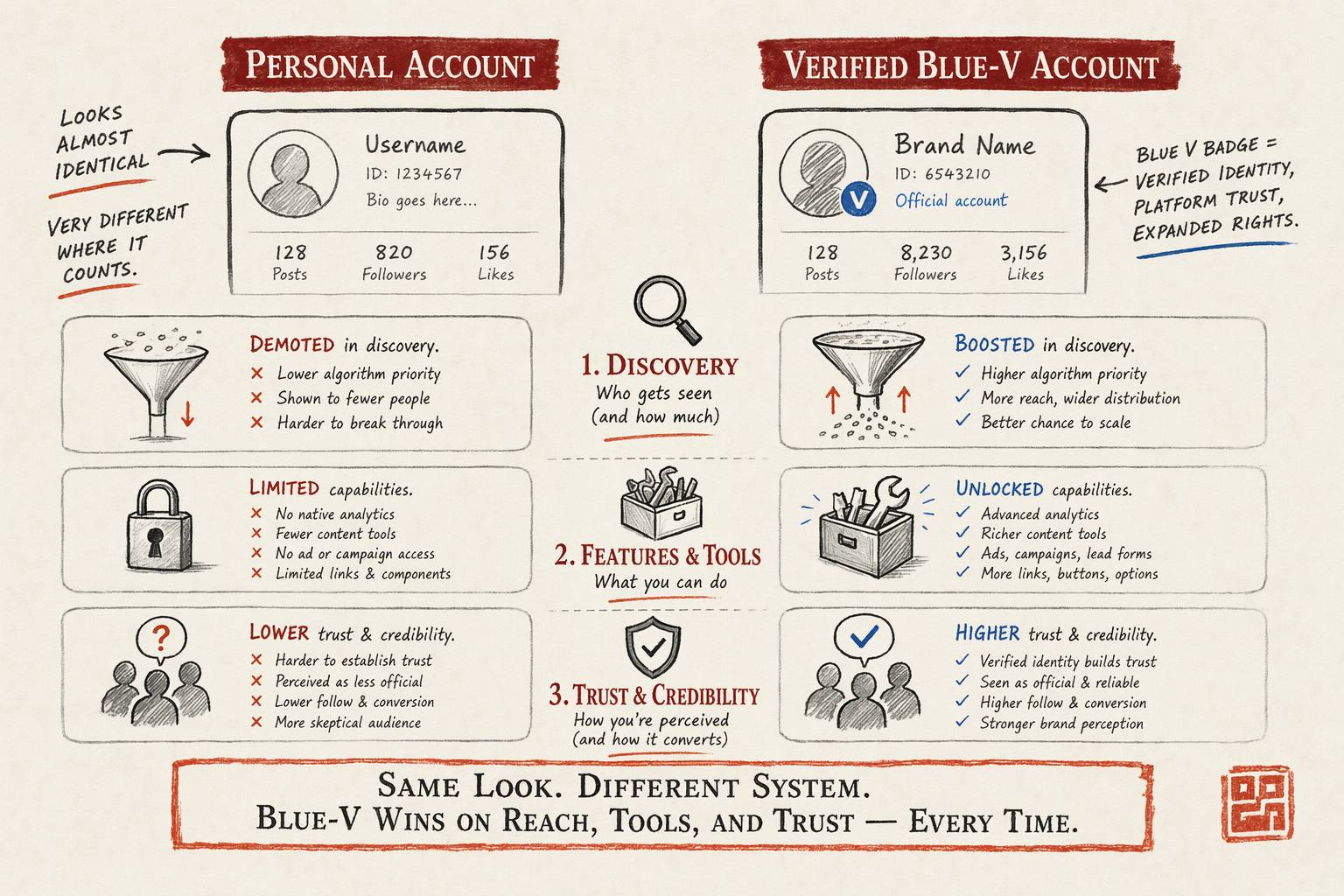
Every Chinese social platform runs a two-tier system: personal accounts (个人号) and brand or enterprise accounts (企业号 or 专业号, marked with a 蓝V — literally 'Blue V' — badge). Visually, they look almost identical. Algorithmically and operationally, they are very different.
Personal accounts get demoted in three places that matter. First, the discovery feed. Xiaohongshu in particular ranks Blue-V posts higher in the explore feed for brand-related queries, on the well-known logic that a verified account is a known counterparty. Second, the search results page; commercial intent searches surface Blue-V accounts first. Third, paid amplification — you can run Xiaohongshu, Douyin, and Bilibili ads only from verified accounts, and on WeChat you can only run Moments ads from an authenticated *服务号* (Service Account). Personal accounts run as if invisible to the ads systems.
There is also the trust question. Mainland users have been trained to look for the Blue V badge before believing a brand account is real. Without it, the account reads as either a fan account or a knockoff, both of which actively hurt conversion. We have seen engagements where switching from a foreign founder's personal Xiaohongshu account to a verified Blue V account doubled the engagement rate on existing content within four weeks, without changing the content itself.
The catch is that verification is platform-specific and document-heavy. Each platform wants the same five categories of paperwork (incorporation, board resolution, legal-rep passport, trademark, brand authorisation) but each platform's portal asks for them in slightly different formats, with translations to slightly different standards. Running the same document set through all five platforms in parallel is the standard pattern; trying to do them sequentially over six months is how foreign brands lose interest and end up unverified.
WeChat Official Account (服务号 vs 订阅号) — picking the right one
WeChat is two products in one app: a messaging client most of mainland China uses every day, and a publishing platform with two distinct account types. Both are called WeChat OA (Official Account) in English. The choice between them is the single most-consequential decision in your China social stack.
服务号 (Service Account) — Posts up to four times per month. Each post triggers a push notification (the dot on the WeChat app icon). Lower posting volume, higher per-post visibility. Critical: Service Accounts can integrate the WeChat Pay API, run third-party mini-programs, deploy custom menus with up to 15 items, and use the template-message API for transactional notifications. This is the account type any brand running a buying flow inside WeChat needs.
订阅号 (Subscription Account) — Posts once per day, every day. Posts are batched into a folder rather than pushing notifications. Higher posting volume, much lower per-post visibility. Cannot integrate WeChat Pay, cannot run a payment-driven mini-program, cannot use template messages. Useful for content-heavy daily-publishing brands; nearly useless for B2B and most B2C buying flows.
The default recommendation for a foreign brand entering China: start with a Service Account. Almost every B2B engagement we run picks Service. Most B2C engagements also pick Service unless the brand is genuinely a daily-publishing content operation (lifestyle media, news, daily-content creators). You can run one of each, but operationally most brands don't have the content discipline to feed a Subscription daily, and an account that stops posting is downranked.
The overseas-entity verification path is real and works. You do not need a mainland entity to verify a WeChat OA. Tencent accepts an apostilled foreign certificate of incorporation, a board resolution authorising the account, the legal rep's passport, a brand authorisation chain back to the trademark holder, and the RMB 600 annual fee. First-pass approval runs around 82-88% on our engagements; rejections are almost always document-format issues that clear on resubmission.
The migration cost between Service and Subscription is real. If you start on a Subscription Account and later decide you need WeChat Pay integration, you do not 'upgrade' — you have to migrate the account, which requires both Tencent approval and a planned downtime window where the existing account is offline. Migrating an OA between operating entities (e.g. from your overseas parent to your newly-formed WFOE) is similarly slow. Pick correctly the first time.
Xiaohongshu (小红书) 专业号 setup — cross-border vs domestic
Xiaohongshu (literally 'Little Red Book', usually written 小红书 or RedNote in English) is the discovery and review platform that has become the closest thing China has to Instagram-meets-Yelp-meets-Pinterest. It is operationally critical for any consumer brand entering China; for cosmetics, beauty, lifestyle, fashion, and food it is closer to oxygen than a marketing channel.
The brand account on Xiaohongshu is called 专业号 (Professional Account, Blue V variant). It requires a CNIPA-registered trademark in the relevant Nice class — usually Class 3 for cosmetics, Class 25 for apparel, Class 30 for food, Class 9 for tech. The trademark certificate is non-negotiable; the filing receipt within six months works for opening the account, but the official storefront cannot launch until the certificate issues.
The strategic choice on Xiaohongshu is between two storefront tracks:
- Cross-border (跨境) — Inventory ships from a bonded warehouse, typically in Hangzhou, Shanghai Pudong, or Guangzhou. Customer pays in RMB; you settle in USD or EUR through the cross-border payments rail. Margin runs 8-15% below domestic because of bonded-warehouse fees and lower-volume logistics. The benefit: no WFOE required. The constraint: inventory has to physically transit a bonded zone, which adds cost and complexity to fulfilment.
- Domestic (国内) — Inventory ships from a mainland warehouse, you invoice in RMB, customer payment lands in your mainland RMB account. Margin runs at parity with overseas DTC, sometimes better. The constraint: you need a WFOE, a general-taxpayer registration, an RMB business account, and the products themselves must clear mainland import compliance (cosmetics require NMPA filings, food requires GACC, electronics require CCC certification).
The default for first-year engagements is cross-border. Domestic is the right structure once monthly Xiaohongshu volume crosses around RMB 800,000-1,200,000 per month, at which point the bonded-warehouse cost line becomes large enough that a WFOE pays back inside 12-18 months. Below that volume, the WFOE compliance overhead outweighs the margin gain.
Common reasons Xiaohongshu demotes brand content even after verification: the trademark is not yet attached to the account (administrative oversight, easily fixed); the product category is on the soft-demoted list (cosmetics with active ingredient claims, supplements making any health claim, weight-loss anything); the post text is too hard-sell rather than experience-sharing (the platform punishes overt sales copy); cross-border shipping claims that contradict the storefront's bonded-zone reality.
Douyin (抖音) enterprise / 蓝V verification for foreign brands
Douyin is the mainland-only sibling of TikTok. The two apps share a parent company (ByteDance), share a video-creation core, and share basically nothing else. A TikTok account is invisible inside China; a Douyin account is invisible outside. Foreign brands routinely try to cross-post and get nothing for it. The two have to be run as separate operations.
Douyin's enterprise verification (Blue V, 蓝V企业号) is the strictest of the five platforms on entity requirements. The account holder must be a mainland entity — a WFOE, a JV, or a domestic Chinese company. A Hong Kong company does not qualify. The cross-border equivalent on Xiaohongshu does not exist on Douyin in the same usable form; Douyin's cross-border merchant programme is real but limited to specific categories and runs through a different verification path.
The platform also requires a CNIPA-registered trademark and demands that the trademark class match the business scope of the operating entity. If your WFOE's *经营范围* (business scope) is general trading and your trademark is in Class 25 (apparel), the verification will sometimes get bounced for category mismatch even though both filings are technically valid. The fix is rewriting the business scope to include the category before submission, which is a separate AIC filing that takes 2-3 weeks.
Verification fee on Douyin is the same RMB 600 annual flat that the other platforms charge. The audit Douyin runs is more rigorous than Xiaohongshu's; first-pass approval on our engagements runs around 70-78%, with the rest going back for either business-scope mismatch or insufficient evidence of operating substance (the platform wants to see at least some activity on the account before granting the badge — a Catch-22 in practice, solved by posting two or three pieces of content before submitting for verification rather than after).
Live commerce (直播带货) on Douyin requires a separate authorisation on top of the basic Blue V. That is a second filing, with separate document requirements and a separate review queue. Most brands do not need it in year one. When they do, plan an additional 4-6 weeks on top of the standard verification.
Bilibili and Weibo blue-V — when they're worth the effort
The fourth and fifth platforms are situational. Both run their own enterprise verification on the same RMB 600 fee structure and the same document set as the others.
Bilibili (B站) — The dominant long-form video platform for the under-30 demographic, particularly strong in gaming, anime, tech, and education content. Brand Blue V is worth the effort if your category overlaps any of those niches; for cosmetics, lifestyle, food, and most B2B categories it generally is not. The verification process is straightforward, runs in 2-3 weeks, and uses the same mainland-entity-plus-trademark requirement as Douyin. The differentiator on Bilibili is content quality and length; the platform's user base does not engage with short-form posts that work elsewhere.
Weibo (微博) — The original Chinese microblog, often described as the local Twitter equivalent though the comparison underweights how news-and-event-driven the platform is in practice. Brand Blue V is worth the effort for B2B brands that want a public-facing news channel (press releases, regulatory updates, partnership announcements get indexed and surface in Baidu) and for consumer brands running celebrity or KOL partnerships. The verification is the easiest of the five platforms; first-pass approval runs above 90%. The catch is that Weibo's reach has declined materially over the past 3-4 years as attention has moved to Xiaohongshu and Douyin, and the platform's monetisation is the weakest of the five.
Our default recommendation: include Weibo in the starter pack (cheap, easy, useful for the SEO surface), skip Bilibili unless your category is on the list above. Adding Bilibili later is straightforward; adding Weibo later is also straightforward but you have probably already lost the account-name window to a squatter.
The 600 RMB verification fee — what it actually covers
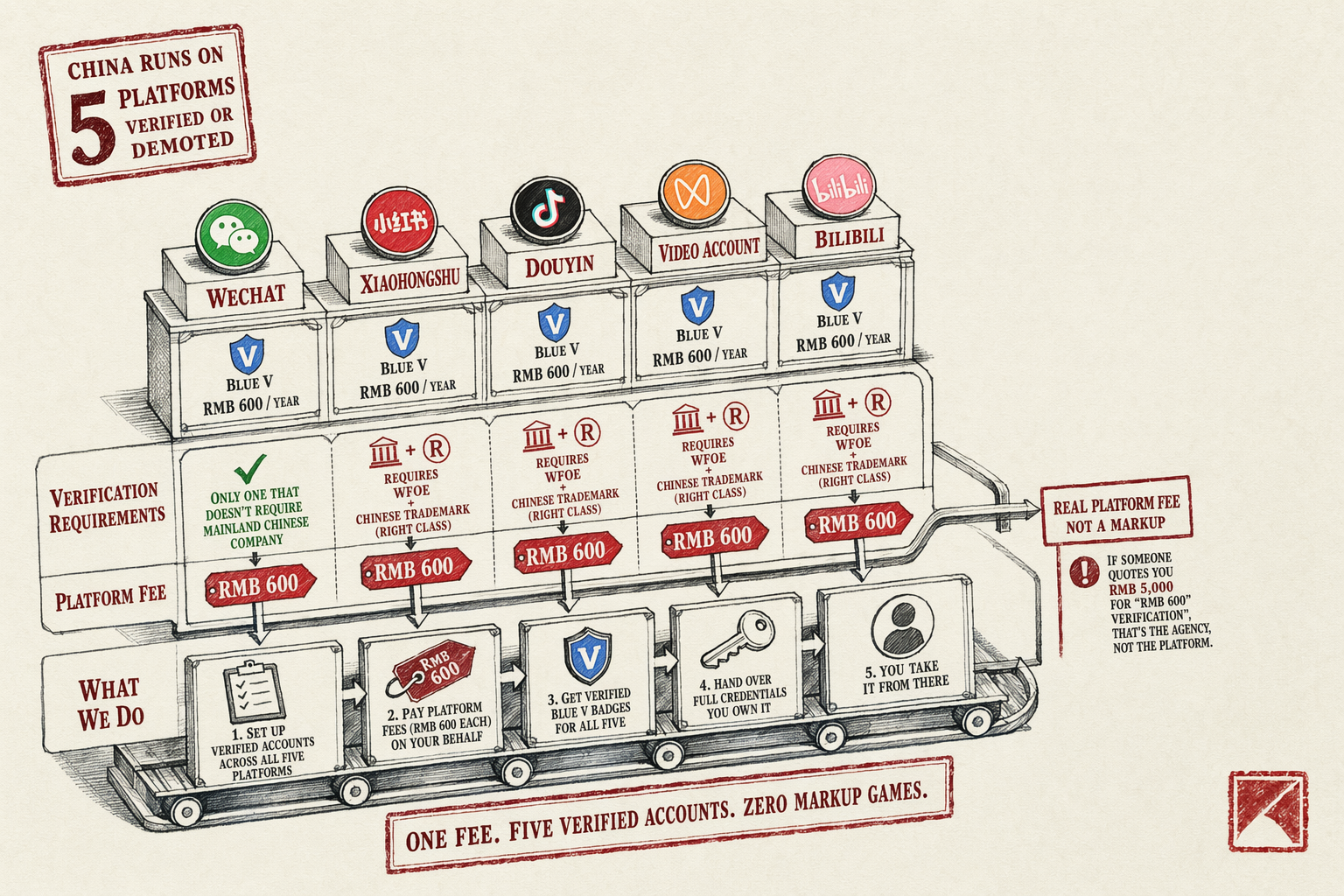
Every one of the five platforms charges a roughly RMB 600 annual fee, payable to the platform directly (Tencent for WeChat, ByteDance for Douyin, Xiaohongshu Inc, Sina Corp for Weibo, Bilibili Inc). It is not a one-time fee, it is not a service charge from your agency, and it is not optional. It is the official platform fee for the annual identity-and-entity reverification that every Blue V account undergoes. Skipping it does not save money; it locks the account features and eventually downgrades the Blue V badge, which kills the algorithmic visibility benefit you paid to obtain in the first place.
What the fee actually covers, in operational terms: the platform's compliance team re-runs the entity identity check (verifies that the trademark, the corporate identity, and the legal rep are still aligned), re-validates the brand authorisation chain (catches cases where a trademark was transferred or a licence was terminated), and re-issues the verification certificate. The receipt is issued in your operating entity's name; for tax-deduction purposes inside a WFOE, it is a recognised expense.
Our engagement letter folds the year-one platform fees into the platform-by-platform line items, so you see the cost clearly itemised. Year-two reverification is something your team can run directly; the platforms charge the fee, your team uploads the same document set, the platform reissues the badge. We can broker year-two reverification on retainer if you want it managed, but most clients move it in-house after the first cycle.
The reason this fee gets flagged as a scam in expat Slack channels is that several less-scrupulous local agencies have charged foreign brands eight to twelve times the actual platform fee as a 'verification service' line, pocketing the difference. The platform fee is a known, published number. If anyone is asking you for the RMB 600 fee at RMB 4,800 or RMB 7,200 markup, that is not the platform charging you; that is the agency.
Why brand-account verifications get rejected
Across the five platforms, the failure modes cluster. The ones we see most often, ordered by frequency:
- Brand authorisation chain is missing or broken. The trademark is held by Parent Holdco; the operating entity opening the account is Subsidiary Trading; no written authorisation exists between the two. Verification bounces.
- Trademark certificate has not actually issued yet. A CNIPA filing receipt within six months works for opening some accounts (Xiaohongshu), not others (Douyin in some categories). The difference is not always documented; the practical answer is to run the filing through a partner who knows which platforms accept which evidence.
- Business scope (经营范围) does not include the product category. Particularly common on Douyin. The WFOE's registered scope must explicitly cover the trade category — 'general trading' is not enough for regulated categories.
- Document translations are not certified. Some platforms (WeChat, Douyin) accept self-translated documents; others (Xiaohongshu, Bilibili) want a translator's stamp. Save the work; do certified from the start.
- Legal-rep passport has under 12 months of validity remaining. All five platforms reject this. Renew before submitting.
- The account name is too close to an existing trademark held by someone else. Xiaohongshu and Douyin both reject for trademark conflict, even when the conflict is with an account in a totally different category. The fix is usually a small variation of the brand name; we run a CNIPA check pre-submission.
- Product imagery in the initial posts contains a competitor brand visible in the background. Yes, really. Bilibili and Xiaohongshu have rejected accounts on this in the last 12 months.
Resubmission across all five platforms is free of additional platform fee for the first cycle. The cost is timeline: each resubmission adds 2-3 weeks. Pre-clearance pays back fast.
Who handles the filings
Mike brokers; named partner firms in Shanghai or Shenzhen execute. Partner-firm assignment depends on which platforms are in scope — WeChat and Weibo verifications are handled by partners with longstanding direct contact at the platform compliance desks (this matters more for resubmission speed than for first-pass approval); Xiaohongshu and Douyin go through partners specialised in those platforms' merchant-onboarding pipelines. Each partner has at least five years of brand-verification filings on record across the relevant platforms.
Partner names appear on the engagement letter, on every document the partner sends, and on the final verification certificates. The partner-firm fees are itemised separately from Mike's brokerage fee on the engagement letter; there is no margin built into the partner line. If a partner is unresponsive mid-engagement, Mike re-routes to a backup partner at no extra fee, and the original partner is removed from the directory.
In plain English
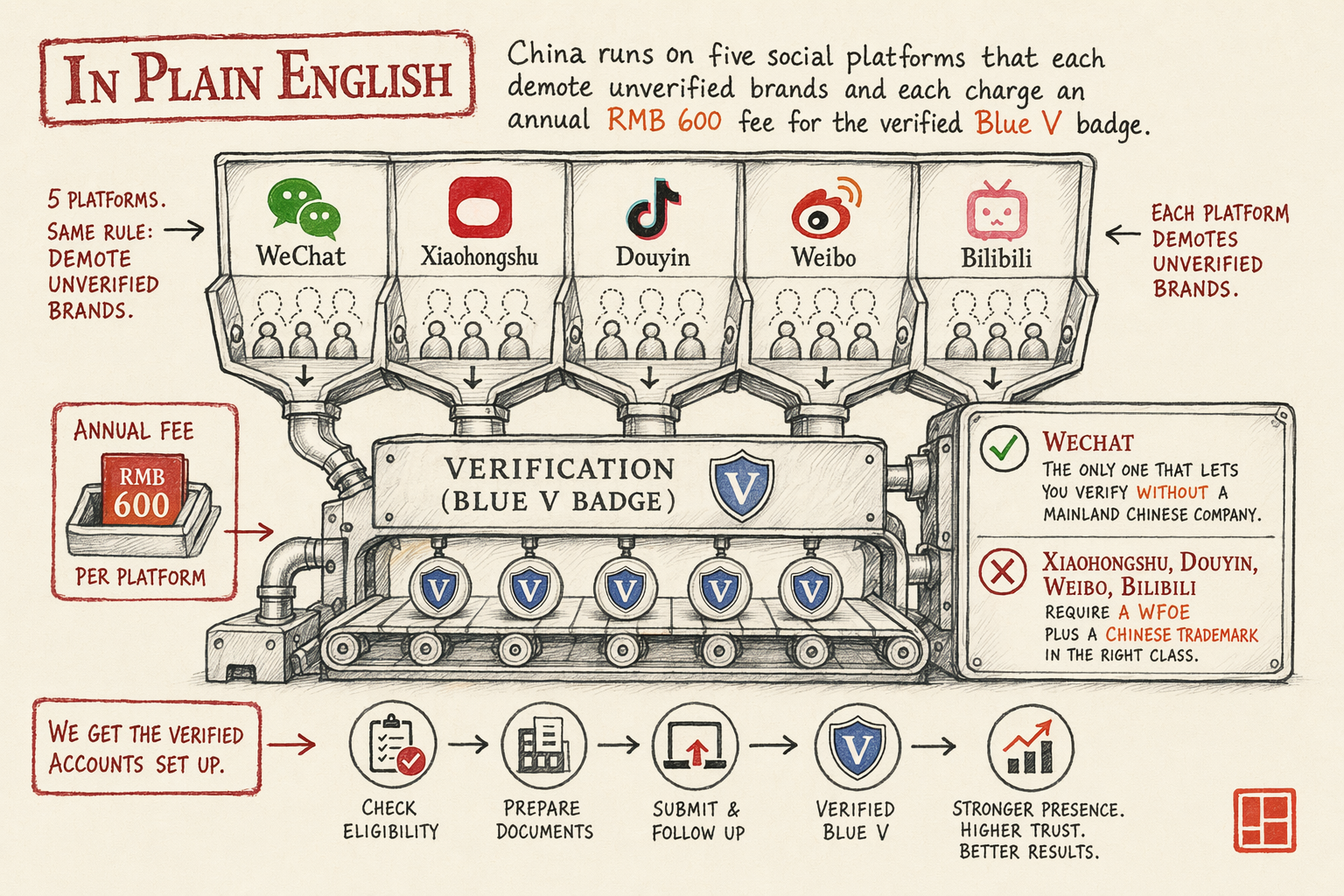
If you only read one paragraph: China runs on five social platforms that each demote unverified brands and each charge an annual RMB 600 fee for the verified Blue V badge. WeChat is the only one that lets you verify without a mainland Chinese company; the others need a WFOE plus a Chinese trademark in the right class. We get the verified accounts stood up across all five for an itemised price, hand over the credentials, and you take it from there. The platform fees are real and not a markup; if anyone is quoting you RMB 5,000 for the RMB 600 verification, that's the agency, not the platform.
How an engagement actually runs
- 01
Scope call (free, 30 min)
Which platforms matter for your category, whether your CNIPA trademark is in the right classes already, and whether you need a mainland entity or can run cross-border.
Within one Asia-Pacific business day
- 02
Document set assembly
Apostilled certificate of incorporation, board resolution, legal-rep passport, trademark certificate or filing receipt, brand authorisation. One document pack covers all four to five platform filings.
Inside the first two weeks
- 03
WeChat OA submission first
WeChat verification is the slowest (10-25 business days) but the most predictable. We start here so the timeline runs in parallel with everything else.
Three to five weeks
- 04
Xiaohongshu, Douyin, Weibo, Bilibili in parallel
Each platform reviews independently; total time is roughly the slowest path, not the sum. We stagger so a rejection on one doesn't block resubmission elsewhere.
Two to four weeks each
- 05
Verification fees paid
Each platform charges its own RMB 600 annual reverification fee. We pay these on your behalf during the engagement and itemise on the engagement letter.
At submission
- 06
Account handover
Credentials, admin-rights document, recovery email and recovery phone, the verification certificate PDFs, and a calendar reminder for year-two reverification.
On final platform approval