What a legal representative (法定代表人) actually does under PRC law
The *法定代表人* (legal rep, often shortened to 法人 in conversation though that technically refers to the corporate person itself) is the natural-person face of a mainland Chinese company under PRC corporate law. The role is recorded on the business license, on the AIC file, on every bank-account opening form, on tax registrations, on contracts with regulators, and on the personal-chop record at the *PSB* (Public Security Bureau). One legal rep per entity. The person can be a foreign citizen, a mainland citizen, or a Hong Kong / Macau / Taiwan resident; the role is identical regardless of nationality.
Legal-rep liability is what makes this role consequential. Under the PRC Company Law and a stack of supporting statutes, the legal rep is personally exposed to:
- Civil liability for the entity's debts in narrow circumstances. Not unlimited — the WFOE is a limited-liability entity — but courts can pierce the veil in cases of fraud, intermingling of personal and company assets, or undercapitalisation. Personal-asset attachment orders against legal reps are not common but not rare.
- Exit-visa restriction (限制出境). If the entity is in tax dispute, regulatory dispute, or owing unpaid wages, the tax bureau or court can freeze the legal rep's exit visa. The legal rep is then physically prevented from leaving China until the matter resolves. Foreign legal reps have been stuck inside mainland for months under this mechanism.
- Criminal liability in cases of company-level offences. Tax evasion, fraudulent invoicing, employment-law violations, environmental violations, certain regulated-industry breaches. The legal rep is named as a defendant alongside the entity. Not all of these are pre-arrangeable; insurance covers some, but the criminal exposure attaches to the person who holds the role, not to the role itself.
- Signature authority on filings. The legal rep's personal chop (法人章) is required for AIC filings, banking changes, and certain contracts. Without the chop, those filings cannot proceed.
None of this is rare or weaponised arbitrarily. In a well-run, well-financed entity with clean tax filings and no regulatory friction, legal-rep liability sits dormant. The exposure is real when the entity gets sideways, which is when you most want the legal rep to be someone who actually understands what they signed up for.
When you can be your own legal rep (and when you can't)
Legal nationality is not the constraint. PRC corporate law has permitted foreign legal reps for decades. The constraint is operational. Three questions decide whether you should be your own legal rep or use a nominee.
Question 1: How often will you physically be in China? Specific filings require legal-rep in-person presence — bank-account opening (all banks; ICBC and BOC are strictest), real-name verification on the e-Tax platform, certain AIC procedures (change of registered address, change of business scope in some cities), some PSB filings. If you spend 60+ days per year in China across multiple trips, being your own legal rep is straightforward. If you spend under 30 days per year, nominee is operationally easier because flying in for a bank counter visit is expensive.
Question 2: Does your industry carry heightened regulatory risk? Fintech, medical devices, healthcare services, food and beverage, education, anything touching consumer data after PIPL — these categories carry materially higher legal-rep enforcement exposure. The exit-visa freeze is not theoretical in regulated categories; it has happened to foreign founders in our extended network in the last three years. For these categories, a mainland-resident nominee with industry-specific D&O insurance is the structurally safer pick.
Question 3: Are you the operational decision-maker, or is someone else? If the entity is operationally run by a country manager in Shanghai while you sit in San Francisco, that country manager being the legal rep maps risk and signature authority onto the same person, which is cleaner than having signature authority offshore and operational decisions onshore. Country-manager-as-legal-rep is the default we recommend once a WFOE has its first mainland hire on board.
Hybrid arrangements work. Many engagements start with a nominee legal rep for the first 6-12 months while the WFOE proves out, then transition to either the founder or a country manager as legal rep once operations stabilise. The transition is an AIC filing plus a chop-record update plus bank-record updates, typically 3-5 weeks of paperwork, and is the standard playbook.
What does not work: trying to be your own legal rep while spending under 20 days per year in China. The bank counter visits alone will burn through that time budget, and you will end up missing a filing window because you couldn't get on a plane in time. We have seen this fail in three engagements over the past two years; in all three, the entity had to be partially restructured to add a nominee mid-stream.
Nominee director arrangements — escrow, replacement, insurance
A nominee legal rep is a real person with a real PRC ID, who signs the documents, holds the legal-rep personal chop, and is named on the business license. The risk that scares people: a nominee with signature authority could, in principle, sign documents binding the company, move money, or hold up filings until paid more. The risk that should not scare people: it is structurally manageable through the four-document arrangement we run as standard.
The four documents:
- Escrow agreement. Governed by Hong Kong or Singapore law, signed between the foreign owner and the nominee, with a third-party law firm (typically in Hong Kong, occasionally in Singapore) holding the executed copy. The agreement defines the scope of the nominee's authority, what they can and cannot sign without owner approval, the nominee's annual fee, the indemnity flowing both ways, and the dispute-resolution mechanism (usually HKIAC arbitration). The mainland-law contract for the nominee role is layered underneath but governed by mainland labour law.
- Pre-signed resignation letter. Held in escrow at the third-party firm. Dated and notarised on the day the nominee accepts the role. The escrow trigger conditions for releasing the resignation are spelled out in the escrow agreement (nominee misconduct, failure to follow approved-document protocol, the foreign owner exercising a removal option). When released, the resignation files at AIC and the nominee is off the entity inside the AIC filing window (typically 2-4 weeks).
- Chop-custody undertaking. Separate document, signed by the nominee, agreeing that the legal-rep personal chop will be held by the third-party law firm or in a dual-control bank-style box, not by the nominee personally. The nominee can request the chop for specific filings against an approval workflow; they cannot walk in with the chop in their pocket.
- Bank token / U-shield protocol. The mainland bank's hardware token (U-shield, in BOC and ICBC parlance) is the key to moving money. It does NOT sit with the nominee. It sits either with the foreign owner, with a trusted operational employee, or in custody at the third-party law firm. The nominee has signature authority on bank-counter forms; they do not have transaction authority via the token.
Done right, the nominee has the legal signature authority required to file documents that ask for the legal rep's chop, while having no day-to-day operational control over what the company actually does or where its money goes. Done wrong (specifically: nominee in possession of the token and the main chop), you have handed someone the keys to your company.
Replacing a nominee mid-engagement is mechanical, not a crisis. The pre-signed resignation files, a new nominee is named, AIC processes the change in 2-4 weeks. Entity continues operating with a transitional protocol on chop access during the change-over window. Our partners can produce a backup nominee inside 7-10 days of a trigger event.
Indicative annual nominee fee: $8,000-18,000 USD / RMB 57,200-129,000 for a low-risk service WFOE in Shanghai or Shenzhen. $25,000-50,000+ USD / RMB 179,000-358,000+ for regulated industries (fintech, medical, food, education). Anyone offering nominee services below roughly $5,000 USD / RMB 35,800 per year is either running a sham (no real escrow, no real chop custody) or planning to upcharge mid-engagement. Walk away.
D&O (directors-and-officers liability) insurance covers a useful subset of nominee risk: civil claims arising from corporate acts within the scope of the role, defence costs, settlement up to the policy limit. It does not cover criminal liability, intentional fraud, or actions outside the scope of the role. Premium runs $2,500-12,000 USD / RMB 17,900-85,800 per year depending on industry and coverage limit. We arrange coverage through partners who specialise in China nominee policies; standard western D&O policies usually exclude China-specific risks.
Virtual office addresses by city (Beijing, Shanghai, Shenzhen, Hangzhou)
A registered address is mandatory. AIC will not issue a business license without one. The address must be commercial-zoned, have a real lease in the entity's name, and be on the local AIC's accepted-cluster list. The cluster part is the gotcha — AIC maintains an informal but real list of buildings and addresses that have been used by too many shell entities and now trigger enhanced scrutiny on any new filing.
Indicative annual virtual-office cost by city, for a real, AIC-inspection-ready address (not a cheap shared mailbox):
- Beijing CBD (Chaoyang, Haidian) —
$2,800-4,400 USD / RMB 20,000-31,500per year. Most foreign-friendly clusters are in Chaoyang along the East Third Ring, with Haidian preferred for tech-adjacent industries. CBD addresses pass inspection cleanly; the cluster lists in Beijing are stricter than other cities. - Shanghai FTZ (Waigaoqiao + Lujiazui), Pudong, Puxi —
$2,400-3,800 USD / RMB 17,200-27,200for FTZ addresses with tax-incentive eligibility;$2,000-3,400 USD / RMB 14,300-24,300for non-FTZ Pudong;$1,600-2,800 USD / RMB 11,500-20,000for Puxi. FTZ addresses are worth the premium for cross-border services and trading entities; they are not magically tax-free, but they grant access to streamlined customs procedures and FTZ-specific tax holidays for certain categories. - Shenzhen Qianhai + Nanshan + Futian —
$1,800-3,200 USD / RMB 12,870-22,880for Qianhai (foreign-friendly cooperation zone with HK-mainland incentives);$1,600-2,800 USD / RMB 11,500-20,000for Nanshan tech corridor;$1,400-2,400 USD / RMB 10,000-17,200for Futian. Qianhai is the right pick for foreign-founder WFOEs with HK connections; Nanshan for tech and SaaS; Futian for general trading. - Hangzhou Future Sci-Tech City + Binjiang —
$1,200-2,200 USD / RMB 8,580-15,740. Cheapest of the four tier-1 / quasi-tier-1 options, with genuinely useful tech-and-trading tax incentives (Hangzhou is hungry for foreign-tech HQs and the local government's incentive package competes with Shenzhen's). The downside is that Hangzhou's foreign-investor handling is less standardised than Shanghai's or Shenzhen's, and specific industries get more friction.
The cheap addresses are out there — $800-1,500 USD / RMB 5,720-10,720 per year. They are almost always shared with 30-50 other entities in the same building cluster, which puts the address on AIC's enhanced-scrutiny list. Once flagged, every entity at that address gets inspected more often, and inspection failures (AIC arrives, no one answers the door, no signage, no operating substance) trigger an address-change penalty plus a mandatory re-filing. The total cost over two years of running a flagged cheap address is usually higher than just paying for the clean one.
What 'real address' means in practice: the building has signage in your entity's name on the floor directory, the suite has a reception desk staffed during business hours, mail addressed to your entity is received and either forwarded or scanned, and someone will answer the phone in your entity's name. AIC site inspections (which arrive unannounced, typically in years 2-3 of the entity's life) check exactly this. A cheap shared mailbox in a building you've never visited fails on every count.

Chop (公章) custody protocols — physical, financial, contract, HR
The Chinese entity has multiple physical chops, each binding the company in a specific category of action. Whoever physically holds a chop can bind the company in that category. There is no chop-equivalent of a digital signature with audit trail; possession is law. Chop custody is therefore the single most-consequential security question in your mainland operation.
The standard chop set on a WFOE:
- 公章 (main company chop) — Binds the company on general contracts, agreements, official letters. The most-powerful chop. Used most often.
- 财务专用章 (finance chop) — Binds the company on banking, tax filings, financial documents. Required co-stamp on most banking actions.
- 合同专用章 (contract chop) — Sometimes used in place of the main chop for purchase orders, sales contracts, and routine commercial agreements. Reduces the main chop's exposure.
- 人事专用章 (HR chop) — Binds the company on employment contracts, social-insurance filings, employment-related correspondence.
- 发票专用章 (fapiao chop) — Stamps issued fapiao. Held by the bookkeeping function.
- 法人章 (legal-rep personal chop) — The legal rep's personal chop, required on a narrow set of high-stakes filings (AIC changes, certain bank account changes).
The dual-control rule that prevents disaster: no single person holds two chops at once. The main chop and the finance chop in particular should never sit with the same custodian. If a single person physically possesses both, they can sign a contract, move the money out of the bank account, and walk away before anyone notices. Splitting custody — main chop with the legal rep's office, finance chop with the bookkeeping function or the foreign owner, contract chop with operations — makes the entity functionally controllable but not catastrophically exposed to any single failure point.
Third-party chop custody at a law firm is the default we recommend for the legal-rep personal chop and (often) the main chop. The chops physically live in a fire-rated safe at the law firm's office. Chop requests follow a written protocol — request submitted in writing, dual approval from the foreign owner and the legal rep, chop applied at the law firm's office (or, for urgent cases, the chop is checked out under a tracked log). The law firm logs every chop application. The audit trail makes mid-engagement disputes resolvable.
The protocol we run as standard on full-bundle engagements:
- Main 公章 + 法人章 — third-party law firm custody, dual-approval workflow.
- 财务章 — foreign owner or trusted bookkeeper custody, NOT nominee.
- 合同章 — operational team in mainland, used routinely for low-stakes commercial paperwork.
- 人事章 — operational HR function or local rep.
- 发票章 — bookkeeping function.
The fastest way to lose a Chinese company is to give one person all five chops 'temporarily' while you sort out a permanent arrangement. Many foreign-founder horror stories trace back exactly to this. Set up the custody protocol on day one of chop carving, not month six.
Mail handling, scanning, and AIC site-inspection readiness
Two operational layers sit on top of the virtual office: mail handling, and AIC inspection readiness. Both fail silently if neglected and both are cheap to do well.
Mail handling. Mainland-side mail to your entity comes in three categories. Tax-bureau correspondence (deadline-sensitive, must be opened and responded to within the stated window), bank correspondence (typically informational but occasionally requires legal-rep signature), and operational mail (suppliers, customers, regulators). Standard protocol: virtual office receives all mail, scans every envelope on receipt, forwards the scan within one business day to a shared inbox you control, holds physical mail for monthly courier or pickup. Critical mail (tax bureau, regulator) is scanned and flagged the same day. We run this on a flat fee of $80-160 USD / RMB 570-1,150 per month for typical mail volumes; the cost grows with regulatory correspondence in regulated industries.
AIC site inspections. AIC arrives unannounced. They check the door signage in your entity's name, ask reception to confirm the entity operates there, look for visible operating substance (a desk, equipment, staff, evidence the entity is real), and read the business license posted at the registered address. A virtual office that is just a mailbox in a building you've never visited fails inspection in 30 seconds.
What passes inspection consistently: signage on the floor directory, the entity name on the suite door, the business license framed on the wall behind reception, a reception desk staffed during business hours, mail in the entity's name visible at reception, and a contact who answers the phone in the entity's name when called. Most clean virtual offices provide all of the above as standard.
Inspection-day playbook we hand over to every full-bundle client: the reception staff have a written script (in Chinese) for the most-common inspector questions, the registered address holder is briefed to escalate within 30 minutes if an inspection occurs, and a phone-call protocol routes the inspector to a designated escalation contact (the partner firm or, in higher-stakes cases, the law firm holding the chops). Most inspections resolve in 20-40 minutes with no follow-up.
Failed inspections trigger one of three outcomes. A warning (you have 30 days to correct), an address-change order (you have 60-90 days to register a different address), or a license suspension (rare but real for repeat or egregious failures). The first two are recoverable; the third can take months to unwind. The whole layer of risk evaporates if your registered address is real and your operational protocol is in place.
When local-rep arrangements break (and how to spot it early)
The most-common ways local-rep arrangements quietly stop working, in roughly descending frequency:
- Address flagged on AIC's enhanced-scrutiny list. Usually because the address was used by 30+ shell entities before you got there. Sign of trouble: AIC sends repeated requests for site-inspection date confirmation, or your filings start needing extra documentary support.
- Nominee stops responding to email. Sign of trouble: a filing is sitting waiting for the legal-rep chop and the nominee has been silent for 7+ days. Action: invoke the escrow trigger, release the pre-signed resignation, name a backup nominee.
- Chop custody has drifted to a single person. Sign of trouble: someone says 'I had to hold the finance chop for a few weeks while X was on leave' and X has been on leave for two months. Action: re-establish dual custody immediately, audit the chop log.
- Mail-handling SLA has slipped. Sign of trouble: a tax-bureau deadline arrived and the mail had not been scanned. Action: tighten the same-day-scan rule and escalate with the virtual office; one slipped tax deadline can trigger a months-long fix cycle.
- Legal-rep visa exposure changed. Sign of trouble: the legal rep gets stuck at the border on a routine trip and can't fly out. Action: check the entity's tax-bureau standing, social-insurance arrears, and any open litigation; one of those will be the cause.
- Annual review missed. Most virtual offices and nominee arrangements require an annual review that is easy to miss. Sign of trouble: the contract is silent on what happens in year two. Action: confirm renewal terms in writing 60+ days before each anniversary.
None of these are uncommon. All of them are catchable with quarterly review cadence and a written escalation contact list. The full-bundle engagement includes both as standard.

Who provides nominees and virtual offices
Mike brokers; named partner firms in Shanghai, Shenzhen, Beijing, and Hangzhou provide the actual nominee candidates and registered-address inventory. Each partner has at least eight years of legal-rep and nominee-arrangement track record, with insurance coverage (their own and their nominees') verified at engagement scoping. The chop-custody third-party law firms are themselves Hong Kong-based — we route custody through HK firms with established arms-length escrow practice rather than mainland firms that might have conflicts of interest with the nominee.
Background checks on nominee candidates are run before introduction: PRC criminal record check, civil-litigation history, prior-nominee engagement references (we will give you the names of two prior owners the nominee has worked with, with their consent), and personal-asset disclosure adequate for the role's risk profile. Nominees are excluded from our directory if they have any active mainland litigation, any prior tax-evasion charge, or any failed-nominee-engagement on record.
Partner names appear on the engagement letter, on the escrow agreement, and on the AIC business license. Annual fees are itemised separately from Mike's brokerage on the engagement letter; there is no margin built into the partner-firm or nominee fee. If a nominee or partner is unresponsive mid-engagement, Mike re-routes within 7-10 days at no extra fee, and the unresponsive party is removed from the directory.
In plain English
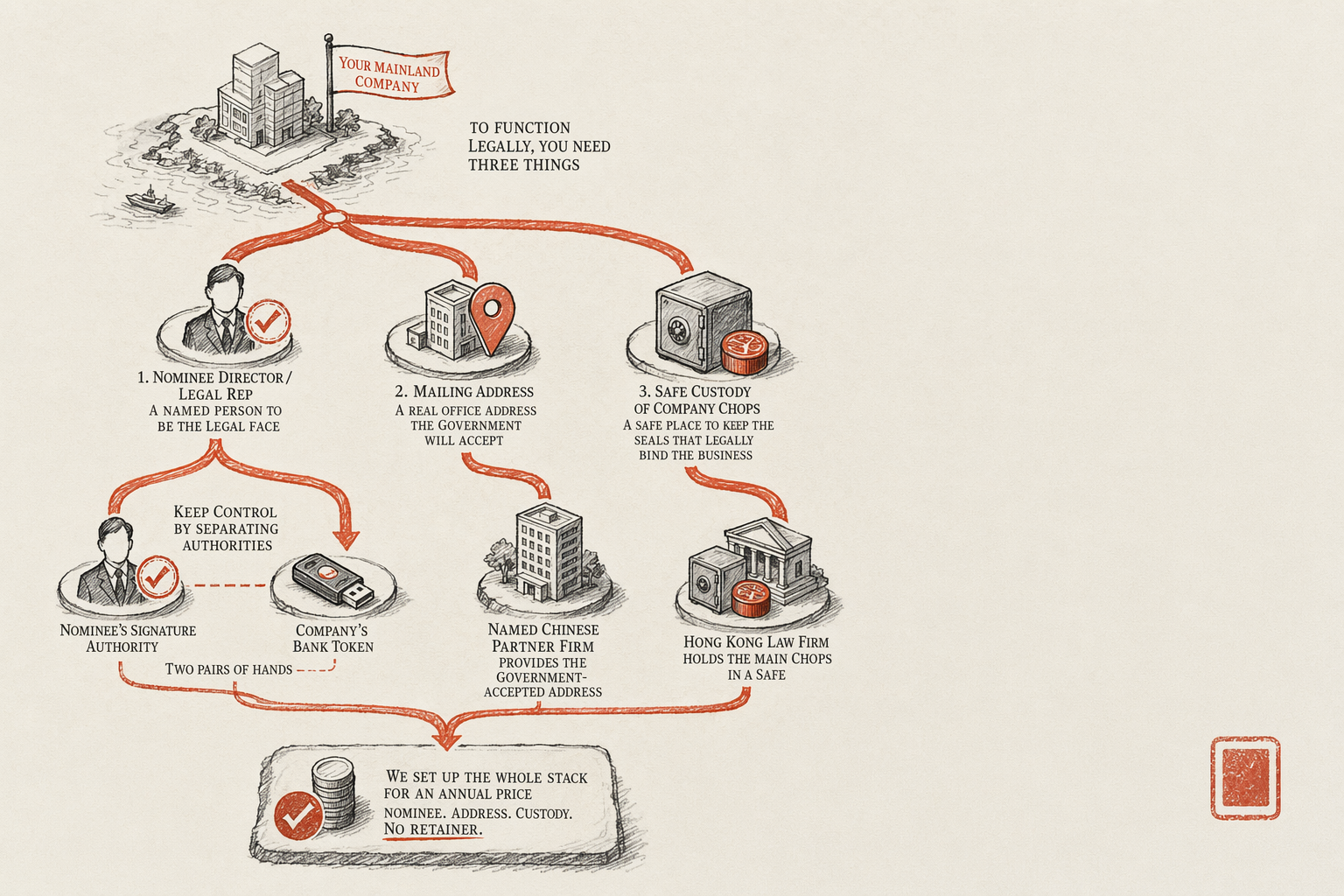
If you only read one paragraph: Your mainland company needs three things in place to actually function — a named person to be the legal face of it, a real office address that the government will accept, and a safe place to keep the company chops (the seals that legally bind the business). If you live abroad most of the year, you probably want a nominee to be the legal face for you, but the way to do that safely is to keep the nominee's signature authority and the company's bank token in two different pairs of hands and to put the main chops in a Hong Kong law firm's safe. We set that whole stack up for an annual price, with a named Chinese partner firm providing the address, a background-checked nominee, and a Hong Kong law firm holding the chops. No retainer.
How an engagement actually runs
- 01
Local-rep scope call (free, 45 min)
We map your operating footprint — where you spend time, who signs what, what risk profile your industry carries — and recommend the minimum nominee structure needed.
Within one Asia-Pacific business day
- 02
City + address selection
We propose specific buildings in your target city based on AIC inspection track record, industry-incentive eligibility (FTZ vs Qianhai vs Future Sci-Tech), and proximity to your operational reality.
Inside the first week
- 03
Nominee candidate shortlist
If a nominee is needed, we present 2-3 candidates with background, prior nominee engagements, regulatory limits, and quoted annual fee. You pick.
Inside the first two weeks
- 04
Escrow + chop-custody documentation
HK- or Singapore-law escrow agreement, pre-signed resignation letter, chop-custody undertaking with the third-party law firm, dual-control protocol for finance and contract chops.
Two to three weeks of drafting + signing
- 05
Address filing + chop carving
Registered-address change filed with AIC if the entity exists; chops carved at PSB-approved carver and registered with PSB.
Two to four weeks
- 06
Operational handover
Mail-handling protocol, AIC inspection-day playbook, chop-request workflow, escalation contacts, and quarterly review cadence. You receive a one-page operating manual on local-rep usage.
On final filings