The five ongoing-compliance workstreams every WFOE runs
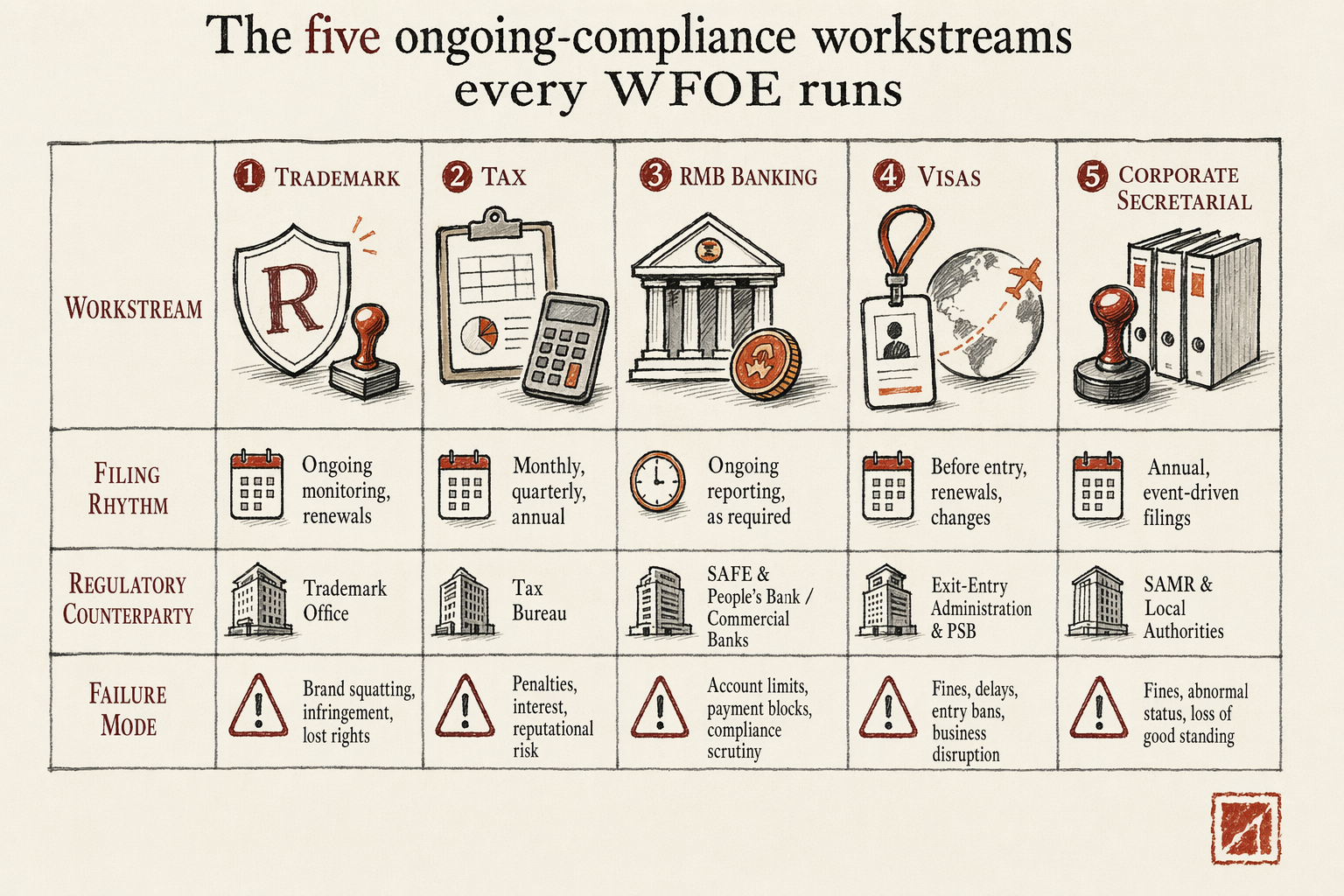
Once the business license issues, five distinct workstreams begin running on the entity. Each one has its own filing rhythm, its own regulatory counterparty, and its own failure mode. Founders who treat compliance as one thing — usually 'the bookkeeper' — find out the hard way that the bookkeeper does not file trademarks, does not run visas, and is not licensed to do tax appeals. The five:
- Intellectual property defence (CNIPA + patent office). Trademark filings in your operating classes, defensive filings against squatters, Chinese-character and pinyin transliteration filings, patent filings where relevant. The cadence is filing-driven, not monthly, but the first 18 months after WFOE formation are the highest-stakes window because of first-to-file dynamics.
- Monthly tax compliance (tax bureau + e-Tax platform). *VAT* (Value-Added Tax) filing monthly, *CIT* (Corporate Income Tax) filing quarterly with year-end true-up, *IIT* (Individual Income Tax) filing monthly for payroll, plus fapiao issuance and management. Bookkeeping closes monthly. Annual statutory audit happens once.
- Banking and FX (commercial bank + SAFE). Basic RMB account maintenance, general account if used, *SAFE* (State Administration of Foreign Exchange) registration for cross-border capital injections and dividend repatriation, ongoing AML reporting, U-shield management.
- Foreign-hire visa and work-permit administration (PSB + Foreign Experts Bureau). Z-visa applications for each foreign hire, post-arrival residence-permit filings, annual visa renewals, work-permit category classification (A / B / C tiers), and the related substance requirements.
- Social insurance and housing fund (city social-security bureau + housing-fund management center). Enrollment for every mainland employee, monthly contributions at the city's mandated rate, individual-employee account maintenance, year-end reconciliation.
The annual cost of running all five at minimum scale, for a small WFOE with 1-3 mainland hires and 1-2 foreign hires: $22,000-38,000 USD / RMB 157,000-272,000 per year. This is the real ongoing run-rate of a WFOE, not the incorporation cost. Knowing this number upfront prevents the common founder surprise around month 8 where everyone realises compliance is a real line item.
CNIPA trademark + patent filing (first-to-file is unforgiving)
China runs a first-to-file trademark system. Whoever registers a mark in China owns the mark in China, regardless of where else in the world the brand has been used, regardless of how famous the brand is in its home market, and regardless of how obvious it is that the registrant is squatting. The Chinese system has gotten better at refusing obvious bad-faith filings over the past five years — there is now a bad-faith opposition track — but the default position remains: register first or lose.
Class coverage strategy is the foundation. The Nice Classification system has 45 classes (1-34 for goods, 35-45 for services). Filing in all 45 costs $15,000-30,000 USD / RMB 107,000-215,000 and is overkill for almost every brand. The right strategy:
- Operating classes — the classes that directly cover what you sell. Cosmetics in Class 3, apparel in Class 25, electronics in Class 9, food in Class 30, software in Class 9 + 42, financial services in Class 36. File these as priority.
- Adjacent classes that squatters target. Class 35 (retail services) is the single most-squatted class for consumer brands because anyone running an online store with your name is technically in Class 35. Always file Class 35 if you sell direct. Class 16 (paper, packaging, advertising materials) is the second most-squatted across categories. Class 41 (entertainment, education) is squatted in content categories.
- Chinese-character and pinyin transliterations. File the English mark, the Chinese-character transliteration (一字 or 二字), and the pinyin separately. Each is treated as a distinct trademark. Squatters routinely register the Chinese-character version of foreign marks even when the foreign English version is registered.
For most foreign consumer brands, the right defensive footprint is 4-6 Nice classes, with English + Chinese-character + pinyin filed in each. Total filing cost $2,400-4,800 USD / RMB 17,200-34,400 for the application stage. Renewal happens every 10 years at modest cost.
Filing routes:
- Madrid Protocol designation — if your home country is a Madrid member, designate China through your WIPO filing. Cost is lower per class, you keep one master record, and the timeline is competitive. The downside: refusals in China are administered by CNIPA and require a local agent to respond; the Madrid efficiency disappears in any contested case.
- Direct CNIPA filing through a licensed agent. Higher cost per class, but the entire filing record lives in CNIPA's system from day one, and amendments / responses are mechanical. The default we recommend for any brand serious about China.
Indicative timeline from filing to certificate: 14-18 months. The filing receipt issues in 2-3 weeks and is sufficient evidence for opening most platform accounts (Xiaohongshu, Bilibili) and for the brand-authorisation chain. The certificate itself is needed for Tmall storefront opening, for Douyin in some categories, and for any litigation. Plan for the long wait; you cannot rush CNIPA.
Recovery of a squatted trademark is possible but slow. The three-year non-use cancellation procedure unblocks marks the squatter never actually used — petition filed at CNIPA, the squatter has the burden of proving use, you wait out the squatter's three-year clock plus the 12-18 month adjudication. Opposition during the 3-month publication window of the squatter's filing is faster but only available during that narrow window. Litigation is longer, more expensive, lower success rate.
VAT, CIT, IIT — monthly bookkeeping and the e-Tax platform
Mainland tax runs monthly. The three taxes that consume the bookkeeping cadence:
- VAT (Value-Added Tax) — Filed monthly on the e-Tax platform. Standard rate is 13% for most goods, 6% for most services, 9% for transportation and some other categories. Small-scale taxpayers pay 1% on revenue without input-tax deduction; general taxpayers pay the standard rate net of input-VAT credits. Cross-border export refunds are mechanical but heavily documented.
- CIT (Corporate Income Tax) — Filed quarterly, with year-end true-up after annual audit. Standard rate is 25%; small-and-low-profit enterprises qualify for reduced rates (5% on the first
RMB 3Mof taxable profit, currently). High-tech enterprises in qualifying categories pay 15%. Effective rate depends on your category and city. - IIT (Individual Income Tax) — Monthly withholding-and-filing for every employee on payroll, foreign and local. Progressive brackets from 3% to 45%. Foreign expat tax preferences (the housing, language-training, children's-education deductions) have been progressively narrowed over the past four years; in 2026 the residual benefit is modest.
The fapiao distinction is the most-common foreign-founder confusion. A fapiao is not a regular invoice — it is the only invoice the Chinese tax bureau accepts as evidence of a transaction. Two types matter: VAT general fapiao (普通发票) for B2C and small B2B, and VAT special fapiao (增值税专用发票) which is the only document letting a B2B customer claim input-VAT credit. If you sell B2B to mainland customers, your customers expect special fapiao. You can only issue special fapiao if you are a general taxpayer.
The small-scale-taxpayer to general-taxpayer migration is therefore the most-consequential first-year decision after incorporation. Small-scale taxpayer is easier — lower VAT rate, simpler filings, lower bookkeeping cost. General taxpayer is more complex — full VAT mechanics, monthly e-Tax filings, more documentation — but you can issue special fapiao, claim input-VAT credit, and run cross-border export refunds. Most operational WFOEs need general-taxpayer status; we file the migration as part of the standard formation handover after the first 30-60 days.
Indicative monthly bookkeeping cost:
- Small-scale-taxpayer WFOE with under 30 transactions per month:
$220-450 USD / RMB 1,580-3,220per month. - General-taxpayer WFOE with 30-150 monthly transactions and fapiao issuance:
$550-900 USD / RMB 3,930-6,440per month. - General-taxpayer WFOE with cross-border export refunds, special-fapiao volume above 200/month, and a mainland payroll above 5 heads:
$900-1,600 USD / RMB 6,440-11,440per month.
Annual statutory audit is mandatory regardless of size. Indicative cost $1,800-3,500 USD / RMB 12,870-25,000 once per year, typically March-May. The audit signs off your CIT year-end true-up.
The e-Tax platform is the front-door for all monthly filings. It runs on a real-name-verified account tied to the legal rep's personal identity. The legal rep's mobile number receives the SMS codes; the legal rep's face is the basis of facial-recognition authentication for high-stakes operations. This is one more reason your legal rep needs to be reachable and willing to authenticate periodically — the e-Tax platform does not care that the legal rep is in Sydney and asleep.
RMB business account — basic vs general account, which first
Every WFOE needs exactly one basic account (基本户) and zero or more general accounts (一般户). The basic account is the entity's primary mainland bank account; it is the only account that can issue cash, the only account that pays salaries to employees, and the legal nexus for the entity's banking. General accounts are operational accounts that can hold balance and transact but cannot directly issue cash. Most small WFOEs run only a basic account for the first year; second accounts come in as operations expand.
Opening the basic account in 2026 is harder than it was five years ago. Three things drive the friction:
- Legal-rep in-person requirement. ICBC, Bank of China, and most state-owned banks require the legal rep at the branch counter, in person, with original passport, for the initial KYC. CMB (China Merchants Bank) and Bank of Communications are slightly more flexible. Foreign legal reps therefore need to time their first mainland trip to coincide with the account opening, which has to wait for the business license, the chops, the tax registration, and the SAFE filing. Plan for 3-5 days on the ground in week 5-8 post-incorporation.
- KYC tightening on cross-border-controlled entities. Banks have increased the documentation they ask for on WFOEs owned at the top of the chain by overseas parents, particularly when the ownership chain runs through low-tax jurisdictions. Standard ask: full ownership chain documented, ultimate-beneficial-owner KYC, source-of-funds for the initial capital injection, business plan summary. Document set is heavier than five years ago; pre-clearance with the bank before counter visit cuts surprise rejections.
- Bank-by-bank willingness to onboard. Some banks have quietly become unwilling to onboard foreign-controlled WFOEs in specific industries (fintech-adjacent, crypto-adjacent, content-adjacent). The bank does not tell you upfront; you arrive, they ask for additional documents, the request goes silent. Pre-engagement with the bank's foreign-investor desk before counter visit avoids this.
The default we recommend for first-time foreign-founder WFOEs:
- Pick a bank whose foreign-investor onboarding desk in the chosen city has a track record (varies by city and branch — Shanghai BOC's Lujiazui branch is strong, Shenzhen's CMB Qianhai is strong, Beijing ICBC depends on the specific district branch).
- Run a pre-clearance call with the foreign-investor desk before scheduling the counter visit. Surface document gaps before the legal rep flies in.
- Open the basic account with one bank; plan a backup with a second bank in case the primary stops working in year 2-3 (banks have changed appetite mid-engagement, which is why having a backup matters).
Indicative timeline from WFOE business license to functioning RMB basic account with U-shield and online banking: 4-8 weeks, with the legal-rep counter visit driving the schedule. The U-shield is the hardware token that authorises every transaction; it must NOT live with a nominee director (see local representation). It lives with the foreign owner or a trusted operational staff member.
SAFE registration runs in parallel. The State Administration of Foreign Exchange tracks every cross-border capital flow into and out of mainland entities. For your initial capital injection (the cash that funds your stated capital), SAFE registration is mandatory and filed alongside the bank account opening. Without it, the bank cannot accept your inbound capital wire. The filing itself is mechanical; the documentary load is real.
Work permit (Z visa) + residence permit for foreign hires
The Z-visa pipeline brings each foreign hire from their home country into mainland China on a permitted-employment basis. It is the only legal route to work in mainland on a payroll. F visa (business), M visa (commerce), L visa (tourism) — none of these permit employment. The Z visa is mandatory; running foreign staff on the wrong visa is a category of risk that has historically resulted in fines, deportations, and the employer's WFOE being flagged.
The three steps:
- Foreign-talent classification (A / B / C). The Foreign Experts Bureau assigns the hire a category based on credentials: A for high-end talent (senior executives, PhDs, specific regulated specialists), B for professional talent (bachelor's plus 2+ years relevant experience, the most-common category), C for ordinary foreign workers (more restricted; subject to quotas in some cities). A and B clear quickly; C runs into city-by-city quotas.
- Work-permit notification letter from the WFOE. The entity files the notification with the local Foreign Experts Bureau, requesting authorisation to hire the named foreign candidate. The bureau checks the entity's operating substance, tax-filing history, and the role's legitimacy. The bureau typically wants to see at least 3 months of tax filings before issuing the notification, which means you cannot hire foreign staff into a brand-new WFOE on day one — there is a deliberate operating-substance gate.
- Z visa at the Chinese consulate, then residence permit on arrival. The hire takes the notification letter to the Chinese consulate in their home country, applies for the Z visa, flies into China, then files for the residence permit at the local PSB within 30 days of arrival. The residence permit is what actually authorises them to work; the Z visa is just the entry mechanism.
End-to-end timeline from filing the work-permit notification to the hire being legally working in China: 8-14 weeks for a B-category candidate with clean credentials. A-category can run 6-10 weeks. C-category can run 14-20 weeks or longer, and is the highest-risk category to plan a hire around.
The substance requirement bites. The Foreign Experts Bureau wants evidence the role is real: an actual office, actual mainland staff in supporting roles, actual revenue or capitalisation, actual reason this specific person needs to be in China. A brand-new WFOE with no mainland staff and no operating revenue applying to hire its first foreign GM will face questions. The standard playbook: hire one or two mainland staff first (administrative or operational), let the entity run for 3-4 months, then file the foreign Z-visa application with the operating substance demonstrated.
Faster routes exist in specific zones. Shanghai FTZ, Shenzhen Qianhai, Hainan Free Trade Port, and the Greater Bay Area cooperation zones all run streamlined Z-visa pipelines for qualifying entities and qualifying roles. Indicative speedup: 30-50%. The catch is that the zones limit certain industries and require the entity to be domiciled inside the zone, which has to be planned at incorporation, not retrofitted.
Renewal cadence: Z-visa work permits issue with 1-, 2-, or 3-year validity depending on category and city. The residence permit matches. Renewal is mechanical if the underlying employment continues; we add it to the compliance calendar.
Indicative all-in cost per foreign-hire visa engagement: $1,400-2,200 USD / RMB 10,000-15,740 covering document prep, work-permit notification, consulate appointment support, and residence-permit filing on arrival. Government fees are modest (mostly under RMB 1,500 total). Pre-arrival logistics (housing, health insurance, school enrollment for children) sit outside this service.
Common failures in ongoing compliance
Compliance failures are usually unspectacular and unglamorous. They cluster around five recurring failure modes:
- Tax filings missed because the e-Tax platform credential expired. The legal rep's real-name verification on e-Tax expires periodically (often annually) and the renewal requires legal-rep facial recognition. If the legal rep is abroad and unavailable when the credential expires, monthly filings stop. Fix: calendar reminders 60 days ahead of credential expiry, plus an authenticated backup operator.
- Trademark renewal missed. CNIPA trademarks renew every 10 years and the renewal window closes 6 months before the anniversary. Missing it forfeits the registration. Fix: 12-month-ahead reminder, automated via the compliance calendar.
- SAFE registration not updated after a change of ownership or capital. Any change in the WFOE's foreign-investor ownership chain (new investor, secondary share transfer at the parent level, change in stated capital) requires a SAFE re-filing within 30 days. Forgetting it can freeze future dividend repatriation. Fix: SAFE re-filing is part of any ownership-change paperwork.
- Bank account flagged for missing AML documentation. Banks ask for ongoing source-of-funds documentation, especially on cross-border inflows. Slow responses get the account temporarily frozen. Fix: standing folder of AML evidence kept current, partner firm responds inside 5 business days on any bank request.
- Z-visa renewal missed because the employer-side tax filings were behind. Visa renewal requires the WFOE to be current on tax filings. A late filing at the bookkeeper level cascades into a denied visa renewal at the PSB. Fix: monthly close discipline, visa renewals filed 60+ days before expiry.
- Social-insurance contributions filed for the wrong city. Mainland employees who move cities mid-year sometimes have contributions filed at the old city while their hukou is in the new one. Resolution requires individual-employee account reconciliation. Fix: HR + bookkeeping coordination on every employee move.
- Annual audit deadline slipped. Statutory audit must complete before the CIT year-end true-up, which is locked to a calendar date. Slipping the audit delays the true-up, which delays the dividend repatriation if you were planning one. Fix: book the audit in January for a March-April close.
None of these are dramatic. All of them are quiet, slow-burn problems that compound if ignored. Our compliance handover includes a per-entity compliance calendar with each filing's due date, the responsible partner, and the escalation contact. Quarterly review keeps it current.
Who handles the ongoing compliance work
Compliance routes through three categories of partner firms: CNIPA-licensed trademark agents (mostly in Shanghai and Beijing, each with 8+ years of foreign-brand filings on record); mainland-licensed bookkeepers and tax practitioners (city-specific — Shanghai bookkeepers run Shanghai WFOEs, Shenzhen partners run Shenzhen WFOEs, because the e-Tax platform and the city tax bureau are local); and partner law firms handling regulated workstreams (visa appeals, tax disputes, audit defence, trademark opposition). Each partner has at least seven years of relevant filings on record, and we verify their licensing status at the relevant bureau before any engagement.
The bookkeeping partner you start with is the bookkeeping partner you stay with unless something breaks; switching mid-year is operationally disruptive and we recommend it only when there is real cause. The CNIPA agent stays with your trademark portfolio for the life of the marks. The visa partner is project-by-project; we route each foreign-hire engagement to the partner with the strongest record in the hire's specific category.
Partner names appear on the engagement letter, on every filing the partner submits, and on the final certificates. Partner-firm fees are itemised separately from Mike's brokerage; there is no margin built into the partner line. If a partner is unresponsive mid-engagement, Mike re-routes to a backup at no extra fee, and the original is removed from the directory.
In plain English
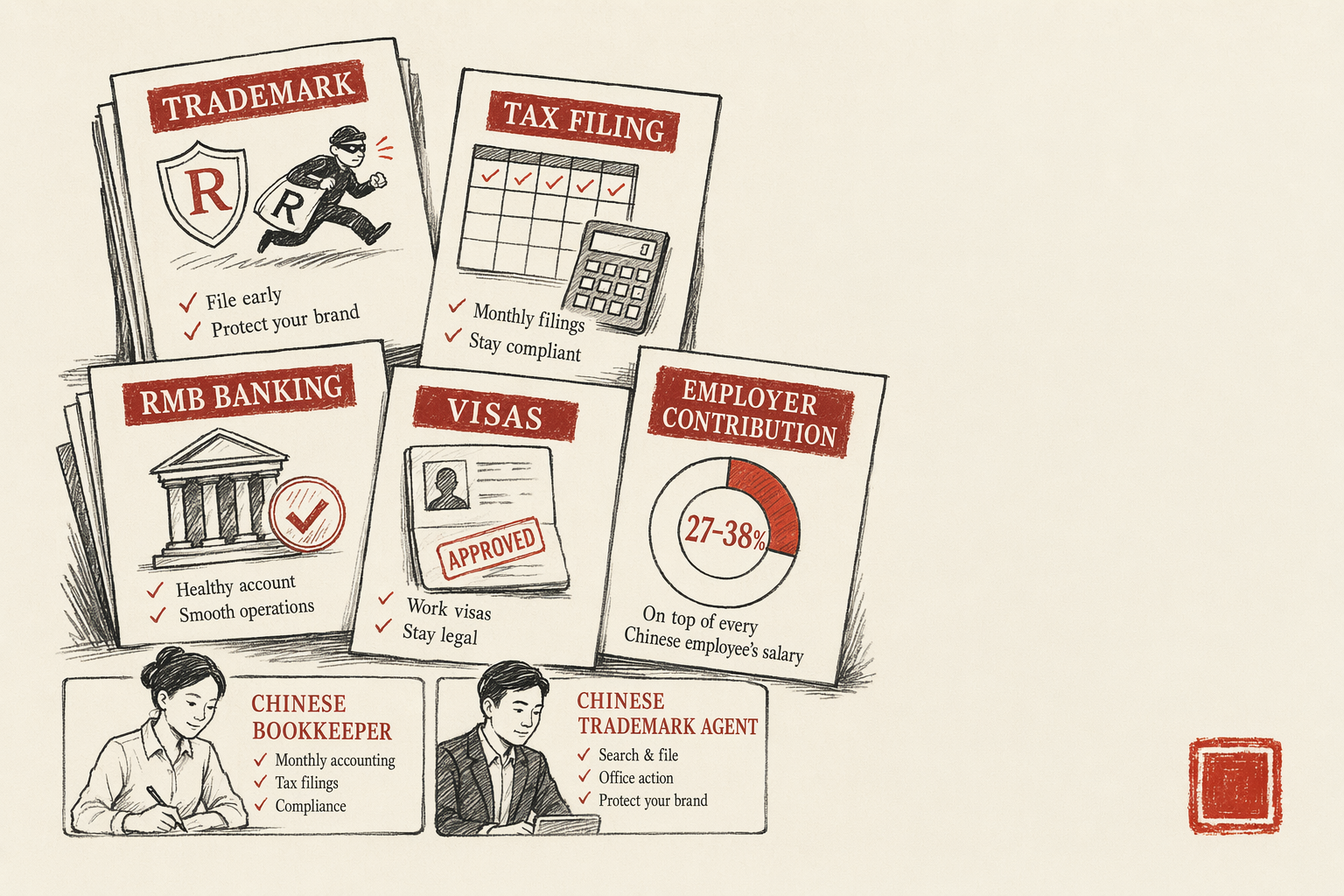
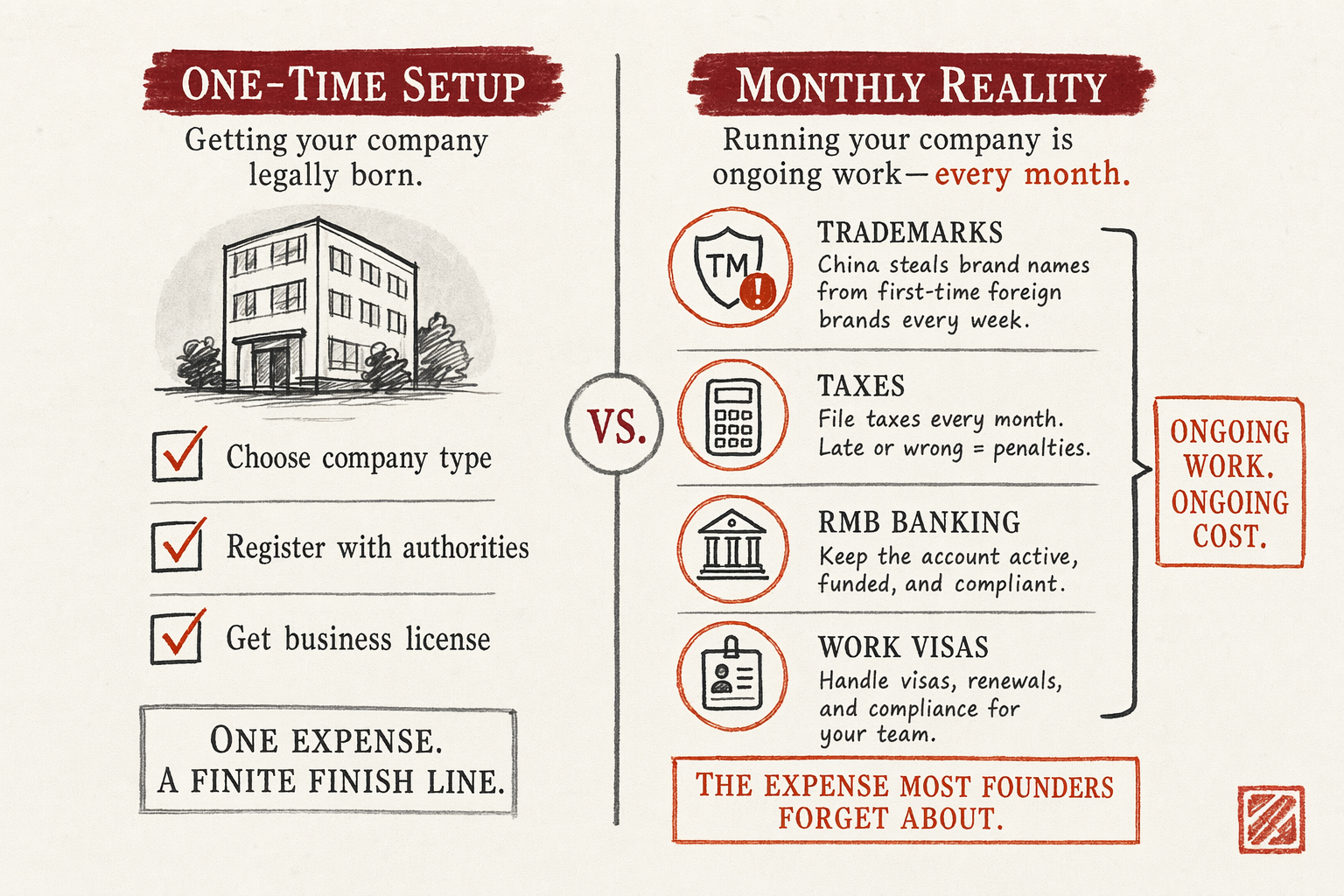
If you only read one paragraph: Setting up your Chinese company is one expense; running it month after month is a different expense most founders forget about. The ongoing work is filing trademarks (China steals brand names from first-time foreign brands every week), filing taxes every month, keeping the bank account healthy, handling work visas for any foreign people you hire, and paying the mandatory employer contribution of roughly 27-38% on top of every Chinese employee's salary. We price each of these as a separate line so you can see exactly what each costs, with a Chinese bookkeeper and a Chinese trademark agent doing the actual work. Plan for around twenty-two to thirty-eight thousand US dollars a year in total compliance costs for a small operating WFOE with a couple of staff. That's the real run-rate of a Chinese company.
How an engagement actually runs
- 01
Compliance scoping call (free, 45 min)
We map your tax workload, trademark exposure, hiring plan, and banking needs against the entity you have or are about to form, and price each workstream separately.
Within one Asia-Pacific business day
- 02
Trademark filings first
Class coverage strategy decided, CNIPA filings submitted via partner agents. Filing receipts in hand inside 2-3 weeks; certificates issue in 14-18 months.
Filings inside the first month
- 03
Bookkeeping handover
Chart of accounts, e-Tax credentials, bank-feed setup, monthly close calendar, bilingual reporting cadence. First close runs at the next month-end.
Inside the first three weeks
- 04
RMB bank account opening
Basic-account application at the chosen bank, legal-rep in-person counter visit, SAFE registration for cross-border capital, U-shield issued to your chosen custodian.
Four to eight weeks
- 05
Z-visa applications per foreign hire
Foreign-talent classification, work-permit notification letter, Z visa at the Chinese consulate in the hire's country, residence permit post-arrival.
Eight to fourteen weeks per hire
- 06
Social insurance + housing fund enrollment
Per-city enrollment with the social-security bureau and housing-fund management center. Required before the first local hire's payroll runs.
Two to four weeks
- 07
Annual cycle handover
We hand you a compliance calendar showing every filing due across the year, with our partner-firm reminders and quarterly check-ins. You decide which workstreams stay with us long-term and which you move in-house.
Social insurance + housing fund (五险一金) — the 27-38% employer cost
The line item nobody warns you about. *五险一金* (literally 'five insurances and one fund') is the mandatory bundle of employer + employee contributions on every mainland employee's payroll. The five insurances: pension (养老保险), medical (医疗保险), unemployment (失业保险), work-injury (工伤保险), and maternity (生育保险). The one fund: housing fund (住房公积金).
The percentages stack as employer contributions on top of gross salary, plus employee contributions deducted from gross salary. Indicative employer-side rates by city in 2026:
Real example arithmetic for a
RMB 25,000per month mainland employee in Shanghai:RMB 25,000RMB 2,800-3,500RMB 2,000-2,800RMB 18,700-20,200RMB 7,500-8,000RMB 32,500-33,000For foreign hires, the rates are similar but with category-specific variations — foreign passport holders are sometimes exempt from certain components in some cities, sometimes not. The exemptions have narrowed over the past decade; default assumption is full participation. We pre-confirm city-specific rules at engagement scoping.
Foreign expat IIT regime: the global-income tax exposure for foreign residents (those who spend 183+ days per year in China) is a separate calculation that has tightened materially under the post-2019 reforms. The five-year tax-free window on foreign-source income still exists but in narrower form. Each foreign hire needs a personalised IIT projection; our bookkeeping partners run this as part of the year-one handover.
Practical implication for hiring plans: a foreign founder budgeting
USD 10,000 per monthof payroll cost per mainland mid-level hire should plan for that figure to absorb roughlyRMB 70,000-72,000of total employer cost in Shanghai or Beijing (gross salary around RMB 55,000 plus 五险一金). The 27-38% on top of gross is non-negotiable, non-deferrable, and tracked monthly by the social-security bureau.