Why your overseas-hosted site can't reach mainland users in practice
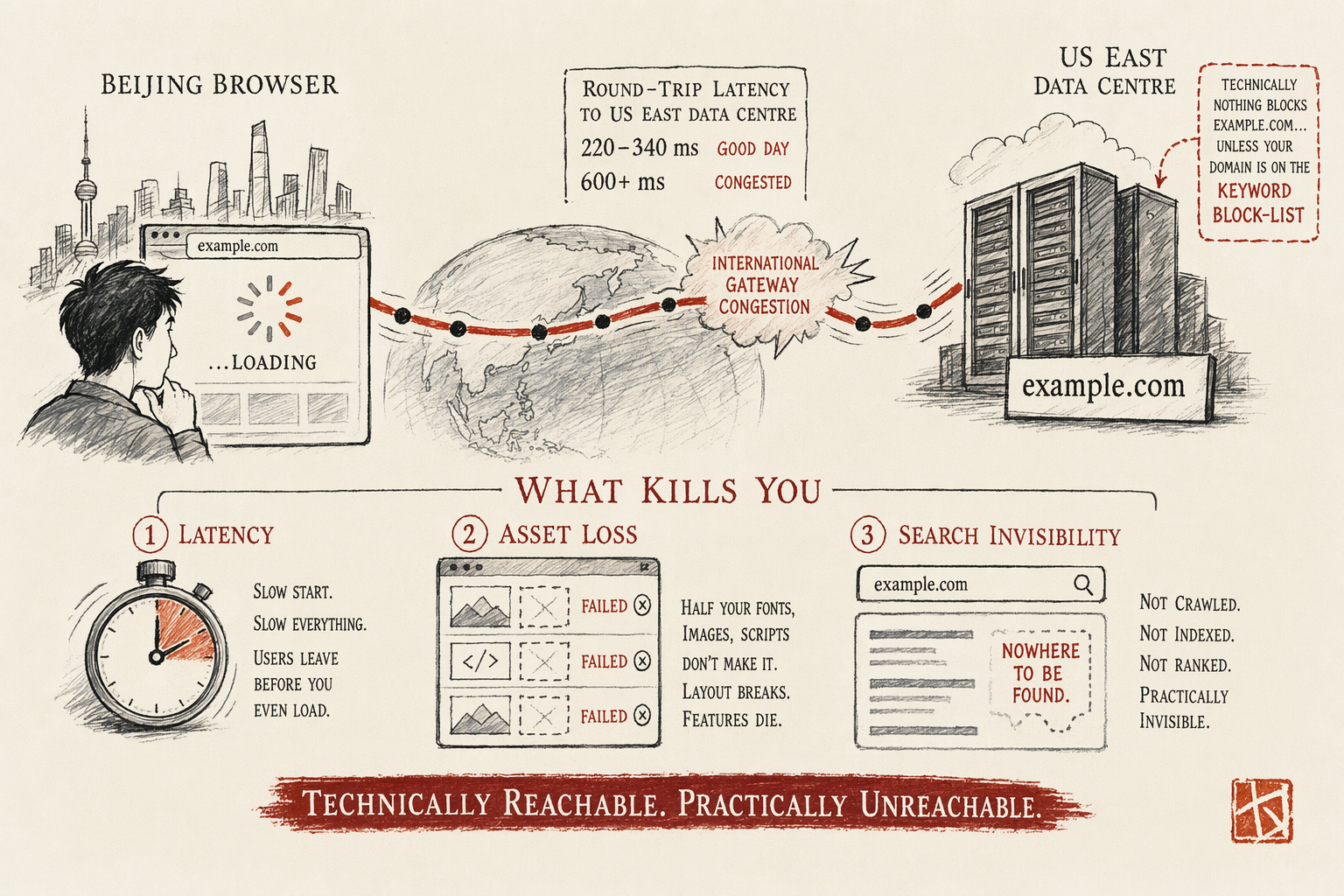
Technically nothing blocks example.com from a Beijing browser, unless your domain is on the keyword block-list. What kills you is latency, asset loss, and search invisibility. Round-trip from a Chinese ISP to a US East data centre runs 220-340 ms on a good day and 600 ms when the international gateway gets congested. Your bundle loads, half your fonts and analytics scripts time out, your Google-hosted assets never arrive, and your Largest Contentful Paint slides past 8 seconds. Conversion craters before the user finishes scrolling.
Then there is the search problem. Baidu only indexes sites that resolve fast inside China, and it weights filed (备案) domains above un-filed ones. Your overseas-hosted English-language page is invisible in Baidu organic regardless of what backlinks you have. WeChat in-app browser, the closest thing China has to a default mobile browser, applies its own performance budget and aggressively kills slow-loading external sites.
The fix is not a faster overseas CDN. Cloudflare's China Network, AWS CloudFront's China region, and Akamai's mainland POPs are all real and they all work for static content, but the moment you collect a phone number, run a payment flow, or push first-party analytics, you are in territory that legally requires a mainland *ICP* (Internet Content Provider) filing. Without that filing, the host can be ordered to take you offline; with it, you sit inside the legal envelope and your latency drops to 30-80 ms.
ICP filing (备案) — what foreign brands actually need to qualify
There are two things people call ICP, and confusing them costs months. The ICP 备案 (filing) is a passive registration of your domain with MIIT (Ministry of Industry and Information Technology). It is mandatory for any site hosted inside mainland China and for any site that wants to be reachable at acceptable speeds for mainland users. The ICP 许可证 (license, sometimes called the commercial ICP) is a separate, much heavier authorisation required for sites that take payments, run paid content, or operate as a platform. Most foreign-brand marketing sites need the filing, not the license; e-commerce flows that touch RMB usually need both.
For the filing to be granted, the entity holding it must be mainland-registered. That means a WFOE (Wholly Foreign-Owned Enterprise), a *JV* (Joint Venture with a Chinese partner), or in very narrow cases a Representative Office. A Hong Kong limited company, a Cayman holdco, or any Delaware vehicle does not qualify, no matter how clearly it owns the mainland operation downstream. If you have not incorporated mainland yet and don't want to, the sponsor model exists for exactly this gap — a licensed mainland sponsor (often an ICP-licensed hosting provider) holds the filing on your behalf and lists your brand as the operator of record on their certificate.
Documents you will be asked for, every time: apostilled certificate of incorporation of the filing entity, board resolution authorising the filing, passport of the *legal rep* (法定代表人), brand authorisation if the operator differs from the trademark holder, and a written commitment that the site will not host the categories that trip content review (gambling, political content, anything in the news-aggregator bucket). The partner firm handles the translation and notary work on their side; you produce the source documents on yours.
Indicative timing assumes documents arrive clean. They rarely do on the first pass. The 18-25-business-day figure quoted by every sales-gloss agency site is the best-case happy-path number. Real engagements run 25-45 business days when one document goes back for correction, which is the median outcome. Plan for that, not the marketing number.
Choosing a sponsor — entity-tied filings and the 30-day PSB clock
If you do not have a mainland entity, you either form one (see China company formation) or you use a sponsor. The sponsor is a mainland-registered, ICP-licensed party — almost always a hosting provider, often the regional Aliyun or Tencent Cloud reseller — that holds your filing under its own certificate. Operationally you behave like anyone else. Legally, the sponsor is the registrant and you are the operator.
The sponsor model has three trade-offs worth being honest about. First, you are tied to the sponsor's host stack. Moving to a different cloud provider requires a sponsor-side filing transfer that takes 4-8 weeks and can drop your filing into a re-review queue. Second, if the sponsor loses their ICP license (it happens, usually for unrelated reasons) your filing dies with it; backup sponsor relationships are not a thing, you re-file from scratch. Third, sponsored filings get more aggressive content review than entity-tied filings — sponsors are liable for everything on a domain they registered, so they enforce harder.
None of these are dealbreakers for a marketing site that just wants Chinese visitors to be able to load it. They become dealbreakers once the site is operationally critical, at which point you want the filing on your own *WFOE*. Our typical engagement starts on a sponsor for the first 6-12 months while the WFOE is being formed, then transfers the filing across once the entity is alive.
The 30-day PSB clock is the gotcha nobody warns you about. After MIIT issues your filing, the local PSB (Public Security Bureau) cyber-security desk requires a separate sub-filing within 30 calendar days. Miss it and the original MIIT filing voids; you are back to month one. Worse, the PSB form is in Chinese, the submission portal varies by district, and the supporting evidence asked for is not documented in English anywhere we have found. Our partner firms do this filing as part of the standard handoff. If you bought ICP services from anyone else and never heard of the PSB sub-filing, check that it was actually done — we have seen three engagements come to us in the last year where it had been silently skipped.
.cn vs .com.cn vs 中国 domain — registration, real-name, gotchas
Three TLDs live in the same regulatory regime under CNNIC (China Internet Network Information Center). The choice matters less than the volume of foreign-marketing advice suggests, but the differences are real.
- .cn — the headline TLD, equivalent of .com in usage. Foreign individuals and foreign entities can register since 2018. Real-name verification is mandatory. Most defensible against squatters because the available namespace is largest.
- .com.cn — second-level under .cn, originally limited to incorporated entities; rules relaxed in 2018. Subjectively reads as more commercial to mainland users, but the SEO signal is identical to .cn. Defensive registration usually means grabbing both.
- .中国 — the Chinese-character TLD. Useful only if your brand has an established Chinese transliteration that mainland users actually search. Most foreign brands don't, in which case this is squatter prevention rather than an active asset.
CNNIC real-name verification applies to all three. The registrar (Aliyun, GoDaddy China, eName, or one of the smaller licensed players) collects passport or apostilled certificate of incorporation, uploads it for manual review, and gates DNS resolution behind approval. Foreign-entity verification takes 3-7 business days; mainland-entity verification clears in 1-3 days. A failed real-name verification parks the domain — it remains registered, you cannot use it or transfer it until the documents are re-submitted and accepted.
The single most-common failure we see: the WHOIS registrant does not match the entity that will eventually hold the ICP filing. If your WFOE is going to be ABC Trading (Shanghai) Co Ltd, the domain has to be registered to that exact entity, not to your overseas parent and not to your *legal rep* personally. When the ICP filing reaches review, the system cross-checks WHOIS against the filing entity, and a mismatch bounces the whole filing. Get the registrant correct on day one of registration; fixing it later requires a domain transfer that can take 6-12 weeks.
Defensive registration cost is modest enough that we usually recommend the bundle. Three TLDs, five-year term, real-name done: around $420 USD / RMB 3,000 all-in via our partner registrar, versus around $180 / RMB 1,300 if you only register .cn. The cost difference is not a strategic decision.
Aliyun and Tencent Cloud mainland hosting — what gets you blocked
Once the filing is granted and a host is bound to it, the hosting stack itself is unremarkable infrastructure. Aliyun runs ECS instances that look and behave like AWS EC2 with worse documentation; Tencent CVM is the same again. The difference between providers, for most foreign brands, is not technical — it's whether the English-language docs cover your use case, whether your billing entity can pay them, and whether the regional hosting reseller has a track record running ICP filings for foreign brands.
Three things consistently get foreign-brand sites either taken offline or quietly throttled, even after a clean ICP filing:
- Google-hosted assets in the page bundle. Google Fonts, Google Tag Manager, Google Analytics, reCAPTCHA, YouTube embeds. Every one of these calls a host that is either blocked or unreliable from inside China. Your page will render, but with broken fonts, missing analytics, and timed-out embeds. The fix is self-hosting fonts, swapping to a mainland-resolvable analytics layer (Baidu Tongji is the default; mainland Plausible-style alternatives exist), and replacing YouTube embeds with native HTML5 video served from your CDN.
- Third-party scripts that resolve to blocked hosts. Anything calling Facebook, Twitter, Stripe.js, Intercom, Crisp, Drift, or a long tail of Western SaaS scripts. The page itself loads; the scripts hang and either consume your performance budget or get cut by the in-app browser. Audit your script tags. The cheap way: load your site from a Beijing or Shanghai cloud test endpoint, watch the network tab.
- Content that drifts into review-trigger categories. The filing did not authorise news aggregation, political commentary, gambling, or unfiltered user-generated content. If your marketing site adds a blog and the blog adds a comments section and the comments section attracts something a content-review bot flags, your filing can be suspended with no warning. The fix is not avoiding all comments; the fix is using a moderation-enabled comment system (Tencent's own UGC stack is the path-of-least-resistance) and keeping content within the categories your filing was granted for.
Hosting cost lands in the $220-480 USD / RMB 1,600-3,400 per month band for a typical foreign-brand marketing site running Aliyun ECS + their CDN. Above that, you are usually paying for traffic spikes or e-commerce machinery, which is a separate scoping conversation. CDN choice — Aliyun CDN, Tencent CDN, Wangsu, ChinaCache — matters less than getting the cache headers correct; mis-tuned cache invalidation is the single biggest cause of stale-content complaints from mainland users.
Bilingual site localization — simplified Chinese, font stack, performance
Filing and hosting solve reachability. Localization is what makes the site convert. A Chinese-language version is not a translation of your English marketing copy; it is a re-architecture of the funnel — sorry, the buying flow — for a different shopper and a different reading pattern.
What we actually deliver on a localization engagement, in practical terms:
- Simplified Chinese (简体中文) primary, traditional (繁體) as a separate variant if Taiwan or Hong Kong is in scope. Never auto-convert; the character sets diverge in business vocabulary in ways the cheap converters get wrong. A second translator pass on traditional is normal if the variant matters.
- Font stack that does not call Google. The default mainland stack is Source Han Sans (思源黑体) self-hosted, with Noto Sans CJK as fallback. PingFang SC works on iOS; Microsoft YaHei (微软雅黑) on Windows. The font file is large — around 2.5 MB for a single weight — so subsetting is mandatory. Most engagements ship a 180-260 KB subset covering the GB2312 plus brand-specific glyphs.
- Bilingual URL structure. Two patterns work:
/zh/path prefix orzh.example.comsubdomain. The path prefix is easier on filing (one filing, one domain) and easier on SEO (single domain authority). The subdomain is cleaner if you want to host the Chinese variant on a separate stack. We default to path-prefix. - Native units and conventions. Prices in RMB with the ¥ glyph, not
RMB 200spelled out. Dates as2026年5月23日, notMay 23, 2026. Phone numbers without the +86 country code (Chinese readers don't expect it inside China). Postal addresses by province → city → district → street, not by street → city → state. - Performance budget tuned to mainland networks. The realistic LCP target on a Chinese 4G connection from a tier-2 city is 2.5-3.5 seconds. Above that, conversion drops fast. We typically strip a third to a half of the page weight versus the English version.
Indicative localization scope for a 12-page marketing site, including translation, font subsetting, bilingual URL setup, performance audit, and one editorial review pass: $3,200-5,800 USD / RMB 22,800-41,500, depending on glossary depth and how technical your category is. For categories where regulatory copy matters (cosmetics, supplements, medical devices, financial services) we route translation through partners who have written regulator-facing copy for that vertical, which adds 20-35% to the line item and saves a lot of resubmission cycles.
Why ICP filings get rejected (the eight most-common causes)
Sales-gloss agency sites quote a 95% first-pass approval rate. Our real-engagement data, across a few dozen filings over the last three years, puts foreign-brand first-pass approval closer to 60-70% with a clean document set, and 30-40% if any of the categories below are present. The fix is almost always documentary; the cost of getting it wrong is 3-6 weeks of resubmission.
- WHOIS does not match the filing entity. Discussed above. Single largest cause.
- Apostille is on the wrong document, or the wrong country issued it. The apostille has to be issued by the competent authority of the country of incorporation, not by a notary in a third country.
- Brand authorisation chain is broken. If the trademark holder is a parent company and the operator is a subsidiary, the chain of authorisation needs to be documented in writing. Verbal arrangements fail review.
- Legal rep passport scan is unreadable, or the passport expires inside 12 months. The system rejects on both.
- Site preview content (the screenshot of the proposed Chinese page) contains a category outside the filing's scope. If you preview a payment button on a filing for a marketing site, the filing is rejected for scope mismatch.
- The domain is on a registrar that does not have a clean track record with the regional MIIT bureau. Rare, but it happens — usually with overseas registrars that have had bulk-filing trouble in the past.
- The PSB sub-filing was either not done or not done correctly. Voids the MIIT filing retroactively.
- The hosting binding is not in place at the moment of review. The host has to confirm it will accept the filing before MIIT issues; if the host has a backlog and confirms late, the filing is rejected.
None of these are insurmountable. All of them are catchable in a pre-clearance pass. Our partner firms run the pre-clearance as standard because resubmission costs them as much as us.
Who actually files this for you
Mike is the broker on your side of the wall. He does not hold a Chinese law license, an ICP license, or a CNIPA registration number. None of those are necessary to broker; all of them are necessary to file. The work is executed by partner firms in Shanghai or Shenzhen, each with seven to fourteen years of *MIIT* filings on record, and each with a working relationship to a regional Aliyun or Tencent Cloud reseller for the host-binding step. We do not publish partner-firm names on this page — partner-firm assignment is part of the engagement-letter handoff, and naming the partner before engagement turns the relationship into a sales-call gauntlet that costs both sides time. You see the partner-firm name on the engagement letter, on every document the partner sends, and on the filing certificate at the end.
Two backstops are part of every engagement. First, if the partner stops responding mid-filing — and this happens occasionally, usually because a partner takes on too much in a busy month — Mike re-routes to a backup firm in the same city at no extra fee. Second, the engagement letter itemises Mike's brokerage fee separately from partner-firm fees, so you can see exactly what each side is paid. There is no margin baked into the partner-firm line; the partner's quote is the partner's quote.
In plain English
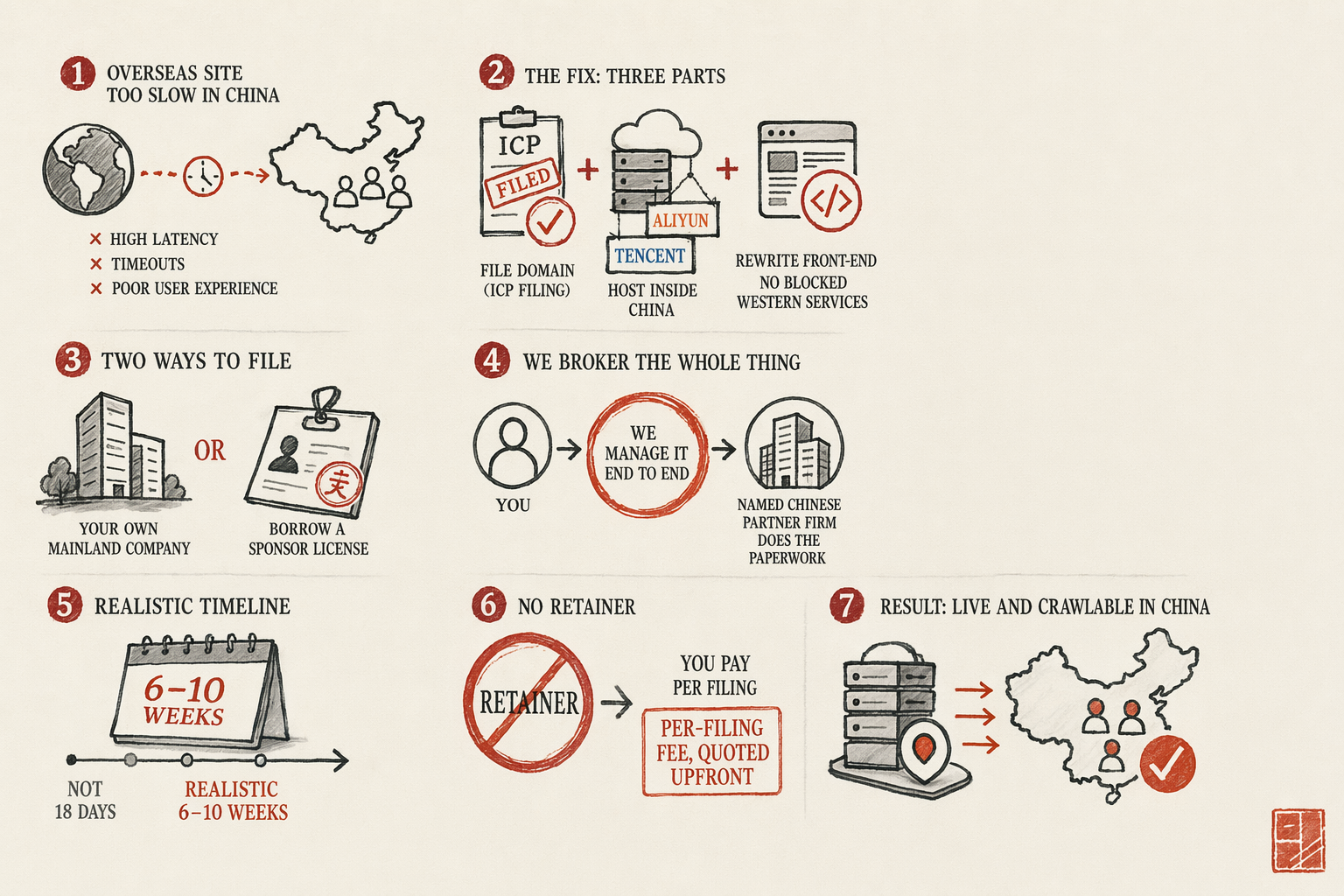
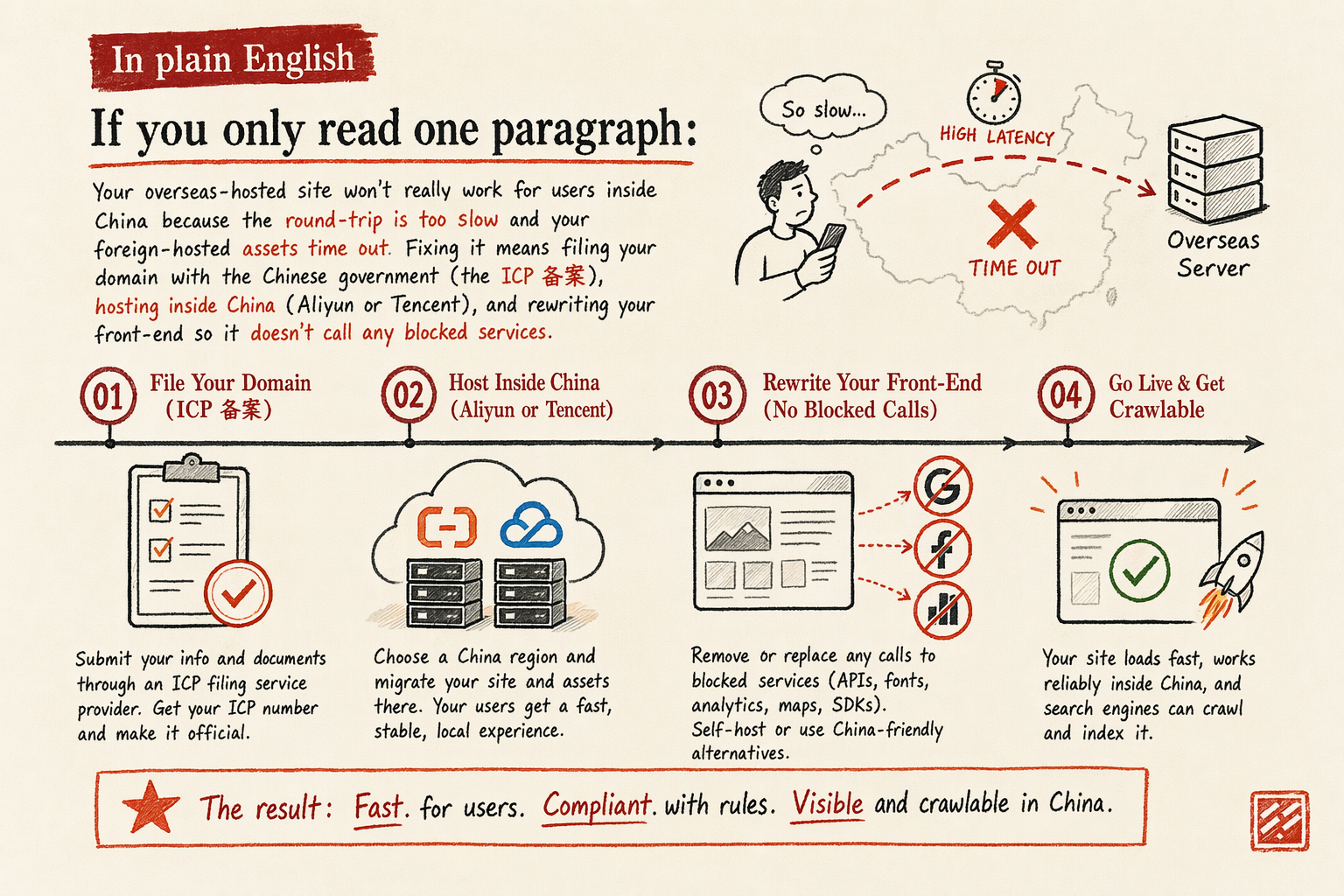
If you only read one paragraph: Your overseas-hosted site won't really work for users inside China because the round-trip is too slow and your foreign-hosted assets time out. Fixing it means filing your domain with the Chinese government (the ICP 备案), hosting inside China (Aliyun or Tencent), and rewriting your front-end so it doesn't call any blocked Western services. You can do this either against your own mainland company or by borrowing a sponsor's license. We broker the whole thing for a quoted per-filing fee, with a named Chinese partner firm doing the actual paperwork, and the realistic timeline is six to ten weeks not the eighteen days some sites will quote you. There is no retainer; you pay per filing.
How an engagement actually runs
- 01
Scope call (free, 30 min)
Mike confirms whether you need a full WFOE filing or a sponsored arrangement, which CDN strategy fits your asset profile, and which city's partner firm handles your engagement.
Within one Asia-Pacific business day
- 02
Engagement letter and partner introduction
Written quote in USD and RMB, partner-firm name and city, three-line timeline. You sign or walk; no retainer.
Within the first week
- 03
Document pre-clearance
Apostilled certificate of incorporation, board resolution, legal-rep passport, brand authorization. We screen everything before submission so first-pass rejections drop sharply.
Within the second week
- 04
MIIT 备案 (filing) submission
Partner files via the regional MIIT portal. Provincial bureaus respond at different speeds; Shanghai and Guangdong typically clear inside 18 business days, Beijing closer to 25.
Roughly three to five weeks total
- 05
PSB sub-filing inside the 30-day window
The local *PSB* (Public Security Bureau, the cybersecurity desk) registration must land inside 30 days of MIIT approval, or the filing voids. We track the clock and prep the form.
Inside the 30-day window
- 06
Host binding and go-live
Aliyun or Tencent Cloud binds the filing number to your domain. Site comes off the firewall queue. We hand over the filing certificate PDF, account credentials, and a renewal calendar.
- 07
Year-two annual review
MIIT runs an annual review. Most filings clear silently; some require an updated entity document. We file the reminder so it doesn't slip.