What the 45 Nice classes cover
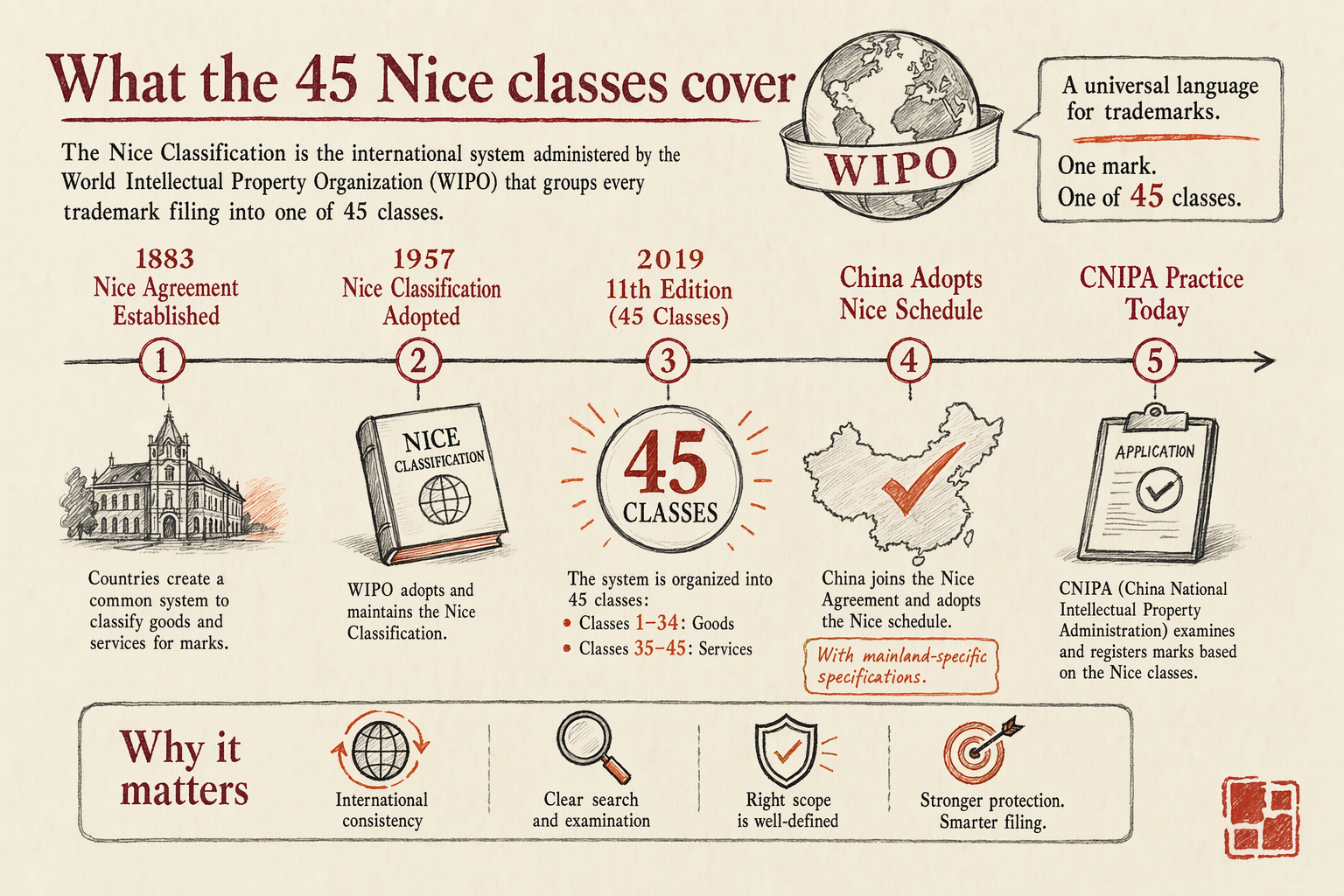
The Nice Classification is the international system administered by the World Intellectual Property Organization (WIPO) that groups every trademark filing into one of 45 classes. Classes 1-34 cover goods; Classes 35-45 cover services. CNIPA (China National Intellectual Property Administration) adopts the Nice schedule with mainland-specific specifications added to the accepted nomenclature.
Each class has a one-line heading and an exhaustive list of accepted goods or services. Examples of headings most relevant to foreign brands: Class 3 (cosmetics, perfumery, cleaning preparations), Class 5 (pharmaceuticals, supplements), Class 9 (electronic apparatus, software, downloadable content), Class 12 (vehicles), Class 18 (leather goods, bags), Class 25 (clothing, footwear, headwear), Class 28 (toys, sporting goods), Class 29 (meat, fish, processed foods), Class 30 (coffee, tea, baked goods), Class 32 (beer, non-alcoholic beverages), Class 33 (alcoholic beverages other than beer), Class 35 (advertising, retail, online sales), Class 36 (financial services), Class 41 (education, entertainment), Class 42 (technology services, software design), Class 43 (food services, accommodation), Class 44 (medical, beauty services), Class 45 (legal and security services).
A filing in a specific class secures rights against confusingly similar marks for the goods or services within that class as actually specified on the application. CNIPA does not protect across classes by default. A registration in Class 3 does not block a later filing in Class 25 for clothing, even if the marks are identical. This is the architecture that makes defensive filing across multiple classes necessary at all.
Which classes squatters target for each industry
Squatters do not file at random. The classes most-targeted for each industry segment cluster predictably around (a) the core product class and (b) classes adjacent enough that consumer goodwill could plausibly extend.
Cosmetics and beauty brands are targeted in Class 3 (the core), Class 5 (supplements, often where cross-category extensions get blocked), Class 35 (retail), Class 21 (cosmetic applicators and containers), Class 41 (beauty education and content), Class 44 (beauty salon services). Six classes covers nearly all real squatter activity.
Apparel and footwear brands are targeted in Class 25 (the core), Class 18 (handbags, leather accessories), Class 35 (retail), Class 9 (eyewear), Class 14 (jewelry), Class 28 (sporting goods if the brand has any athletic positioning). Six classes again.
Consumer electronics and software brands are targeted in Class 9 (the core), Class 42 (software services), Class 35 (retail), Class 38 (telecommunications if any messaging or networking element), Class 41 (digital content). Five classes for most.
Food and beverage brands are targeted in Class 29, 30, 32, or 33 depending on the specific product, plus Class 35 (retail), Class 43 (restaurant services if any flagship or pop-up planned). Four to five classes.
SaaS and B2B software brands are targeted in Class 9 (downloadable software), Class 42 (SaaS services), Class 35 (retail / advertising), Class 38 (telecommunications), Class 41 (training content). Five classes.
The pattern across all of these is that the core class plus Class 35 (retail/online-sale, where marketplaces check) plus 2-4 industry-adjacent classes captures the vast majority of squatter targeting. Squatters rarely file in classes that have no plausible relationship to the brand's actual or extension positioning, because the resale value of a wholly unrelated-class mark is low.
The 4-6 class defense most foreign brands actually need
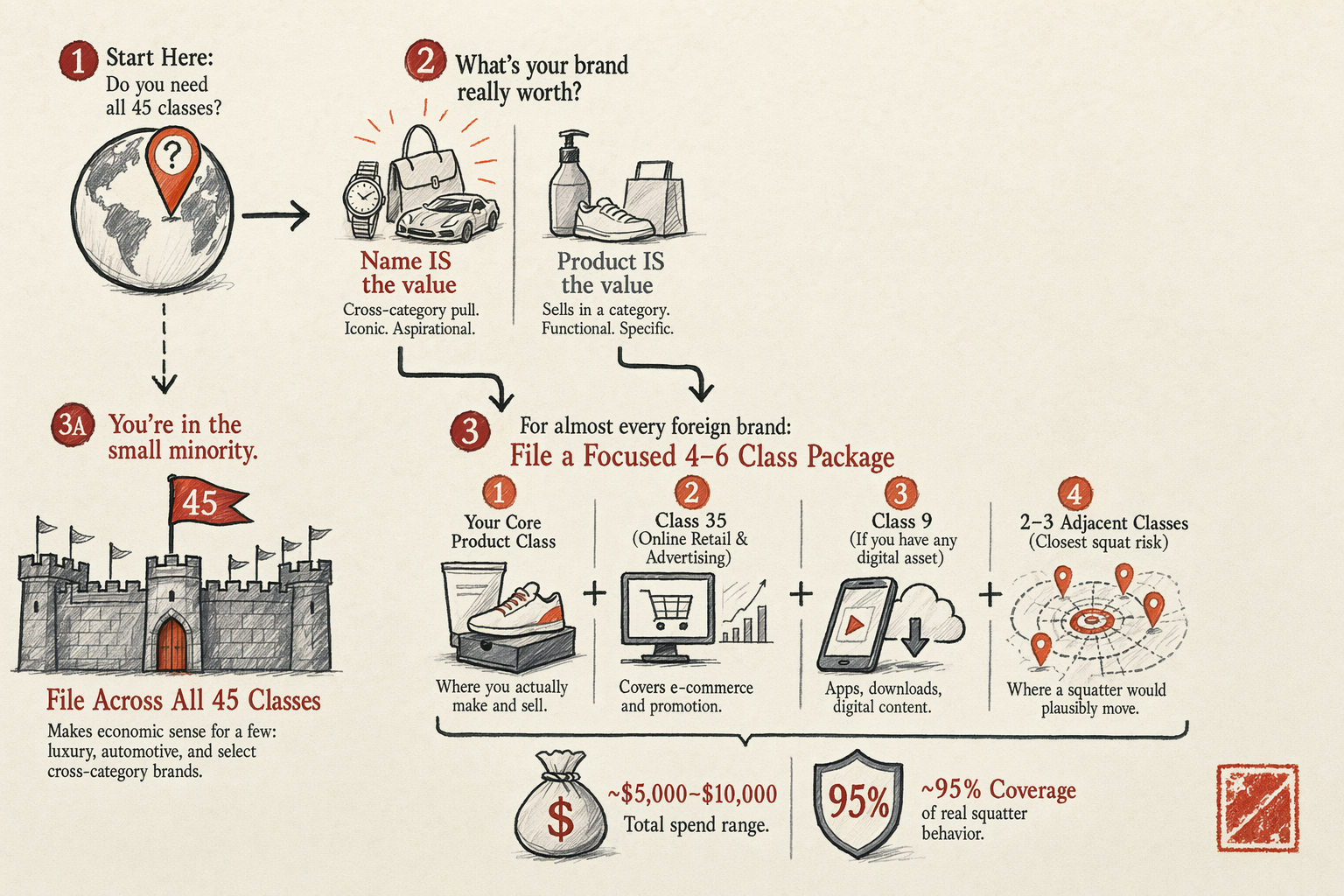
For most foreign brands, the right defensive package is a 4-6 class cluster, filed in three forms (English, Chinese characters, pinyin), at total cost of roughly $5,000-$10,000 in fees. The cluster composition is:
- Class 1 (the core class). Your primary product class. This is the registration the marketplaces and customs officers will check first.
- Class 35 (online retail and advertising). Universal across all consumer-facing brands. Marketplaces, ad-tech platforms, and the certification frameworks for Tmall, JD, and Pinduoduo require Class 35 coverage regardless of underlying product class.
- Class 2 (closest adjacency). The class that a reasonable squatter would file in to extort an extension. For cosmetics this is usually Class 5 or Class 44; for apparel this is usually Class 18 or Class 14; for software this is usually Class 42 or Class 41.
- Class 3 (second adjacency). A second adjacent class on the same logic. Many brands stop at three adjacencies; some extend to four.
- Class 4 (vertical extension). Classes you might plausibly extend into in the next 24-36 months. A beauty brand planning a supplement line should file Class 5 defensively even if no product exists yet.
- Class 9 (downloadable assets), optional. If you have any digital content, app, or downloadable, Class 9 is worth the additional $700-$1,500. If you have no digital surface, skip.
The decision tree for an entry-stage brand is: identify your one core class, add Class 35 automatically, then add 2-4 adjacencies based on (a) where competitors in your category have been squatted, (b) what extensions you plan in the next 2 years, and (c) which classes have the heaviest squatter activity in CNIPA's published statistics for your industry.
When all 45 makes economic sense
The full 45-class defensive filing — sometimes called a "blanket" filing — costs roughly $14,000-$22,000 per mark in fees and is worth it for a defined set of brands. The economic case is straightforward: if the brand's name has substantial cross-category licensing value or cross-category recognition risk, the cost of one large filing is less than the cost of fighting 30 separate squatters over 8 years.
The brands for which this calculus actually holds:
- Luxury brands. A luxury house's name carries value across fashion, fragrance, accessories, hospitality, education, and event services. Squatters in any class can extract meaningful rent. The historical pattern is that luxury brands enter China with all 45 classes covered.
- Automotive brands. The brand name extends across the vehicle (Class 12), accessories (Class 12 specifications, Class 9), apparel (Class 25 — branded merchandise), hospitality (Class 43 — branded experiences), and finance (Class 36 — auto financing). A 45-class filing is standard.
- Cross-category lifestyle brands. Brands like global consumer-goods houses where a single name covers food, personal care, household care, and apparel.
- Brands with active or near-term licensing programs. If your brand will license to third parties across categories (toys, apparel, content), the licensee will demand evidence of class coverage. A 45-class filing satisfies any licensee's diligence.
Brands for which 45 classes is generally not justified: single-category SMBs, B2B software, niche consumer-goods brands, content-creator brands with no licensing roadmap, and brands with combined Chinese revenue under roughly $5M. The math reverses below that revenue line.
Sequencing — what to file first, what to wait on
If budget is constrained, file the four most-critical classes first and the 2-4 adjacency classes 3-6 months later. The phased order:
- Phase 1 (file in week 1, before any China-visible activity): Core class + Class 35 + the two highest-risk adjacencies. Cost: roughly $3,500-$5,500 across the three mark forms.
- Phase 2 (file by month 4-6): The remaining 2-4 adjacency classes. Cost: roughly $1,500-$3,500 across the three forms. By month 6 your phase-1 marks are in substantive examination and CNIPA's registry will show your filing dates, which deters squatters from filing in adjacent classes (squat economics depend on being able to demonstrate a real defense if challenged; an active filer in adjacent classes is a hard target).
- Phase 3 (file if needed by month 12): Vertical-extension classes you defer until your business plan firms up. If you decided in phase 1 you would never enter a category, skip; if your strategy shifts, you can add the class later at $300-$700.
What you do not do is file the core class only and "add more later if needed." The 4-9 month examination cycle at CNIPA means a single-class filing leaves you exposed for the entire window during which a squatter can file 5 adjacent classes. The cluster approach in phase 1 closes the window before squatters can exploit it.
If you have a name that you cannot afford to lose and a roadmap that includes any of toys, apparel, content licensing, financial services, or hospitality, model the all-45 filing against the expected legal-cost run-rate of fighting 30 squatters over 8 years. The all-45 filing usually wins on cost.