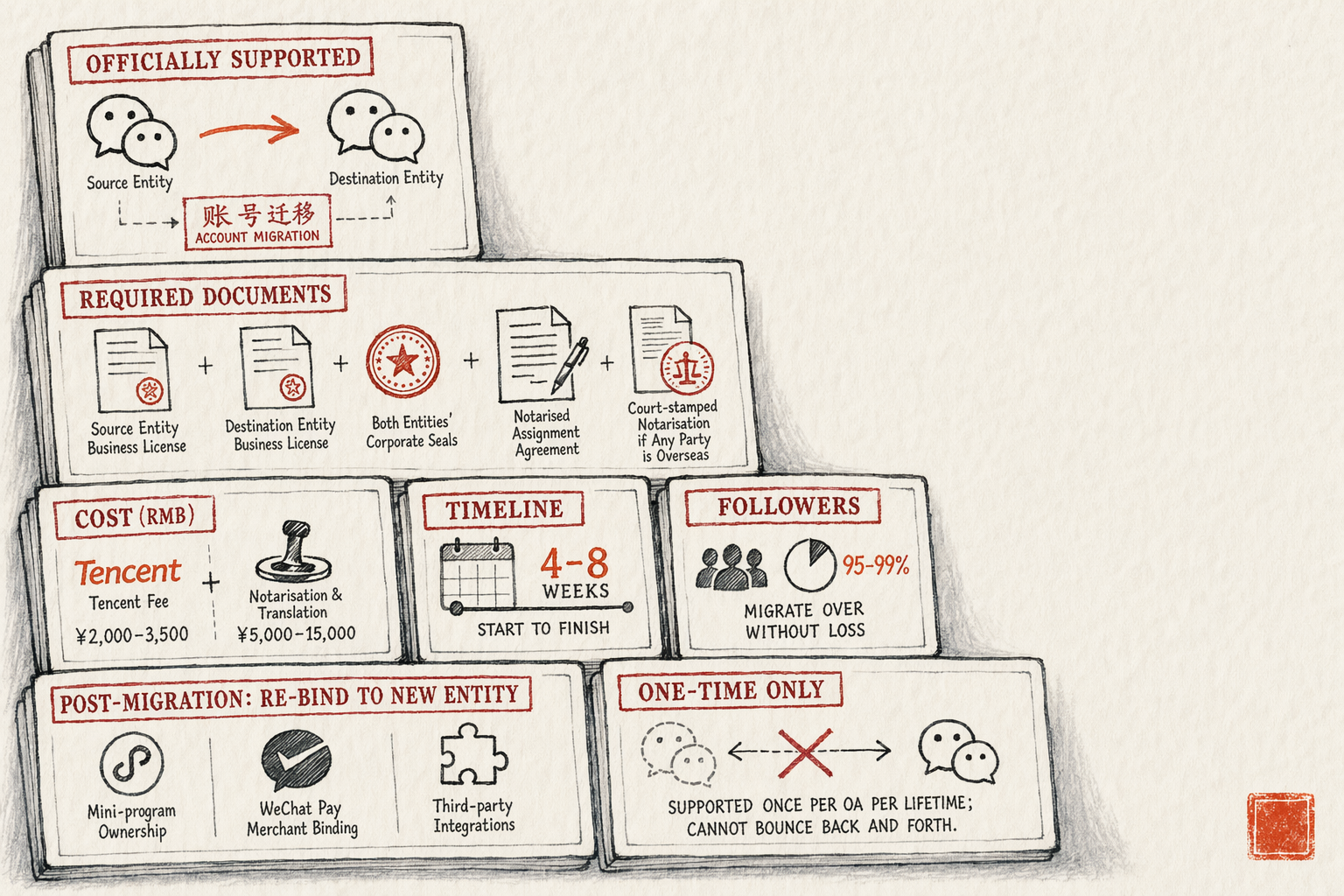
WeChat Official Accounts are owned by legal entities, not by people. Once an OA is verified under your Hong Kong limited or your Delaware Inc, that entity is the registrant of record at Tencent. When the underlying entity changes — M&A, restructuring, replacing a sponsor company, moving the operation from an overseas vehicle to a mainland WFOE — the OA has to be migrated to keep the registration aligned.
The migration is officially supported. It is also paperwork-heavy, time-consuming, and exactly one-shot — you get one migration per OA per lifetime, and there is no way back. This article walks the cases that actually require migration, the procedure as Tencent documents it, what breaks during the move, and how to minimise the follower-loss risk.
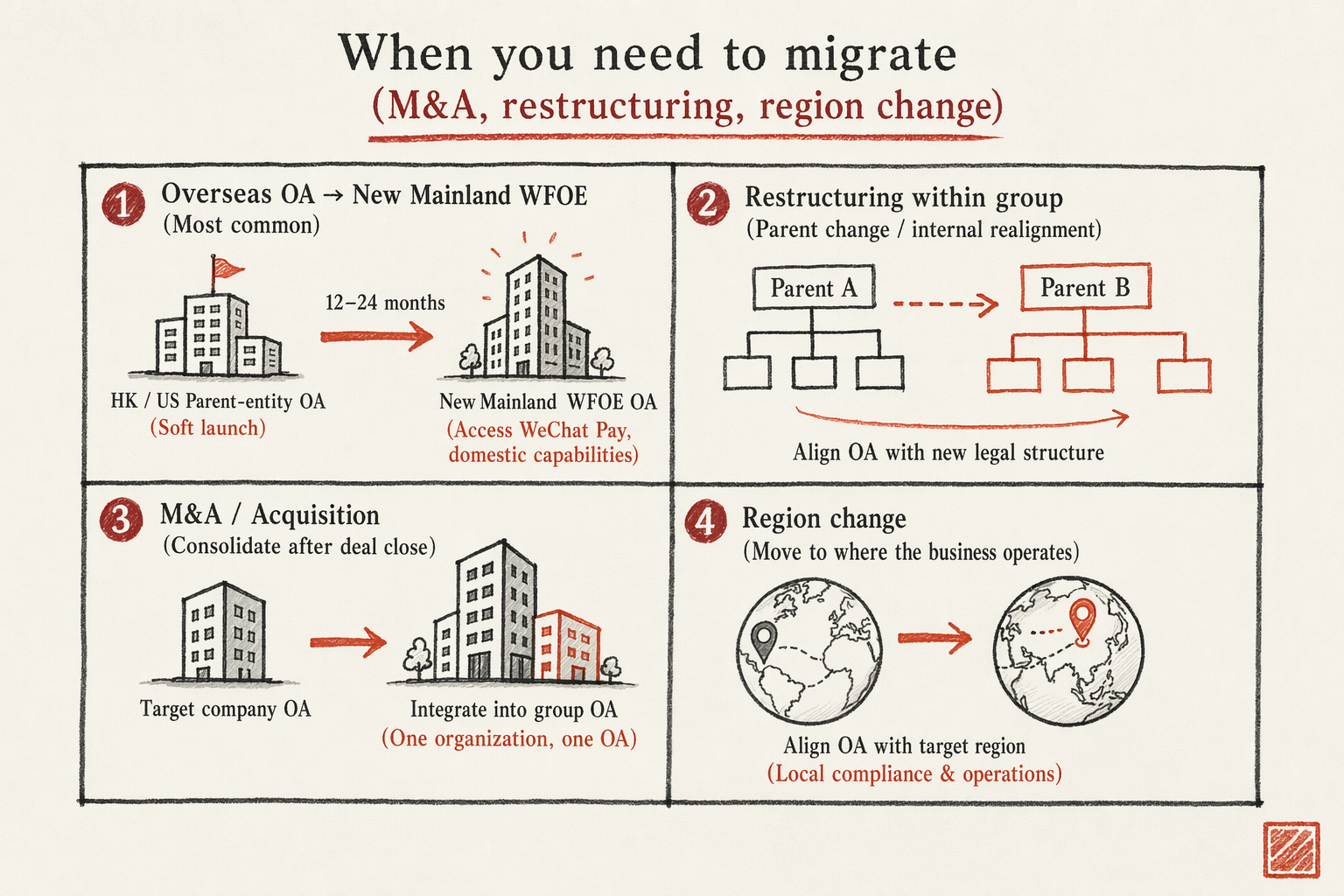
When you need to migrate (M&A, restructuring, region change)
The legitimate cases for entity migration, in roughly descending order of how often we see them:
- Overseas-entity OA moving to a newly-incorporated mainland WFOE. The most common case. A brand sets up the OA under their Hong Kong or US parent for the soft launch, then forms a WFOE 12-24 months in to get access to domestic WeChat Pay and other mainland-entity features. Migration shifts the OA under the WFOE.
- M&A: parent company acquired, brand transferred. The acquiring company wants the OA under their entity for consolidation and ad-account standing reasons. Migration is the only legitimate way to do this; informal handovers (sharing credentials) breach Tencent's terms of service and risk account suspension.
- Restructuring inside a corporate group. Brand moves between subsidiaries (operating unit to brand-holding subsidiary, or vice versa). Migration keeps the OA continuous through the legal-entity restructure.
- Sponsor or nominee company being replaced. An OA initially registered under a partner firm or nominee entity gets transferred to the brand's own entity once formed. Migration is the cleanest exit.
- Region change (rare). Moving the OA from Hong Kong-based regional operations to a Singapore or Japan regional entity. Supported but uncommon.
Cases that look like they need migration but actually don't: changing your brand name (use the name-change form, no entity change required), changing your legal representative within the same entity (use the legal-rep change form), changing the bank account where settlement lands (separate process within WeChat Pay). The OA-migration procedure is specifically for cases where the legal entity on the OA registration is changing.
Tencent's official migration form and process
The procedure is run through Tencent's verification partner and gated by the WeChat Open Platform's 账号迁移服务 (account migration service) portal. The high-level steps:
- Document set assembly. Both the source and destination entities' business licenses (or apostilled certificates of incorporation for overseas entities), both legal representatives' passports, both corporate seals, the OA's current credentials and verification certificate.
- Notarised assignment agreement. A written contract between source and destination entities, signed and sealed by both sides, formally assigning the OA from one to the other. Where one or both parties is overseas, the agreement has to be notarised in the jurisdiction of each party and apostilled. Where both are mainland, a single mainland notary signs off.
- Tencent fee payment. RMB 2,000-3,500 paid to the verification partner. The fee covers the migration review, the documentation processing, and the system-level account-transfer execution. The amount varies slightly with the category of account and whether there is a payment-merchant relationship attached.
- Submission and review. The full package is submitted via the OA admin portal. Tencent's verification team reviews — initial response 5-10 business days, full review 15-25 business days when documents are clean.
- User-notification window. Tencent pushes an in-app notification to every follower of the OA explaining that the account is being transferred to a new operating entity, and offering a one-tap unfollow option. The notification window runs 7-15 calendar days. Most followers (95-99%) do not unfollow.
- Execution. Tencent flips the registrant on the verification certificate, the OA's display surface updates to show the new operating entity, and the credentials transfer to the new entity's WeChat Open Platform account.
Total realistic timeline start to finish: 4-8 weeks. The fastest we have seen is 28 days, the slowest 73 days (a case where the overseas-side apostille bounced for technical reasons).
What breaks during migration
The migration itself does not break the OA. Broadcasts can be sent, the menu stays live, template messages keep flowing — operationally the account does not go dark. What breaks is the downstream integrations and bindings, each of which has to be re-attached to the new entity after migration completes:
- WeChat Pay merchant binding. The merchant relationship is registered to the old entity. After migration, the merchant has to be re-onboarded to the new entity (cross-border or domestic track, see the merchant onboarding guide) with a fresh 5-15 business day review. Plan for payment outage during this window unless you maintain a parallel payment method.
- Mini-program ownership. Mini-programs are separately registered entities at Tencent. If the OA controls one or more mini-programs, each one has to go through its own migration process. Mini-program migration is similar but separately fee'd at RMB 2,000-3,000 per mini-program.
- Third-party integrations. Any custom CRM, marketing automation, or analytics integration that uses OA credentials needs to be re-authorised under the new entity. OAuth tokens issued by the old entity are revoked at the moment of migration completion.
- Ad-account standing. The WeChat ad account (used for Moments ads, Channels ads, in-OA banners) is bound to the operating entity. Migration drops your credit history to zero on the new entity unless you submit a continuity attestation, which Tencent generally accepts. The ad-account standing recovery takes 30-60 days.
- Template-message templates. All previously approved templates remain valid but are re-bound to the new entity. The 7-day-per-template quota does not reset.
- Custom URL / WeChat ID. The OA's @-handle and custom URL stay intact. The OA's display name updates only if you file a name change alongside migration.
The one thing that genuinely breaks for users is the verified-company display. Until migration completes, users tapping on the verified badge see the old entity. After migration, they see the new one. There is a brief 24-72 hour window during execution where the badge surface can show inconsistent state across different WeChat client versions. We recommend not running a major campaign during migration week.
How to minimize follower loss
Follower loss during migration is dominated by two effects: the user-notification window's opt-out tap and the small fraction of inactive users that Tencent rolls off during the transfer. The opt-out tap rate runs 1-4% across our brokered migrations; the inactive-user roll-off adds another 1-3%. Total follower loss is typically 2-7% but can spike higher if the transfer narrative is unclear.
The three practical levers:
- Pre-announce the migration to your audience. A broadcast (Service) or daily post (Subscription) the week before migration starts, framing the transfer in terms followers understand: "we are formalising our China operations under a new entity, your follow stays intact, here is why we are doing this." The broadcast tends to halve the opt-out rate.
- Pick a quiet operational period. Migration mid-campaign costs you because followers who are mid-engagement read the in-app notification with extra friction. Mid-summer or mid-winter, away from your major commercial events, is the right window.
- Maintain content cadence through the transfer week. Going silent during the migration week reads as the OA being shut down, which raises the opt-out rate by 1-2 percentage points. Even a low-energy content post during transfer week stabilises perception.
The single biggest follower-loss event we have observed (38% loss) was a case where the migration was paired with a brand-name change and the brand had not pre-announced either. Followers received an in-app notification that the OA they had followed was now a different entity with a different name; many tapped unfollow. Migration-only events with pre-announcement consistently keep follower loss under 5%.
When to migrate vs start fresh
The case for starting fresh:
- Follower count is small (under ~5,000) and unengaged. The cost of migration paperwork is meaningful relative to the audience value.
- The brand identity is genuinely changing and the new entity should be perceived as a different operation.
- The migration documents are unobtainable — for example, the source entity is being liquidated and the legal representative cannot be located.
- You already used your one allowed migration on this OA.
The case for migrating:
- Follower count is meaningful (over ~10,000) and engaged. Followers represent real audience value worth the migration cost.
- Brand identity is continuous; the change is structural rather than market-facing.
- The OA has a long content history, custom URL, or WeChat ID that has real recognition value.
- WeChat Pay merchant standing, ad-account history, or third-party integration scaffolding is meaningful and would take time to rebuild.
For the underlying verification path that both source and destination entities need to satisfy, see the WeChat OA verification playbook. For the structural caps that apply to the migrated account, see the WeChat OA menu and template-message limits.
In plain English
If you only read one paragraph: Migrating a WeChat Official Account from one company to another is officially supported — Tencent calls it 账号迁移 (account migration) and runs it through a paid procedure that requires both the source and the destination entity's business licenses, both corporate seals, a notarised assignment agreement between the two companies, and a court-stamped notarisation if any party is overseas. Cost runs RMB 2,000-3,500 for the Tencent fee plus RMB 5,000-15,000 in notarisation and translation costs. Realistic timeline is 4-8 weeks start to finish. Followers migrate over without loss in 95-99% of cases. Mini-program ownership, WeChat Pay merchant binding, and any third-party integrations all need to be re-bound to the new entity afterwards. Migration is supported once per OA per lifetime; you cannot bounce back and forth.
Related
7 min read
WeChat OA Verification Playbook for Overseas Brands
服务号 vs 订阅号, the overseas-entity verification path, RMB 600 annual fee, payment-API access, menu architecture.
6 min read
How to Choose an ICP Sponsor for Your Domain
Picking an ICP sponsor — entity-tied filings, sponsor fee ranges, support quality, what happens when a sponsor disappears.