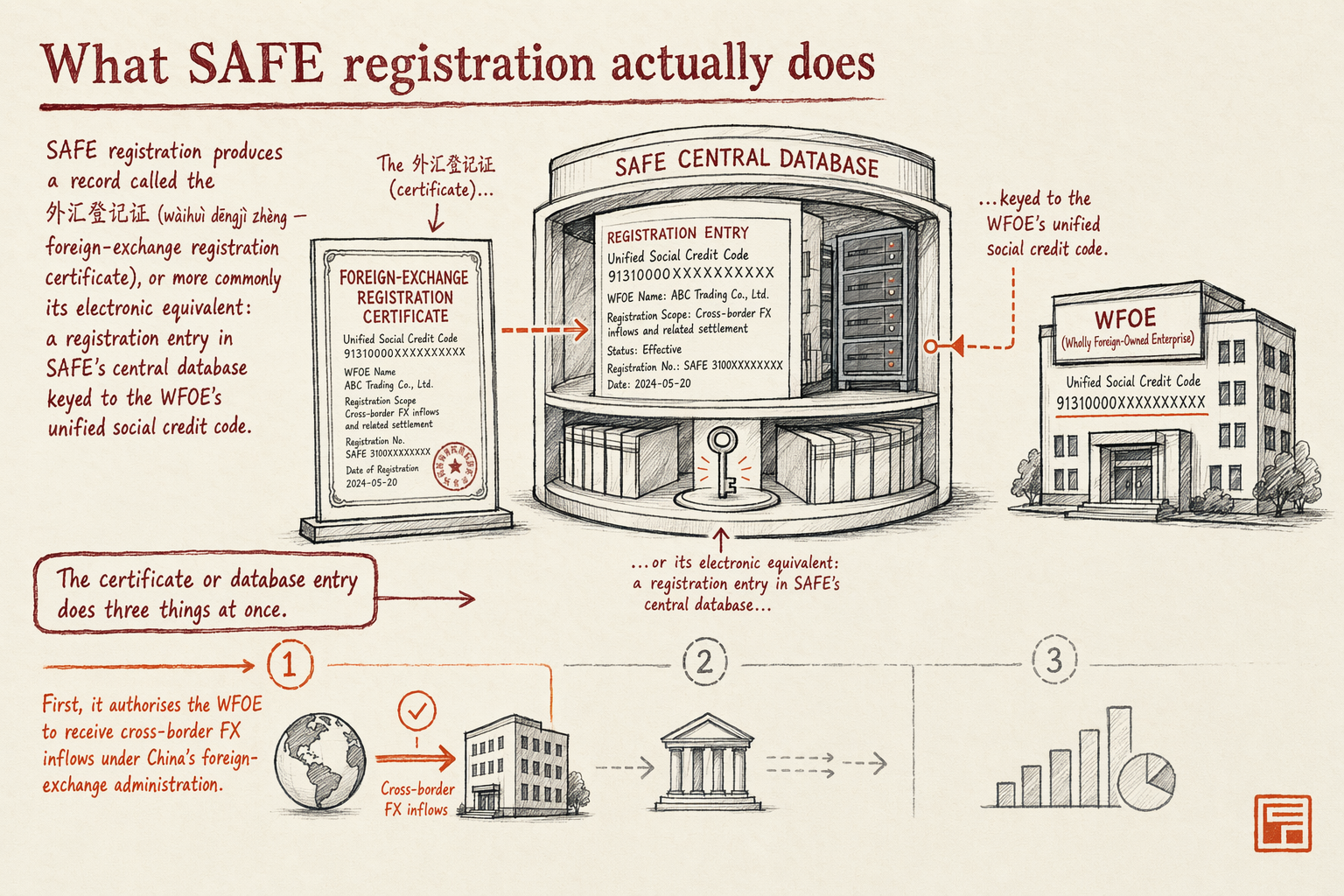
What SAFE registration actually does
SAFE registration produces a record called the 外汇登记证 (wàihuì dēngjì zhèng — foreign-exchange registration certificate), or more commonly its electronic equivalent: a registration entry in SAFE's central database keyed to the WFOE's unified social credit code. The certificate or database entry does three things at once.
First, it authorises the WFOE's basic and general banks to accept inbound FX wires from named foreign counterparties. A capital injection from the foreign parent shareholder, an intercompany loan from a sister entity, a licensing fee from an overseas customer — none of these arrive in the WFOE's capital account or general account until SAFE has the registration on file. The receiving bank checks SAFE's database in real time as part of inbound-wire reconciliation; if there is no matching registration, the funds are bounced or held in suspense.
Second, it sets the cap and category for each registered flow. Capital injections register against the WFOE's authorised registered capital; shareholder loans register against a separate debt cap calculated from registered capital plus retained earnings; royalty payments register against a contract reference. The bank will not allow flows in excess of the registered cap without an amendment, and the amendment requires its own SAFE filing.
Third, it provides the audit trail for the eventual outbound flow. Dividend repatriation, intercompany loan repayment, royalty remittance, and capital reduction all reference the original inbound registration. A WFOE that fails to register an inbound flow correctly often discovers the gap only years later when it tries to repatriate dividends and the SAFE outbound desk asks for the original registration that does not exist.
Capital-account vs current-account flows
SAFE separates flows into two regimes with different registration logic.
Capital-account flows. Cross-border movements of capital itself — equity injections from the foreign shareholder, intercompany loans (also called shareholder loans), capital reductions, dividend distributions to the foreign shareholder, equity-purchase or equity-sale flows in M&A. Capital-account flows have the heavier registration burden. Each new flow type requires its own SAFE filing; aggregate caps apply to each category; the supporting documentation set is larger.
Current-account flows. Cross-border movements of goods, services, royalties, fees, and interest. These flow against contracts and invoices, not against registered capital. The registration model is lighter — the WFOE registers as an entity once, then each transaction clears against a per-transaction documentation pack (invoice, contract, tax clearance certificate where applicable). Current-account flows above USD 50,000 equivalent per transaction trigger document review at the bank; below that threshold, banks process most flows under a self-declaration regime.
For a foreign-owned tech-sector WFOE in its first year, the typical SAFE-registration shape is: one capital-account registration for the registered-capital injection from the foreign parent, plus the WFOE's entity-level current-account registration that covers downstream service-export invoices and royalty payments. Add a shareholder-loan registration in year two or three if the WFOE needs working-capital top-ups beyond the original registered capital. Add a dividend registration when retained earnings are large enough to repatriate.
The DigiSAFE online portal walkthrough
SAFE migrated most foreign-investment filings to the online DigiSAFE portal in stages from 2019 through 2023. The portal is administered through the SAFE Bureau in the WFOE's registered city; the user-facing UI is in Chinese with partial English-language hint text. A typical foreign-investment capital-account registration on DigiSAFE runs:
- Pre-registration in the AIC business-license system. The WFOE has to be fully registered with SAMR, have a unified social credit code, and have its foreign-investment information filed in the central foreign-investment information report system. Without this upstream filing, the SAFE registration cannot index. The foreign-investment information report itself is a separate SAMR-side filing, free of charge, that takes 5-10 business days.
- Account creation on DigiSAFE. The 法人 (legal rep) or a delegated finance officer creates an account on the local SAFE bureau's DigiSAFE portal. Identity verification runs through the SAMR system using the WFOE's credit code.
- Foreign-investment registration form (外商投资企业基本信息登记). The first filing. Names the WFOE, the foreign shareholders, the percentage holdings, the registered capital and its currency denomination, the planned capital-injection schedule, and the business scope. Documents required: apostilled foreign-shareholder corporate certificate (or passport for individual foreign shareholders), apostilled foreign-shareholder board resolution authorising the investment, the WFOE's SAMR business license, the WFOE's articles of association.
- Bank designation. The WFOE designates the bank that will hold the capital account for this registered flow. The bank is notified through the SAFE system and updates its inbound-wire whitelist accordingly.
- Review and certificate issuance. SAFE bureau review runs 5-15 business days for clean submissions. The output is the registration entry in SAFE's central database; some bureaus still issue a paper 外汇登记证 alongside the database entry, which is useful as a physical artefact for the WFOE's compliance file.
Subsequent flows (shareholder loans, royalty registrations, dividend remittance authorisations) each add their own filing on top of the foundational entity-level registration. The portal logic is incremental — each filing references the prior layer, so the cumulative file becomes the WFOE's full FX history.
Common rejection causes
First-pass SAFE rejection rates for foreign-WFOE registrations run 25-35% in our brokered engagements. The causes cluster into a small set:
- Foreign-investment information report not filed at SAMR. The upstream prerequisite. SAFE refuses to register if the SAMR-side filing does not exist or is not yet processed. Single largest cause we see.
- Apostille on the wrong document, or by the wrong authority. The apostille has to be from the competent authority of the foreign shareholder's country of incorporation. A US Delaware shareholder needs a Delaware Secretary of State apostille, not a notary's seal from a different state.
- Foreign-shareholder corporate certificate older than six months. SAFE requires the foreign shareholder's good-standing certificate to be issued within six months of the registration filing. Older certificates need re-issuance.
- Currency denomination mismatch. The WFOE's registered capital is denominated in USD or another foreign currency at SAMR but the planned injection currency on the SAFE form does not match. The two have to align.
- Articles of association inconsistent with the SAMR business license. If the AOA mentions a business scope or shareholding ratio different from what the business license shows, SAFE bounces the filing for inconsistency.
- Bank designation conflict. The designated capital account is at a bank that does not have FX-desk authorisation at that branch. Some smaller branches are not authorised; the registration has to designate an authorised branch.
- Translation errors in supplementary documents. Required documents in a language other than Chinese have to be accompanied by certified Chinese translations. Self-translated documents get rejected on the certification line.
Realistic first-pass-clean turnaround on DigiSAFE: 1-3 weeks. Realistic resubmission turnaround for a rejection that triggers one round of document fixes: 4-6 weeks total. Plan for 6 weeks; celebrate if you get 2.
Dividend repatriation prerequisites
The most common reason brokered engagements come back to SAFE in year two or three is to register the outbound flow of dividends to the foreign shareholder. Dividend repatriation has its own checklist on top of the basic SAFE registration:
- The WFOE must have audited annual financials. Dividend repatriation flows against retained earnings as shown on the audited balance sheet. An unaudited WFOE cannot repatriate dividends.
- Mandatory reserve funds must be set aside. PRC Company Law requires 10% of after-tax profit to go to a statutory surplus reserve until that reserve reaches 50% of registered capital. Dividend repatriation can only come from after-reserve retained earnings.
- Withholding tax must be settled before remittance. Dividend payments to a foreign shareholder carry a 10% withholding tax (reducible to 5% under most tax treaties if the foreign shareholder is the beneficial owner and substance tests pass). The WFOE pays the withholding to the tax bureau, obtains a tax clearance certificate, and presents the certificate to the bank for the outbound wire.
- SAFE outbound-flow registration must be on file. A SAFE filing specific to the dividend remittance, referencing the original capital-account registration, the audited financials, the board resolution authorising the distribution, and the tax clearance certificate.
- Bank-side document review. The remitting bank reviews the full document pack and confirms with SAFE's database before releasing the outbound wire. Median bank-side review time: 5-10 business days.
Total elapsed time from board decision to repatriated USD in the foreign shareholder's account, document-clean: 6-10 weeks. Plan it for a calendar moment that does not conflict with mainland public holidays or the year-end book-close.
For the parent topic linking up to all RMB-banking articles see RMB Bank Account That Clears. For the parent service see Ongoing Compliance. For rejection-cause patterns that overlap between SAFE and bank-side reviews see why your RMB account got rejected.
In plain English
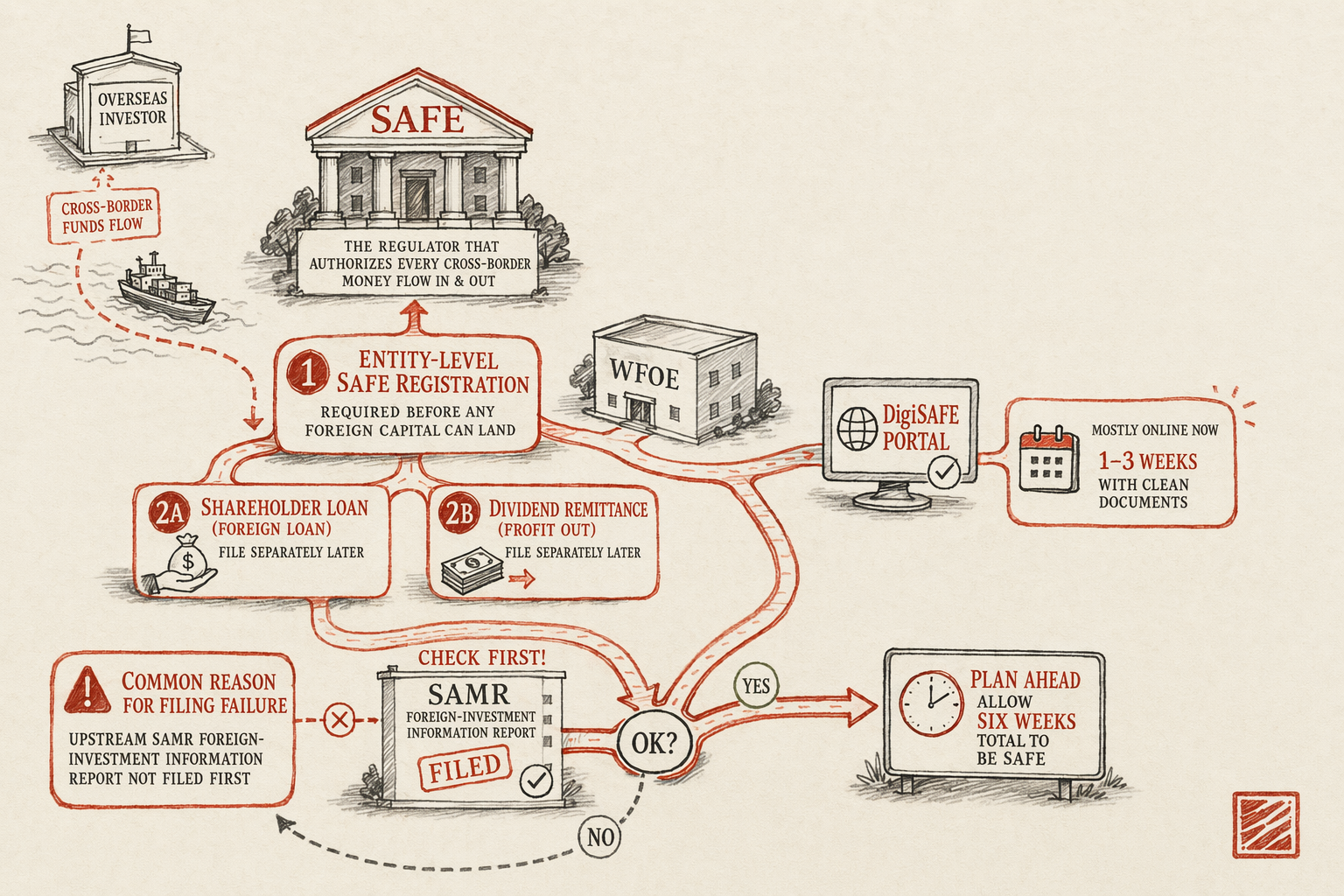
If you only read one paragraph: SAFE is the regulator that authorises every cross-border money flow into and out of your WFOE. You need an entity-level SAFE registration before any foreign capital can land, plus separate filings for shareholder loans and dividend remittance later. The registration mostly happens online now through the DigiSAFE portal and takes one to three weeks when documents are clean. The most common reason filings fail is that an upstream SAMR foreign-investment information report has not been filed first, so always check that prerequisite before submitting to SAFE. Plan six weeks total to be safe.
Related
7 min read
Opening an RMB Business Account That Actually Clears
Basic vs general account, legal-rep in-person rules, KYC red flags, cross-border FX (SAFE) registration, ICBC vs BoC vs CMB.
6 min read
How to Choose an ICP Sponsor for Your Domain
Picking an ICP sponsor — entity-tied filings, sponsor fee ranges, support quality, what happens when a sponsor disappears.