The most common bad advice foreign founders get about WeChat is that you need a WFOE (Wholly Foreign-Owned Enterprise) to register an Official Account. You don't. Tencent has supported overseas-entity verification since 2013 and the path is documented in their own help centre, in Chinese, in a place nobody English-language ever looks. The reason agency sites quietly skip this path is that it pays them less — selling you a WFOE is a much bigger ticket.
The overseas path is legitimate, it works, and most foreign brands should start there. You can later migrate to a mainland-entity account if and when you incorporate. This article walks the exact path: which entities qualify, which documents the verification reviewer asks for, what features you give up versus a mainland-entity OA, and what the realistic reject rate looks like on first submission.
The overseas-entity path Tencent officially supports
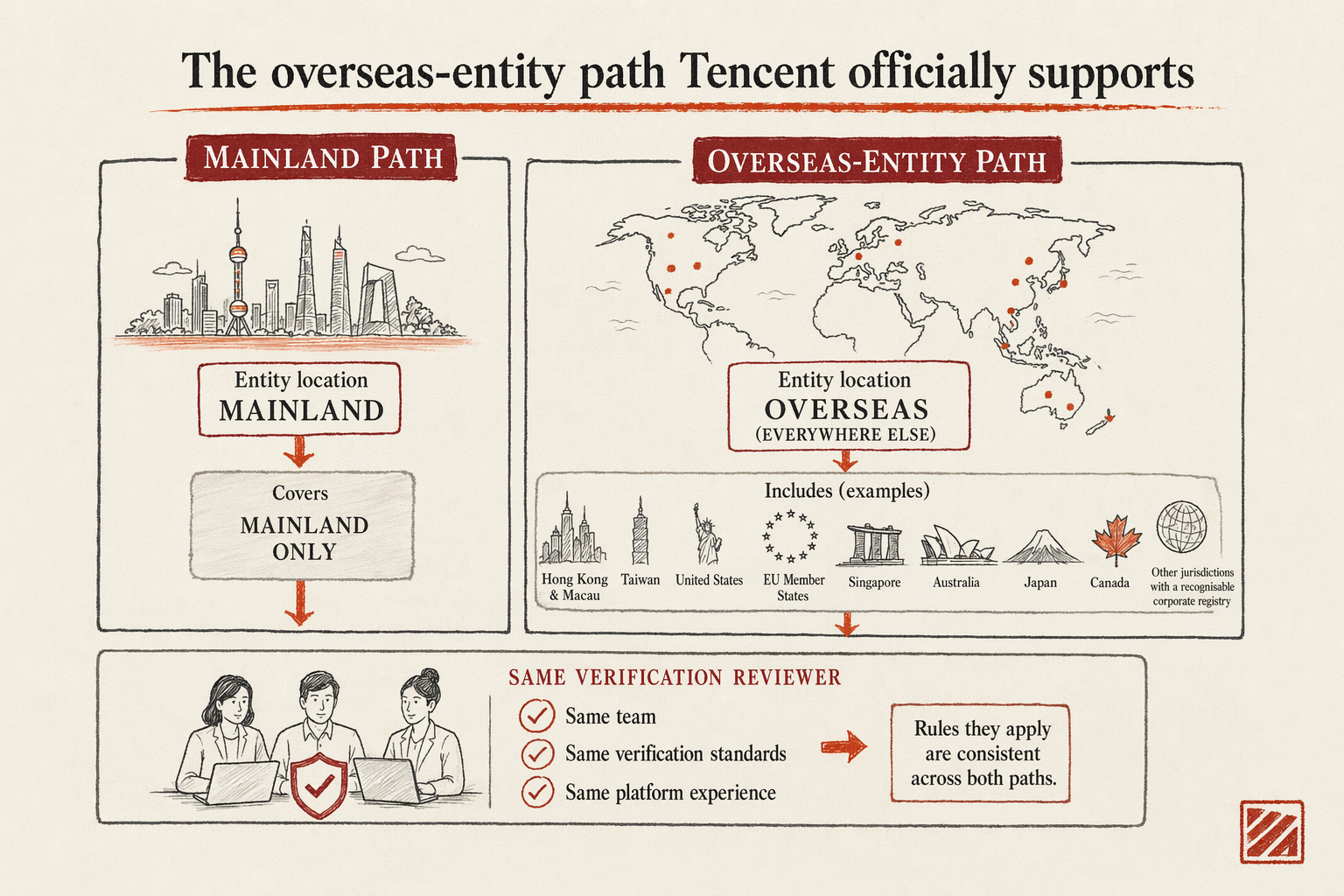
Tencent groups verifying entities into mainland (大陆) and overseas (海外). Overseas covers everywhere else — Hong Kong, Macau, Taiwan, the US, EU member states, Singapore, Australia, Japan, Canada, and the long tail of jurisdictions that have a recognisable corporate registry. The verification reviewer is the same team in both cases; the rules they apply differ.
The qualifying entity types, in roughly descending order of how often we see them on engagements:
- Hong Kong limited company. The most common overseas vehicle for foreign brands targeting China, partly because the documents are easy to apostille and partly because the legal-rep can be the same person who runs the parent. Roughly 45% of the overseas-track OAs we have helped set up since 2023 are HK Ltd.
- US Inc or LLC, Delaware or otherwise. Works fine, slightly more apostille friction because the issuing state authority varies. Roughly 25% of overseas-track OAs.
- EU corporation (Ltd, GmbH, SAS, BV). Works, with Apostille Convention rules making the document chain clean. Roughly 15%.
- Singapore Pte Ltd. Works well, particularly for brands routing into China via ASEAN. Roughly 10%.
- Other (UK, Australia, Canada, Japan, etc). Roughly 5%, all individually fine if the apostille chain resolves.
The single firm rule: the entity verifying the OA has to be the entity whose name will appear on the public-facing OA verified-company display. If your trademark sits on a parent and the operator is a subsidiary, you supply both documents plus a written authorisation chain. We get into the documents in the next section.
Document checklist (apostille, board resolution, brand authorization)
The document set is consistent across jurisdictions, even if the local names differ. Tencent's verification partner reviews each one and rejects on any one of them being incomplete, expired, or mis-translated.
- Apostilled certificate of incorporation. Issued by the corporate registry in your jurisdiction (Companies House for UK, the Secretary of State's office for Delaware, the Companies Registry for Hong Kong, etc). Apostille has to be from the competent authority of the same jurisdiction — you cannot apostille a Delaware document in California. The apostille has to be dated within the last six months at the moment of submission.
- Board resolution authorising the WeChat OA. A signed minute from the company's directors (or sole director) authorising the application, naming the OA's intended display name and operator. Has to be either apostilled or notarised; Tencent accepts both. The resolution names the legal representative who will appear on the OA and the authorised contact for the verification process.
- Passport of the legal representative. A clean colour scan of the personal-information page, validity at least 12 months out, name matching the board resolution exactly. Most rejections in this category are for blurry scans, not document substance.
- Brand authorisation letter (when the trademark owner differs from the operator). A written authorisation from the trademark holder to the operator, naming the OA, the trademark, the territory (China is enough), and the duration (one year minimum, three years standard). Has to be on letterhead of the trademark holder, signed by an authorised officer, dated within the last six months.
- Company seal / corporate stamp scan. Where the entity has a corporate seal (mandatory for HK, common in Asia, optional in the US and most of EU), include the seal impression on the board resolution. Where there is no seal, an apostilled signature certification of the director's signature substitutes.
- WeChat OA application form. Tencent's own form, in Chinese, filled in by your partner firm or by you if you read Chinese. The form names the OA display name, the operator entity, the legal rep, the bank account for the RMB 600 verification fee, and the operator's contact information.
Translation: all non-Chinese documents need a certified Chinese translation. The verification reviewer compares the source document and the translation side-by-side. Use a translator who has done a verification submission before — generic certified translators get fields wrong ("director" vs "executive officer," "resolution" vs "minute," "apostille" vs "notarisation") and the reviewer rejects on the discrepancy.
The RMB 600 annual verification fee is paid by wire to Tencent's verification partner from the operator's bank account (or, in practice, from any bank account if you supply a fapiao-equivalent receipt). The fee is identical to the mainland-entity track. It recurs annually — skip a year and the OA loses verified status, your menu disappears, and you re-verify from scratch.
Features you give up vs a mainland-entity OA
The honest list of overseas-track restrictions, in 2026:
- Domestic WeChat Pay merchant onboarding. Gated to mainland-entity OAs only. Cross-border WeChat Pay is available and is what most foreign brands actually want on first deployment. See the WeChat Pay merchant onboarding guide for the cross-border vs domestic breakdown.
- WeChat Mini-Program publishing. Mini-programs (the in-app sub-apps that power most WeChat e-commerce) can be published from overseas-entity OAs, but with category restrictions: financial-services, regulated-medical, gambling, education with credentialling, and a few others require a mainland entity. Standard e-commerce, content, tools, and games are open.
- Some location-targeting features. Tencent restricts a handful of geo-targeting features on the broadcast and ad-platform side to mainland entities. The practical impact on most foreign brands is small.
- WeChat Channels (视频号) creator monetisation. If you want to monetise short-video content directly inside Channels via the platform's own creator-revenue programme, you need a mainland entity. Content publishing and audience-building works fine on the overseas track.
Everything else — the four-per-month or daily broadcast, custom menus, template messages, OAuth user-profile read, customer-service messaging, broadcast segmentation — is identical between the two tracks. The Service Account vs Subscription Account choice is independent of the overseas vs mainland choice; you make both at the same time.
Migration path if you later get a WFOE
The migration from overseas-entity OA to mainland-entity OA is supported and well-trodden. The mechanism is Tencent's 账号迁移 (account migration) procedure — the same form used to migrate between mainland entities, just with overseas-source documentation. We cover the full process in the migrating a WeChat OA between operating entities guide; the overseas-to-mainland slice has three quirks worth flagging here.
First, follower transfer is intact in 95-99% of cases. Tencent moves the OpenID-to-account mapping over, so users see the same OA in their followed list, with the same content history and the same custom URL. The 1-5% loss is users whose accounts were inactive long enough that Tencent had cleared them; this is not migration-specific.
Second, the WeChat ID (the @-handle) can be kept. You file a name-change application alongside the entity migration if the brand naming differs across the move (the mainland Chinese-character name is often different from the overseas English-language name). The same display name on both sides is the default.
Third, you have to terminate the overseas verification before activating the mainland one. There is roughly a 5-15 business day window during which the OA shows as "verification in transition" — the OA stays live, broadcasts still send, but you cannot accept new payments or change menu structure. Plan the migration for a quiet operational period.
What you gain in the migration: domestic WeChat Pay access, the small set of category-gated mini-program types, and the location-targeting features mentioned above. You also gain access to Tencent's credit assessment for advertisers, which improves your ad-account standing. None of this is dramatic; the migration is best framed as a year-two or year-three upgrade, not an urgent step.
Realistic success and reject rates
Across the overseas-track engagements we have brokered or observed since 2023, first-submission reject rates run 12-25%, with a long tail of categories:
- Apostille / notarisation issue (~40% of all rejects). Wrong issuing authority, expired apostille, missing apostille on a document that needed one, mismatched stamp impressions. Resubmission rate after correction: 90%+.
- Translation quality (~25% of all rejects). Wrong terminology, missing translation of a stamp or seal, mismatched date format, mis-translated officer titles.
- Brand authorisation chain (~15%). Trademark holder differs from operator and the authorisation letter is missing, unsigned, or dated too far back.
- Passport / legal-rep mismatch (~10%). Passport expires inside 12 months, name on passport doesn't match the board resolution exactly, blurry scan.
- Application form errors (~10%). Wrong operator-entity name, mismatched bank-account details, ambiguous OA display name.
None of these are insurmountable. All of them are catchable in a pre-clearance pass. After one resubmission cycle, the cumulative approval rate runs 85-95%; after two cycles, it is close to 99%. The reject rate is not a sign that the overseas path is harder than the mainland one — it is a sign that the documentary discipline required for cross-border filings is higher than for domestic ones, and that most agencies do not run a pre-clearance pass.
For the underlying verification track, including what RMB 600 buys you and what the full timeline looks like, see the WeChat OA verification playbook.
In plain English
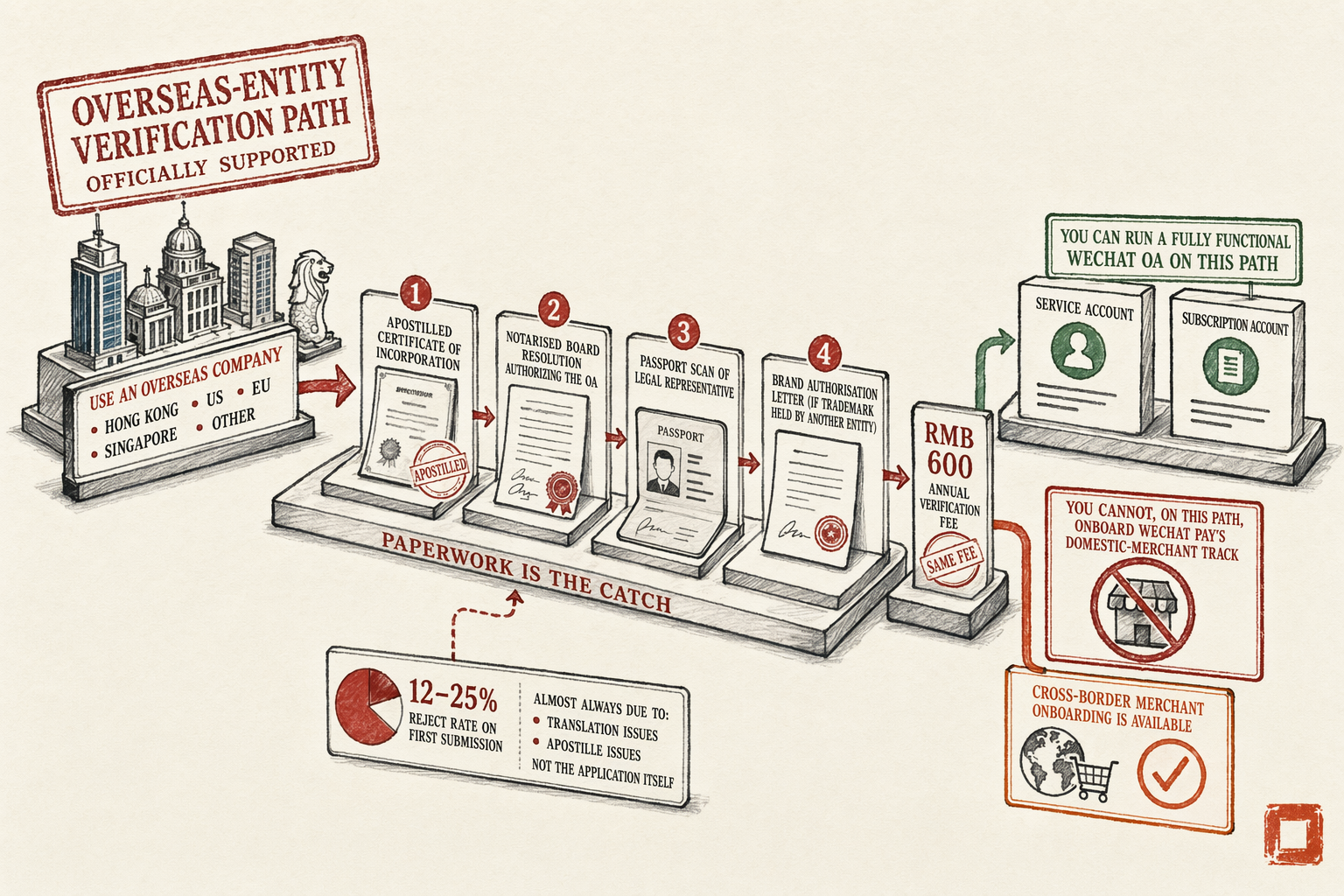
If you only read one paragraph: You can verify a WeChat Official Account using a Hong Kong, US, EU, Singapore, or other overseas company — Tencent calls this the overseas-entity verification path and it is officially supported. The catch is paperwork: an apostilled certificate of incorporation, a notarised board resolution authorising the OA, a passport scan of the legal representative, and a brand authorisation letter if the trademark sits with a different entity. The RMB 600 annual verification fee is the same. Reject rate on first submission runs 12-25% — almost always for translation or apostille issues, not the application itself. You can run a fully functional Service or Subscription account on this path; you cannot, on the same path, onboard WeChat Pay's domestic-merchant track. Cross-border merchant onboarding is available.
Related
7 min read
WeChat OA Verification Playbook for Overseas Brands
服务号 vs 订阅号, the overseas-entity verification path, RMB 600 annual fee, payment-API access, menu architecture.
6 min read
How to Choose an ICP Sponsor for Your Domain
Picking an ICP sponsor — entity-tied filings, sponsor fee ranges, support quality, what happens when a sponsor disappears.