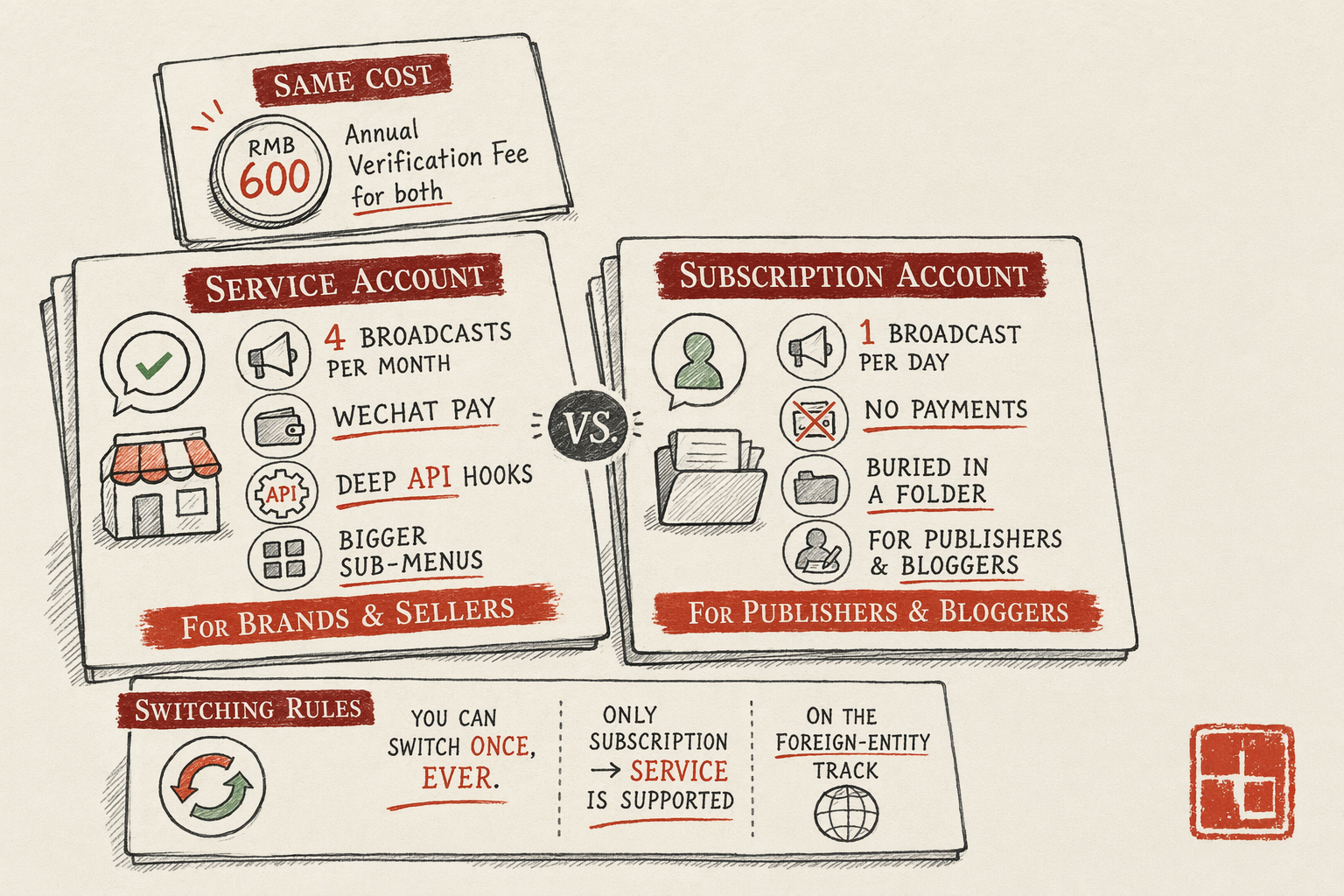
Every foreign founder who tries to set up a WeChat Official Account hits the same fork in the road at the registration screen. Tencent asks: Service Account (服务号) or Subscription Account (订阅号)? Most pick wrong because the labels are misleading. "Subscription" sounds like the SaaS thing you want; "Service" sounds like B2B support. Both readings are wrong. The names refer to how Tencent surfaces your account inside the WeChat app, not what business you run.
This piece walks the five differences that decide which one you want, the limits each side hits first, and what you can and cannot change later. If you take one thing away: brands that sell, even adjacent to selling, pick Service. Publishers that earn from ad reads, sponsored posts, or subscription dues pick Subscription. Everyone else picks Service by default, because Service is strictly more capable on every axis that matters except daily-broadcast volume.
The five differences that actually matter
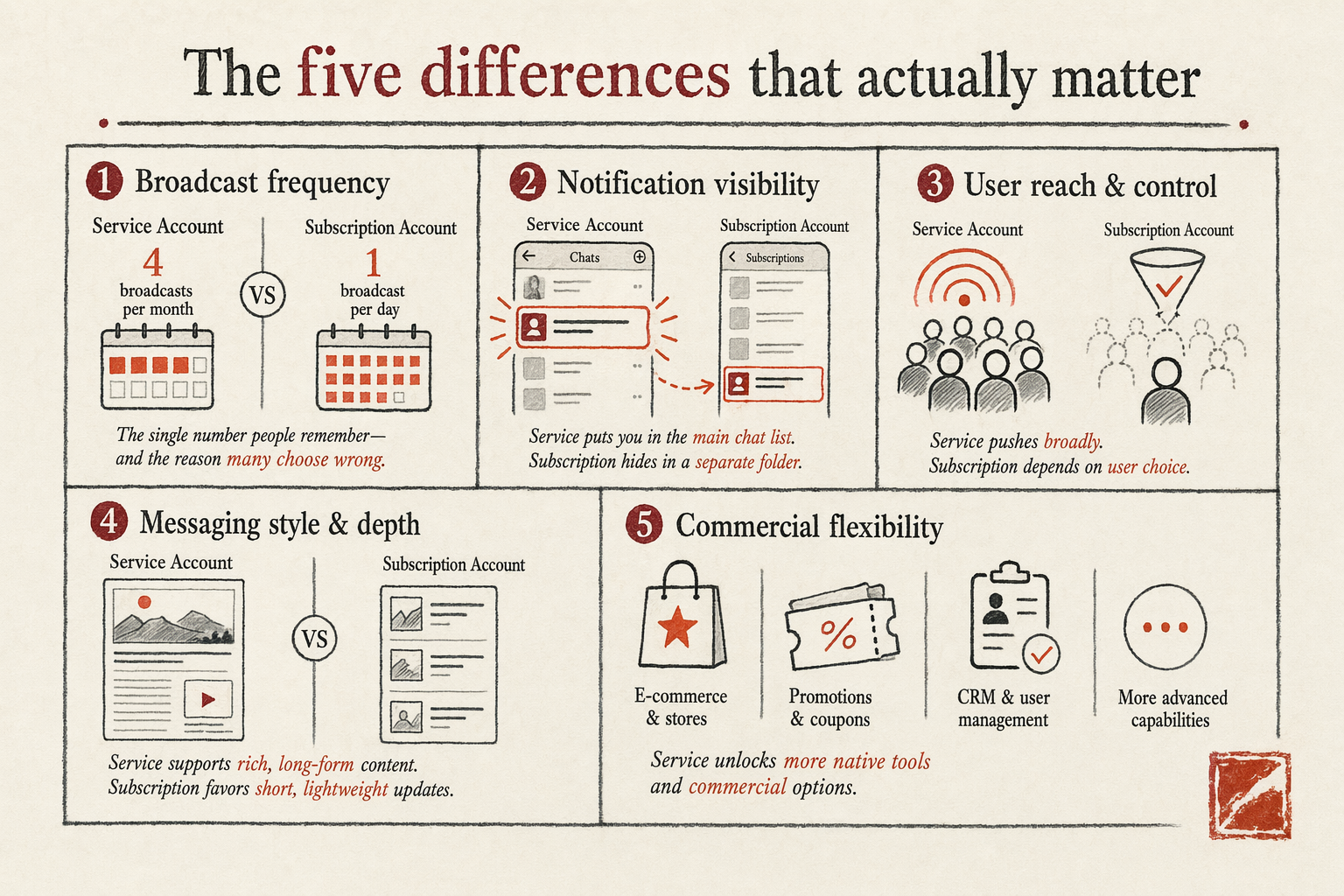
Tencent's own comparison page lists seventeen feature differences. Most are minor. The five that decide the choice for a foreign brand:
- Broadcast frequency. Service: 4 broadcasts per month. Subscription: 1 broadcast per day. This is the single number people remember, and it pushes a lot of brands toward Subscription for the wrong reason.
- Notification surface. Service broadcasts land in the user's main chat list with a red badge and a push notification, sitting alongside personal chats. Subscription broadcasts land inside a stacked Subscriptions folder one level deep, no badge, no push. Service messages are seen. Subscription messages are scrolled past.
- WeChat Pay access. Service accounts can apply for WeChat Pay merchant onboarding and accept payments in-feed, in HTML5 mini-stores, and via custom URLs. Subscription accounts cannot — full stop. If you ever want to take money inside WeChat, you need Service.
- API access. Service opens the full API surface: custom menus with deep links into HTML5 pages, OAuth user-profile read, template messages, mass-send with segmentation, and CRM tagging. Subscription gets a thin slice — basic menus, broadcast send, very little else.
- Customer service messaging. Both account types let users message you and get a reply within a 48-hour customer-service window. But only Service can integrate that into a CRM, route by tag, or send templated responses through the messaging API.
Annual verification fee — RMB 600 per year, paid to Tencent's verification partner — is identical on both. The fee is the part the sales-gloss agency sites bury, because it sounds like a setup cost when it is actually a yearly recurring cost. Skip the fee and your account loses verified status, your menu disappears, your payment integration breaks. We've seen brands try to skip year-two and lose three months of audience while they re-verify.
Posting limits and notification surface
The four-per-month limit on Service accounts sounds brutal, and on paper it is. A daily-posting magazine on Subscription would publish 28 issues a month; you get four. But the practical impact reverses itself once you look at where the messages land.
A Service broadcast generates a red-dot notification on the user's chat list. The user sees it the next time they open their phone. Open rates on Service broadcasts run 18-35% for engaged audiences and 6-12% for cold lists. A Subscription broadcast lands in the Subscriptions folder, which the average user opens roughly once every 2-4 days. Open rates on Subscription broadcasts run 1-4% across the board. The math is straightforward: four high-impact broadcasts beats thirty low-impact ones for almost every commercial use case.
The exception is content brands whose business model is impression-based — magazines, niche-media outlets, KOL-led editorial. They need the daily-broadcast slot for advertiser obligations and content-rhythm reasons. Their audience opts into the Subscriptions folder because they want to consume content, not buy product. Subscription works for them. Everyone else is pretending.
There is a secondary lever almost nobody uses: Service accounts can also send template messages, which are not broadcasts but transactional notifications (order confirmations, appointment reminders, status updates). Template messages bypass the four-per-month limit entirely. They have to map to a Tencent-approved template (one per industry, refreshed quarterly), and you can only send them to users who have interacted with the account in a relevant trigger event. But for a commerce brand, the operational throughput of template messages dwarfs the broadcast cap.
Payment API access and merchant onboarding
If anyone on your team has ever said "we want to sell on WeChat," you need a Service account. WeChat Pay merchant onboarding is gated to Service accounts only. Subscription accounts cannot apply, cannot integrate, cannot accept a single yuan.
The merchant onboarding itself is a separate process from the OA verification — it sits at the WeChat Pay merchant platform and is administered by Tenpay Payment Technology Co Ltd, the Tencent payment subsidiary licensed by the People's Bank of China. You apply after your Service account is verified, supply your business license or apostilled overseas equivalent, link a settlement bank account, and pass a separate documentation review that takes another 5-15 business days. The transaction fee is 1.0-1.5% for the cross-border merchant track and 0.6-1.0% for the mainland-entity merchant track.
For the merchant-track decision, see the WeChat Pay merchant onboarding guide. The short version: cross-border WeChat Pay settles in USD or EUR to an overseas bank account, no WFOE (Wholly Foreign-Owned Enterprise) required, and is the right answer for most foreign brands soft-launching in China. Domestic WeChat Pay settles in RMB to a mainland bank account, requires a WFOE or other mainland entity, and is the right answer once you are doing enough volume that the fee difference matters.
The API access difference matters even if you never take a payment. Service accounts can build deep-linked menus that drop a user directly onto a specific HTML5 product page with their WeChat OpenID already attached — meaning you can recognise returning users, retarget them with template messages, and tag them in your CRM. Subscription accounts cannot. For any kind of operational follow-up (lead qualification, support routing, abandoned-cart recovery), Subscription is a dead end.
Use cases that favor each type
Use-case mapping, said plainly:
- DTC e-commerce brand selling cross-border to China. Service. The Pay merchant access alone justifies it. Daily content lives on Xiaohongshu and Douyin; WeChat OA is for order updates, customer service, and four high-signal broadcasts a month.
- SaaS company running a Chinese sales motion. Service. Custom menus for free-trial, demo-booking, and support routing matter more than broadcast volume. Templated transactional messages for trial-expiry and onboarding sequences are the killer feature.
- B2B exporter with a sales team. Service. Lead capture, CRM tagging, and template messages for inquiry follow-up are core. Broadcast volume is near zero anyway.
- Industrial brand running technical content marketing. Service. The four broadcasts a month happen to match the natural cadence of high-quality long-form B2B content. You do not need a daily slot to flood the timeline.
- Magazine, niche-media publisher, KOL. Subscription. The daily slot is the product. Payments are downstream (sponsorship, premium-subscriber gates can sit on a third-party platform).
- Embassy, NGO, government-adjacent communications office. Subscription. Volume matters; commerce is forbidden.
The 90/10 rule for foreign brands is: 90% should pick Service, 10% are publishers who should pick Subscription. If you are reading this and have not used the word "magazine" or "media outlet" to describe your business in the last six months, you are in the 90%.
Can you migrate between them?
The migration path is asymmetric and one-shot. Tencent supports a single account-type upgrade: Subscription → Service. There is no documented path from Service → Subscription. There is no path back if you regret the upgrade.
The Subscription → Service upgrade requires the account to be already verified, with no pending policy violations, and is gated to one upgrade per account per lifetime. The upgrade triggers a fresh verification pass — Tencent re-validates your documents, re-charges the RMB 600 verification fee on your next anniversary, and migrates your follower base across without loss. You keep your WeChat ID (the @-handle), your custom URL, and your historical broadcast archive. The follower count rolls over intact.
What you lose: the daily-broadcast slot drops to four per month immediately. Any existing template messages need to be re-approved under the Service-account template schema. Any custom menu items that pointed at Subscription-only features (the in-folder Subscriptions surface) are silently dropped. Budget two to three weeks for the verification pass and another two weeks to rebuild the menu and template message structure.
The far more common pattern, in our brokerage experience, is that founders pick Subscription on day one because the daily-broadcast number sounds better, then realise six months in that they cannot integrate WeChat Pay, cannot run a CRM tag, and cannot retarget existing followers. They upgrade to Service. The upgrade works but they pay for six months of missed commerce. If there is any chance you will want to sell, integrate, or tag — pick Service on day one. The four-per-month broadcast limit is rarely the bottleneck people fear it is.
For the underlying verification track that governs both account types, see the WeChat OA verification playbook. For broadcast-frequency, menu-architecture, and template-message specifics, see the WeChat OA menu and template-message limits guide.
In plain English
If you only read one paragraph: WeChat Official Accounts come in two flavours. A Service Account (服务号) can push only four broadcasts per month but gives you WeChat Pay, deep API (Application Programming Interface) hooks, and bigger sub-menus — the right pick if you sell anything. A Subscription Account (订阅号) can push once per day but lives buried in a folder, has no payments, and is mostly used by publishers and bloggers. Tencent charges the same RMB 600 annual verification fee on both. If you are a brand, pick Service. If you are a magazine, pick Subscription. You can switch once, ever, and only Subscription → Service is supported on the foreign-entity track.