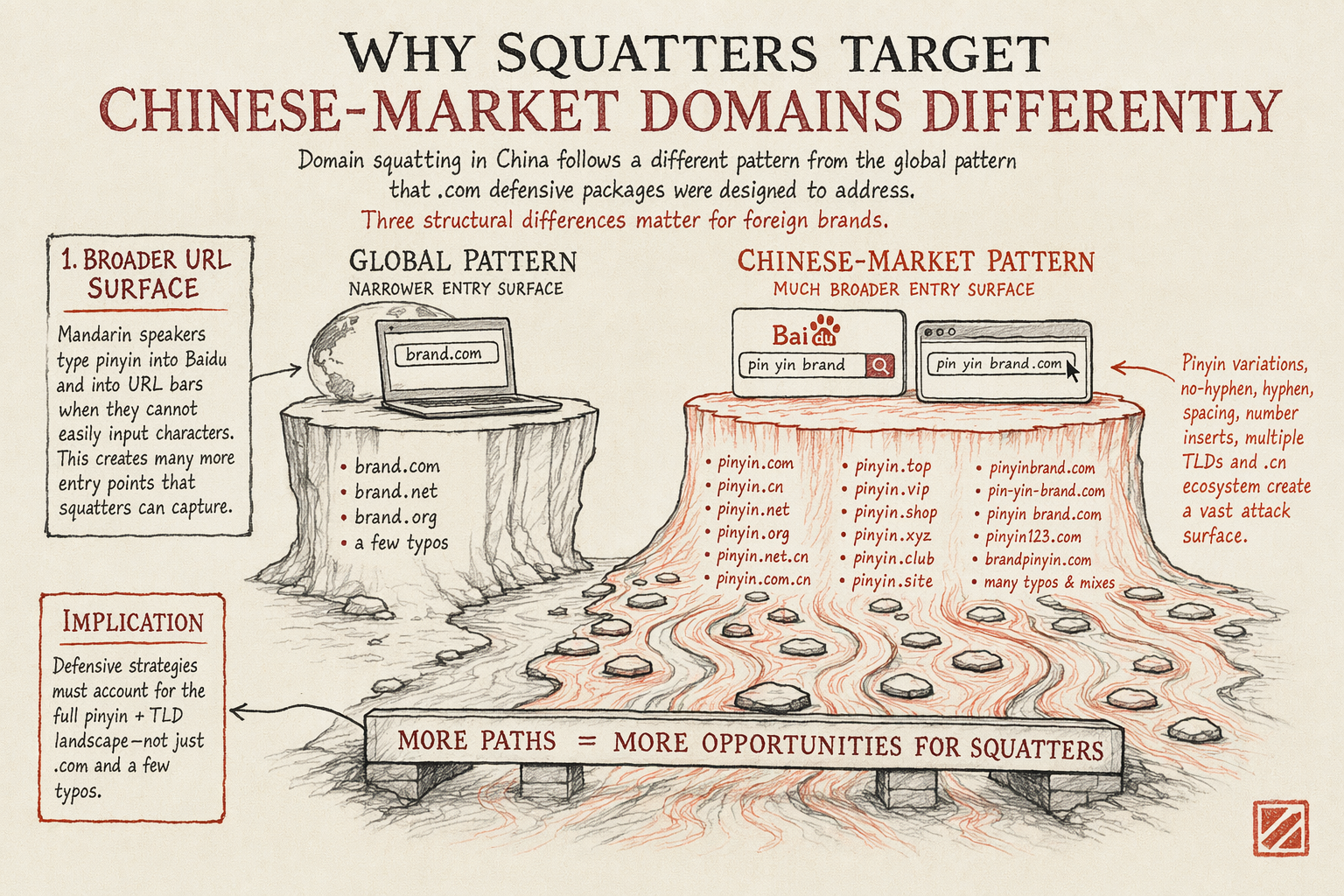
Why squatters target Chinese-market domains differently
Domain squatting in China follows a different pattern from the global pattern that .com defensive packages were designed to address. Three structural differences matter for foreign brands.
First, the URL surface that Chinese consumers actually type is broader. Mandarin speakers type pinyin into Baidu and into URL bars when they cannot easily input Chinese characters; consumers in mixed bilingual contexts type either Chinese or pinyin or English; brand-search behavior splits across multiple romanizations of the same Chinese-character name. A global brand with one canonical English form has, in China, a primary Chinese-character form, a primary pinyin form, and one or two alternate pinyin forms — four to five URL surfaces, not one.
Second, the Great Firewall and the speed advantage of mainland hosting reward squatters who park alternate URLs on fast mainland infrastructure. A squat site that loads in 800ms outranks (in user experience and in Baidu signals) a legitimate site that loads in 4 seconds from an overseas host. This raises the operating value of any squatted domain, which raises the squatter's willingness to defend it.
Third, the cost asymmetry favors squatters. A squatter can register and hold a .cn domain for $4-$8/year wholesale, while the legitimate brand owner faces transfer-out costs and dispute costs running $1,500-$10,000 if recovery is needed. The economic logic of preemptive defensive registration is therefore much stronger in China than in Western markets where the squatter's holding cost is similar but the brand's recovery cost is lower.
The pinyin variant problem
If your brand has a Chinese-character name, it has at least one pinyin equivalent. 宝马 (BMW's Chinese name) renders as baoma in standard pinyin. 可口可乐 (Coca-Cola's Chinese name) renders as kekoukele. 麦当劳 (McDonald's Chinese name) renders as maidanglao. Squatters register the pinyin form across .cn, .com.cn, and sometimes .com if available, especially when the matching Chinese-character mark is held by the real brand at CNNIC.
The pinyin variant problem is layered. There is often more than one acceptable romanization of a given Chinese name:
- Standard pinyin without tone marks: the most common URL form. Tones are stripped for technical reasons.
- Pinyin with hyphens: bao-ma instead of baoma. Some brands use the hyphenated form in their Chinese marketing.
- Wade-Giles romanization: an older system still used in some Hong Kong and Taiwan contexts. Tsing Tao beer is the Wade-Giles form of Qingdao.
- Hong Kong / Cantonese romanization: for brands with strong HK or southern-China positioning, the Cantonese romanization is sometimes more recognizable than Mandarin pinyin.
The defensive question is which forms to register. For most brands, standard Mandarin pinyin in .cn and .com.cn is the priority. Wade-Giles is rarely worth defensive registration unless the brand has historical use of that form. Cantonese romanization is worth registering only for brands with active HK or southern-China marketing.
A worked example: an EU skincare brand with the Chinese-character mark 艾娜 (pinyin aina) entering mainland China should consider aina.cn, aina.com.cn, and possibly 艾娜.中国 as the defensive package alongside the brand's English-language .cn and .com.cn. Five Latin-script and one IDN registrations cover the pinyin and Chinese-character risk at roughly $80-$150/year.
Character variants and homoglyphs
Beyond pinyin, two other risks need defensive consideration.
Character variants. Some brands have settled on one canonical Chinese-character rendering but multiple plausible alternatives exist. A foreign brand whose CNIPA-registered mark is 艾娜 may face squatter activity on 爱娜 or 欸娜 — different first characters with similar pronunciation. The defensive question is whether to register the alternative character forms as Chinese-character IDN domains. For most brands, registering one alternative is enough; the marginal value drops sharply after that.
Homoglyph attacks. Homoglyphs are characters that look visually identical but are technically different. The Latin letter "o" and the Cyrillic letter "о" render identically in most fonts but are different Unicode code points; brand.com with a Cyrillic "a" is not the same URL as brand.com with a Latin "a". Homoglyph squatting affects mostly internationalized domains and brands targeted by phishing operations. For typical foreign brands the defensive package is to register your canonical Latin-script domain across the major TLD families (.com / .cn / .com.cn / .中国) and skip aggressive homoglyph defense unless you have observed specific homoglyph attacks against the brand.
The practical rule on character variants and homoglyphs: include one alternative character form if your brand consultant identifies a high-probability alternate Chinese rendering; otherwise, the primary IDN registration in the canonical form is enough. The 10-character-variant defensive package some registrars market is rarely justified.
Typo squats and the .cn / .com.cn pair
Typo squatting is the registration of domains that match common typing mistakes against a legitimate brand. The categories of typo squat:
- Transposed letters: brand.com → brnad.com.
- Doubled letters: brand.com → brannd.com.
- Missing letter: brand.com → brad.com.
- Adjacent-key substitution: brand.com → brsnd.com (s is next to a on QWERTY).
- TLD typo: brand.com → brand.cm (the Cameroon ccTLD, commonly used in typo squats).
- Homophone typos: Chinese typos use pinyin homophones rather than QWERTY adjacencies. A common typo on baoma is baomo (different vowel) or baoma with the pinyin entered through an IME that auto-selects a similar-sounding character.
Most foreign brands register the primary domain plus 2-3 highest-risk typo variants. The selection method: list the typo patterns above against your specific brand name, rank by likelihood (transposed and doubled letters are usually highest), and register the top 2-3. A common simplification is to register the .cn and .com.cn versions of the brand's existing .com typo-squat defense if that defense already exists.
The pair-registration logic — .cn and .com.cn together — is universal. Squatters who cannot get the .cn registration of a typo variant frequently take the .com.cn instead. Registering one without the other leaves an obvious squat target.
An aggressive typo-squat defense including 8-15 typo variants is rarely justified except for brands with very large Chinese consumer exposure and a documented history of phishing or typo-driven confusion. The cost of 15 variants across the .cn family runs $250-$600/year; the defensive value of variants 4 through 15 is usually marginal.
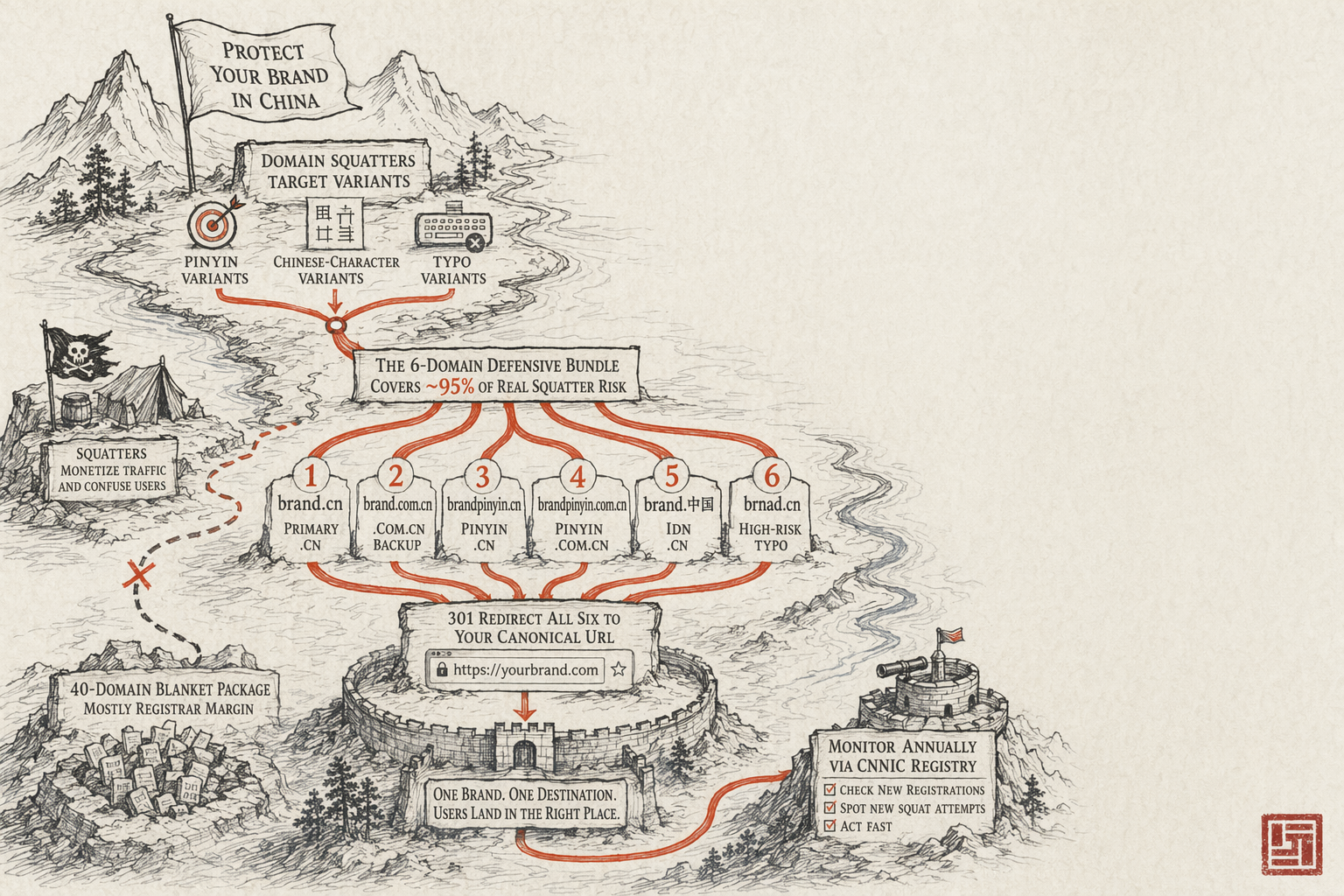
A 6-domain defensive bundle vs 40
The reasonable defensive bundle for most foreign brands consists of 4-8 domains, structured around the following slots:
- Primary brand .cn — your main brand name as registered at CNIPA.
- Primary brand .com.cn — the matching second-level.
- Pinyin .cn — the standard Mandarin pinyin transliteration of your Chinese-character mark, if you have one.
- Pinyin .com.cn — the same in the second-level.
- Chinese-character .中国 — your CNIPA-registered Chinese-character mark as an IDN.
- One highest-risk typo variant on .cn or .com.cn, chosen by typing-error frequency against your specific brand name.
The total annual cost runs $90-$200 through major registrars. Renewals are usually billed in 1-year, 2-year, or 5-year terms; locking in 5-year renewals where the registrar allows reduces both the per-year cost and the risk of accidental lapse.
The 40-domain blanket package some registrars market typically includes:
- The 6-domain core above.
- 10-15 additional Chinese-character TLDs (.公司, .网络, .手机, .招聘, .商城, etc.).
- 8-12 additional typo variants.
- 5-8 city-level .cn extensions (.sh.cn, .bj.cn, .gd.cn, etc.).
The marginal defensive value of the additional 34 domains is usually small. Most of the additional Chinese-character TLDs have low consumer recognition; most of the additional typo variants represent uncommon error patterns; the city-level .cn extensions are rarely used commercially. The 40-domain package runs $400-$800/year — roughly 4-5x the cost of the 6-domain core for an incremental defense that closes maybe 5-10% additional real squatter risk.
The optimal default is the 6-domain core, all registered through one registrar, all pointed at your canonical brand URL via 301 redirect, all renewed in 5-year terms, and all monitored annually against the CNNIC registry for new squatter activity that might warrant adding a 7th or 8th defensive slot. If a squatter attempts a registration on a variant outside your defensive package, you have the recovery routes covered in how to recover a hijacked .cn domain and domain dispute resolution under CNNIC policy.
Related
7 min read
Registering a .cn Domain as a Foreign Entity
.cn vs .com.cn vs 中国, CNNIC real-name verification, foreign-entity documents, registrar choice, and defensive registration.
6 min read
How to Choose an ICP Sponsor for Your Domain
Picking an ICP sponsor — entity-tied filings, sponsor fee ranges, support quality, what happens when a sponsor disappears.