How CNNIC dispute resolution differs from ICANN UDRP
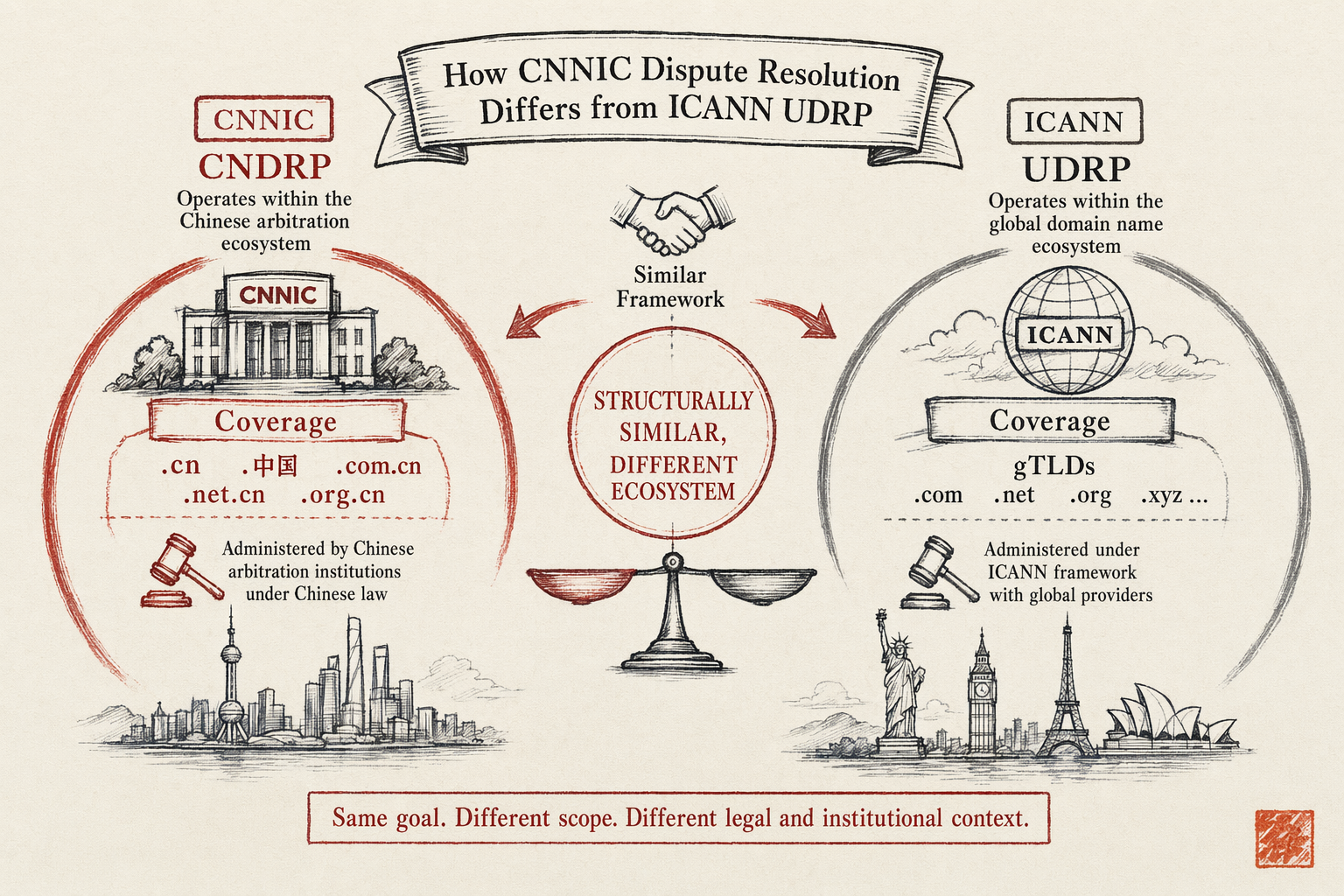
The CNNIC Domain Name Dispute Resolution Policy (CNDRP) is structurally similar to ICANN's UDRP but operates inside the Chinese arbitration ecosystem. The key differences foreign brands need to understand:
- Coverage. CNDRP applies to .cn, .中国, and the second-level domains under .cn (.com.cn, .net.cn, .org.cn). ICANN UDRP applies to generic TLDs (.com, .net, .org, and most new gTLDs). The two systems do not overlap; a single dispute over both a .com and a .cn requires parallel filings.
- Forums. CNDRP is administered by accredited Chinese arbitration centers, primarily CIETAC and HKIAC. UDRP is administered by ICANN-accredited providers such as WIPO and the National Arbitration Forum.
- Language. CIETAC proceedings are conducted in Chinese; HKIAC accepts both Chinese and English filings with translation of responses if cross-language. UDRP defaults to English with translation rules per case.
- Grounds. CNDRP grounds (CNDRP Article 8) are textually similar to UDRP grounds (UDRP Paragraph 4(a)): identical or confusingly similar, no rights or legitimate interests, bad faith. Application differs in details — CNDRP panels weigh registered Chinese trademark much more heavily than foreign trademark; UDRP panels treat trademark from any jurisdiction roughly comparably.
- Time limits. CNDRP has a 3-year limitation from the disputed domain registration date. UDRP has no formal limitation period. The 3-year window is a hard procedural rule that catches some brands by surprise; a domain hijacked 4 years ago cannot be reclaimed through CNDRP.
- Costs. CNDRP fees through CIETAC or HKIAC run roughly $1,500-$3,000 in arbitration fees. UDRP fees through WIPO run roughly $1,500-$5,000 depending on number of domains and panel size. Attorney fees on both sides are usually larger than the official fees.
- Implementation. CNDRP decisions are implemented by the .cn registrar under CNNIC instruction within 10-15 days. UDRP decisions are implemented by the gTLD registrar within similar timelines.
The 3-year limitation is the procedural rule most likely to catch a foreign brand. Discovering a 4-year-old hijack and finding CNDRP unavailable forces the brand into trademark-back-channel routes or People's Court action, both of which are slower and more expensive.
Three grounds for a successful complaint
CNDRP Article 8 requires the complainant to prove all three of the following, on the balance of evidence reviewed by the panel:
Ground 1: The disputed domain is identical with or confusingly similar to a name in which the complainant has rights. The relevant rights are typically (a) a registered trademark in China, (b) a registered trademark elsewhere with documented Chinese-market awareness, (c) a personal name, business name, or other commercial identifier in which the complainant has prior rights. CNDRP panels treat a registered Chinese trademark as the strongest form of evidence here; foreign-only marks are weaker but admissible if accompanied by Chinese-market evidence.
The "confusingly similar" element typically encompasses pinyin equivalents, character variants, common typo variants, and IDN versions of the same name. A panel will generally treat brand-cn.cn, brand.com.cn, and brnad.cn as confusingly similar to a complainant's brand.cn rights claim.
Ground 2: The registrant has no rights or legitimate interests in the domain. This shifts the burden of production to the registrant once the complainant has presented a prima facie case. Legitimate interests recognized by CNDRP panels include: (a) the registrant has been commonly known by the disputed domain name, (b) the registrant uses the domain in connection with a bona fide offering of goods or services, (c) the registrant makes legitimate non-commercial or fair use of the domain. A registrant with none of those has no rights claim.
Ground 3: The registrant has registered or is using the disputed domain in bad faith. CNDRP Article 9 enumerates non-exhaustive bad-faith indicators: (a) the registrant offers to sell, rent, or transfer the domain to the complainant for valuable consideration in excess of out-of-pocket costs, (b) the registrant registered the domain to prevent the trademark owner from reflecting their mark in a domain name, (c) the registrant registered the domain primarily to disrupt a competitor's business, (d) the registrant uses the domain to attract internet users for commercial gain by creating likelihood of confusion with the complainant's mark.
All three grounds must be established. A complaint that wins on grounds 1 and 2 but fails to establish ground 3 (bad faith) is denied. Bad faith is often the hardest ground for foreign brands to establish, particularly when the squatter has done minimal active use of the domain.
Evidence standards
The evidence package that wins CNDRP cases for foreign brands typically contains the following categories. CNDRP panels weigh evidence on the balance, with stronger weight assigned to documentary and date-verifiable evidence over assertion-only claims.
Rights evidence (for ground 1):
- CNIPA trademark registration certificate (strongest form, especially when class matches the goods or services the domain is being used for).
- Foreign trademark registration certificates with translated certified copies.
- Documented use evidence in mainland China — invoices, marketplace records, advertising contracts, customs declarations bearing the mark.
- Press coverage and third-party recognition of the brand in Chinese media.
No-legitimate-interest evidence (for ground 2):
- Registrant's WHOIS record showing they have not been commonly known by the domain.
- Domain history showing no active commercial use, or use only as a placeholder, parked page, or pay-per-click landing page.
- Demonstration that the registrant's other domain holdings (often available through public WHOIS analysis tools) show a pattern of name-grabbing across unrelated brands.
Bad-faith evidence (for ground 3):
- Correspondence in which the registrant offered to sell the domain at an inflated price, especially to the complainant directly.
- The registrant's portfolio of domains matching other trademarks — a pattern of name-grabbing is often the cleanest bad-faith evidence.
- Evidence the registrant has used the domain for confusion-marketing — knockoff sites, redirects to competitors, paid-ad parking pointed at the complainant's industry.
- Geographic and business-scope mismatch between the registrant's actual business and the domain's apparent positioning.
The strongest single piece of evidence is a registered CNIPA trademark in the same form as the disputed domain. The strongest combination is a registered CNIPA mark plus documented Chinese-market use plus a clear bad-faith pattern by the registrant. Cases built only on foreign trademark with no mainland evidence are uphill but not hopeless, especially when the bad-faith pattern is strong.
HKIAC and CIETAC as panel options
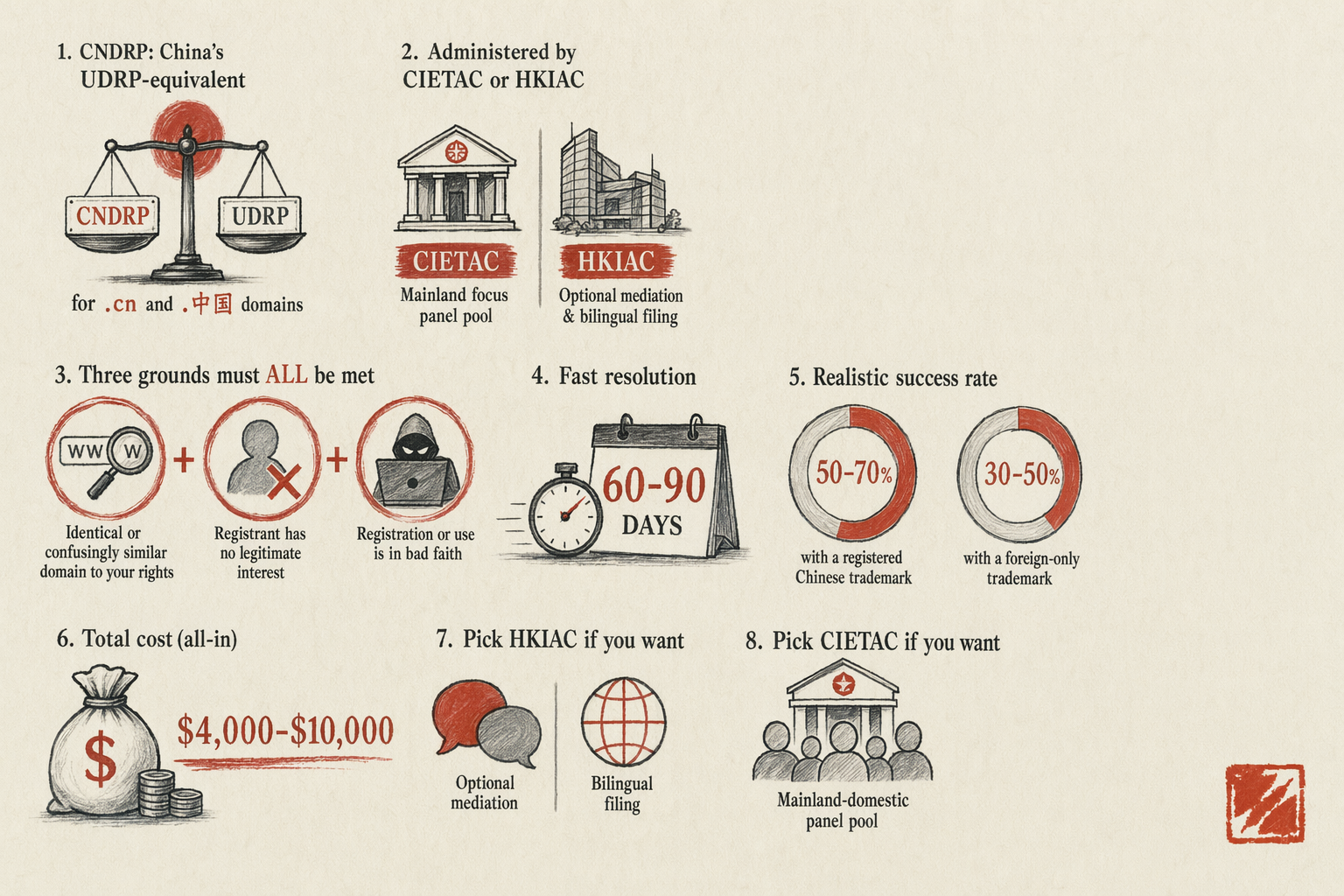
The two primary dispute resolution centers accredited to handle CNDRP cases are CIETAC (China International Economic and Trade Arbitration Commission), a mainland body, and HKIAC (Hong Kong International Arbitration Centre), a Hong Kong body. Both have CNDRP-accredited panels and both follow the CNNIC procedural rules, but they differ on several practical dimensions that affect a complainant's choice.
CIETAC characteristics:
- Filings in Chinese; English filings require translation.
- Panel pool drawn primarily from mainland Chinese trademark and arbitration practitioners.
- Filing fees in the lower half of the CNDRP fee range, typically $1,500-$2,500 per single-domain case.
- Panel decisions issued in Chinese; English translations available on request.
- Procedural style tends toward documentary review with limited oral hearing; cases typically decided on paper submissions.
- Strong choice for foreign brands with mainland representatives and Chinese-language documentation already prepared.
HKIAC characteristics:
- Bilingual filings accepted; case can run in English with Chinese translations of opposing-party submissions.
- Panel pool drawn from international and Hong Kong practitioners with cross-border IP experience.
- Filing fees in the upper half of the range, typically $2,000-$3,000 per single-domain case.
- Optional pre-arbitration mediation step that occasionally settles cases without full panel proceedings.
- Procedural style is similar to CIETAC but with more procedural latitude for the complainant to brief points beyond the standard CNDRP recitation.
- Strong choice for foreign brands without mainland Chinese representation, brands that prefer bilingual handling, or brands seeking the mediation option.
Panel composition is single-panelist by default. Either party can elect a three-panelist tribunal at additional cost (roughly $3,000-$5,000 extra for the three-panelist option). Single-panelist decisions complete faster (30-45 days from panel appointment) and are usually sufficient for clean cases. Three-panelist tribunals are usually elected for complex cases involving multiple domains, contested rights claims, or where the complainant wants the additional panel-level review to strengthen any subsequent People's Court challenge.
Realistic success rates and timelines
Aggregate CNDRP data published by CIETAC and HKIAC suggest complainants prevail in approximately 70-80% of cases overall. The number is higher than the typical foreign-brand experience because the aggregate includes domestic Chinese brands with strong CNIPA registrations against squatters with weak defenses, which are the easiest cases.
Foreign-brand-specific success rates observed across published decisions and broker reports:
- Foreign brand with registered CNIPA mark in the same form, plus bad-faith evidence: 60-75%. The strongest configuration.
- Foreign brand with registered CNIPA mark, weak bad-faith evidence: 45-60%. The CNIPA mark carries grounds 1 and 2, but ground 3 sometimes fails when the squatter has not done active confusion-marketing.
- Foreign brand with foreign-only trademark plus Chinese-market use evidence: 35-55%. Weaker on ground 1 unless the foreign mark is well-known under PRC standards.
- Foreign brand with foreign-only trademark, no Chinese-market activity: 15-30%. Difficult but not hopeless if bad-faith evidence is exceptionally strong (squatter has a documented portfolio pattern, has offered to sell the domain at an inflated price).
Procedural timelines from filing to decision and to implementation:
- Filing to panel appointment: 30-45 days at CIETAC, 25-40 days at HKIAC.
- Panel appointment to decision: 30-45 days for single-panelist cases, 45-60 days for three-panelist tribunals.
- Decision to registrar implementation: 10-15 days.
- Total filing-to-transfer: 70-105 days for standard cases.
The 70-105 day timeline is materially faster than most foreign brand recovery routes. Combined with the moderate cost ($4,000-$10,000 all-in) and the meaningful success rates for brands with reasonable evidence, CNDRP is usually the right primary lever once registrar escalation has been exhausted. The trademark-back-channel route is the complement when the brand's CNDRP evidence is thin and the squatter holds a vulnerable matching trademark that can be removed via CNIPA action first. See how to recover a hijacked .cn domain for the integrated recovery sequencing across registrar escalation, CNDRP, and trademark-back-channel.
Related
7 min read
Registering a .cn Domain as a Foreign Entity
.cn vs .com.cn vs 中国, CNNIC real-name verification, foreign-entity documents, registrar choice, and defensive registration.
6 min read
How to Choose an ICP Sponsor for Your Domain
Picking an ICP sponsor — entity-tied filings, sponsor fee ranges, support quality, what happens when a sponsor disappears.