What CNNIC actually checks
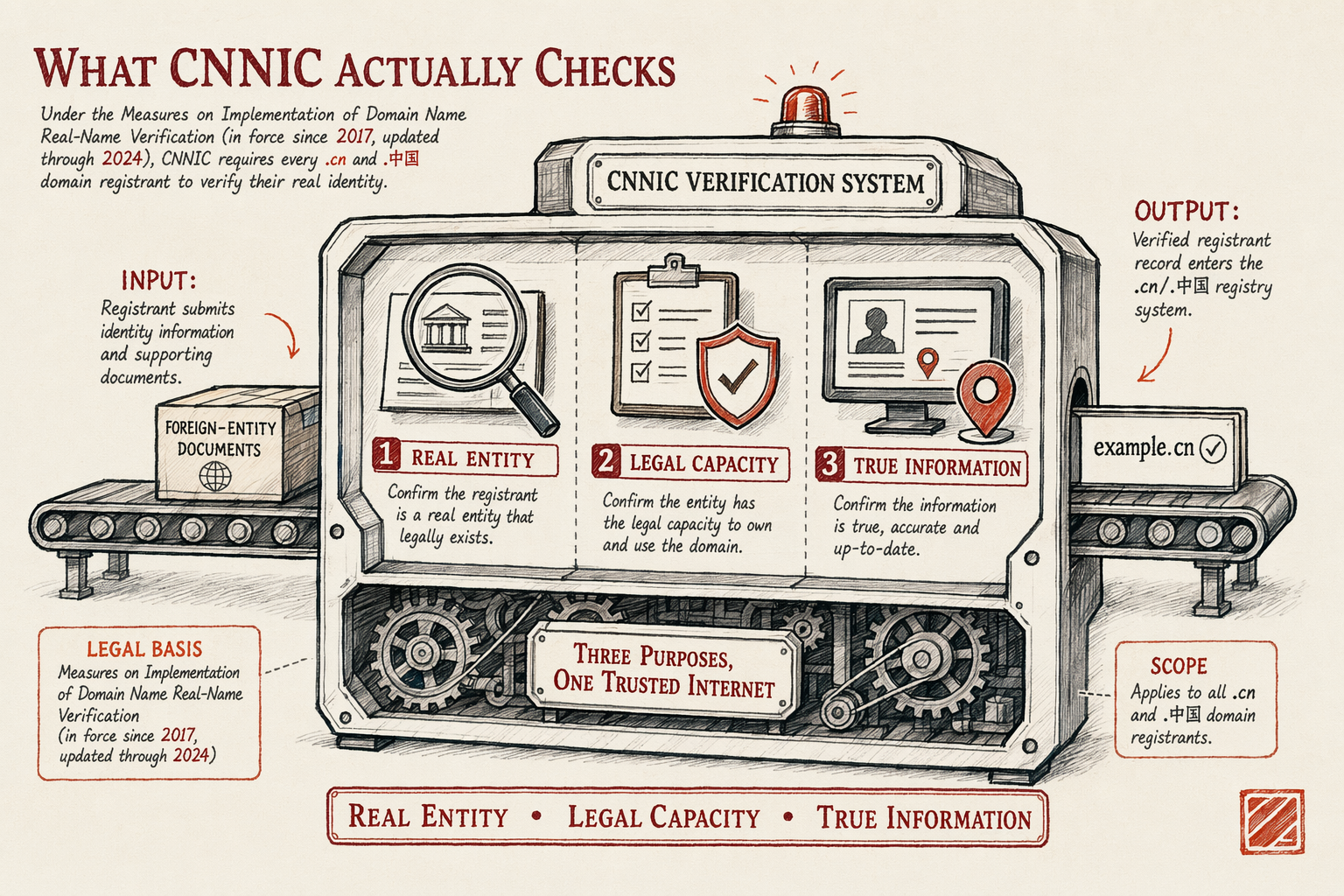
The Measures on Implementation of Domain Name Real-Name Verification, in force since 2017 and updated procedurally through 2024 by CNNIC (China Internet Network Information Center), require every .cn and .中国 domain registrant to verify their real identity at registration. The verification has three purposes: confirm the registrant is a real entity or person, link the domain to a responsible party for content matters under MIIT regulations, and prevent anonymous registration that would obstruct dispute resolution.
For foreign-entity registrations the verification checks:
- Identity of the registering entity. Through a certified copy of the certificate of incorporation, business license, or equivalent foundational document.
- Identity of the legal representative. Through a passport or government-issued ID copy of the person who signs on behalf of the entity.
- Designated contact administrator. The person or role that will receive CNNIC correspondence about the domain. The administrator can be the same as the legal representative or a different individual.
- Match between the application and the documents. Names, registration numbers, and addresses on the application must match the documents exactly, including punctuation and capitalization.
The verification is procedural, not investigative. CNNIC does not investigate the underlying business; it confirms documentary identity. Rejections typically come from documentary defects rather than from substantive concerns about the registrant.
The exact foreign-entity document list
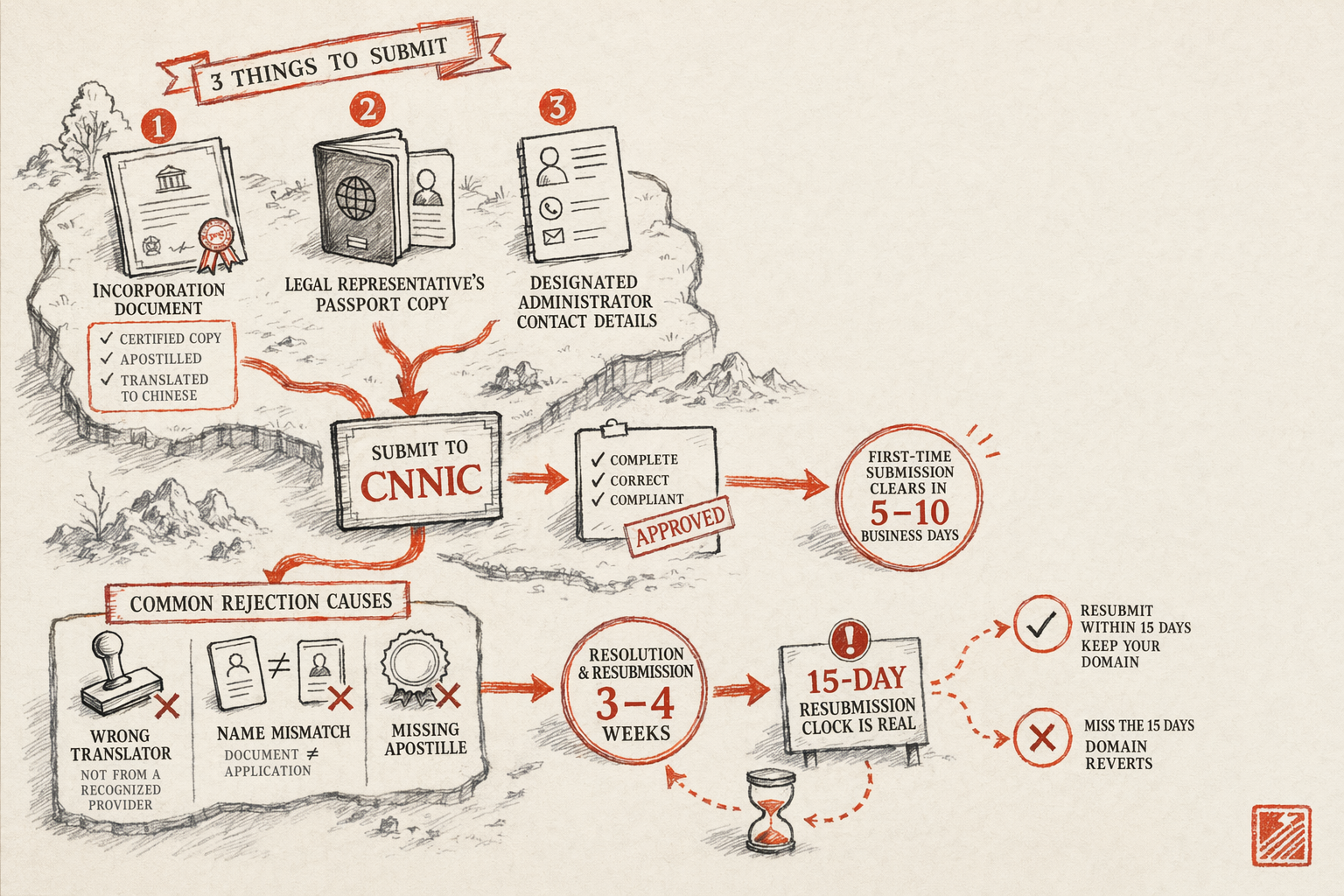
For a foreign limited company (US LLC or Inc., UK Ltd, AU Pty Ltd, EU GmbH/SARL/SRL, Hong Kong Ltd, Singapore Pte Ltd, BVI / Cayman / Marshall Islands company, and analogous structures), CNNIC requires the following package:
- Certificate of Incorporation or equivalent. The foundational document issued by the foreign company registry. For US LLCs this is the Articles of Organization plus the Certificate of Good Standing dated within the last 6 months. For UK companies the Certificate of Incorporation plus optionally the current officers list. For Hong Kong companies the NNC1 plus the Business Registration Certificate.
- Apostille on the foundational document. Required for all jurisdictions party to the Hague Apostille Convention. Non-Apostille countries require consular legalization through the Chinese embassy or consulate in the country of origin. Hong Kong and Macau companies do not require apostille for CNNIC purposes.
- Certified Chinese translation of the foundational document by a translation provider recognized by the registrar or by a Chinese Notary Public office. Self-translation is rejected.
- Passport copy of the legal representative — the person signing on behalf of the entity. The passport must be valid for at least 6 months from the verification submission date.
- Notarized or certified copy of the passport, with the certifier's stamp and signature visible. A scanned digital copy without certification is rejected; certification can be by a notary public, by an attorney, or by a Chinese consular officer.
- Designated administrator contact form. The form is provided by the registrar and identifies the individual or role that will receive CNNIC correspondence. The administrator's name, role, email, phone, and address are required.
- Domain registration agreement from the registrar, signed by the legal representative. Most registrars provide a Chinese-language template for foreign entities.
- Optional but useful: Articles of Association or equivalent showing the legal representative's authority to bind the entity. Some registrars require this; CNNIC does not always demand it, but having it on hand prevents a back-and-forth.
For foreign individuals registering as natural-person registrants, the document list is simpler: passport copy (notarized), proof of address (utility bill or bank statement dated within 3 months, translated and notarized), and the registrar's domain registration agreement.
Translation and apostille requirements
The apostille is the standardized authentication used among countries that are parties to the 1961 Hague Convention. The document goes from the issuing authority (e.g. the US state Secretary of State for a US LLC's Articles of Organization) to a designated competent authority (the same Secretary of State or, federally, the US Department of State) which attaches the apostille certificate. The apostille certifies the authenticity of the signature and seal on the underlying document. CNNIC accepts apostilled documents from any Hague Convention signatory.
Non-Hague Convention countries (a shrinking list) require consular legalization instead. The document is authenticated by the issuing country's foreign ministry, then again by the Chinese embassy or consulate in that country. This is slower and more expensive than apostille — typically 4-8 weeks and $200-$600 versus 1-3 weeks and $50-$150 for apostille.
The certified Chinese translation must be performed by:
- A translation provider recognized by the .cn registrar (each major registrar — Aliyun, eName, Xinnet, GoDaddy China — maintains a list of accepted partners).
- A translation firm registered with a Chinese Notary Public office, with the firm's stamp and translator's signature on each page.
- The Chinese consulate or embassy abroad, in some cases combined with the apostille legalization (this is the most expensive option but combines two steps).
Self-translation, translation by a freelancer without a recognized affiliation, or translation by general-purpose services without notarization are all rejected. The cost of acceptable translation through a registrar partner is $40-$150 per document, with turnaround of 2-5 business days.
One specific gotcha: if your company name uses non-Latin characters (a Korean limited company, a Japanese Kabushiki Kaisha), the Chinese translation must render the name in Chinese characters in a manner consistent with the company's Chinese-language usage elsewhere (Chinese-language business cards, Chinese-language press, prior CNIPA filings). Inconsistent renderings of the name across documents trigger rejection.
Common reasons documents get rejected
The top documentary defects across foreign-entity CNNIC submissions, ranked by frequency observed across registrar partner reports:
- Name mismatch between the application and the documents. Application written "Acme Inc." but the certificate reads "ACME, INCORPORATED". CNNIC examiners require exact match including capitalization and punctuation, with translation rendering the same name consistently.
- Apostille missing or invalid. The applicant uploaded the foundational document without the apostille certificate attached, or attached an old apostille (over 6 months) for a Certificate of Good Standing that requires a recent date.
- Translation by an unrecognized provider. Self-translation, freelancer translation without a notary stamp, or translation by a provider not on the registrar's accepted list.
- Passport copy not certified. A scanned digital copy without a notary stamp, attorney certification, or consular certification.
- Administrator contact incomplete. Missing phone, missing email, or mismatched name between the administrator form and the company's record of who has signing authority for IT matters.
- Legal representative not authorized. The person signing the application is not the one named on the foundational document as having signing authority, and no Articles of Association or board resolution accompanies to grant the delegation.
- Document date issues. Certificate of Good Standing older than 6 months, passport within 6 months of expiry, utility bill older than 3 months.
- Hong Kong NNC1 missing. Hong Kong applicants who supply only the Business Registration Certificate without the NNC1 incorporation form. Both are required for CNNIC.
The fix on most defects is a single document refresh and resubmission within the 15-day window. A clean first submission requires upfront work, but the cost of getting it right (a half-day of document prep, $50-$150 in translation, $50-$150 in notarization) is less than the cost of three resubmissions over 4 weeks.
Resubmission and the 15-day clock
If CNNIC rejects the first verification submission, the registrar issues a rejection notice within 2-5 business days that identifies the specific defects. The applicant has 15 days from the rejection notice to resubmit. Missing the 15-day window typically results in the domain being moved to a parked state pending manual resolution, which can take an additional 2-4 weeks to clear.
The resubmission process:
- Read the rejection notice carefully. The notice identifies the defective document and the specific defect. Most rejections cite one or two defects, not the entire package.
- Fix the specific defect. If the apostille was missing, get the apostille and re-upload the apostilled document. If translation was the issue, redo the translation through the registrar's accepted partner. If a passport scan was uncertified, get it certified.
- Resubmit the package. Some registrars allow incremental resubmission of only the defective document; others require the full package to be re-uploaded. The Aliyun and eName portals typically accept incremental updates; GoDaddy China typically requires full re-upload.
- Confirm receipt. The portal should acknowledge the resubmission within 24 hours. If not, contact the registrar directly through their domain support channel.
- Wait for re-examination. Re-examination typically completes in 3-5 business days, faster than initial review because only the resubmitted documents are re-examined.
If the second submission is also rejected, the third resubmission window extends to 15 days but the domain enters a frozen state where it cannot be transferred or modified until verification clears. Three rejections often means the application or document chain has a structural flaw — typically the legal representative is not the right person to sign, or the company name is rendered inconsistently across the document chain — and the resolution is a fundamental rework rather than another upload. At that point the best move is to escalate to the registrar's customer-support team and request a manual review with a senior verification officer rather than another automated resubmission. For brands that need the .cn domain on a hard timeline (an ICP filing in progress, a launch date locked in), assume 3-4 weeks for first-pass verification and front-load document prep accordingly.