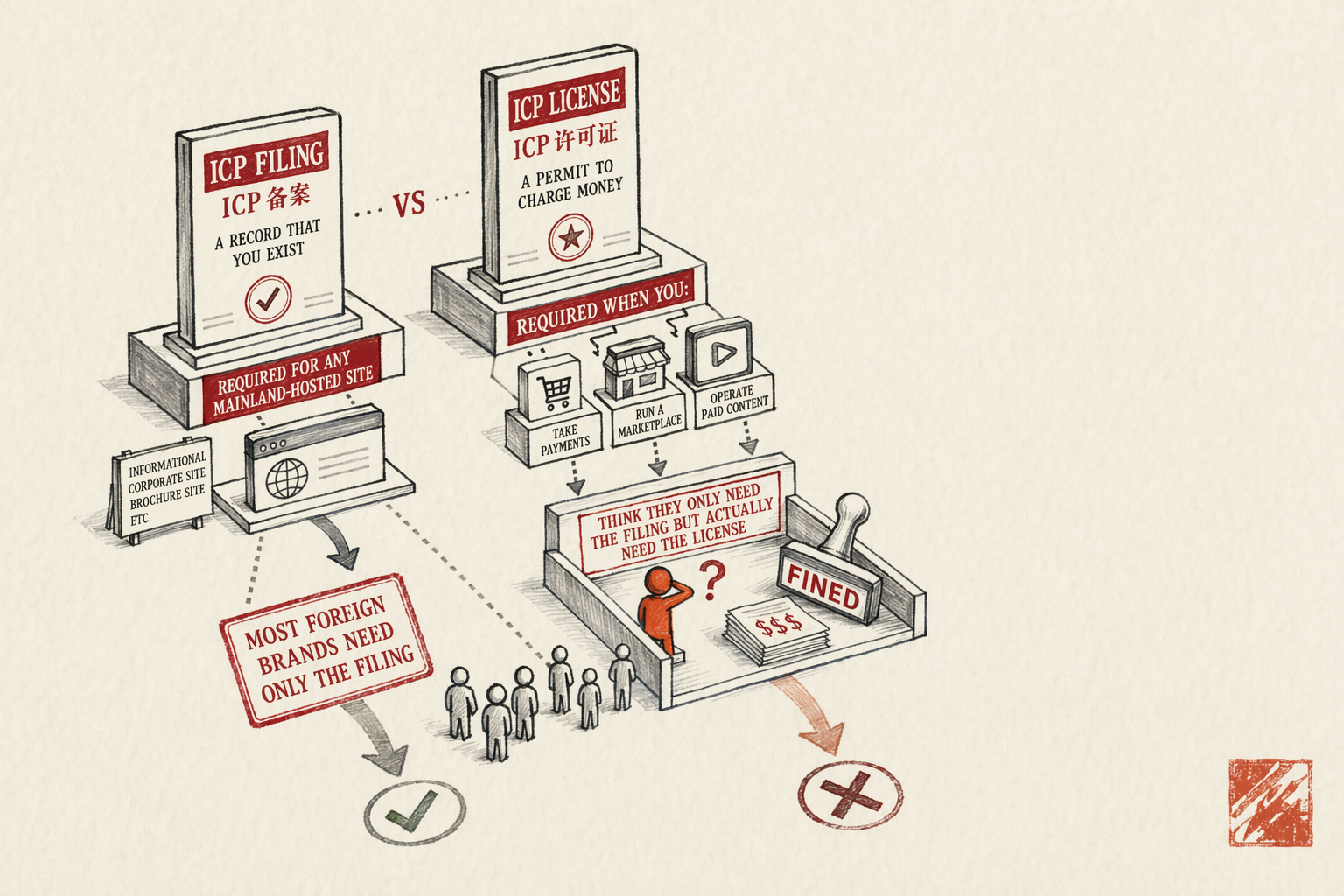
Every foreign founder who looks up ICP for the first time hits the same wall. The two words sound the same, the abbreviation "ICP" covers both, and the agency websites use them interchangeably in places they should not. Then someone tells you the filing takes a month and the license takes three months, and you do not know which clock applies to you.
The short answer: ICP 备案 (the filing, often written ICP beian) is mandatory for any site served from a mainland China IP address. ICP 许可证 (the license, sometimes called the ICP commercial license) is required on top of the filing when the site engages in commercial operations — paid content, e-commerce checkout, marketplace listings, paid SaaS subscriptions, or third-party paid services running on the same domain. This article walks through which one you actually need, the practical document and timeline differences, and how to upgrade if your business model changes mid-flight.
The two ICP types and what triggers each
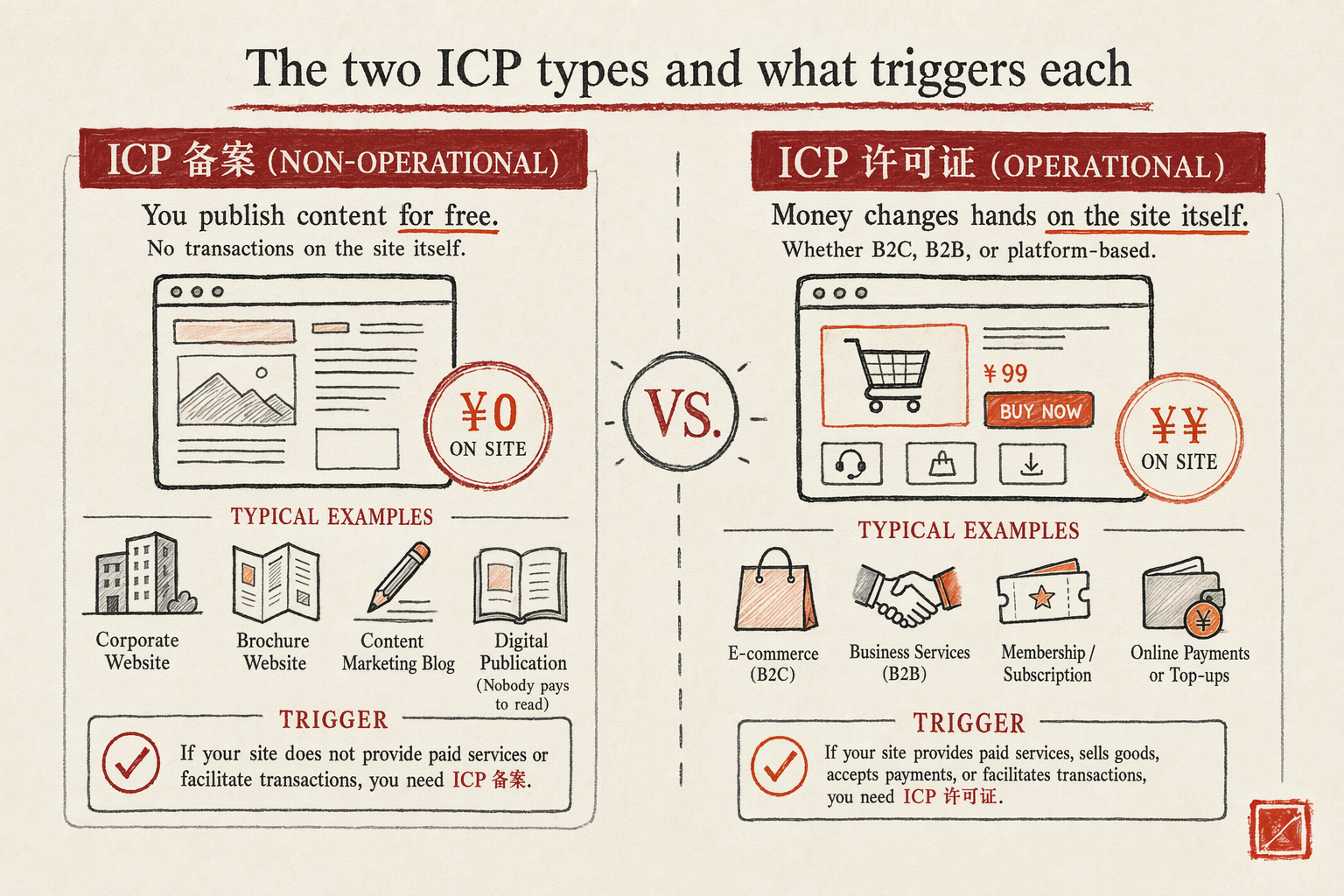
The 1999 Internet Information Services Regulation distinguishes between non-operational and operational internet content services. Non-operational means you publish content for free — corporate site, brochure site, content marketing blog, a publication that nobody pays to read. Operational means money changes hands on the site itself, whether B2C, B2B, or B2B2C.
Triggers for the filing (备案): hosting a website on a mainland IP, regardless of size, traffic, or commercial intent. Triggers for the license (许可证): selling on the site, running a paid subscription, hosting a marketplace, operating paid information services, or providing telecom-adjacent services like IDC, ISP, or content distribution.
The mistake foreign brands make is assuming "non-commercial" means "non-revenue." If your site is a marketing brochure that drives users to your iOS app where they pay — that is filing-only, because the payment happens off-domain. If the same site has a one-click Buy now button that opens a checkout flow on the same domain — license territory, even if you process only a handful of transactions per month.
ICP 备案 (filing) — what it covers
The 备案 is a record-keeping filing held at the MIIT (Ministry of Industry and Information Technology). It binds a domain to a mainland-registered legal entity through a sponsor's IDC license. Once approved you receive a filing number that must be displayed in your site footer — typically the format is 沪ICP备XXXXXXXX号 for Shanghai, with the prefix character changing by province.
The filing covers: informational websites, corporate brochure sites, content marketing blogs, app landing pages, free-tier SaaS marketing surfaces, and any site that does not handle payment, paid content, or marketplace functions on the domain itself. The filing is held in the name of the operating entity (WFOE, Rep Office in limited cases, JV, or a sponsored cross-border arrangement). It does not give you the right to take money on the site.
Timeline: 18-25 business days from clean-document submission to approval, plus the 30-day PSB (Public Security Bureau) sub-filing window that runs the day MIIT issues your filing number. Cost: roughly RMB 2,000-5,000 all-in including sponsor fees, document handling, and translation. Annual renewal is included in maintenance fees in the RMB 600-1,800/yr range.
ICP 许可证 (license) — what it covers and when you need it
The 许可证 is a substantive license issued by the provincial Communications Administration on behalf of MIIT under the Telecommunications Regulations (2000, revised). The licensing categories are: B11 (online data and trading services, the cover for most marketplaces and e-commerce), B12 (information services, including paid content and paid SaaS), B25 (call center services), and several adjacencies.
You need a license when: you run an e-commerce site where customers check out on the domain; you operate a marketplace where third parties transact on your site; you run paid content (subscription publishing, paid courses, paid video); you provide a paid SaaS where users sign up and pay on the same domain; or you operate as an aggregator routing paid traffic between buyers and sellers.
The bar is high. License applicants must be a mainland-registered company with minimum registered capital of RMB 1,000,000 (one million RMB) — and that capital must be wired and audited, not merely stated. Three of the company's key personnel need to be socially insured in China. The entity must have at least one year of clean tax filings, often more. Foreign-owned applicants face additional scrutiny under the catalog of services restricted to mainland-controlled entities — some B11 sub-categories are formally restricted, while B12 is generally open.
Timeline: 60-90 business days for the license itself, layered on top of the existing filing. Cost: roughly RMB 25,000-60,000 for the licensing engagement including agent fees, capital injection support, and the documentation cycle. Plus ongoing annual reporting.
Application differences and timelines
Side by side, the two paths look like this. The filing wants four documents: apostilled certificate of incorporation, legal rep ID, domain WHOIS, and a content sample. The license wants those four plus: capital verification audit, social insurance records for three key personnel, one year of tax filings, a substantive business plan, a personal-data security assessment, and in many provinces a real-name verification interview with the legal representative either in person or by video.
The filing approval flow is automated for foreign-friendly sponsors — documents flow into the MIIT portal, get reviewed in 5-15 business days at the sponsor level, then 5-10 business days at MIIT. The license flow runs through the provincial Communications Administration with human review at every step, and an in-person interview window that varies by province from 2 to 6 weeks.
Cost is the headline difference. Filing is RMB 2-5k all-in. License is RMB 25-60k all-in plus the underlying RMB 1M capital that has to actually exist in your RMB (Renminbi) basic account before you apply.
Upgrading from filing to license
You can upgrade in place: the filing stays, the license is added. The practical sequence is to top up registered capital to the RMB 1M threshold, run the audit, accumulate the 12 months of tax filings, hire the social-insurance-eligible personnel, and then submit the license application alongside your existing filing record number.
What trips foreign founders up here is timing the business model. If you launch on filing-only assuming the brand site will not take payments, then six months later you ship a paid feature on the same domain, you are technically operating without a license from the day the paid feature shipped. Catching it before the provincial Communications Administration does means a self-disclosed upgrade application; catching it after means a fine plus suspension. The fix is to split commercial functions onto a sub-domain under a separately-licensed entity, or to start the license application 3-4 months before you plan to ship the paid feature.
For a side-by-side cost and feature comparison see the ICP 备案 vs ICP 许可证 comparison. The parent topic ICP filing guide covers the broader filing lifecycle, and the China digital presence service hub shows quoted prices for both engagements. If you suspect a filing-only site is doing license-required commercial activity, the related article why ICP applications get rejected covers the scope-mismatch trap.
Frequently asked questions
Does a WeChat Mini Program need a separate ICP filing?
Mini Programs running on Tencent's platform inherit Tencent's licensing, but the brand operating the Mini Program needs its own ICP filing if the Mini Program calls back to a brand-owned domain for content or payment routing. The Tencent platform alone does not cover the brand's surface.
Is the license required for B2B SaaS billed offshore?
If the SaaS billing happens on a foreign domain (.com hosted offshore) and the mainland site is purely marketing, you can usually stay filing-only. If any part of the customer's billing flow — including pricing pages with a Buy Now button — lives on the mainland-hosted domain, you cross into license territory.
Can a foreign brand pass the RMB 1M capital threshold for a license?
Yes, the threshold is entity-level not nationality-level. Foreign-owned WFOEs routinely hold ICP licenses in B12 categories. Restricted B11 sub-categories require a workaround structure that brings in a minority mainland-controlled partner, which is its own engineering exercise.
What is the penalty for operating commercially on filing-only?
Per the Telecommunications Regulations, fines of RMB 30,000-1,000,000 depending on scope and duration, plus suspension of the site at the carrier level until the license is in place or the commercial features are removed. Self-disclosure before discovery typically caps the fine at the low end.
Next step
Not sure which category your site falls into? Run through the ICP Readiness Checklist — it includes a decision tree that names every revenue pattern that crosses from filing into license territory. Free PDF, 10 pages.