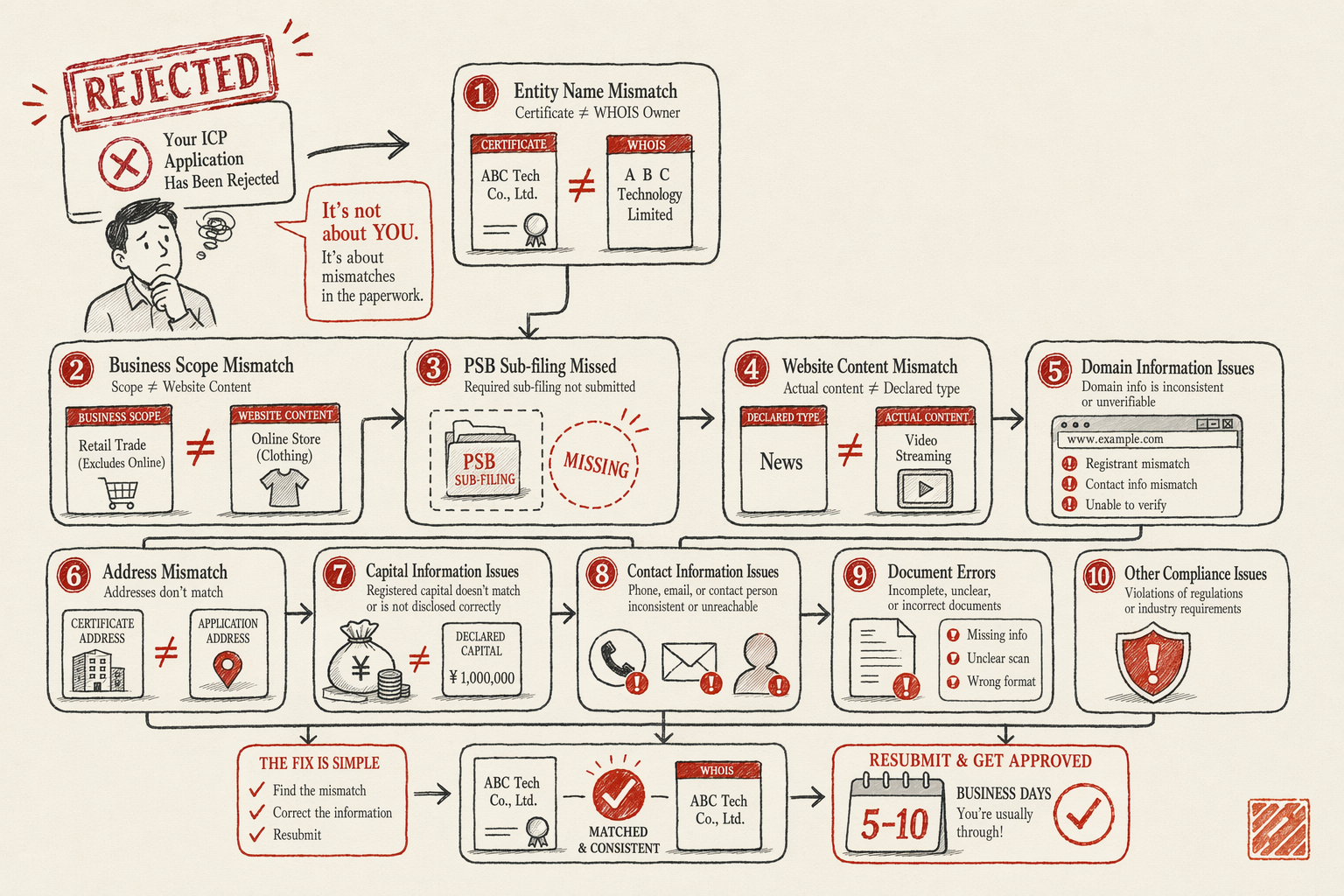
This is the most-googled question in the China-entry compliance space, and for good reason. Roughly 22-30% of foreign-entity ICP (Internet Content Provider) filings get rejected on first submission. The rejection rate is not because the system is hostile to foreign brands — it is because the documents have to triangulate across four agencies and one cloud sponsor, and any one mismatch sends the whole packet back.
The rejections cluster into 10 patterns. The first four are document-quality issues at the sponsor stage. The next three are substantive issues that surface when MIIT (Ministry of Industry and Information Technology) actually reads the file. The last three are post-approval booby traps where you think you are through and then get tagged for a follow-on filing. This is the foreign-founder cheat sheet — fix these before you submit and your first-pass rate climbs into the high 80s.
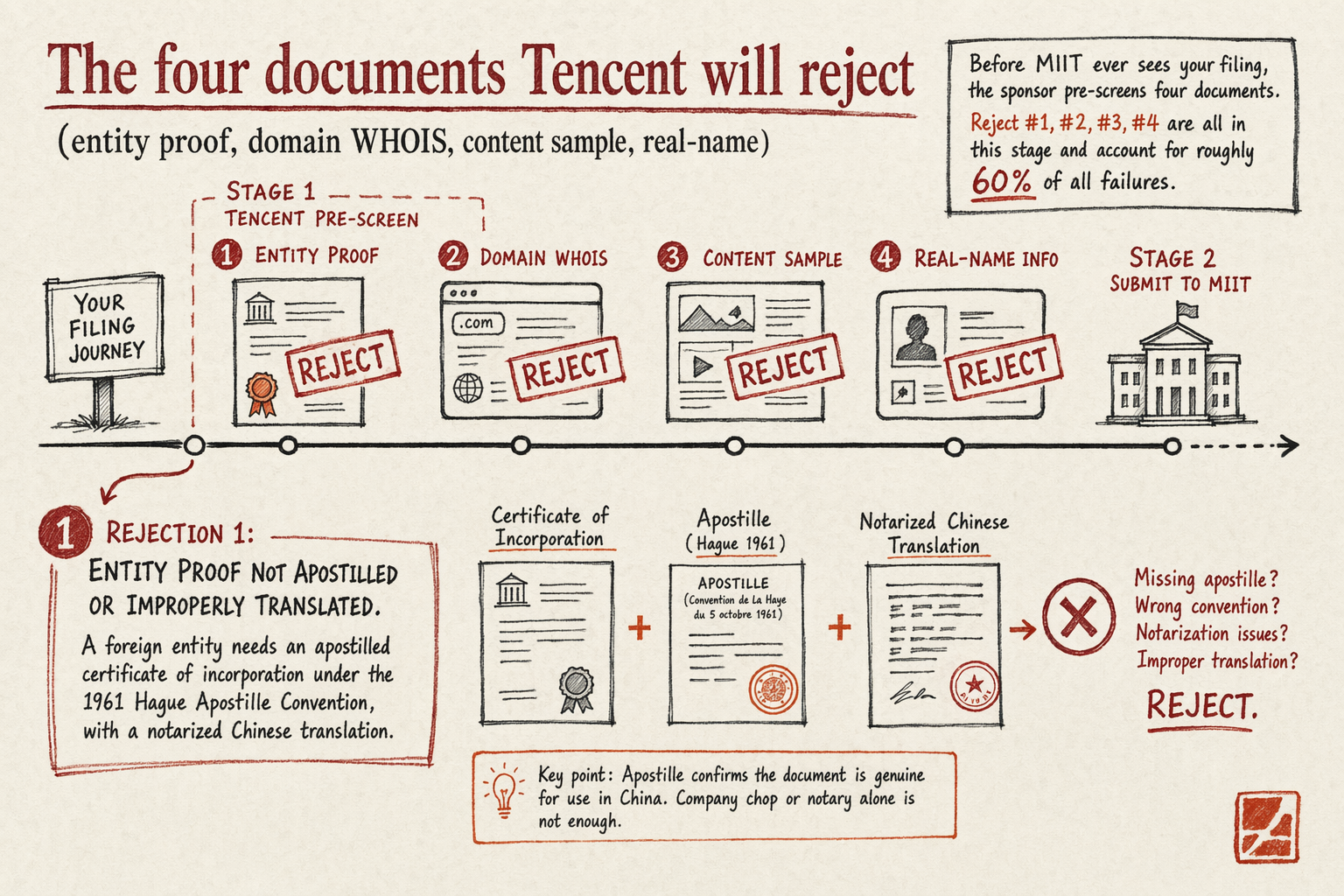
The four documents Tencent will reject (entity proof, domain WHOIS, content sample, real-name)
Before MIIT ever sees your filing, the sponsor pre-screens four documents. Reject #1, #2, #3, #4 are all in this stage and account for roughly 60% of all failures.
Rejection 1: Entity proof not apostilled or improperly translated. A foreign entity needs an apostilled certificate of incorporation under the 1961 Hague Apostille Convention, with a notarized Simplified Chinese translation attached. Plain notarization is not enough. Translation by Google Translate or by a non-certified translator gets bounced — the translator needs a registered translation-agency stamp from a mainland or Hong Kong agency.
Rejection 2: WHOIS owner does not match the filing entity. If the domain WHOIS shows "John Smith" and the filing names "Acme China Trading Co., Ltd.," the sponsor rejects on day one. The fix is to transfer the domain into the entity's name at the registrar before submitting. CNNIC-managed .cn domains require an additional real-name re-verification when transferred.
Rejection 3: Content sample triggers manual review. The sponsor asks for a screenshot of the planned site. Anything that looks like e-commerce, paid content, financial services, news, or user-generated content escalates the filing to license territory (see ICP 备案 vs ICP 许可证 explained). Generic brochure pages pass; checkout buttons do not.
Rejection 4: Real-name verification fails. The legal rep gets a verification call to the registered mainland mobile number during business hours. Voicemail counts as failure. If the rep is offshore, the sponsor needs a documented forwarding arrangement and the call window scheduled in advance.
Entity-domain ownership mismatch
Rejection 5 — the single most common substantive failure. Your WFOE was set up under one name; the domain was registered earlier under your personal name or your overseas parent's name; the WHOIS record never got migrated. The MIIT portal automatically pulls WHOIS at submission and cross-checks against the filing entity.
Fix: have the registrar transfer the domain into the filing entity's name. For .com, this is a control-panel change and a couple of business days for the registrar's verification email. For .cn, the transfer plus CNNIC (China Internet Network Information Center) real-name re-verification adds 5-7 business days. Submit only after the WHOIS shows the new owner and the change has propagated to the WHOIS lookup tools sponsor staff use.
A subset of this rejection: WHOIS privacy. If the registrar applied WHOIS privacy and the public record shows "Privacy Service" instead of your entity, MIIT can read that as a mismatch too. Turn off WHOIS privacy for the duration of the filing — you can re-enable it after approval.
Business scope outside ICP-eligible categories
Rejection 6 — the trap that catches every foreign brand that drafted its 经营范围 (business scope) for trading or services and now wants to run a marketing site about software. The AIC (Administration for Industry and Commerce, now part of SAMR — the State Administration for Market Regulation) approves a specific list of business activities for your WFOE. The ICP filing requires that the website's content category falls within that scope.
If your WFOE scope says "wholesale trade in cosmetics, import and export" and the site you are filing is a B2B SaaS marketing page, that does not match. The fix is either to amend your WFOE business scope at SAMR (a one-time filing, 10-20 business days, low cost) or to align the site's stated activity with the existing scope. The amendment is cleaner.
This is why we recommend reading WFOE business scope language that survives review before you register the WFOE — broad-but-specific scope is what you want, not narrow industrial scope that you then have to amend before you can put up a marketing site.
Content sample that triggers manual review
Rejection 7 — the sponsor asks for screenshots of the site you plan to host. Anything that looks like one of the following categories escalates the file from automated approval into manual review at the provincial Communications Administration: e-commerce checkout flows, paid SaaS pricing pages, news or media content, paid courses, finance and investment content, healthcare and pharma claims, paid live streaming, or any content area that intersects MIIT's restricted catalog.
Manual review can add 30-60 business days and often results in a request to either remove the offending content category or upgrade to a full ICP license. The fix is to submit a stripped-down marketing-only sample for the initial filing — privacy policy, about, contact, brand story, no checkout, no pricing, no news — and then ship the commercial features post-approval once you understand what category you are operating in.
If the commercial feature is the whole point of the site, plan to file for the license from day one. See ICP 备案 vs ICP 许可证 explained for the threshold.
Province-match rule violations
Rejection 8 — the sponsor's IDC (Internet Data Center) license is registered in province A; your WFOE is registered in province B; the website serves users in province C. Most of the time this is fine. Sometimes the receiving provincial Communications Administration applies the province-match rule and bounces the filing because the local rules require the IDC license to be in the same province as either the entity or the hosted servers.
The rule is enforced unevenly. Shanghai, Beijing, Guangdong, and Zhejiang are typically permissive. Sichuan, Henan, and Fujian have applied the strict reading in the last two years. The fix is to use a sponsor whose IDC license is registered in the same province as your WFOE, or to use a pan-national sponsor whose license covers multiple provinces.
Rejection 9 is the related PSB 30-day sub-filing miss. After MIIT approves the filing, you have 30 calendar days to file the supplementary cyber-security record with the PSB (Public Security Bureau). Miss it and the filing is suspended. The sponsor usually handles this filing for you, but you need to confirm in writing that it is in the engagement scope — otherwise you discover at day 40 that the site is offline and your sponsor assumed you would file it yourself.
How to fix and resubmit
Rejection 10 is the avoidable one — resubmitting without addressing the original reason. Sponsors tell you the rejection reason in a short tag like "WHOIS mismatch" or "content sample escalated." The temptation is to resubmit the same packet hoping for a different reviewer. MIIT logs your submissions; a second-round filing with the same flaw escalates to a stricter review and can blacklist the domain for 90 days.
Clean resubmission workflow:
- Get the rejection reason in writing from the sponsor — the short tag and the underlying portal screen.
- Identify which of the 10 patterns above it maps to.
- Fix the underlying mismatch — apostille, WHOIS transfer, scope amendment, content sample edit, IDC sponsor switch, or PSB filing — not just the surface symptom.
- Wait the propagation window (3-10 business days depending on the fix).
- Resubmit with a written cover note naming the original rejection and the fix.
First-time foreign-entity filings clean-resubmit within 5-10 business days of the original rejection. Multi-round resubmissions stretch out and signal to MIIT that the entity has not addressed the underlying issue.
Back to the broader context: see the ICP filing guide for the full filing lifecycle, the China digital presence service hub for quoted prices on filing engagements, and how to choose an ICP sponsor for the question list that pre-empts most of the document-quality rejections.
Frequently asked questions
How many resubmissions does MIIT allow before blacklisting?
There is no hard published limit, but in practice the third rejection on the same filing reads as a refusal-to-cure and the domain enters a 90-day cooldown. Two clean resubmissions are well within tolerance.
Does a new WFOE need to wait until business operations are running to file ICP?
No. You can file as soon as the WFOE has its business license and registered address. You do not need to be operational or have employees yet.
Can I appeal a rejection rather than resubmitting?
Formal administrative reconsideration exists under the 1999 Administrative Reconsideration Law, but for ICP rejections the practical move is always resubmission with a corrected packet. Reconsideration timelines run 30-60 days and rarely overturn document-quality rejections.
Will rejection of one filing affect future filings for the same entity?
Repeated rejections on different domains for the same entity can flag the entity for additional scrutiny. One rejection that you cleanly resubmit and get approved leaves no lasting record.
Next step
Pre-empt the 10 rejection patterns above with the ICP Readiness Checklist — a 10-page PDF that runs your documents and content sample against each rejection pattern before you submit. Free.