You sat down to write the business scope for your WFOE filing and immediately hit the question: do I write "sell stuff" broadly or "sell B2B SaaS contracts for workforce-analytics software in the consumer-packaged-goods vertical" specifically? The first looks like it asks for trouble; the second looks like it locks you out of pivots. Both impulses are partly right.
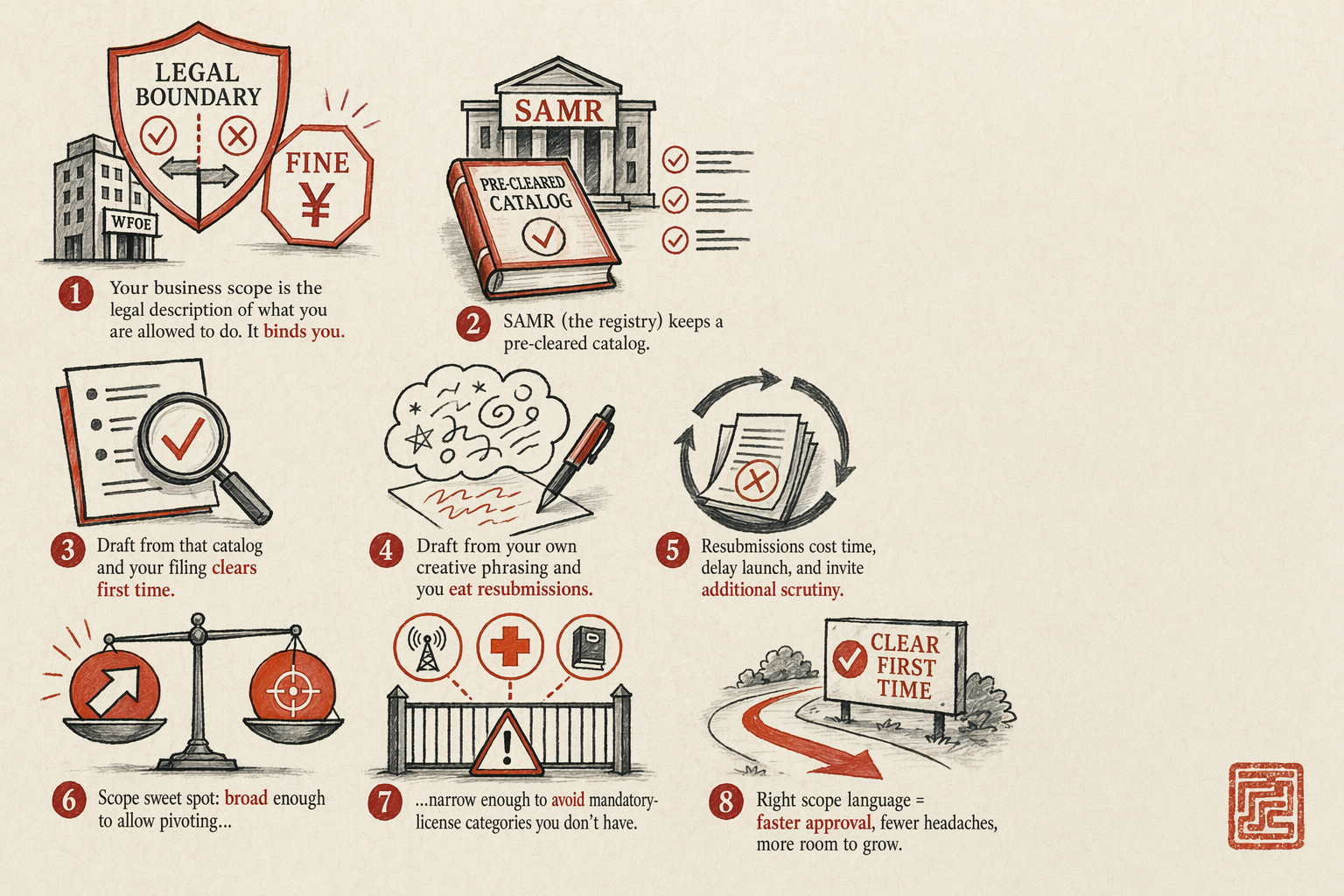
The 经营范围 (jīngyíng fànwéi — business scope) is the legal description of what your WFOE is permitted to do under PRC law. It appears on the business license, on tax registrations, in bank KYC, in customer contracts, in customs filings. Get it right at filing and you spend zero time amending. Get it wrong and you spend a quarter retro-fitting and possibly migrating customer contracts that referenced unauthorized scope. This article walks through the drafting choices that produce a first-pass approval and a forward-compatible scope.
What 'business scope' (经营范围) legally binds you to
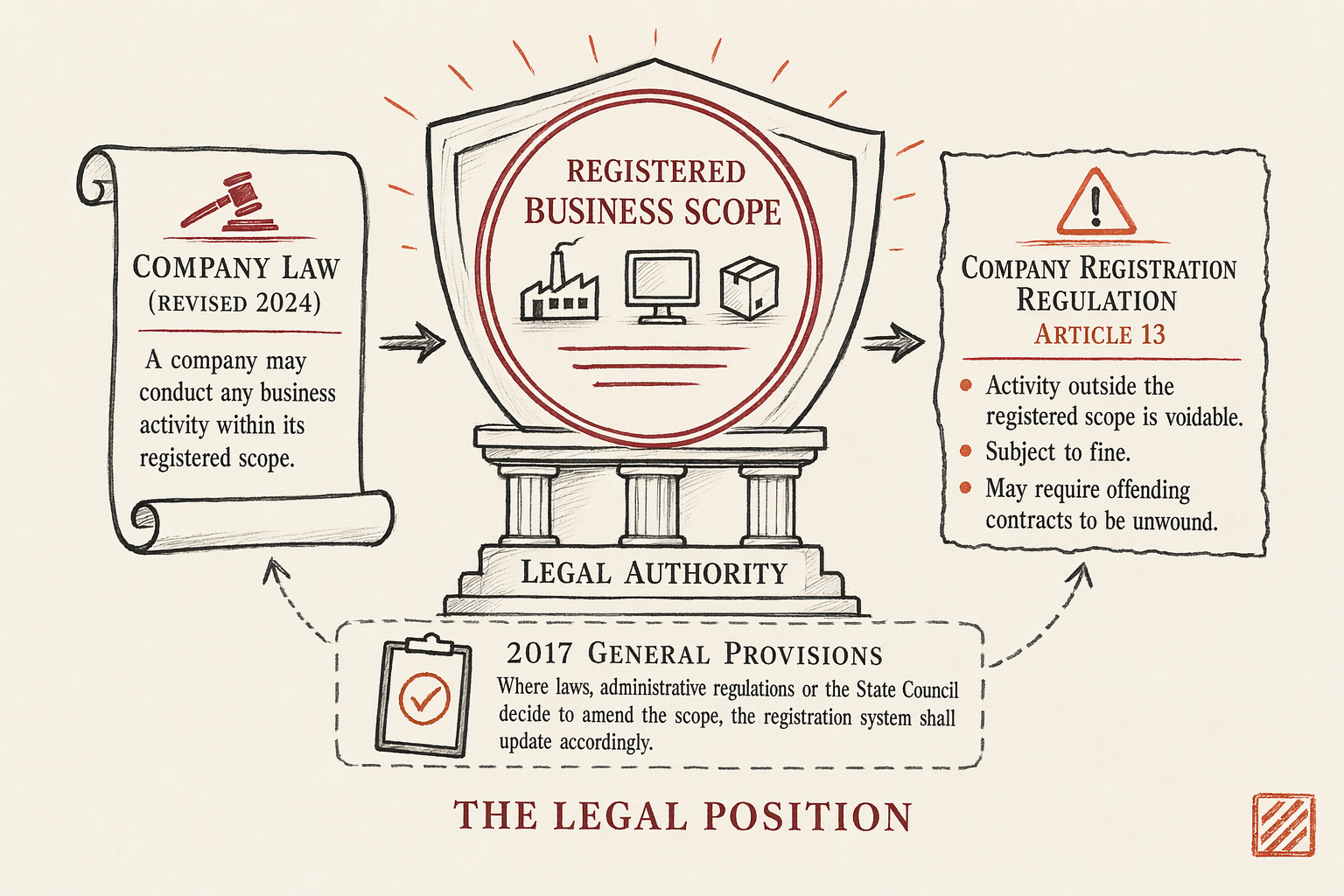
The legal position. The Company Law (revised 2024) provides that a company may conduct any business activity within its registered scope. Article 13 of the Company Registration Regulation confirms that activity outside the registered scope is voidable, subject to fine, and may require the offending contracts to be unwound. The 2017 General Provisions of Civil Law (now in the Civil Code) softened the historical strict-construction reading — minor scope overshoots no longer automatically void contracts — but operating in materially outside-scope activity still incurs regulatory action.
What "materially outside-scope" means in practice: invoicing for services that fall outside the listed activities, issuing fapiao with goods/service descriptions outside scope, signing contracts whose object is not within the scope. The tax bureau cross-references fapiao descriptions against the scope and queries mismatches; auditors flag scope mismatches in the annual audit; customers' procurement departments query mismatches in their own due diligence.
The scope is also the gating control for license-requiring activities. If your scope includes "online sales of goods through internet platforms," you can apply for the ICP commercial license; if it does not, you cannot. Adding scope post-registration is possible but each addition is a SAMR amendment with its own clock and audit-trail entry.
The pre-cleared scope catalog AIC uses
SAMR maintains a pre-cleared scope catalog (the 登记前置许可标准化条款 system, refined annually with the most recent material update in 2023). The catalog contains thousands of standardized phrasings organized by industry sector. SAMR registration officers approve filings whose scope language matches the catalog without supplementary review.
Real examples of pre-cleared catalog phrasings that are commonly used by foreign WFOEs:
- Consulting WFOE: "商务信息咨询;企业管理咨询;市场营销策划;品牌推广策划;企业形象策划" (business information consulting; enterprise management consulting; marketing planning; brand promotion planning; corporate image planning).
- Trading WFOE: "日用百货、化妆品、服装、鞋帽、皮革制品的销售;货物进出口、技术进出口" (sale of daily commodities, cosmetics, clothing, footwear, leather goods; import-export of goods and technology).
- Tech WFOE: "计算机软件的技术开发、技术服务、技术咨询、技术转让;计算机软件的销售" (technical development, technical service, technical consulting, and transfer of computer software; sale of computer software).
- Cosmetics e-commerce WFOE: "通过互联网从事化妆品零售;网上信息咨询服务" (online retail of cosmetics via the internet; online information consulting services). Note: this scope alone does not authorize taking payments on the same domain; the ICP license is separate.
Working from the catalog versus drafting bespoke language has a direct effect on first-pass approval. Bespoke language gets parsed against the catalog by the SAMR officer; non-matches generate clarification requests. Catalog language clears at the automated stage.
Mandatory-license scope vs general scope
Some activities require additional licensing on top of business registration. The scope sentence that names the activity must be followed by the 许可经营项目 (license-requiring item) marker, and the WFOE cannot conduct the activity until the underlying license is obtained.
Common license-requiring activities relevant to foreign WFOEs:
- Food and beverage — requires Food Operation License from the local market regulator.
- Medical devices and cosmetics — Class II and III medical devices require NMPA filings; cosmetics import requires CBEC or import registration depending on channel.
- Telecommunication value-added services — the ICP license, plus cross-border data services where applicable.
- Education and training — Education Department licensing varies by sub-category; many are restricted for foreign-controlled entities.
- Logistics and freight forwarding — Ministry of Transport licensing.
- Financial services — restricted to mainland-controlled entities or specific authorized vehicles.
Including license-requiring scope when you do not yet have (and may not get) the underlying license creates a permission you cannot use. The SAMR business license will mark these items as license-pending — which signals to banks, customers, and tax bureaus that the WFOE has not yet completed the prerequisite licensing. Better to omit license-requiring scope and add it later once the underlying license is in hand.
General scope items — consulting, trading, distribution, technology services — are 一般经营项目 (general business items) and can be conducted immediately upon registration.
Broad vs narrow — picking room to pivot
The drafting tradeoff. Broad scope ("general consulting; technology consulting; technology services") covers more pivots without amendment, but invites the SAMR challenge that the registered capital does not justify the breadth. Narrow scope ("workforce analytics SaaS consulting for retail customers") clears the SAMR substance check easily but locks you out of adjacent moves.
The pattern that works in practice for tier-1 city WFOEs: broad-but-specific. Stack 5-8 catalog phrasings that cover the current business plus the obvious next two adjacent moves, plus one general-purpose catch-all from the same category.
Example — a B2B SaaS WFOE planning to start with workforce-analytics for retail and expand into adjacent verticals:
"计算机软件的技术开发、技术服务、技术咨询、技术转让;计算机软件、计算机硬件的销售;企业管理咨询;商务信息咨询;数据处理服务;信息系统集成服务;市场营销策划"
(Translated: technology development, services, consulting and transfer of computer software; sale of computer software and hardware; enterprise management consulting; business information consulting; data processing services; information system integration services; marketing planning.)
That scope clears tier-1 city SAMR review at RMB 500k-1M stated capital. It supports the workforce-analytics core, allows pivots into HR consulting, data analytics services, and adjacent vertical SaaS, and includes the system-integration phrasing that opens systems-implementer revenue models. None of it triggers a mandatory license — all general scope items.
Adding new scope after registration
Adding scope is a SAMR amendment filing. Mechanics:
- Board resolution authorizing the scope addition.
- Amended Articles of Association reflecting the new scope.
- SAMR amendment application through the local market regulator's portal.
- If the new scope is license-requiring, the underlying license must be in hand or in progress.
- Issued amended business license — typically 10-20 business days from clean submission.
Cost: RMB 1,500-4,000 through a compliance vendor for a clean amendment, including the resolution drafting and the SAMR filing. License-requiring additions cost more because the underlying license process has its own engagement.
The cadence to expect at a typical foreign WFOE: zero-to-one scope amendments in years 1-2, two-to-three amendments across years 3-7 as the business pivots and adds product lines, then steady-state. Each amendment is on the entity's public record; cumulative amendments do not look bad up to a point, but a record with eight scope changes in three years signals an entity that does not know what it does, which surfaces in bank KYC reviews and large-customer due diligence.
For the broader formation context see the WFOE vs Rep Office vs Hong Kong limited topic hub and the China company formation service hub. To budget scope-amendment fees alongside the rest of the year-1-to-year-5 expense profile, the realistic WFOE registered capital for 2026 article covers the capital side of the same SAMR filing flow.
Frequently asked questions
Can I write my scope in English?
The official scope on the business license is in Simplified Chinese only. You can keep an English working translation for internal use but the legally binding text is the Chinese.
What if my activity has no obvious match in the SAMR catalog?
Common for emerging technology categories. The drafting move is to use the closest catalog phrasing for the platform layer (data processing, technology services, information consulting) and let the underlying activity sit within that umbrella. Avoid invented category names that SAMR officers will treat as non-standard.
Does scope affect tax rates?
Some encouraged-industry sub-categories qualify for tax incentives (high-tech enterprise reduced 15% CIT rate; Hainan FTP incentives; FTZ-specific reliefs). Capturing the eligible scope category enables the incentive application but the incentive itself requires separate qualification.
Can I conduct activities outside my scope if the customer requests them as a one-off?Technically no, even one-off. In practice small overshoots are common and rarely sanctioned, but they show in the next audit cycle. The defensive move is to keep scope slightly broader than current operations.
Next step
To draft a scope that matches your business plan and the catalog, use the China Expansion Budget Estimator — the second tab includes a scope-drafting worksheet with the catalog phrasings keyed to the eight common foreign-WFOE archetypes. Free download.