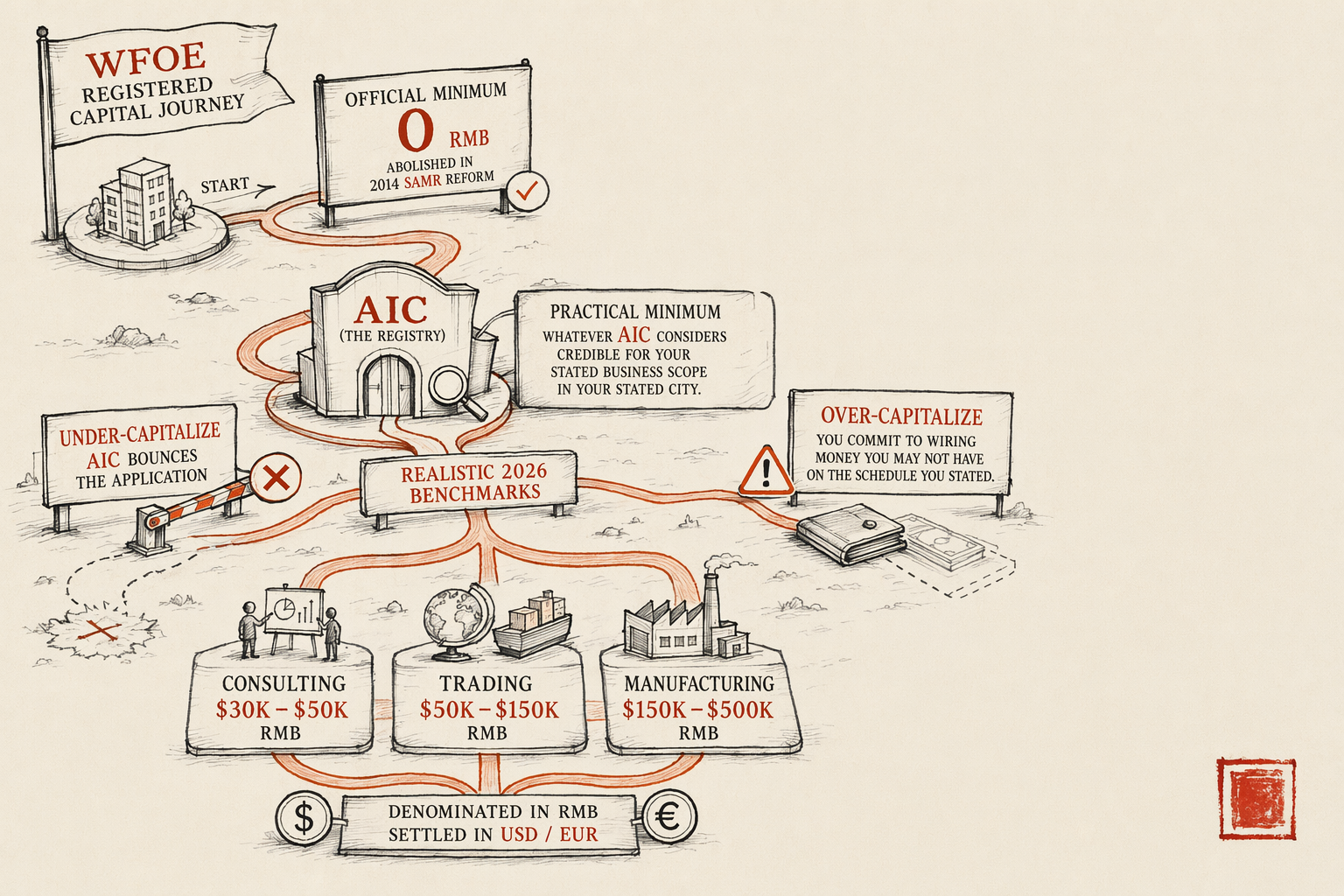
Two myths fight each other on this topic. Myth 1: "You need to register a million dollars to get a WFOE." Myth 2: "Minimum capital was abolished, you can register with $1." Both are wrong. The 2014 reform — the State Council's Decision on Implementing the Registered Capital Subscription System, executed through SAMR (State Administration for Market Regulation, then called AIC) — abolished a hard minimum. It did not abolish the registry's discretion to challenge a stated capital figure that does not match the stated business scope.
This article gives you the working numbers for 2026 — what the registry actually expects, by industry and city, what happens at the challenge stage if you underbid, and how to structure a multi-year capital injection schedule so you do not commit to wiring money that does not yet exist. Written for the founder picking the capital line on the WFOE application and trying to decide whether to write USD 50k or USD 500k.
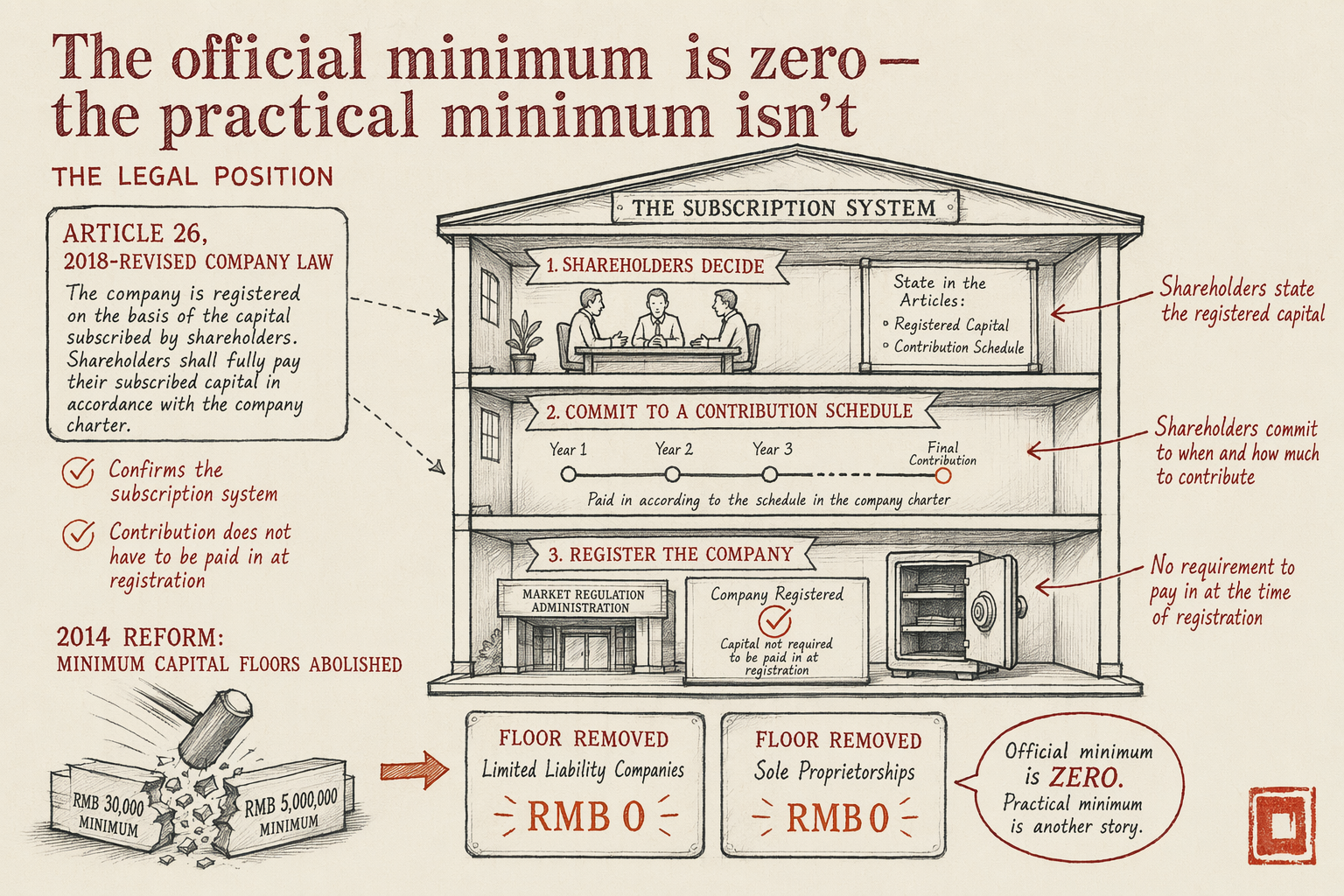
The official minimum is zero — the practical minimum isn't
The legal position. Article 26 of the 2018-revised Company Law confirms the subscription system: shareholders state the registered capital, commit to a contribution schedule, and the contribution does not have to be paid in at registration. The original 2014 reform abolished the RMB 30,000 floor for limited liability companies and the RMB 5,000,000 floor for joint stock companies. No statutory minimum remains for general WFOEs.
The operational position. SAMR's registration officers retain discretion under the Company Registration Regulation (last amended 2024) to reject filings where the stated capital is "obviously inconsistent" with the stated business scope. "Obviously inconsistent" is not statutorily defined — it is enforced through internal SAMR guidelines that vary by district. A trading WFOE in Shanghai's Pudong New Area declaring RMB 10,000 of capital will be challenged. A consulting WFOE in the same district declaring RMB 200,000 will not be.
The 2024 Company Law revisions tightened the practical floor by requiring contribution within five years of registration. You can no longer commit to wiring capital over 30 years — the five-year cap means whatever number you state, you have to actually fund within five years. That changes the calculation: stated capital is now an enforceable wire commitment, not a paper figure.
How AIC challenges your stated capital
The challenge happens during the registration officer's substantive review, typically days 5-10 of a clean filing. The officer reviews your stated business scope, stated registered address, and stated capital figure. If the figure looks low for the scope, the officer issues a written supplementary-information request — usually phrased as "please justify the rationale for the stated capital in light of the operational scope."
What works at this stage: a business plan covering Year 1 operating expenses (rent, salaries, marketing, COGS estimates), proof that the foreign parent can fund the stated capital, and a contribution schedule that aligns with operating cash needs. A two-page memo from the foreign parent's CFO, plus a year-one budget, plus a wire confirmation showing the parent has access to the funds, gets the challenge cleared in 5-10 business days.
What does not work: arguing that the 2014 reform eliminated the minimum, asserting that the registry has no authority to challenge, or providing only a high-level revenue projection. SAMR officers have heard all of these and the challenge stands until you provide the substantive justification.
Capital benchmarks by industry (trading, consulting, manufacturing)
Working 2026 benchmarks. These are the figures that SAMR officers in tier-1 cities approve without supplementary-information requests. Numbers in stated capital, RMB equivalent at filing-time FX.
- Consulting WFOE (management, technology, design services): RMB 200,000-500,000 — roughly USD 30-50k.
- Trading WFOE (import-export, wholesale, distribution): RMB 350,000-1,200,000 — roughly USD 50-150k. Higher if the scope includes warehousing or bonded operations.
- F&B and retail WFOE: RMB 500,000-2,000,000 — roughly USD 75-250k. Reflects rent commitments, fit-out costs, and inventory.
- Manufacturing WFOE: RMB 1,000,000-3,500,000 — roughly USD 150-500k. Reflects equipment, factory lease, raw materials.
- Tech / R&D WFOE: RMB 500,000-2,000,000 — roughly USD 75-250k. Driven by 1-3 years of payroll for senior technical staff.
- Media / advertising WFOE: RMB 1,000,000-3,000,000 — restricted scope, higher operational substance expectations.
These benchmarks are the band where SAMR clears without further questions. You can register lower with a strong supplementary-information response, but each step below the benchmark adds 5-15 business days of registry review.
Capital benchmarks by city (Shanghai, Shenzhen, Beijing, Hangzhou)
Within the same industry, the working figure varies by city. The hierarchy in 2026:
- Shanghai: tier-1 baseline. Pudong New Area is strictest on substance documentation; Free Trade Zone areas are slightly more permissive on stated-capital reductions when the WFOE is in encouraged-investment sectors.
- Shenzhen: lower than Shanghai for tech and digital-content WFOEs. Qianhai Free Trade Zone has documented relaxed capital expectations for HK-controlled WFOEs under CEPA.
- Beijing: highest of the four. Tier-1 financial and cultural-services WFOEs are routinely required to show RMB 1,000,000+ in stated capital plus documented capital availability before registration completes.
- Hangzhou: meaningful concessions for technology WFOEs under the Future Sci-Tech City special policies. Operating consulting WFOEs at RMB 200,000 stated capital is normal here.
Tier-2 cities (Chengdu, Xi'an, Suzhou, Wuhan, Qingdao) are typically more permissive but require physical-presence verification more aggressively than tier-1, which offsets the capital flexibility.
Visa quota is the second factor that pushes capital up. The 2024-revised Foreign Talent Catalog ties foreign-hire visa quotas to capital tiers: under RMB 500k capital, expect 1-2 foreign hire visas; RMB 1-3M, expect 3-5; above RMB 5M, the cap relaxes. If your business model requires 3+ foreign hires from year one, the stated capital has to support the visa application even if your operating runway does not yet need that figure.
Capital injection schedules and the multi-year approach
The five-year cap from the 2024 Company Law revision changed how schedules are drafted. The conservative pattern in 2026:
- Year 1 (registration to Month 12): wire 20-30% of stated capital. Funds the basic account, social insurance enrolment, year-one operating expenses, and the audit trail.
- Years 2-3: wire an additional 30-40% in line with operating cash needs. This typically tracks first-revenue and first-customer-acquisition spend.
- Years 4-5: wire the remaining 30-50% to complete contribution within the five-year cap.
The schedule is documented in the Articles of Association at filing time. Changes after filing require a SAMR amendment — possible but adds 10-20 business days and on-the-record visibility of the change.
Foreign parents typically execute capital injections through SAFE (State Administration of Foreign Exchange) registered cross-border wires. Each tranche is a separate SAFE filing under the inbound-FDI catalog, processed through the WFOE's basic account bank. Allow 5-10 business days per injection from initiation to credit confirmation.
What happens if you can't actually wire the stated capital
Three failure modes, in order of severity:
Mode 1 — schedule slip, in-band. You stated RMB 1,000,000 over five years and at Year 2 you have wired RMB 200,000 instead of the RMB 400,000 on schedule. Not yet a violation since the five-year endpoint is still in front of you, but it appears on the annual 工商年报 AIC report and starts a track record. Cure: catch up in subsequent tranches or formally amend the schedule at SAMR.
Mode 2 — schedule slip, end of five years. You committed RMB 1,000,000 by Year 5 and you have wired RMB 600,000 at the cap date. Violation of the 2024 Company Law cap. SAMR can fine the shareholders up to RMB 200,000 per offence and force capital reduction or deregistration. Cure: file a capital reduction at SAMR before the cap date — the reduction itself takes 45-60 business days and includes a 45-day public notice period.
Mode 3 — capital reduction triggered by ongoing losses. Operating losses have eroded the WFOE's net assets below the registered capital floor. The WFOE remains legal but the registered capital figure stops reflecting reality. The fix is the same — capital reduction filing — but the audit trail matters for banking and visa quotas.
The defensive move is to register a stated capital you can actually fund on the stated schedule, with a 20% buffer. Aggressive stated capital impresses no one in 2026 and creates a wire commitment you may not want.
For broader structural context see WFOE vs Rep Office vs Hong Kong limited. The China company formation service hub lists quoted prices for WFOE registration. And for the post-registration audit cycle that surfaces capital schedule slips, see WFOE annual audit and 工商年报 walkthrough.
Frequently asked questions
Does the stated capital have to be in RMB or can it be in USD?
It can be stated in USD, EUR, HKD, or other major currencies. The filing converts at the SAFE-published reference rate on the filing date. Most foreign founders state in USD and let the conversion happen at filing.
Can I reduce stated capital after registration?
Yes, through a SAMR capital reduction filing — 45-60 business days, includes a public-notice period for creditors. Reductions are routine but show on the entity's record.
Does increased stated capital improve banking outcomes?
Materially yes. ICBC, Bank of China, and CMB all weight registered capital in their KYC scoring for foreign-controlled WFOEs. Higher capital correlates with faster account opening and higher initial transfer limits.
Is there a benefit to registering with stated capital well above the realistic operating need?
For visa quotas yes (see capital benchmarks by city), and for procurement perception with state-owned-enterprise customers yes. Otherwise no — and remember the five-year wire commitment under the 2024 Company Law.
Next step
To work out your actual capital figure against your operating budget, use the China Expansion Budget Estimator — XLSX with formulas, populates the five-year contribution schedule alongside year-one OpEx. Free download.