The filing went through. Your site is live, the footer carries the 沪ICP备XXXXXXXX号 number, traffic is coming in. Eighteen months later you log in one morning and the site is unreachable from mainland China. No warning email. No SMS to the legal rep's phone. The sponsor's response: "Your filing was suspended for failing the annual review."
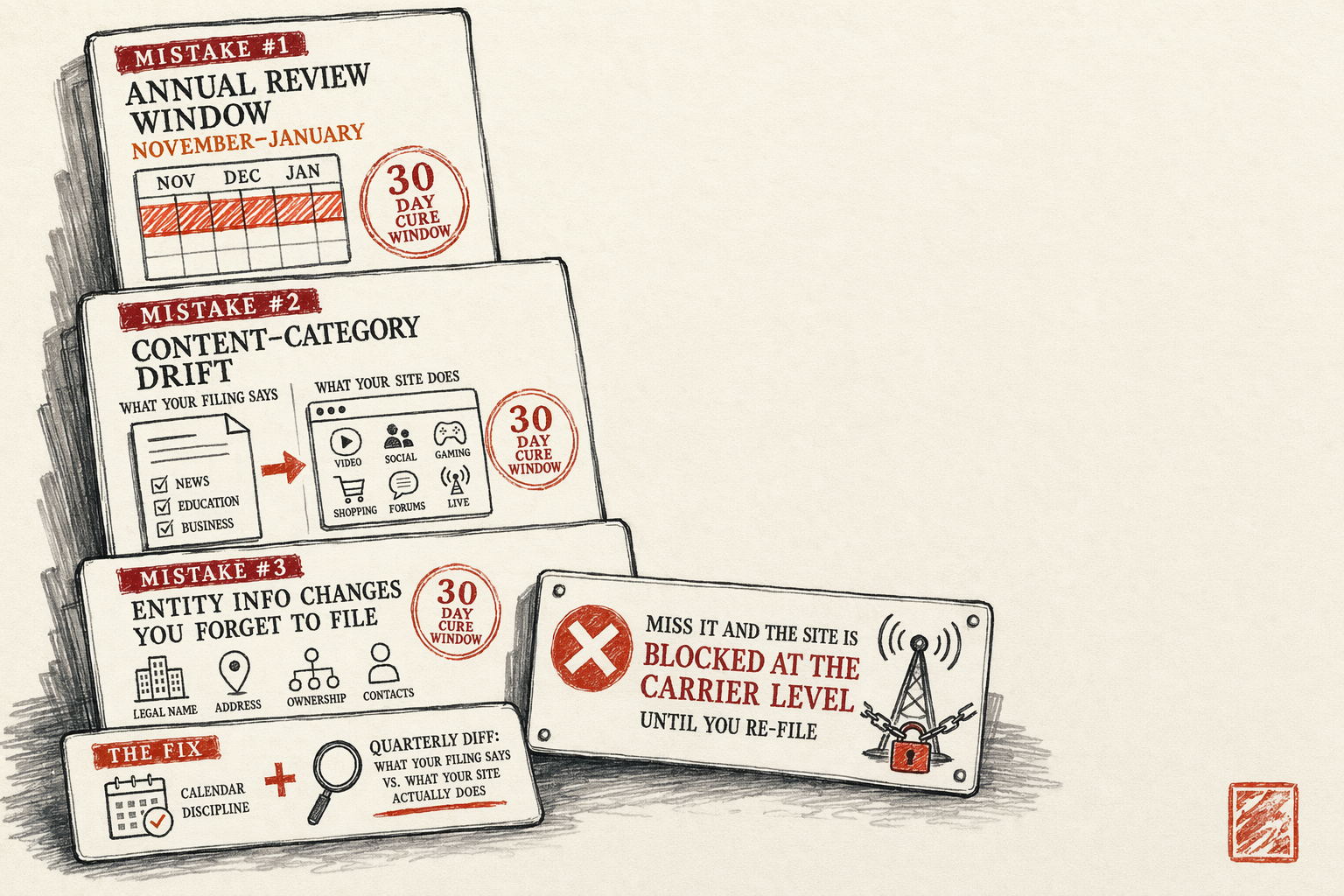
This article is the maintenance brief. Filings die in three predictable windows, each with a 30-day cure clock that almost nobody catches in time. This piece walks through the calendar, names the mistakes that quiet-kill foreign-brand filings, and outlines the recovery procedure when you miss one. Written for the operator who has the filing in hand and needs to keep it alive without scheduling a 12-month engagement with a compliance vendor.
The ICP annual-review cycle
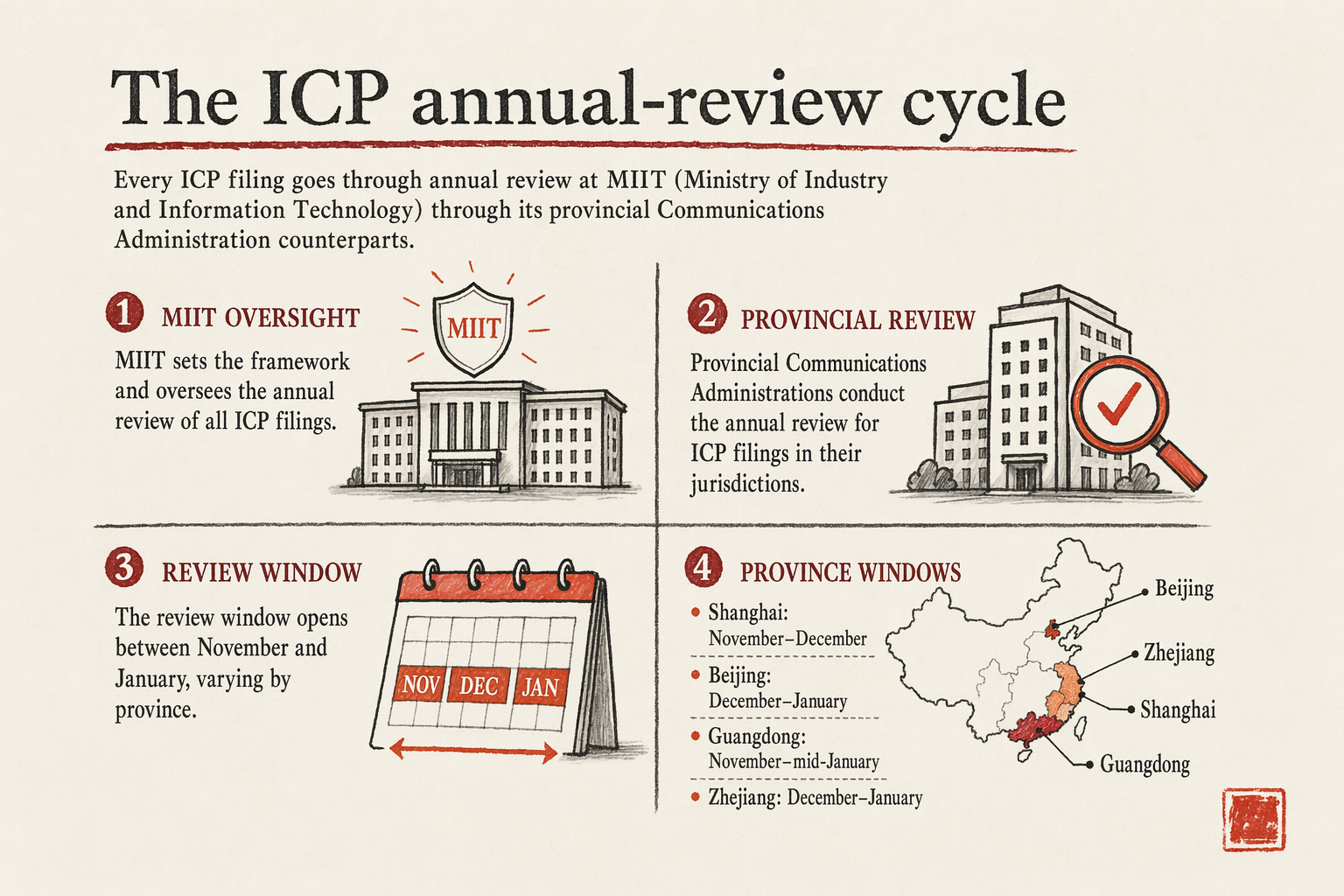
Every ICP filing goes through annual review at MIIT (Ministry of Industry and Information Technology) through its provincial Communications Administration counterparts. The window opens between November and January depending on the province — Shanghai typically November-December, Beijing December-January, Guangdong November-mid-January, Zhejiang December-January.
What review actually means: the sponsor confirms in the MIIT portal that the entity is still active, the legal rep is unchanged, the domain still resolves to a host within the sponsor's IDC, and the content category has not drifted. A check-box exercise on the sponsor's side that mostly happens silently — until something does not check out and the sponsor needs information from you that you do not respond to in time.
The mistake foreign founders make: assuming review is automatic because the sponsor handles it. It is automatic if nothing has changed. If anything material changed in the prior year — entity name, legal rep, registered address, business scope, content category, hosting provider — the sponsor needs documents to file the update alongside the review. Without them the review fails and the filing enters the cure clock.
Content category drift that invalidates filings
Reason #1 that filings fail review: the site has grown features the filing does not cover. The classic pattern is a brand site that started as a brochure (filing-only category) and quietly added a checkout button (license category — see ICP 备案 vs ICP 许可证 explained). Or a marketing site that started monolingual and added a paid content section. Or a content site that started editorial and added user-generated comments without registering as a community service.
Provincial Communications Administrations sample-audit sites during annual review. Their crawlers look for: checkout flows, payment integrations, sign-up forms behind paywalls, downloadable paid resources, user-content-generating components, content categories on the restricted list (financial, medical, news, real estate). When they find one of these on a filing-only site, the review fails.
Pre-empt this with a quarterly content audit: list every page on the site, classify each by content category, and compare against your filing record. If anything has crossed into a category the filing does not cover, either remove the feature from the mainland-hosted domain or initiate a license upgrade before the annual review window opens. Doing it pre-emptively gets a self-disclosure discount; getting caught at review gets a fine.
Entity-info change procedures
Reason #2: entity-info changes that were not filed. Any of the following triggers a mandatory supplementary filing within 30 calendar days under MIIT Circular [2005] No. 35 as amended:
- Change of 法定代表人 (legal representative) — happens when a founder leaves, a nominee rotates, or you hire a local GM and move the role.
- Change of registered entity name — happens when the WFOE rebrands or restructures.
- Change of registered address — happens when you move the virtual office.
- Change of business scope at SAMR (State Administration for Market Regulation) — happens when you amend your 经营范围 to add new activities.
- Change of registered capital — happens when you inject additional capital or do a capital reduction.
- Change of hosting provider or IP address pool.
Each requires the sponsor to file the update on the MIIT portal with documentation. Most foreign brands handle 1-3 of these in a typical 24-month window and forget to file one. The unfiled change surfaces at the next annual review — sponsor checks the SAMR record against the filing record, finds the mismatch, fails the review.
The 30-day cure window
When a review fails or a violation is detected, the filing enters a 30-day cure window. The provincial Communications Administration sends a written notice (paper, mailed to the registered address) and an electronic notice (to the legal rep's registered mobile number). Day 1 of the cure clock starts the day the notice is sent, not the day you receive it.
What you must do in 30 days, in this order:
- Acknowledge the notice through the sponsor's MIIT portal interface — establishes that the entity is responsive.
- Identify the failure cause — content drift, entity change, sponsor IDC issue, or PSB sub-filing lapse.
- Cure the underlying issue — remove the offending content, file the entity-info update, transfer to a new sponsor, complete the PSB filing.
- Submit the cure documentation to the sponsor for filing.
- Wait for re-validation — typically 5-10 business days after the cure filing.
Miss any step and the filing is suspended at day 31. Suspension means the site is blocked at the carrier level inside mainland China. Reactivation requires re-filing from scratch as a new submission. Allow 25-30 business days of additional downtime if it gets that far.
What to do when your filing is suspended
You missed the window. The site is blocked. The legal rep just got the notice from the sponsor that you are in active suspension. What happens next:
Option 1 — file from scratch under the same entity. Requires re-submitting the full document packet (entity proof, WHOIS, content sample, real-name) at the sponsor and going through the 18-25 business day approval cycle. The original filing number is gone; you get a new one. Downstream consequence: any third-party listings referencing the old filing number (app stores, ad platforms, partner directories) need updating.
Option 2 — file under a different sponsor while disputing the original suspension. This is appropriate when you believe the suspension was administrative (sponsor error, false-positive content flag) rather than substantive. The dispute runs in parallel through the provincial Communications Administration with a 30-60 day administrative-reconsideration window under the 1999 Administrative Reconsideration Law. Most disputes do not reverse the suspension but they do clear the entity's record so the new filing does not inherit the suspended status.
Option 3 — for serious cases involving content violations or repeat offenses, the entity itself can be flagged at MIIT, blocking new filings under the same entity for 6-24 months. The recovery here is to file under a related entity (parent, subsidiary, sister WFOE) and accept that the original entity's filing capacity is offline for the duration.
For the operational migration mechanics see transferring ICP between sponsors. The broader ICP filing guide covers the underlying filing lifecycle, and the China digital presence service hub shows quoted prices for renewal and remediation engagements.
Frequently asked questions
Does the sponsor remind me when annual review is due?
Good sponsors do. Cheap sponsors do not. The sponsor question list in how to choose an ICP sponsor includes the review-reminder commitment — get it in writing in the engagement letter.
Is there a renewal fee separate from the annual maintenance fee?
The MIIT review itself is free. What you pay annually is the sponsor's maintenance fee (typically RMB 600-1,800/yr) which covers the sponsor's labor for review handling. If the sponsor charges a separate "renewal fee" they are double-billing.
What happens if my legal rep changes mid-cycle and we cannot file the update in 30 days?
File a placeholder notice through the sponsor stating the change is in progress and provide the SAMR amendment receipt as evidence. The 30-day clock pauses while the SAMR amendment is processing (typically 10-20 business days). Resume the filing on receipt of the new business license.
Can I voluntarily cancel my filing if I no longer need the mainland-hosted site?
Yes. Submit a voluntary cancellation through the sponsor's MIIT portal. The filing is deleted in 5-10 business days and the entity's record stays clean for future filings.
Next step
Set yourself up for review season with the ICP Readiness Checklist — page 7 includes the maintenance calendar (annual review window, entity-change triggers, PSB renewal) you can drop into whatever calendar system you use. Free PDF.
Related
7 min read
ICP 备案 Filing: What Foreign Brands Actually Need
Filing types, sponsor model, real-name and domain rules, top rejection reasons, renewal pitfalls — everything that goes wrong with ICP filings.
6 min read
How to Choose an ICP Sponsor for Your Domain
Picking an ICP sponsor — entity-tied filings, sponsor fee ranges, support quality, what happens when a sponsor disappears.