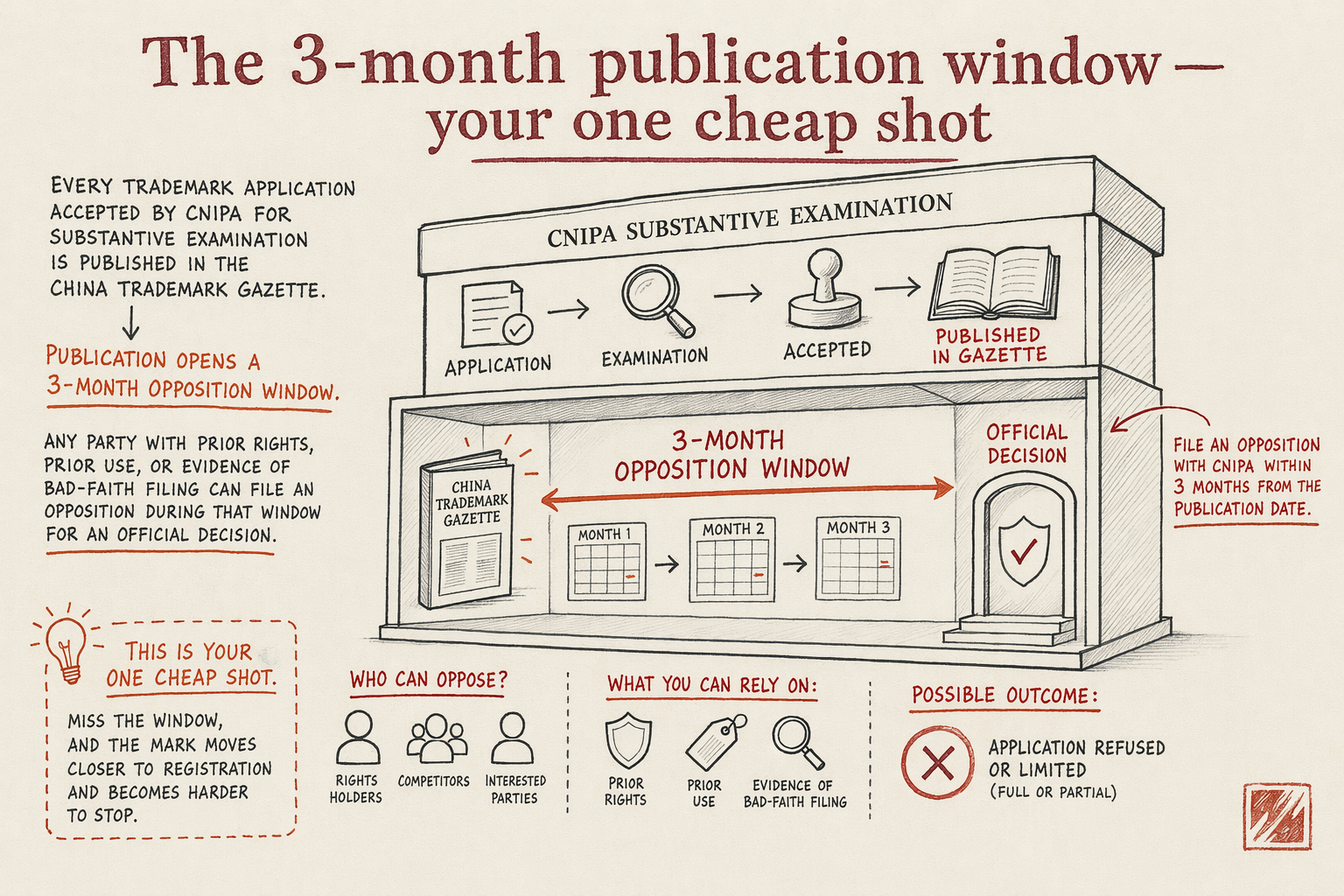
The 3-month publication window — your one cheap shot
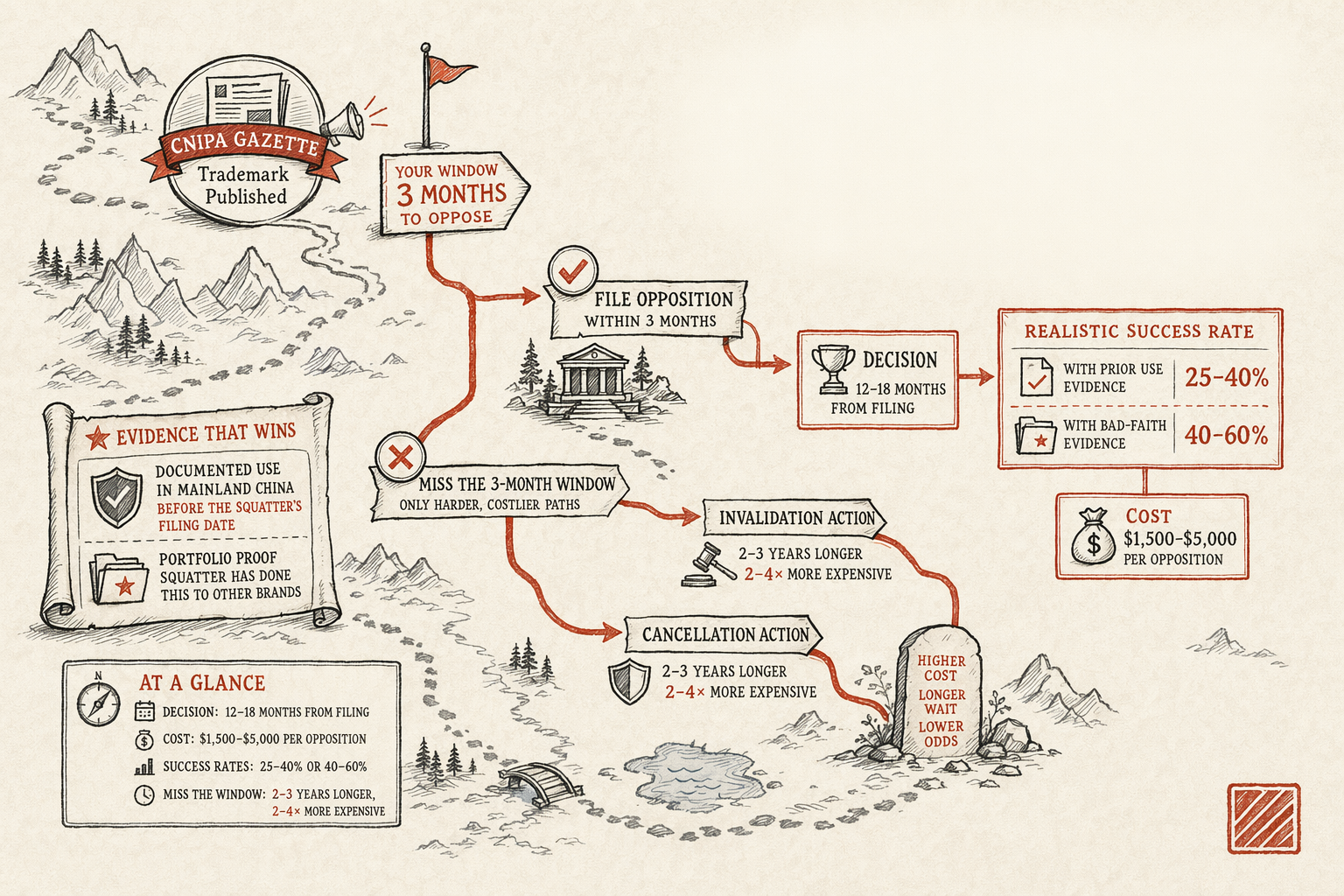
Every trademark application accepted by CNIPA (China National Intellectual Property Administration) for substantive examination is published in the China Trademark Gazette. Publication opens a 3-month opposition window. Any party with prior rights, prior use, or evidence of bad-faith filing can file an opposition during that window for an official fee of approximately $80-$150, plus agent fees of $1,500-$5,000 depending on evidence complexity. If the opposition succeeds, the mark is refused and the squatter has no registered right. If the opposition fails or no opposition is filed, the mark moves to registration and the squatter holds enforceable rights for 10 years renewable.
The window is the cheapest and fastest path to defeat a squat. By comparison, invalidation (an adversarial proceeding launched against an already-registered mark) typically runs $4,000-$15,000 over 18-24 months. Three-year non-use cancellation requires waiting out the squatter's 3-year clock first, then 12-18 months of CNIPA review. Beijing IP Court appeals run another 12-24 months on top of either.
Missing the 3-month window is the single most-common error in foreign-brand trademark defense in China. Most brands discover the squat months or years after publication because they were not monitoring the gazette. The fix is annual gazette monitoring ($300-$1,200/year via a licensed Chinese trademark agent) keyed to your registered mark, common-law usage, and likely Chinese-character transliterations.
What evidence CNIPA accepts
CNIPA's opposition examiners evaluate evidence against the standards in the Trademark Law of the People's Republic of China (Articles 30, 31, 32 for prior-rights grounds; Articles 4, 13, 44 for bad-faith grounds; Article 7 for the general good-faith requirement). Different grounds require different evidence packages.
Prior-rights evidence (Article 32): the prior registration or prior-use evidence that establishes your standing. For foreign brands the strongest evidence is a CNIPA filing predating the squatter's (rare, since by the time you are opposing you usually do not have an earlier CNIPA filing) or documented in-China use predating the squatter's filing. Acceptable proof: dated invoices to Chinese customers, marketplace order histories from Tmall/JD/Pinduoduo, shipping records into China, Chinese press coverage with verifiable publication dates, advertising contracts with Chinese platforms. Foreign use alone is rarely sufficient absent well-known-mark recognition.
Prior-rights evidence under Article 30 / 31 (collision with earlier filings): the prior earlier-filed mark held by you or your predecessor in interest. This is the strongest evidence — a registered or earlier-filed mark in the same or similar class beats almost any squatter's defense.
Bad-faith evidence (Articles 4, 13, 44): evidence that the applicant is not the bona fide owner of the brand and is filing in bad faith. The strongest forms are (a) the applicant holds a portfolio of other-people's marks, available from CNIPA's applicant-history database, (b) the applicant has previously offered to sell the mark to its real owner or to other parties, (c) the applicant's address, principal, or business scope has no plausible connection to the goods or services in the class.
Evidence weight at CNIPA is roughly: registered-mark conflict > documented Chinese in-country use > documented Chinese press coverage > squatter's bad-faith portfolio > foreign-country registration > general consumer awareness claims.
Bad-faith filing as a recognized grounds
The 2019 revision to the Trademark Law strengthened Article 4, which now explicitly forbids "applications for trademark registration filed in bad faith without the intent to use." Article 13 covers protection for well-known marks against registration of identical or similar marks. Article 44 allows for invalidation on bad-faith grounds. Together these three articles form the spine of any bad-faith-grounded opposition.
Proving bad faith at CNIPA generally requires demonstrating a pattern, not a single act. The strongest bad-faith evidence package contains:
- The squatter's CNIPA filing portfolio. A list of all marks filed by the same applicant, available via the applicant-history search on the CNIPA public registry. A squatter with 40 marks across 12 unrelated brands has a much weaker defense than a squatter with 2 marks in their own apparent business sector.
- Evidence of resale or licensing offers. Emails, WeChat messages, or third-party reports showing the squatter has offered the mark for sale, especially to its real-world owner. Brokers in this market are sometimes willing to provide statements naming the squatter as a known opportunist.
- Mismatch between the squatter and the class. A Shenzhen office furniture company that filed a Class 3 cosmetics mark has obvious mismatch on its face. CNIPA examiners read this as a strong bad-faith signal.
- Prior CNIPA decisions against the squatter. If the applicant has lost prior oppositions or invalidations on bad-faith grounds, those decisions are admissible and weighty.
Bad-faith oppositions are slower to prepare than prior-rights oppositions because the evidence portfolio requires research, but they often succeed against squatters where pure prior-rights evidence is thin. They are also more durable on appeal, because the Beijing IP Court has historically affirmed bad-faith findings at higher rates than narrow prior-rights findings.
Realistic success-rate ranges by evidence type
The CNIPA Trademark Office publishes aggregate statistics annually. The numbers below are derived from published statistics and from observed outcomes across foreign-brand opposition portfolios; they should be read as bands, not point estimates.
- Opposition with a registered prior CNIPA mark in the same class: success rate 75-90%. This is the strongest case and almost always wins.
- Opposition with documented Chinese in-country use predating the squatter: 40-65%. Strength depends on the quantity and quality of the use evidence and on whether the use was for the same goods.
- Opposition with foreign registration + significant cross-border awareness in China: 25-45%. Weaker than in-country use but workable for brands with documented Chinese consumer awareness through digital channels.
- Opposition on bad-faith grounds with documented portfolio: 40-60%. Works best when the squatter has a clear pattern of filings unrelated to their own business.
- Opposition combining prior rights and bad faith: 50-75%. Layered grounds give CNIPA multiple paths to refusal and increase the durability of the decision on appeal.
- Opposition with only foreign use, no Chinese activity, no bad-faith portfolio: 10-25%. Possible but not the bet to make.
Two notes on these numbers. First, success rates have been trending upward for foreign brands since the 2019 law revision, particularly on bad-faith grounds; statistics from before 2020 understate current odds. Second, the success rate at first instance does not include the appeal layer. A first-instance loss can be reversed at the Beijing IP Court at meaningful rates (20-35%) on appeal, depending on the grounds and the quality of the evidence package.
Cost vs three-year non-use cancellation alternative
If the 3-month publication window has already closed, the choice is between invalidation (immediate, expensive, lower odds for foreign brands) and three-year non-use cancellation (delayed, cheaper, higher odds against squatters who don't actually use the mark). The economics:
Opposition during publication: $1,500-$5,000 in agent fees plus CNIPA fees. Decision in 12-18 months. Success rate 25-65% depending on evidence. Cheapest path if the window is open.
Invalidation (post-registration adversarial): $4,000-$15,000. Decision in 18-24 months. Success rate 20-50% for foreign brands depending on grounds. Worth considering when bad-faith evidence is strong, less attractive when only prior-use evidence is available.
Three-year non-use cancellation: $2,000-$6,000. Decision in 12-18 months after the squatter's 3-year clock has run. Success rate 50-70% because most squatters cannot prove the use the burden requires. Total timeline from initial squat to recovery: roughly 3 years registration plus 12-18 months cancellation = 4-4.5 years. The detail is in three-year non-use cancellation procedure.
Negotiated purchase: $5,000-$80,000. Immediate. The squatter prices to the marketplace, which means professional squatters charge in proportion to the visible commercial value of the mark to its real owner.
The optimal combination for a brand needing to launch within 12 months is usually: file the opposition if the window is open, file the cancellation petition in parallel as soon as the registration clock allows, and open a transfer negotiation with the squatter at the same time. The squatter's negotiating leverage falls every month a credible CNIPA proceeding sits on their file. The negotiated price at month 12 of an active opposition is usually 40-70% of the price the squatter would have demanded at month 0.
Related
7 min read
China Trademark Squatting — Defensive Playbook
First-to-file principle, Class 1-45 coverage strategy, Chinese transliteration filing, opposition windows, non-use cancellation recovery.
6 min read
Three-Year Non-Use Cancellation Procedure
How to recover a squatted Chinese trademark via the 3-year non-use cancellation route — burden of proof, timeline, and gotchas.