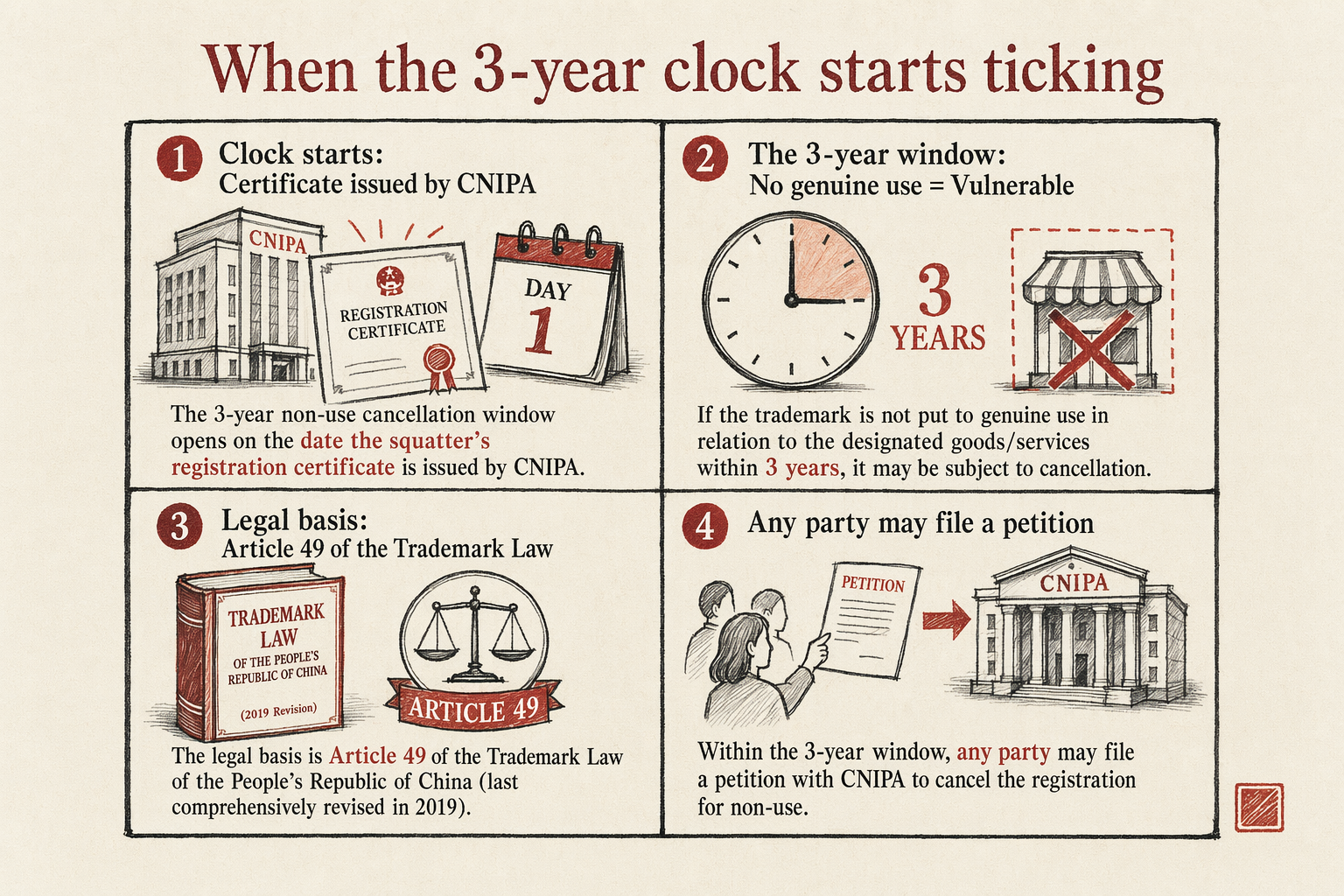
When the 3-year clock starts ticking
The 3-year non-use cancellation window opens on the date the squatter's registration certificate is issued by CNIPA (China National Intellectual Property Administration). The relevant authority is Article 49 of the Trademark Law of the People's Republic of China (last comprehensively revised 2019), which provides that any party may file a petition for cancellation against a mark that has not been used for 3 consecutive years.
Two clarifications on the timing. First, the clock starts at certificate issuance, which is typically 12-15 months after the original filing date. The application date and the publication date are both earlier and irrelevant for cancellation timing. Second, the 3-year window is rolling: cancellation can be sought based on any continuous 3-year non-use period after registration, not just the first 3 years. A mark used in years 1-2 and then abandoned can be cancelled based on non-use in years 3-5.
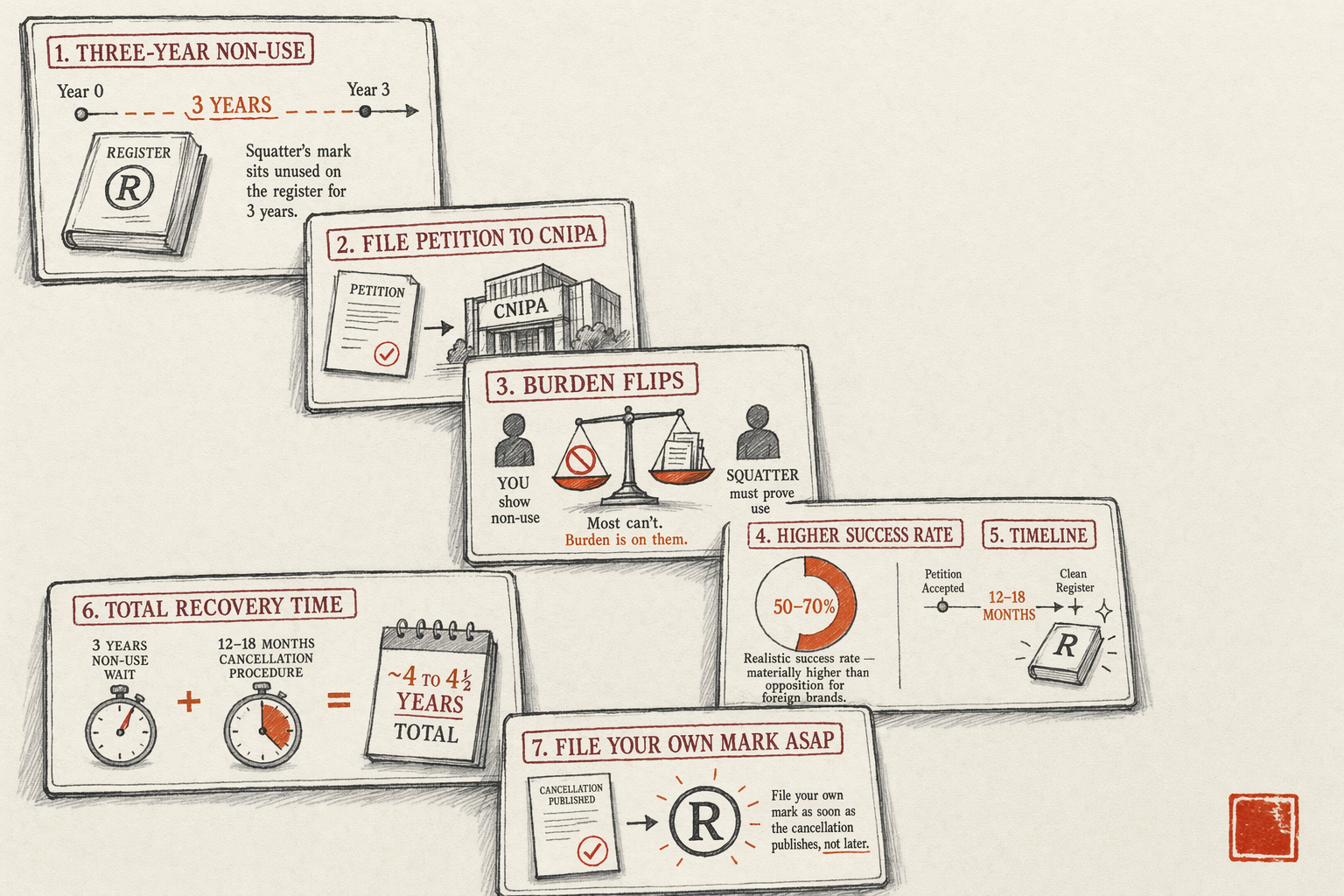
The strategic implication for a foreign brand that has just been squatted is harsh. Best-case recovery via non-use cancellation runs roughly 4 years from the squatter's filing date: 12-15 months for the squatter's mark to register, then a 3-year non-use window, then 12-18 months for CNIPA to process and decide the cancellation. If the squatter mounts a defense with use evidence and you appeal, add another 12-24 months at the Beijing IP Court.
The reason non-use cancellation is still the most-used recovery route for foreign brands is not speed but odds. Opposition during the 3-month publication window has 25-40% success rates for typical foreign-brand evidence packages. Non-use cancellation has 50-70% success rates against squatters who never used the mark, which describes most squatters.
Filing the cancellation petition
The cancellation petition is filed with CNIPA's Trademark Office, not the Trademark Review and Adjudication Board. The procedural steps:
- Confirm the registration has been on the books for at least 3 years. Pull the registration certificate from CNIPA's online registry and verify the issuance date. A petition filed even one day before the 3-year mark is rejected on procedural grounds and the agent fee is generally not refundable.
- Identify the specific goods or services to cancel. The petition can target the entire registration or specific goods within it. For brands needing to file their own mark in a narrower set of specifications than the squatter holds, partial cancellation often works better than total cancellation.
- Draft the petition statement. The petitioner asserts that the mark has not been used on the designated goods or services within mainland China during the relevant 3-year window. The petitioner does not have to prove non-use; the petitioner asserts it and the burden flips to the registrant.
- File through a licensed Chinese trademark agent. Foreign petitioners must file through a CNIPA-licensed agent. The agent fee runs $2,000-$6,000 depending on the complexity of the goods specification and the firm. Official CNIPA fees are roughly $80-$150.
- Receive the docket and notify the registrant. CNIPA dockets the petition within 4-8 weeks and serves the registrant with notice. The registrant has 2 months to file a use defense.
Petition drafting is light work — the substantive evidence burden is on the squatter, not on the petitioner. The agent fee primarily reflects the certified-agent role and the responsibility for serving CNIPA correspondence, not for building a deep evidentiary case at filing time.
Squatter's burden to prove use
After service of the petition, the registrant has 2 months to file a use defense with CNIPA. The defense package must demonstrate genuine commercial use of the mark on the designated goods or services within mainland China during the 3-year window. CNIPA's standard for acceptance of use evidence has tightened materially since the 2019 revision.
Use evidence CNIPA accepts:
- Dated invoices issued in mainland China showing the mark on the goods or services, with verifiable buyers and shipping records.
- Marketplace listings (Tmall, JD, Pinduoduo, Taobao) showing the mark in storefront or product titles, with order history attached.
- Packaging photographs with verifiable dates, ideally from third-party advertising or media coverage that corroborates the date.
- Paid advertising contracts with Chinese platforms (Baidu, WeChat, Xiaohongshu) showing the mark in placement, with payment records.
- Customs declarations or import records bearing the mark.
Use evidence CNIPA increasingly rejects:
- Sham or token use staged specifically after the petition is filed. Examiners check the dates against the petition serving date and treat post-petition spikes as evidence of bad faith.
- Use only outside mainland China, including Hong Kong, Macau, and Taiwan. The mark must be used inside the territory CNIPA covers.
- Use on goods or services materially different from those in the registration. A Class 25 registration for footwear is not preserved by use on apparel.
- Self-issued documents without third-party verification — internal invoices, undated brochures, undated photographs.
The practical effect is that squatters who have never traded in the goods or services they registered cannot manufacture a defense in 2 months. Approximately 50-70% of non-use cancellations against pure squatters succeed at first instance. The most-common reason for a failed cancellation is a squatter who staged real commercial activity — manufactured small batches of goods bearing the mark, sold them on Taobao, kept invoices and shipping records — within the 3-year window. Cancellation against a squatter who has acted is materially harder than cancellation against a squatter who has simply held the certificate.
Timeline from petition to cancellation
The procedural timeline at CNIPA, with the 2024 standard cycle times:
- Filing to docketing: 4-8 weeks. CNIPA assigns a case number and serves the registrant.
- Registrant defense window: 2 months from service. The registrant either files use evidence or fails to respond.
- Examination: 6-9 months. The Trademark Office reviews the use evidence, requests supplementary submissions if needed, and issues a first-instance decision.
- Decision: Roughly 12-18 months from petition filing for non-defended or weakly-defended cases. Defended cases run 14-20 months.
If the first-instance decision favors the petitioner, the registration is cancelled. The mark returns to the public domain after a brief publication period. If the decision favors the registrant, the petitioner can file a review with the Trademark Review and Adjudication Board (TRAB) within 30 days; TRAB review adds 12-18 months. Appeals from TRAB go to the Beijing Intellectual Property Court, adding 12-18 months on top.
Best-case end-to-end timeline from squat detection to clean register, assuming you wait the full 3-year clock and the cancellation succeeds at first instance: roughly 4-4.5 years. Worst-case with defended cancellation and full TRAB + Beijing IP Court appeals: 7-8 years. For brands needing to launch within 12 months of detection, non-use cancellation is the long-game; the short-game is negotiated purchase plus opposition (where the publication window is still open) plus immediate defensive filings around the squatted mark.
Refile your own mark immediately after
The moment a cancellation publishes, file your own mark in the same class (and your defensive cluster around it) without delay. The reason: the mark becomes available again on the public registry the day the cancellation is announced, and squatters monitor cancellation decisions specifically to refile the freshly-available marks.
The sequence for refiling:
- Subscribe to cancellation publication alerts at CNIPA. Your agent can set this up. The decision is published in the China Trademark Gazette and on CNIPA's online registry.
- Pre-prepare your own application package. By month 6-9 of the cancellation proceeding, the trajectory is usually clear from the CNIPA correspondence and the registrant's response. Have your own application drafted and ready to file, including the agent-of-record arrangement.
- File the day the cancellation publishes. CNIPA's filing-date rule applies: the first filer after the cancellation has priority. Even a 24-hour delay can hand the slot back to a different squatter.
- File the defensive cluster, not just the cancelled class. The original squatter — or a different one — may have filed in adjacent classes during the cancellation period. Pull the registry and refile in every class where your defensive cluster requires coverage, not only in the cancelled class.
- Monitor the gazette for the next 12 months. Any subsequent squatter filing on your freshly-registered marks should be caught at the 3-month publication window for opposition.
The cleanest outcome is the one where the refile lands the day after publication, the defensive cluster is filed in parallel, and the brand has registered marks in every class where a squatter could plausibly file within the year following recovery. The dirtier outcome — and a common one for brands without standing monitoring — is to recover the cancelled mark only, then discover six months later that the original squatter or a new one has filed in the adjacent classes. The whole cycle then restarts in those classes.
Related
7 min read
China Trademark Squatting — Defensive Playbook
First-to-file principle, Class 1-45 coverage strategy, Chinese transliteration filing, opposition windows, non-use cancellation recovery.
6 min read
Opposing a Squatted Trademark — Process and Odds
The CNIPA opposition process during the 3-month publication period, what evidence wins, what evidence doesn't, and success-rate ranges.