The WeChat Official Account interface looks deceptively flexible. You can build a menu, you can push broadcasts, you can send template messages, you can host HTML5 pages. Then you start operating it and discover that each of these surfaces has hard caps Tencent enforces silently. The first time you find out about most of these is when something breaks.
This article catalogues the structural limits — the ones you cannot negotiate around with a fee or a partner — and the operational limits that look harder than they are. By the end you'll know which constraints to architect around and which ones reward a tiny amount of cleverness.
Template messages — quotas and approval
Template messages are the underrated workhorse of WeChat OA. They are transactional notifications (order confirmations, appointment reminders, payment-status updates, shipping notices) that get sent to a specific user inside a 48-hour window after that user has interacted with your OA. They are not broadcasts; they bypass the four-per-month limit on Service accounts entirely. They are also the part of the API surface most foreign brands underuse.
The constraints, said plainly:
- One template per industry-category per 7 days. Tencent groups templates into industry-mapped catalogues (retail, hospitality, finance, education, B2B services, etc), and your OA registers under one or two of these. You can use any of the approved templates inside your registered industry, but each individual template's quota is one send per user per 7-day rolling window.
- The 48-hour customer-service window. A template message can only be sent to a user within 48 hours of that user interacting with your OA (a message they sent, a menu item they tapped, a payment they completed). After 48 hours, the message is rejected. This is the constraint people forget about.
- Templates require approval. Each template you want to use has to be selected from Tencent's catalogue, customised with your variable fields, and submitted for approval. Approval takes 3-7 business days for standard categories.
- Industry-template catalogues are not negotiable, but they are swappable. Your OA can change industry classification once per quarter, with a fresh review. Most brands stick with one industry for the life of the account.
The 48-hour window is the source of most operational frustration. You cannot proactively message a user who has not interacted with you recently — even to remind them about an abandoned cart, even to alert them about an order issue, even to follow up on a customer-service ticket. The workaround is to engineer interactions: a tap on a menu item counts as an interaction, a reply to a previous message counts as an interaction. Brands that nail this build deliberate "interaction triggers" into their content strategy ("reply 1 for size guide, 2 for delivery info"), which reset the 48-hour window each time.
Broadcast frequency by account type
The broadcast limits are the most-quoted numbers about WeChat OA, and the part Tencent will not budge on:
- Service Account: 4 broadcasts per calendar month, full reset on the 1st of the next month. Each broadcast can contain up to 8 articles in a multi-card layout, but the card-count above 1 is rarely worth it — engagement drops sharply after the second card.
- Subscription Account: 1 broadcast per day, with the 24-hour window enforced by Tencent's send-time logging. You can technically send at 11:59pm on day N and again at 12:01am on day N+1, but the back-to-back optics destroy open rates.
Broadcasts cost a notification slot. A Service-account broadcast generates a red-dot push notification to every follower. A Subscription-account broadcast lands silently in the Subscriptions folder.
Both account types lose the broadcast slot in three cases: pending policy violation under review, account suspended for any reason, or the verified-status RMB 600 fee unpaid past its anniversary. We have seen exactly one client lose 90 days of broadcasts because their finance team did not flag the verification fee renewal. Set a calendar reminder for the verification fee 30 days ahead.
Limits overseas brands hit first
The four limits we see foreign brands hit, in roughly the order they hit them:
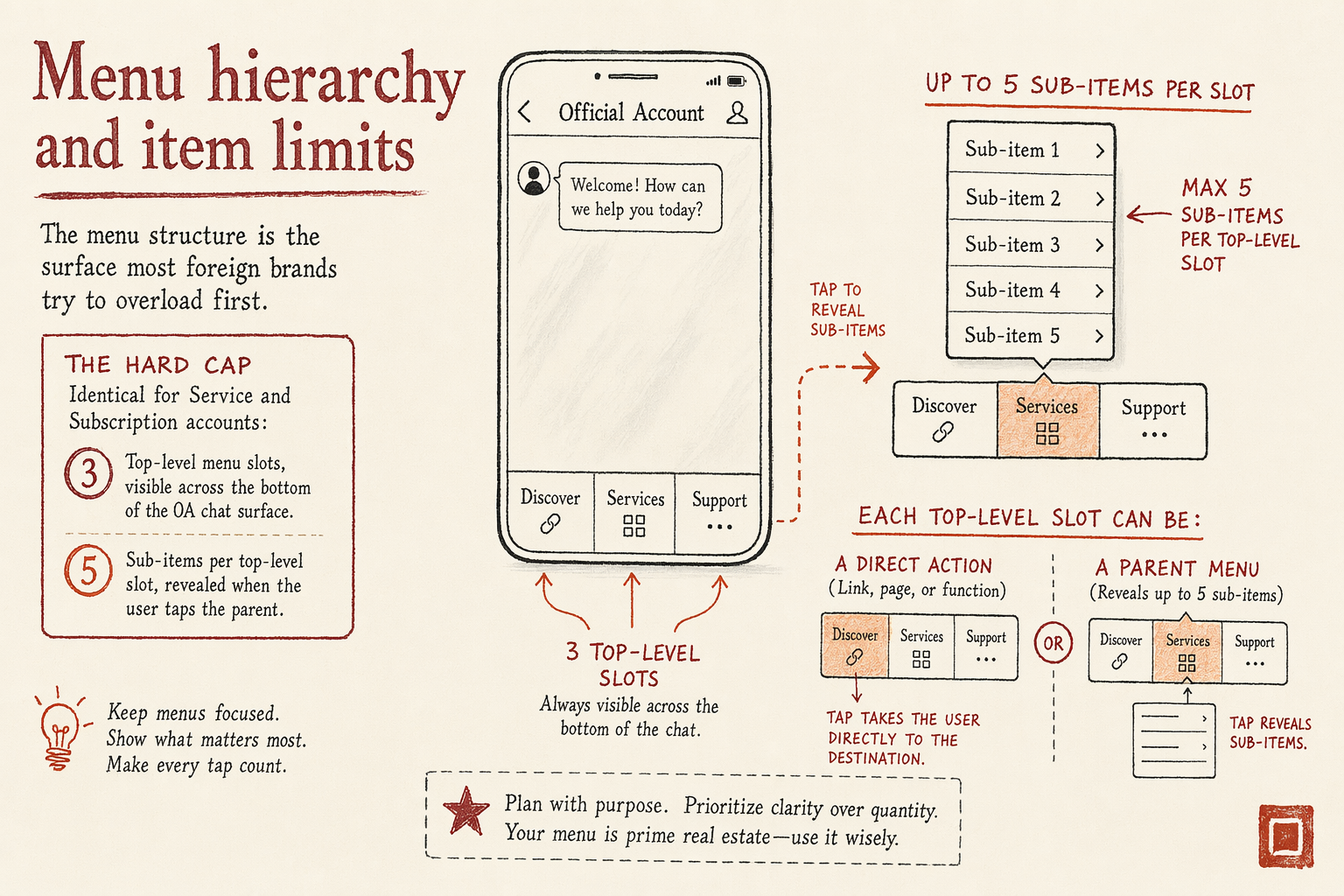
- The 3-top-level menu cap, usually in week one. The first version of the menu always has 5-7 top-level items because that is what the website has. Cut back to three and put the rest in sub-menus or on the HTML5 site.
- The 48-hour template-message window, usually in month one. First time the team wants to send a re-engagement message to lapsed users and finds out they cannot.
- The industry-template catalogue not having a template that fits, in month two or three. Brands operating in cross-category territory (a SaaS company that also runs a content business, an e-commerce brand that also offers consulting) find that no single industry catalogue maps cleanly. The workaround is to use the closest-match template and customise the variable fields aggressively, which is fine.
- The 4-broadcast-per-month limit, usually around launch and at major commercial events. Tempting to push five for a Black Friday equivalent. You can't. The workaround is template messages around the campaign, plus mini-program in-app messaging, plus paid advertising on WeChat's Moments and Channels surfaces.
Things foreign brands worry about but rarely hit: the 30-menu-update-per-month limit, the 8-cards-per-broadcast limit, the API rate limits on user-tag updates (10,000 user-tag operations per minute per OA, which only matters at follower counts above six figures).
Workarounds when you outgrow the defaults
The honest answer is that most of these limits cannot be raised. Tencent enforces them at the platform level, and there is no enterprise tier that raises the caps. What you can do is engineer around them.
- Multiple OAs. A single legal entity can hold up to 50 Service Accounts and 50 Subscription Accounts. We see brands at scale run a flagship Service OA for commerce and a separate Subscription OA for editorial content, each within its own broadcast quota.
- Mini-programs. A WeChat Mini-Program runs inside WeChat but operates under its own messaging surface. Mini-program subscribe-messages (a 2021 replacement for the old template-message system, with similar but distinct rules) give you a parallel notification channel that can supplement OA template messages. Mini-program subscribe-messages have their own 7-day-per-template quota but stack on top of OA quotas.
- WeChat Channels (视频号). A Service Account can link to a Channels account, which has its own push surface for short-video content. Channels notifications are not subject to the OA broadcast cap.
- Paid advertising. Tencent's ad platform — Moments ads, Channels ads, in-OA banners — sits outside the broadcast quota. Paid placement is how brands at scale supplement organic reach.
For the account-type choice that gates all of the above, see the Service Account vs Subscription Account walkthrough. For the verification path required to apply any of these features, see the WeChat OA verification playbook.
In plain English
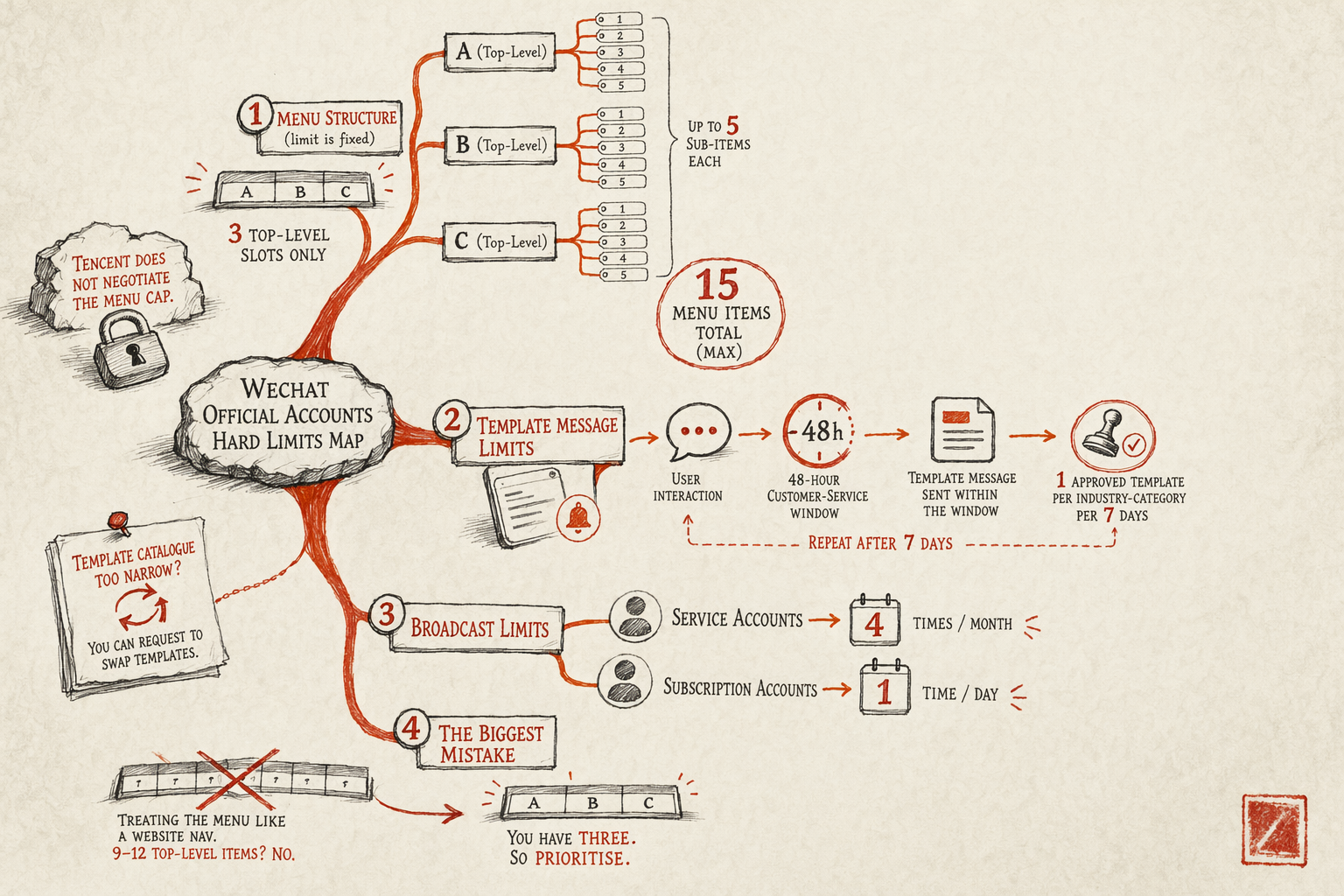
If you only read one paragraph: WeChat Official Accounts have hard structural limits — three top-level menu slots with five sub-items each (so 15 menu items total, max). Template messages (the in-app transactional notifications) are capped at one approved template per industry-category per 7 days, sent inside a 48-hour customer-service window after a user interaction. Service Accounts broadcast four times a month; Subscription Accounts once a day. Tencent does not negotiate the menu cap. They do let you swap templates if you find that your industry-category catalogue is too narrow. The single biggest mistake foreign brands make is treating the menu like a website nav and trying to fit 9-12 top-level items in; you have three, so prioritise.
Related
7 min read
WeChat OA Verification Playbook for Overseas Brands
服务号 vs 订阅号, the overseas-entity verification path, RMB 600 annual fee, payment-API access, menu architecture.
6 min read
WeChat Service Account vs Subscription Account
Service Account (服务号) vs Subscription Account (订阅号) — feature differences, posting limits, payment-API access, which to pick.