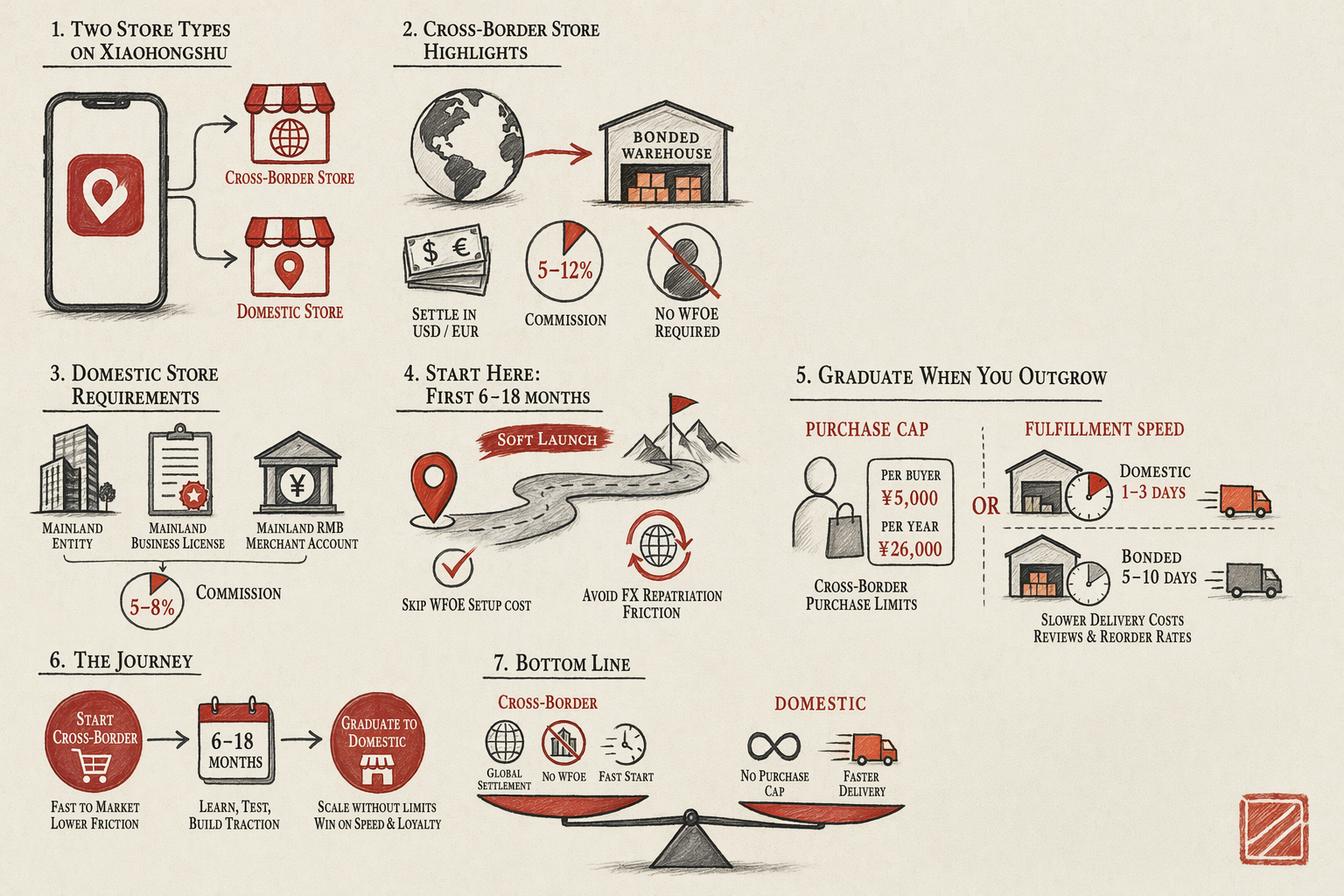
Xiaohongshu (小红书, sometimes Romanised RED or RedNote, operated by Xingyin Information Technology) is the discovery-driven social commerce platform that has become the default for cosmetics, skincare, lifestyle, and increasingly food and supplement brands selling to the under-35 mainland-China audience. The platform supports two distinct commercial structures for foreign brands. Picking the wrong one delays launch by 6-12 months and ties you to a costlier-than-necessary fulfillment stack.
This article walks the two tracks, the entity requirements that gate them, the margin impact of the commission and fulfillment differences, and the operational signal that tells you when it's time to graduate from one to the other. Both tracks require a trademark in the relevant CNIPA Nice class — see the trademark requirement explained for that prerequisite.
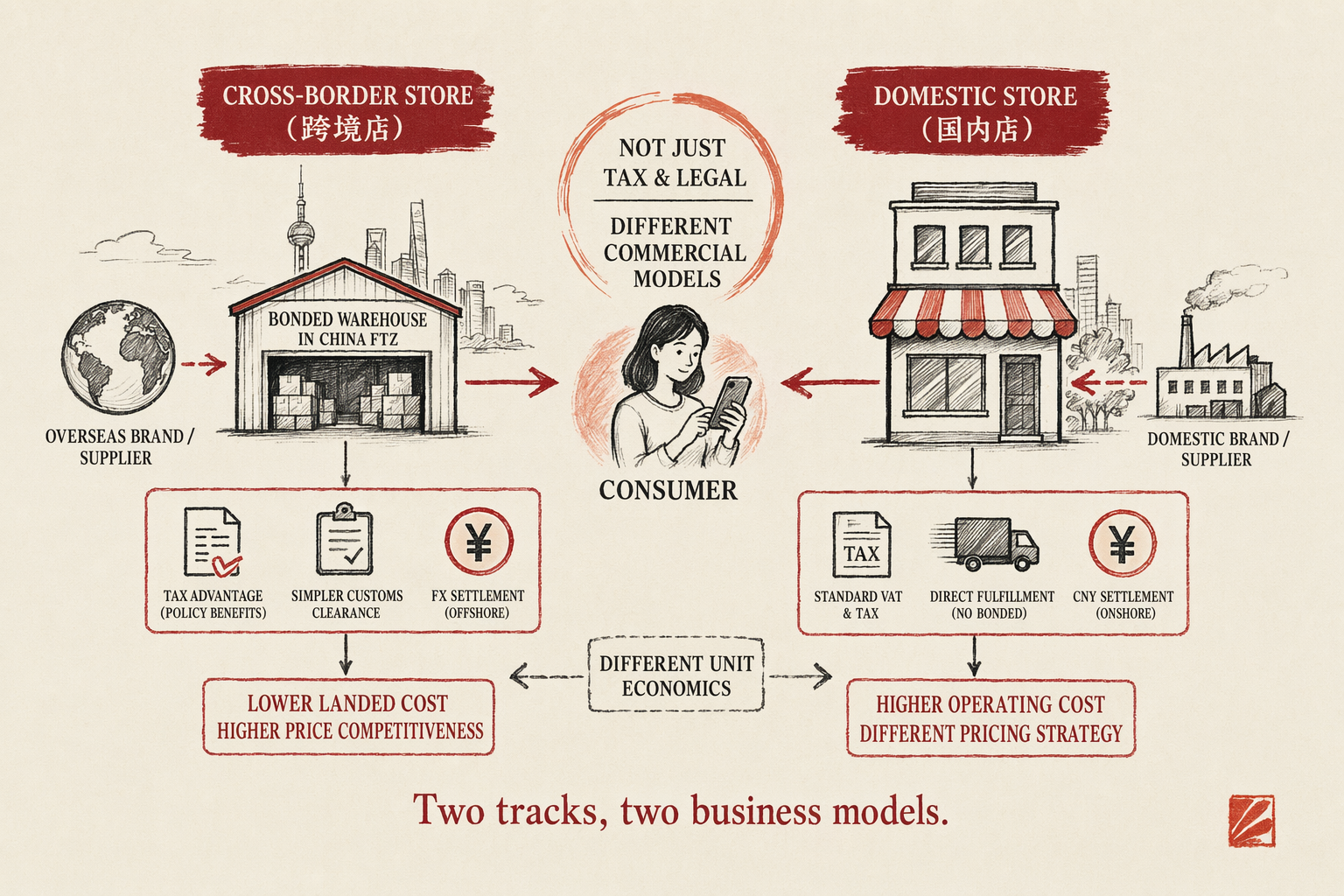
Two tracks, two business models
The two store types are not just a tax-and-legal distinction — they are different commercial models with different unit economics. Said plainly:
- Cross-border store (跨境店). Foreign-incorporated entity, products shipped from a bonded warehouse inside a Chinese free-trade zone (typically Shanghai, Hangzhou, Ningbo, Zhengzhou, or Chongqing). Settlement to overseas bank account in USD or EUR. Commission 5-12% by category. Fulfillment 5-10 days for the buyer. Subject to mainland buyers' annual cross-border purchase caps.
- Domestic store (内地店). Mainland-registered entity (WFOE, joint venture, or mainland Ltd), products shipped from inside China through a domestic 3PL. Settlement to mainland RMB merchant account. Commission 5-8% by category. Fulfillment 1-3 days. No purchase cap.
The choice cascades into the rest of your stack. Cross-border means you do not need a mainland trademark holder on day one (you do need a CNIPA-recognised trademark, but it can be Madrid-designated from your home country); you do not need a WFOE; you do not need a mainland bank account; you do not need ICP filing for the store itself (Xiaohongshu's own ICP covers the storefront, separately from your owned site). Domestic means you do need all four.
The 6-18-month default sequence we run with most foreign brands: launch on cross-border, build audience and SKU validation, then graduate to domestic once one of the operational triggers (covered in the last section) fires. We have seen exactly one brand for whom the right answer was domestic on day one — a category that was prohibited on cross-border but allowed on domestic, and the founder already had a Chinese co-founder running the mainland entity.
Entity requirement by track
Cross-border store applications require:
- Apostilled certificate of incorporation of the foreign entity, with Chinese translation.
- Brand authorisation from the trademark holder to the operating entity, if those are different. Authorisation has to be in Chinese, notarised in the issuing jurisdiction.
- CNIPA-recognised trademark in the product Nice class. Madrid-designated registration, mainland filing, or a filing receipt with at least 6 months of waiting period are all accepted. See trademark requirement for the document-by-document detail.
- Product category certification appropriate to the category. Cosmetics need cosmetics filing (化妆品备案 for cross-border) under NMPA's cross-border simplified process. Food needs a bonded-list inclusion. See the banned-product list for category-specific certs.
- Bonded warehouse contract — Xiaohongshu requires merchants to nominate a bonded warehouse in an approved free-trade zone; the platform integrates with about a dozen approved warehouses.
- Customs filing as a cross-border e-commerce merchant under the relevant GACC (General Administration of Customs of China) category.
- Settlement bank account in the foreign entity's name, in an accepted currency.
Domestic store applications require:
- Mainland business license (营业执照) of the operating entity.
- CNIPA-registered trademark held by the operating entity, or a notarised authorisation chain to the trademark holder.
- Category-specific Chinese certificates — cosmetics filing under NMPA's domestic rules (heavier than the cross-border simplified track), food production licenses, medical device registration certificates (where applicable), etc.
- Tax registration certificate.
- Mainland bank account opening documents.
- Corporate seal (公章) of the operating entity.
Application review timeline: 5-15 business days for cross-border, 7-20 for domestic. Reject rate runs around 25-40% on first submission for cross-border (mostly category-cert issues), 15-25% for domestic (a tighter set of issues, since the entity is pre-vetted by Chinese authorities before Xiaohongshu sees it).
Margin impact and settlement currency
The headline commission rates lie a little. The 5-12% cross-border and 5-8% domestic ranges are the platform-side commission — what Xiaohongshu takes. They are not what the brand actually pays once you load in fulfillment and FX.
The realistic margin stack for a cross-border seller on a typical SKU priced at ¥299:
- Xiaohongshu platform commission: 8% (skincare category) = ¥23.92.
- Bonded warehouse handling: roughly ¥8-15 per order.
- Cross-border logistics first-mile (overseas to bonded warehouse): variable, but typically amortising to ¥15-30 per order at meaningful volume.
- Last-mile from bonded warehouse to mainland buyer: ¥12-25.
- Cross-border duty and VAT, paid by buyer at checkout under the simplified cross-border tax regime (typically 9.1% of order value for most categories): ¥27.21.
- FX margin on settlement, roughly 0.3-0.8% of gross: ¥0.90-2.40.
- Payment-processing fee bundled into platform commission.
Total platform-and-fulfillment cost on a ¥299 cross-border order: roughly ¥87-100, or 29-33% of GMV. Net margin to brand after COGS depends on COGS but typically lands in the 35-55% range for a well-priced SKU.
The same SKU on the domestic track:
- Xiaohongshu platform commission: 6% = ¥17.94.
- Domestic 3PL last-mile only (no first-mile cross-border): ¥8-15 per order.
- Standard mainland VAT and consumption tax built into product price (paid by merchant on the wholesale-to-retail margin, typically 13% of retail or roughly ¥34 amortised on this SKU).
- No FX margin.
Total platform-and-fulfillment cost on a ¥299 domestic order: roughly ¥60-67, or 20-22% of GMV. Net margin to brand is 9-12 percentage points higher than the cross-border equivalent.
The margin gap is real, but the cross-border overhead pays for itself for the first 6-18 months because it lets you skip the WFOE setup (~$15-50k all-in) and the corresponding mainland tax obligations. Once your monthly GMV gets meaningful, the gap inverts.
Fulfillment — bonded warehouse vs domestic 3PL
Cross-border fulfillment runs through bonded warehouses (保税仓) inside Chinese free-trade zones. The mechanism: you ship inventory in bulk from overseas to the bonded zone under the cross-border e-commerce customs regime, the warehouse holds it under customs supervision (untaxed) until a mainland order is placed, and at order time the warehouse picks-packs-ships to the buyer with customs clearance happening on the unit level under the simplified cross-border tax regime.
The buyer-side experience is 5-10 day delivery, with most orders landing in 5-7 days for top-tier-city addresses. This is faster than international shipping (10-25 days) but slower than purely domestic 3PL (1-3 days), and the difference shows up in Xiaohongshu's review distribution: cross-border average ratings on delivery speed run 4.2-4.5 stars; domestic average runs 4.7-4.9.
Bonded warehouses we see foreign brands use most often are in Hangzhou-Xiaoshan, Shanghai Pudong, Ningbo-Zhoushan, Zhengzhou airport zone, and Chongqing inland. Hangzhou is the default for cosmetics and beauty; Shanghai for general merchandise; Ningbo for higher-volume staples; Zhengzhou for inland-air shipments. The choice matters mostly for first-mile logistics — pick the bonded zone closest to your origin warehouse.
Domestic 3PL is the standard mainland-China express-courier network (SF Express, JD Logistics, Cainiao, ZTO, etc). Same-province delivery is overnight; cross-province delivery is 1-3 days. Costs are typically ¥8-15 per order for standard sub-3kg shipments. Service quality is dramatically better than the bonded last-mile equivalent because the network is mature and the volume is huge.
One operational subtlety: cross-border orders have a per-buyer purchase cap. Under the 2019 cross-border e-commerce regulations administered by GACC, mainland buyers can purchase up to ¥5,000 per single transaction and ¥26,000 per calendar year from all cross-border sources combined. Once a buyer hits the cap, additional cross-border orders are blocked at customs. Brands with high-AOV products or with strong repeat-purchase patterns hit this constraint surprisingly early. Domestic stores are not capped.
When to graduate from cross-border to domestic
The signals that suggest it's time to graduate, in roughly the order they typically fire:
- Monthly GMV exceeds RMB 200,000-500,000. The margin gap (9-12 percentage points) starts paying for the WFOE setup and ongoing compliance overhead within a 12-18 month payback window.
- Delivery speed is showing up in negative reviews. Once 10%+ of your reviews mention slow delivery as a friction point, the cross-border fulfillment stack is costing you reorders. Domestic 3PL eliminates this.
- Repeat-buyer cohort is hitting the annual ¥26,000 purchase cap. If a meaningful fraction of your top-50% revenue comes from buyers whose lifetime spend is approaching the cap, you are leaving money on the table by staying cross-border.
- Category certification on the cross-border simplified track is not enough. Some categories (cosmetics with regulated actives, supplements with health claims, food with specific health functions) require the full NMPA domestic-cert path to make the marketing claims that drive conversion. Cross-border restricts what you can claim.
- You want to run an offline pop-up or B2B channel alongside Xiaohongshu. Cross-border inventory cannot be sold outside the cross-border e-commerce regime; you would need a parallel domestic supply chain.
The flip itself is not a flag — you can keep both stores live and route traffic intelligently. Many brands keep the cross-border store for new-SKU testing (no NMPA filing required, faster to launch) and run high-volume SKUs through the domestic store. For the underlying brand-setup workflow that covers both tracks, see the Xiaohongshu brand setup playbook. For the structured comparison version, see the cross-border vs domestic comparison.
In plain English
If you only read one paragraph: Xiaohongshu (小红书) hosts two store types. A cross-border store (跨境店) lets a foreign-incorporated brand sell into mainland China through bonded warehouses, settles in USD or EUR, charges roughly 5-12% commission, and requires no WFOE (Wholly Foreign-Owned Enterprise). A domestic store (内地店) requires a mainland entity, a mainland business license, and a mainland RMB merchant account, and charges 5-8% commission. Cross-border is the right pick for the first 6-18 months of any soft launch — it sidesteps the WFOE setup cost and FX repatriation friction. Graduate to domestic once you outgrow the per-buyer ¥5,000 / per-year ¥26,000 cross-border purchase cap that mainland buyers face, or when fulfillment speed (1-3 day domestic vs 5-10 day bonded) starts costing you reviews and reorder rates.