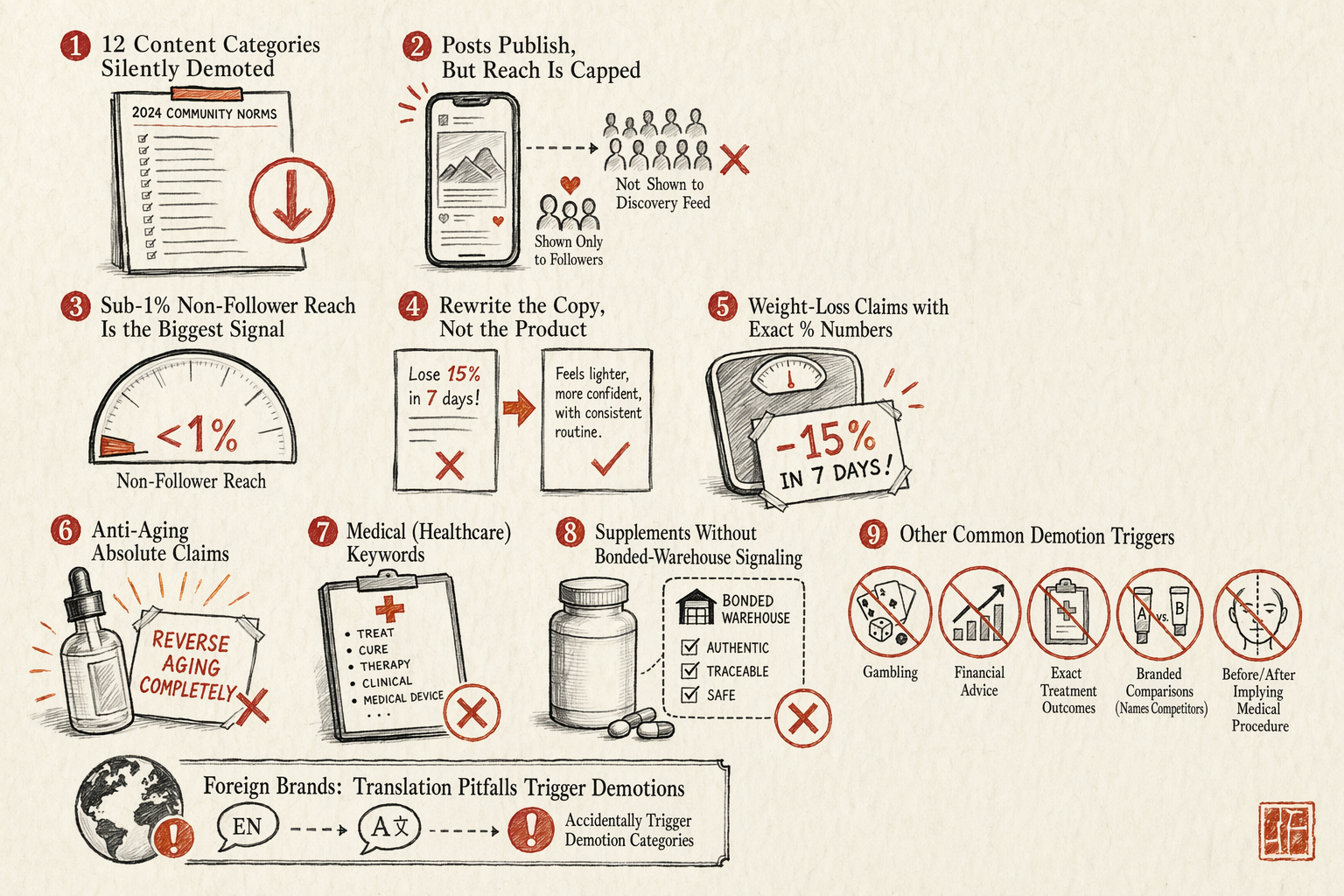
Xiaohongshu does not tell you when it is suppressing your content. Posts publish normally, sit in your profile, get a small handful of likes from your existing followers, and then disappear. The discovery feed never picks them up. The brand looks at the engagement metrics and assumes the content is bad. The reality is that the algorithm has flagged the post against one of about a dozen suppressed content categories codified in Xiaohongshu's 2024 platform rules, and is gating the reach.
This article maps the twelve demotion buckets, walks how the silent demotion actually works, and gives the rewriting patterns that consistently move suppressed content back onto the discovery feed. Most foreign brands trip at least one of these without realising it — the categories track Chinese-internet content standards more than Western platform norms, and translating English copy directly is the single most common trigger.
How Xiaohongshu's suppression actually works
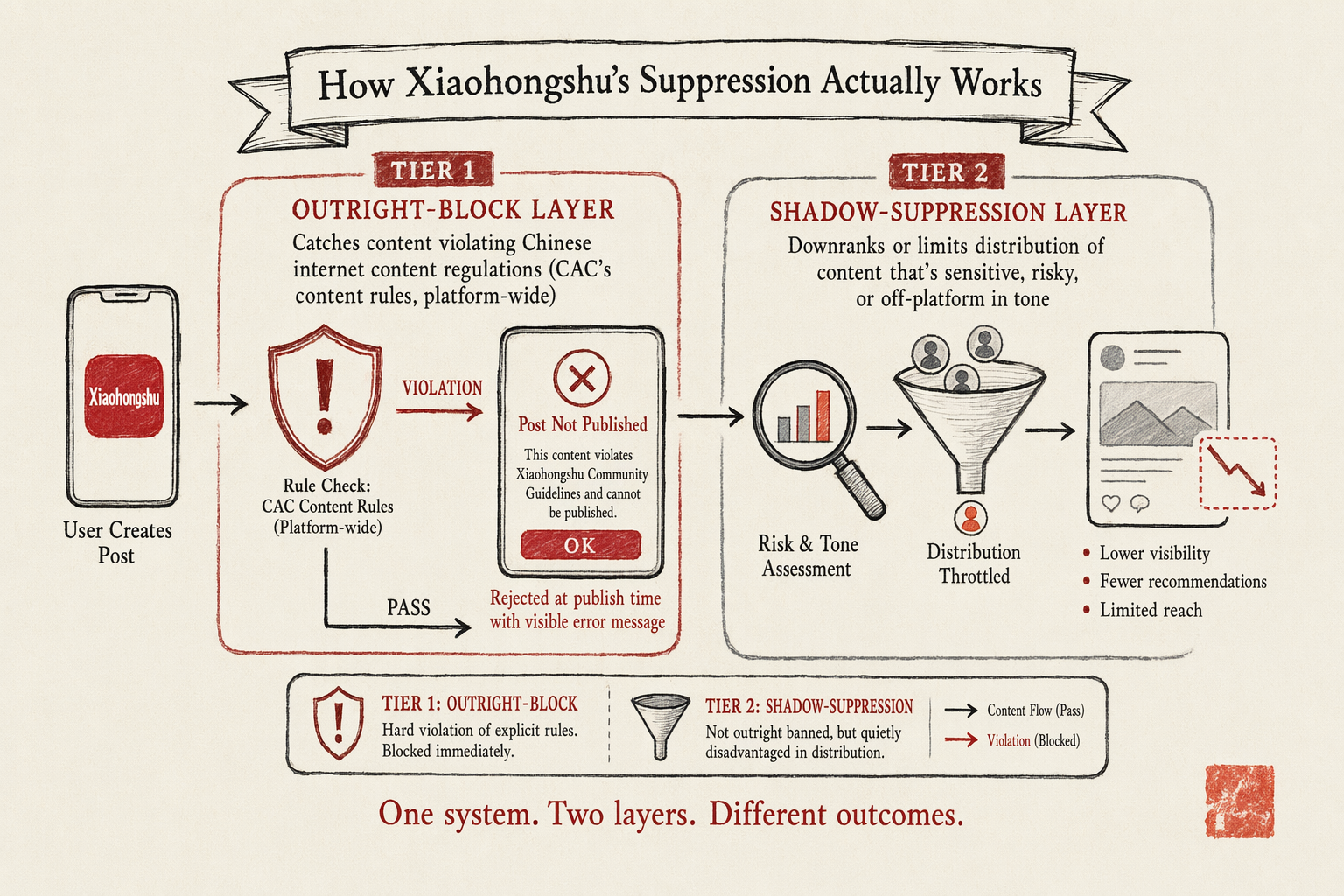
Xiaohongshu runs a two-tier content moderation system. The first tier is the outright-block layer that catches content violating Chinese internet content regulations (CAC's content rules, which apply platform-wide across mainland-China internet services). Posts in this tier get rejected at publish time with a visible error message.
The second tier — the one this article is about — is the limited-reach tier. The post publishes, the user sees it in their own feed, but the algorithm caps the audience to a tight subset (often just the post's author and a handful of their direct followers) and refuses to serve the post into the recommendation feed that drives 80-95% of Xiaohongshu's organic reach. The post is not censored; it just isn't promoted.
The way you find out is by looking at the impression-to-follower ratio. A healthy Xiaohongshu post serves 5-50x your follower count in impressions during the first 48 hours. A suppressed post serves 0.1-0.5x. If your post has 500 followers and the impression count after 48 hours is under 100, it is suppressed.
Xiaohongshu's Community Norms (社区公约), updated annually, list the rules in Chinese. The platform also publishes a separate Brand Account Operating Standards for verified business accounts that overlay extra rules on commercial content. Both are read-once-and-rule-out documents: if you operate at scale on Xiaohongshu without internalising the demotion categories, you will discover them empirically and expensively.
The 12 demoted-category buckets
The categories the algorithm consistently demotes, said plainly:
- Weight-loss claims with exact percentages. "Lose 5kg in 30 days," "reduces body fat by 20%," any precise weight or BMI-change number triggers demotion. Vague wellness framing ("feel lighter," "healthier shape") does not.
- Anti-aging absolute claims. "Reverses 10 years of aging," "reduces wrinkles by X%," "erases fine lines" — exact percentage outcomes on age-related skincare are demoted across the board, even for cross-border bonded SKUs.
- Medical (医疗) keywords. 治疗 (treat), 治愈 (cure), 疗效 (therapeutic effect), 医治 (medical treatment), 处方 (prescription). Use of any of these in product copy demotes the post regardless of whether the product is actually medical.
- Supplements (保健品) without bonded-warehouse signaling. Health-functional supplement content gets demoted unless the post explicitly identifies the SKU as cross-border bonded-warehouse stock (the platform's regulated lane for these products).
- Gambling, betting, lottery references. Including casual references in cosmetics/lifestyle copy ("this serum is a gamble that pays off"). The algorithm pattern-matches on the term, not the context.
- Financial advice with specific returns. "This deposit earns 8%," "this fund returned 15% last year." Foreign brands rarely trigger this directly but adjacent lifestyle copy occasionally does.
- Exact treatment outcomes for cosmetic procedures. Before-and-after content that implies a medical aesthetic procedure (injectables, lasers, surgical) is demoted heavily even for cosmetics that are not procedure-related.
- Branded competitive callouts. Posts that name a specific competing brand by name — even positively — get reach-capped. The platform does not want comparative content to dominate the discovery feed.
- Counterfeit or grey-market references. Any phrasing that suggests authenticity ambiguity ("how to tell if your X is real," "avoid fakes") is demoted defensively.
- Specific treatment claims for children's products. Children's skincare, food, and supplements are held to a much stricter content standard. "Helps growth," "boosts immunity," "calms tantrums" all demote child-oriented product posts.
- Direct purchase-incentive copy without the platform-native CTA. "Click my link in bio," "DM me to buy," "buy direct on my site" — the algorithm wants commerce to happen inside the Xiaohongshu store, and posts driving off-platform purchase are demoted.
- Repeat-content / multi-account-duplicate detection. Posts that are visually or textually too similar to recent content from your account or related accounts get demoted as suspected spam.
Cross-border bonded-warehouse signaling
For category 4 (supplements) and a handful of adjacent regulated categories, Xiaohongshu's algorithm distinguishes between content selling product through the platform's own cross-border bonded warehouse pipeline and content driving to external supplement sales. Bonded-warehouse content gets a meaningful suppression dampener — the same post that would be demoted for a non-bonded SKU rides on the discovery feed when it is identified as bonded stock.
The signaling lives in two places:
- The product card embedded in the post. Xiaohongshu store SKUs that are flagged as cross-border bonded stock carry a small 跨境 badge that the algorithm reads.
- The post's text. Mentioning the bonded zone ("杭州保税仓发货," "宁波保税直邮") in the copy gives the moderation system the textual signal it needs to lean toward the cross-border treatment.
This matters operationally for cosmetics brands selling cross-border. Cosmetics with regulated actives (vitamin C, retinol, exfoliating acids, hyaluronic acid above certain concentrations) get demoted under category 1/2 unless the post identifies the SKU as cross-border bonded. The platform's own simplified-cosmetics-filing route (under NMPA cross-border rules) gives the product a lighter regulatory standing than full domestic NMPA filing — and the algorithm rewards content that operates within this lane.
Rewriting product copy to escape demotion
The most common pattern we see when helping foreign brands de-suppress content: take a piece of English-language product copy that triggers one or more demotion categories, rewrite it in a way that keeps the substance but loses the trigger phrases, and re-publish. The reach usually recovers within 24-48 hours on the new post.
Examples (English-translated for clarity, real implementation is in Chinese):
- Original: "This serum reduces wrinkles by 32% in 8 weeks." Rewritten: "After 8 weeks of nightly use, my skin felt visibly smoother." (Substantive claim retained, exact-percentage trigger removed.)
- Original: "Treats acne and clears breakouts." Rewritten: "Calms blemish-prone skin and supports a clearer complexion." (医疗 keyword "treats" / 治疗 removed; consumer-skincare framing replaces medical framing.)
- Original: "Better than [Competitor Brand]'s X." Rewritten: "A simple, gentle alternative to heavier formulas." (Branded callout removed.)
- Original: "DM me to buy direct, save 20%." Rewritten: "Available in my Xiaohongshu store — link in profile." (Off-platform purchase trigger replaced with native-CTA.)
- Original: "This supplement boosts your child's immunity." Rewritten: not viable for a children's-supplement post — the category is structurally demoted on Xiaohongshu and the right answer is to skip the channel for child-supplement marketing. Use a different platform.
The rewriting work is genuinely tedious. Most agencies handle it by running a pre-publish moderation check on every post — they pattern-match against the demotion-trigger keyword list (which they maintain from observation since the platform does not publish a full list) and flag triggers for editorial review.
When to pivot to a different channel
Some product categories are structurally demoted on Xiaohongshu regardless of how you write the copy. The honest signal that it's time to pivot:
- Children's-product brand. Most child-oriented commercial content is demoted or capped. WeChat OA + Douyin Children's Channel work better for this category.
- Heavily regulated medical-adjacent products. Medical devices, prescription-adjacent cosmetics, products that require regulatory claims to convert — Xiaohongshu suppresses these by design. Channel pivots to JD Health, Alibaba Health, or category-specific verticals (Dingxiang for medical) are usually right.
- B2B services. Xiaohongshu's audience is consumer; commercial-services posts (consulting, SaaS, B2B logistics) get demoted as off-category. WeChat OA, Zhihu, and LinkedIn are the right alternatives.
- Single-purpose supplement brands. Sports-nutrition, weight-management, and condition-specific supplement brands run into category 1 and 4 simultaneously, and rewriting around both is exhausting. Pivot to Tmall or JD's bonded-supplement category, which have a regulatory lane Xiaohongshu does not.
For the underlying category-by-category banned-product list (the harder set of rules that govern what you can sell, not just how you can talk about it), see the banned-product list for foreign brands. For the brand-setup playbook that covers both content and commerce, see the Xiaohongshu brand setup topic hub.
In plain English
If you only read one paragraph: Xiaohongshu's 2024 Community Norms (社区公约) lists about twelve content categories the recommendation algorithm silently demotes — weight-loss claims with exact percentage numbers, anti-aging absolute claims, medical (医疗) keywords, supplements without bonded-warehouse signaling, gambling, financial advice, exact treatment outcomes, branded comparisons that name a competitor, before-and-after photos that imply a medical procedure, and a few others. The platform does not block these posts outright — they publish, they sit in your feed, but the algorithm caps the reach to your existing followers and refuses to serve them to the discovery feed. The single biggest signal that you are being demoted is sub-1% reach to non-followers. The fix is almost always rewriting the copy, not changing the product. Most foreign brands who write English-language copy and translate to Chinese trigger at least one demotion category by accident.
Related
7 min read
Xiaohongshu Brand Account Setup, Step by Step
专业号 vs 个人号, trademark requirement, cross-border e-commerce linkage, KOL/KOC collaboration tools, banned categories.
6 min read
How to Choose an ICP Sponsor for Your Domain
Picking an ICP sponsor — entity-tied filings, sponsor fee ranges, support quality, what happens when a sponsor disappears.