Foreign brands discover the Xiaohongshu trademark requirement at a bad moment: they have built a launch plan, agreed a content calendar with their first KOC roster, and then are told by the platform that their account application requires a Chinese trademark and they don't have one. The realistic delay between filing and getting something usable is 6-15 months. The launch slips. The plan blows up.
This article walks why the requirement exists, exactly which documents Xiaohongshu accepts, the under-publicised 6-month filing-receipt window that lets you operate while waiting for full CNIPA examination, the brand-authorization paperwork that lets one entity operate a store under another entity's trademark, and what to do operationally while CNIPA processes your registration. The single biggest lesson: file the CNIPA trademark first, before anything else, even before you decide which platforms to launch on.
Why Xiaohongshu requires trademark documentation
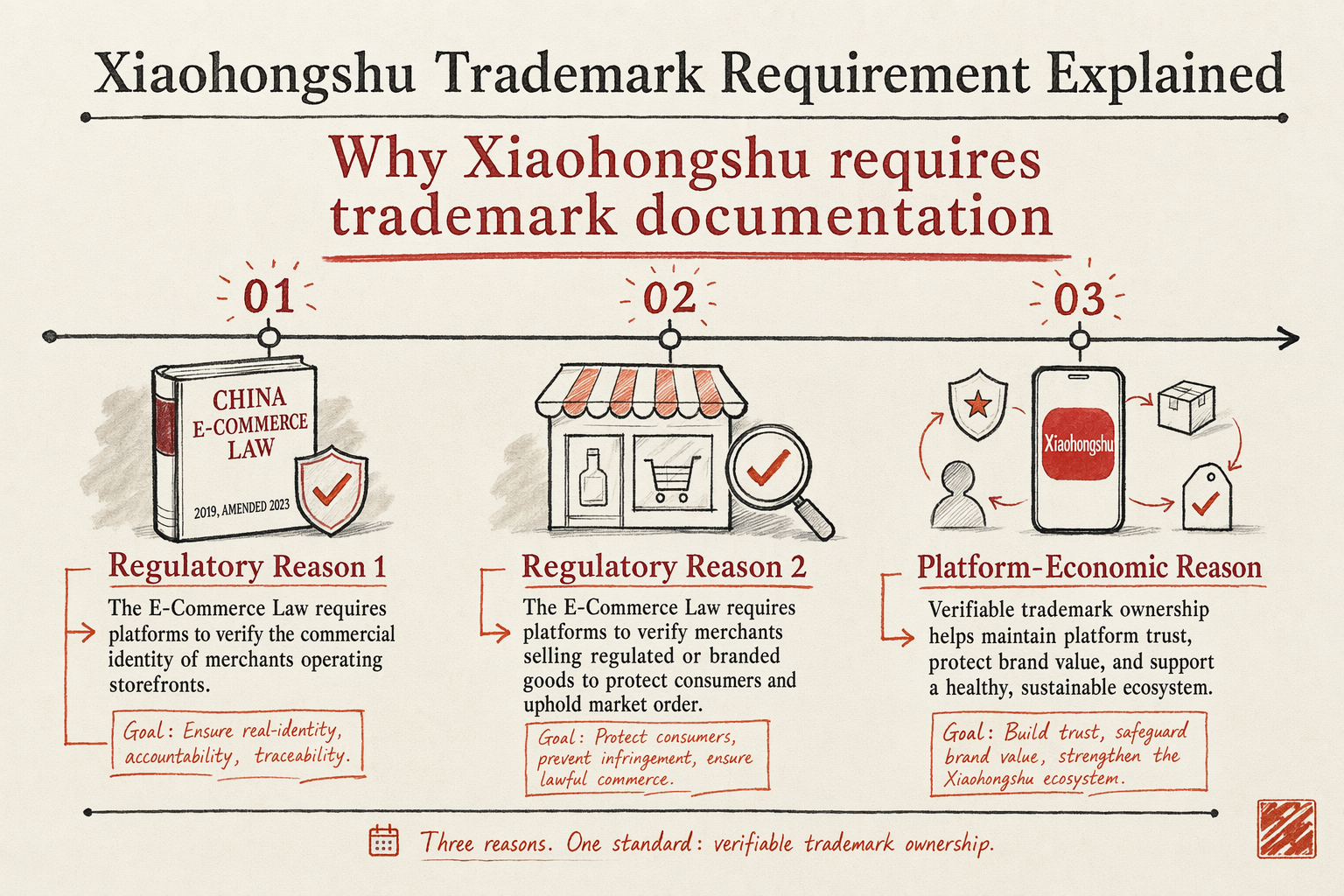
Xiaohongshu requires verifiable trademark ownership for two regulatory reasons and one platform-economic reason.
The regulatory reasons live in Chinese e-commerce law. The E-Commerce Law of the People's Republic of China (2019, amended 2023) requires platforms to verify the commercial identity of merchants operating storefronts and selling regulated goods. The Trademark Law of the People's Republic of China (most recent amendment 2019) treats unauthorised use of an unregistered foreign trademark on Chinese e-commerce platforms as a separate issue from regular trademark infringement. Xiaohongshu, as the platform host, faces secondary liability if it lets merchants sell under marks that turn out to be squatted, unregistered, or held by someone other than the merchant. The trademark documentation requirement insulates the platform.
The platform-economic reason is fraud and brand squatting. A meaningful fraction of new-merchant applications on every Chinese e-commerce platform are people trying to sell under brand names that belong to someone else — sometimes the foreign brand itself, sometimes a Chinese squatter who registered the mark first. The trademark-verification step pushes the squatting and fraud problem upstream into CNIPA's examination, which is far better resourced to adjudicate than the platform itself.
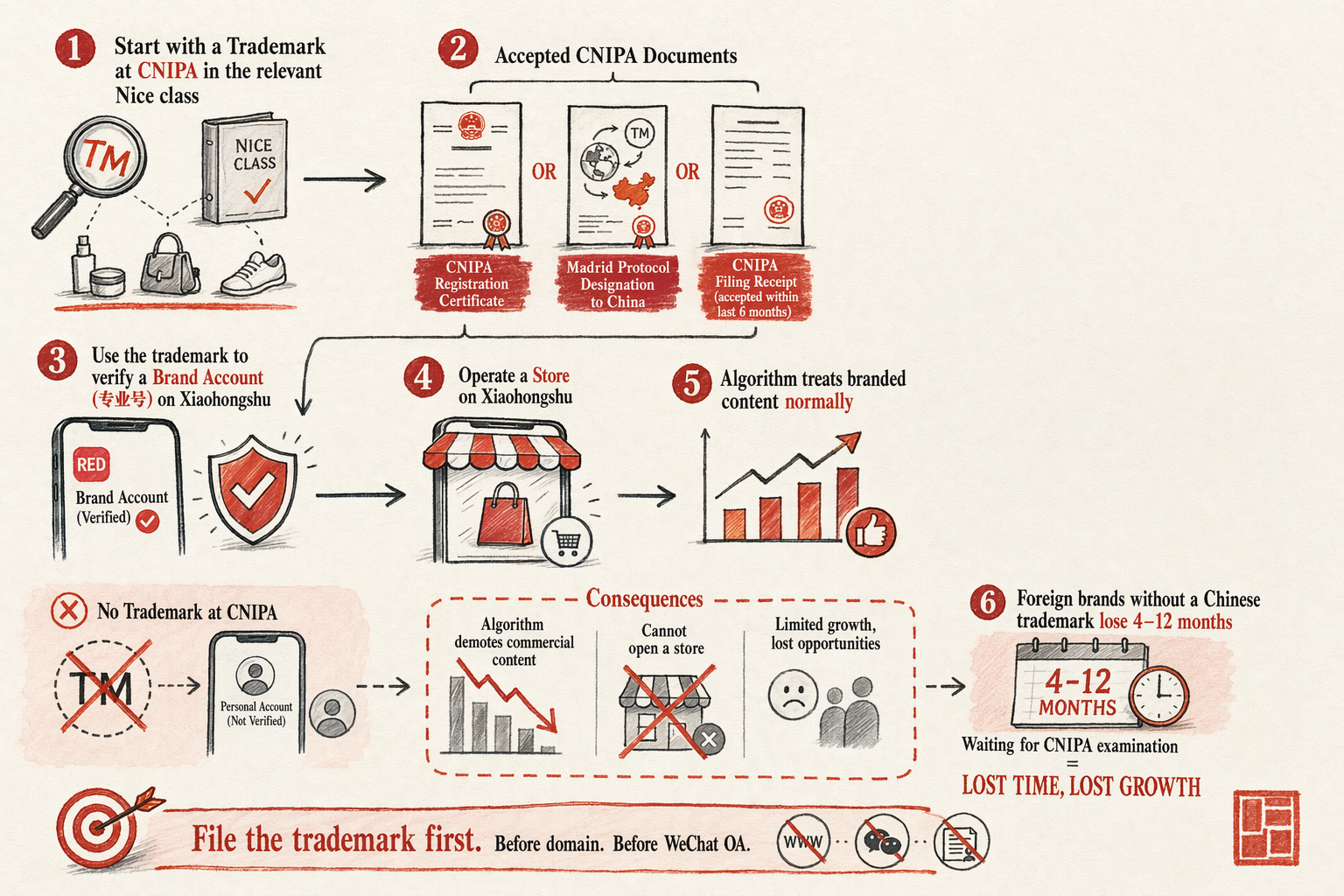
The operational effect is that you cannot get to a verified brand account (专业号), and therefore cannot open a Xiaohongshu store, without a CNIPA-recognised mark. A personal account works for the content side — you can post, build followers, and run KOC campaigns — but commercial content is algorithmically demoted on personal accounts, and the platform's commerce tooling (in-post product cards, store-tagged content, the Dandelion talent marketplace) is gated to brand accounts.
Accepted document types
Xiaohongshu's brand-account verification (and the parallel store-application process) accepts four document types as proof of CNIPA-recognised trademark ownership, in 2026:
- CNIPA registration certificate (商标注册证). The gold standard. Issued by CNIPA after the full examination process completes — typically 12-15 months after filing. Once you have this, the trademark question is closed for the entire validity period (10 years, renewable).
- Madrid Protocol designation to China. If you have an existing trademark registered in your home country and that country is a Madrid Protocol member, you can extend the registration to China via WIPO (World Intellectual Property Organization). Xiaohongshu accepts the WIPO certificate showing the Chinese designation. The full process takes 9-18 months from designation to acceptance, and the certificate is accepted at the point of designation acceptance, not just filing.
- CNIPA filing receipt (受理通知书) within the 6-month window. Xiaohongshu accepts the CNIPA-issued filing receipt as interim proof, but only for 6 months from the receipt's issue date. After 6 months, the filing receipt is no longer accepted and you need to switch to either the registration certificate (if examination has completed) or to a brand authorisation from a third party that does hold a registration.
- Trademark authorisation chain from a CNIPA-registered mark holder. If your operating entity does not hold the trademark but a related entity does (a parent company, a brand-holding subsidiary, or a licensor), a notarised authorisation chain transfers the operating right to your entity. We cover this in the brand-authorisation section below.
Documents Xiaohongshu does not accept:
- A foreign-only trademark registration with no Chinese designation. Your US PTO or EU EUIPO registration is irrelevant on its own.
- A common-law trademark claim. China is a first-to-file jurisdiction; common-law usage rights do not exist in CNIPA's framework.
- A trademark filed under the WIPO Madrid system but not yet at the China-designation acceptance stage.
- A registered trademark in the wrong Nice class. Your skincare brand registered only in Nice Class 25 (clothing) does not qualify to operate a Xiaohongshu skincare store; you need Class 3 (cosmetics) registration or filing.
The 6-month filing-receipt window
The 6-month filing-receipt window is the under-publicised lever that most foreign brands use to launch ahead of full CNIPA examination. Here is how it actually works:
You file your CNIPA trademark application — either directly through a Chinese trademark agent or via Madrid Protocol designation. Within 4-8 weeks, CNIPA issues a filing receipt (受理通知书) confirming the application has been accepted into formal examination. The receipt does not mean the trademark has been granted; it means the application is alive and in queue.
From the filing-receipt date, you have 6 calendar months during which Xiaohongshu (and most other major Chinese e-commerce platforms) treats the filing receipt as interim verification. You can apply for a brand account, open a store, run paid placements, and operate normally. The platform updates the merchant record at the 6-month mark and asks for either the full registration certificate or proof of continued examination progress.
What happens at the 6-month mark depends on where examination is:
- If examination has completed and the trademark has been granted — you submit the registration certificate, and the merchant record is updated to a permanent-status flag.
- If examination is still in progress (the most common case) — you submit a CNIPA progress confirmation showing the trademark is in substantive examination. Some platforms accept this and extend the interim window; Xiaohongshu's current stance (as of 2026) is to grant a 3-month extension if the examination is in good standing.
- If examination has been opposed by a third party — the merchant record is frozen pending opposition resolution. You can keep operating but cannot expand to new product categories.
- If the application has been rejected outright — the merchant record is suspended, the store is closed within 30 days, and you are required to re-establish trademark standing.
Most foreign-brand filings clear substantive examination on first pass at roughly 65-80% rates. The 20-35% that face opposition or partial rejection usually resolve in 4-9 months of follow-on work. Plan around the 6-month window for the optimistic case; budget for 12-15 months total to full registration certificate for the realistic case.
What to do while waiting for CNIPA certification
The 4-15 months between filing the CNIPA trademark and getting a usable mark is a real constraint. The honest tactics we recommend, in order of how much we lean on them:
- File the trademark first, before anything else. Before the domain, before the WeChat OA, before the Xiaohongshu setup, before the WFOE. The trademark is the long-lead-time dependency, and starting it on day zero shortens your overall path.
- Use the 6-month filing-receipt window aggressively. Once the receipt is in, apply to Xiaohongshu and open the brand account immediately. Do not wait for full examination — most of the value is in being on the platform during the examination window, not after it.
- Build content on a personal account while waiting. A personal account on Xiaohongshu has no trademark requirement. You can build a content base, grow followers, develop your visual language and content patterns. Once the brand account is approved, the personal account's content can be migrated by following yourself from the brand account and re-publishing the highest-engagement posts.
- Use a partner's trademark for cross-border-only operations. If you are working with a Chinese distributor who already has a registered mark in your category, you can operate under their mark with a co-branded authorisation chain. This is a stopgap, not a long-term answer — your eventual independence requires your own mark.
- Skip Xiaohongshu and start on WeChat OA + Douyin. Both platforms have parallel but slightly more lenient trademark requirements. WeChat OA in particular accepts a wider range of intermediate proof. Build audience on those platforms while waiting for the Xiaohongshu trademark window to open.
For the broader China-trademark filing process, including the squatting-prevention measures we recommend running in parallel, see the China trademark defense topic hub. For the underlying brand-setup workflow that this article fits inside, see the Xiaohongshu brand setup playbook.
In plain English
If you only read one paragraph: To run a verified brand account (专业号) on Xiaohongshu and operate a store, you need a trademark registered or pending at CNIPA (China National Intellectual Property Administration) in the relevant Nice class for your product category. Accepted documents are the CNIPA registration certificate, a Madrid Protocol designation extending an existing foreign registration to China, or a CNIPA filing receipt (受理通知书) issued within the last 6 months. No mark means no brand account, which means a personal account, which gets algorithmically demoted on commercial content and cannot open a store. Foreign brands without a Chinese trademark routinely lose 4-12 months waiting for CNIPA examination, which is why we tell every brand to file the trademark first, before they even register the domain or set up the WeChat OA.
Related
7 min read
Xiaohongshu Brand Account Setup, Step by Step
专业号 vs 个人号, trademark requirement, cross-border e-commerce linkage, KOL/KOC collaboration tools, banned categories.
7 min read
China Trademark Squatting — Defensive Playbook
First-to-file principle, Class 1-45 coverage strategy, Chinese transliteration filing, opposition windows, non-use cancellation recovery.