Industry view
Mainland China Launch for Creators and Influencers
HK-Ltd brand entity, CNIPA trademark, Xiaohongshu and Douyin dual blue-V verification, cross-border merch fulfillment for foreign creators.
Email Mike—
Y1 cost band
Mike's running benchmarks
—
Time to first revenue
Mike's running benchmarks
—
Common pivot at month 12
Mike's running benchmarks
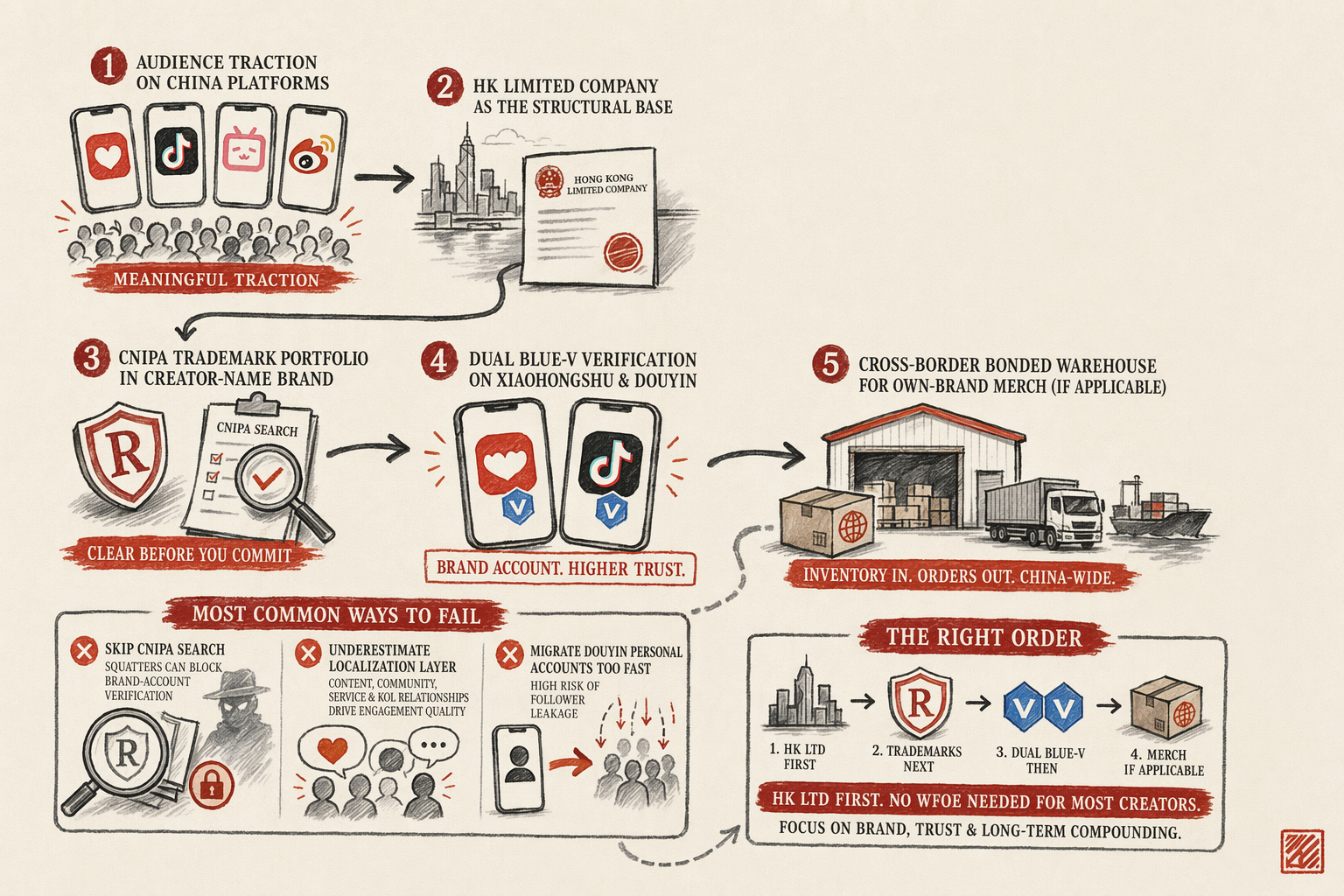
Foreign creators and influencers entering the mainland Chinese market face a structural problem that is unique to the vertical: the platforms operate a two-tier distribution model where personal accounts above a certain audience size get algorithmically demoted in favor of verified brand accounts. The personal-account ceiling is not a temporary friction. It is the platforms' business model, designed to channel commercial-classified accounts (which generate platform revenue through ad spend, livestream commissions, and e-commerce fees) into the feed positions that personal accounts can no longer reach. Creators with growing mainland traction who do not understand this hit a plateau, often around the 30,000-80,000 follower range, and mistake the plateau for an algorithm change or a content problem.
The fix is structural rather than creative. Brand-account verification on Xiaohongshu and Douyin requires a registered legal entity holding a relevant trademark in the creator-name brand. A foreign creator's home-country business entity (US LLC, UK Ltd, Australian Pty Ltd) is accepted in principle but the document chain runs cleaner through a Hong Kong limited company. CNIPA trademark filings in Class 35 (advertising and brand-promotion services) and Class 41 (entertainment and content) take 4-6 weeks to receipt and unlock brand-account verification on the strength of the receipt alone, without waiting for the 14-18 month certificate. This page covers what foreign creators need, the vertical's specific regulatory layer, the structural pattern that fits most launches, the rejection-and-stall patterns we see, and the realistic timeline and budget for a sequenced launch.
What foreign creators and influencers typically need in the mainland market
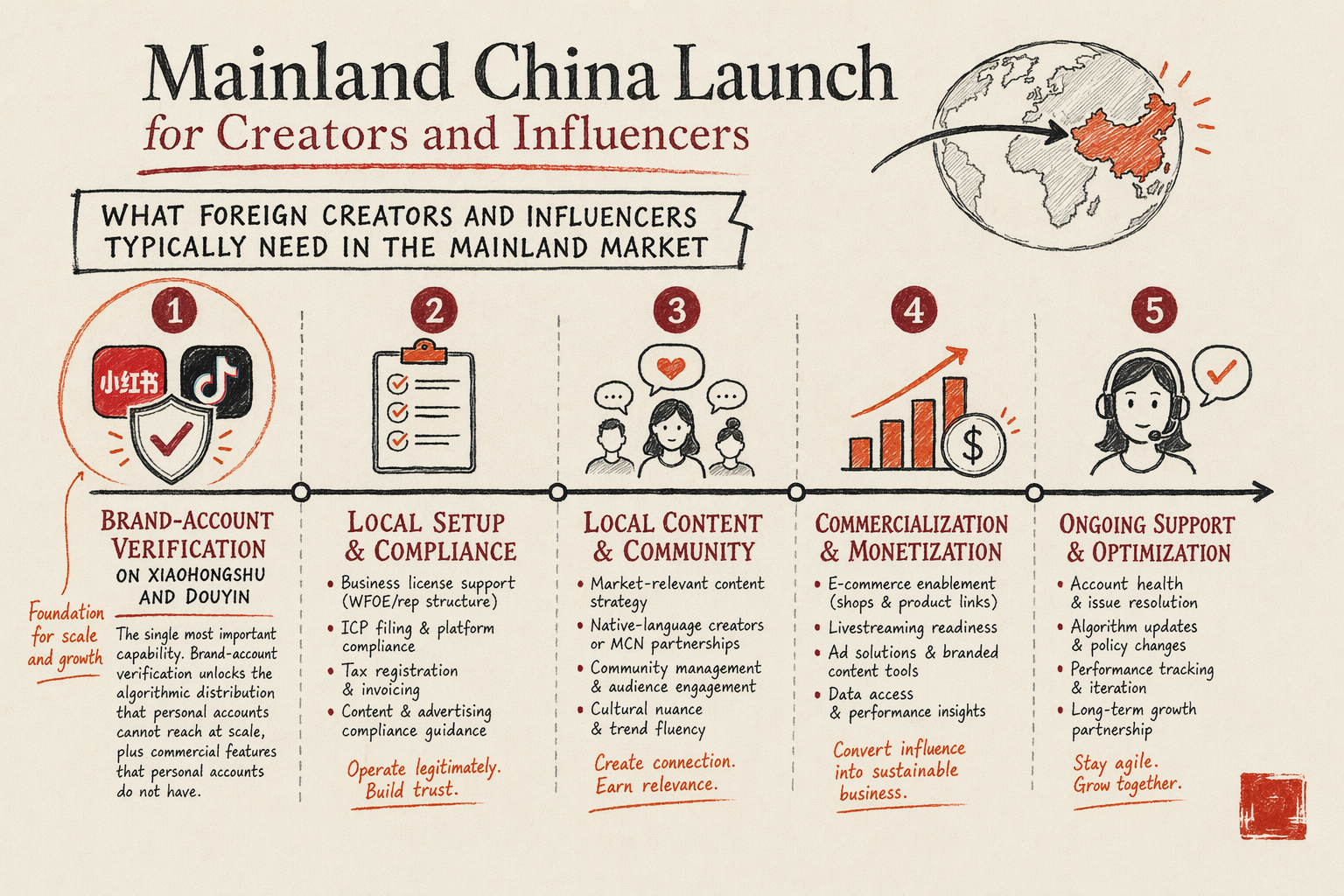
The operational ask from a foreign-creator mainland launch tends to cluster into five categories.
One — brand-account verification on Xiaohongshu and Douyin. The single most important capability. Brand-account verification unlocks the algorithmic distribution that personal accounts cannot reach at scale, plus commercial features that personal accounts cannot run — external link-out, e-commerce integration on Xiaohongshu Shop and Douyin Shop, brand-deal certification (which mainland brands routinely require before placing budget with a creator), and ad-buying capability if the creator wants to amplify content directly. Without brand-account verification, the creator's mainland presence is capped at the personal-account algorithmic ceiling and excluded from most of the mainland brand-deal economy.
Two — a registered legal entity holding the creator-name brand trademark. Brand-account verification requires the operator entity to hold (or have filed for) a trademark in a class relevant to the brand-account activity. Class 35 (advertising, brand-promotion services, retail) is the typical primary class. Class 41 (entertainment, online content, education services) is secondary. Adjacent classes activate based on the creator's category — Class 3 (cosmetics) for beauty creators with merch lines, Class 25 (apparel) for fashion creators, Class 30 (food) for food creators, Class 28 (toys and games) for parenting and kids creators. The HK Ltd is the most common entity choice for foreign creators.
Three — a working approach to Mandarin-language content and engagement. Caption translation through a generic service does not produce Mandarin-native content quality. The algorithm rewards platform-native voice and trend-aware engagement; translated-feeling content underperforms even when the visual content is strong. The two operational solutions are a Mandarin-native content collaborator (part-time, contractor-based, working through the HK Ltd or directly with the creator) who handles caption refinement, comment engagement, and trend suggestions, or a dedicated mainland-based localization team for creators at meaningful scale. The collaborator approach is the default at launch; the team approach activates once mainland revenue passes specific thresholds.
Four — cross-border merch fulfillment if there is a merch line. Foreign creators with own-brand merch (apparel, beauty products, wellness supplements, lifestyle goods) almost always launch through the cross-border bonded-warehouse model rather than mainland-domestic distribution. The bonded-warehouse channel bypasses NMPA filing for beauty and wellness SKUs, bypasses domestic-store inventory commitments, and lets the creator launch merch in months rather than the 12-24 months a mainland-domestic launch typically requires. The trade-off is that the bonded-warehouse markup compresses margin compared to mainland-domestic, and certain SKU categories cannot ship cross-border.
Five — a banking and payment posture that handles platform-side payouts. Mainland platform payouts (brand-deal payments, livestream commissions, e-commerce settlements) flow in RMB to either a mainland entity bank account or, increasingly, to cross-border payment processors that can convert RMB to USD/EUR/HKD for offshore-entity beneficiaries. The HK Ltd opens HKD and USD accounts at a HK bank, with a cross-border payment processor handling the RMB-to-USD conversion on the platform side. Pingpong, Airwallex, and a handful of other cross-border payment providers operate in this lane.
The vertical's specific regulatory layer — blue-V verification, CNIPA trademark, KOC payment-rail
Beyond the generic entity work, foreign creators face three vertical-specific regulatory and platform-rule layers.
Blue-V and brand-account verification. Xiaohongshu's brand-account tier (品牌号 / 专业号) and Douyin's blue-V enterprise tier (蓝V企业号) each have specific platform-side verification requirements. Common elements: business license of the entity, trademark certificate or filing receipt for the brand name being used, brand-authorization documentation linking entity to brand, identity documentation for the legal representative or designated operator, and platform-specific verification fees (typically RMB 600 per platform plus operator-side service fees). Platform-side review runs 3-8 business days when documentation is clean.
Important distinction: Xiaohongshu offers a personal-account-to-brand-account conversion path that preserves the existing handle and follower base, available when the brand-name handle has not been claimed by anyone else. Douyin does not — brand-account verification creates a fresh account that operates separately from the personal account. This drives the migration-versus-fresh-account decision for each platform during the conversion plan.
CNIPA trademark filings in the creator-name brand. The mainland Chinese trademark register operates first-to-file. A foreign creator's home-country trademark (USPTO, EUIPO, IP Australia) gives no standing in mainland Chinese trademark law. CNIPA filings in Class 35 and Class 41 at minimum are required for brand-account verification on Xiaohongshu and Douyin. Class 35 covers the commercial brand-promotion activity that is the core of a creator's commercial profile; Class 41 covers the entertainment-and-content activity that is the core of the creative output. Additional classes activate based on merch lines or specific category positioning.
The pre-filing diagnostic: run a CNIPA scan on the creator-name brand in the relevant classes. A squatter holding a senior mark in your creator-name in Class 35 can block brand-account verification until the cancellation-action sequence resolves or until defensive filings in adjacent sub-classes achieve sufficient coverage. The trademark-squatting scanner covers the diagnostic. If the register is clean, file your own marks immediately. If it is not, plan for 6-12 weeks of cancellation-action preparation before the brand-account verification can proceed.
KOC payment-rail and brand-deal contracting. Mainland brand-deal contracting for foreign creators runs on a hybrid model. The contracting party is the creator's entity (HK Ltd or equivalent) signing a brand-deal contract with the mainland brand's marketing agency, typically denominated in RMB or USD. Payment flows through the cross-border payment processor that the brand-deal MCN (Multi-Channel Network) or agency uses. KOC (Key Opinion Consumer, the lower-tier-influencer category for mid-followers content seeders) payment rails are similar but smaller-ticket and more automated, often handled through platform-native creator-monetization programs that the brand account unlocks. Both rails require brand-account status; KOC programs in particular are gated to verified brand accounts.
Typical entity-structure pick — HK Ltd plus CNIPA filings plus bonded warehouse
The default structure for first-time foreign-creator mainland market entry runs three components.
Component one — a Hong Kong limited company as the dedicated mainland-market brand entity. The HK Ltd holds the mainland trademark portfolio, holds the platform-side brand accounts, holds the cross-border merch fulfillment contracts, and operates the bilingual brand-name plate that platform reviewers expect. The HK Ltd is typically incorporated above the creator's existing home-country business entity (US LLC, UK Ltd, Australian Pty Ltd, etc) with the home-country entity as the operating shareholder. Setup runs under €3,000 all-in; annual carry €4,000-7,000 for a lean entity. The HK layer also handles the cross-border payment-receipt flow for mainland platform payouts and brand-deal payments.
Component two — CNIPA trademark filings in Class 35, Class 41, and any adjacent classes. Class 35 and Class 41 are the brand-account-verification baseline. Adjacent classes activate based on the merch line: Class 3 for beauty, Class 25 for apparel, Class 30 for food and beverages, Class 28 for toys, Class 21 for household goods. Multi-class filings can be lodged simultaneously; filing receipts arrive in 4-6 weeks. Full certificates land in 14-18 months through the standard CNIPA examination timeline. The pre-filing CNIPA scan in all relevant classes is the cheap insurance step.
Component three — bonded-warehouse fulfillment arrangement if there is a merch line. For creators with own-brand merch, a bonded-warehouse operator handles per-parcel customs clearance, per-parcel logistics fulfillment, and per-parcel returns processing. Bonded-warehouse fees typically run 4-7% of GMV depending on volume and SKU mix; consumer-side cross-border duty is paid by the consumer at checkout per parcel. Bonded-warehouse operator selection is partly geographic (Hangzhou and Ningbo are common choices for beauty and wellness; other zones serve other categories) and partly capability-based (some operators specialize in creator-direct fulfillment and have working integrations with Xiaohongshu Shop and Douyin Shop).
What is explicitly not in the default structure: no mainland WFOE, no domestic-Tmall flagship, no mainland-staff team. Each of those is appropriate at a different stage. The WFOE conversation becomes relevant when the creator's commercial profile expands into mainland-domestic activity (livestream sales of domestic goods, mainland-based content production, mainland staff hires). The domestic Tmall flagship becomes relevant when the merch line has crossed the cross-border GMV threshold where the bonded-warehouse markup is materially compressing margin. Mainland staff become relevant when the operation has scaled beyond what a part-time mainland collaborator can handle. None of these are day-one decisions for a creator-led mainland launch.
Common rejection patterns specific to foreign creators
The rejection and stall patterns specific to foreign-creator mainland launches cluster around four themes.
Pattern one — trademark squatter blocking brand-account verification. A third party holds the senior CNIPA Class-35 mark on the creator-name brand, and the platform-side trademark gate rejects the brand-account verification application. This is more common with established Western creators whose names have meaningful brand value than with first-time-mainland-entrant creators — squatters target creators who have already built audience equity. The fix is the pre-launch CNIPA scan and the defensive-filing-plus-cancellation-action sequence, same as the cosmetics-brand pattern. The faster the scan runs, the faster the trademark situation is clear or remediated.
Pattern two — Douyin personal-account migration leaking followers. The Douyin personal-account-to-blue-V migration runs over a 60-120 day window with redirect content. Migration capture typically lands at 70-85% of the personal-account base, depending on how dense the cross-channel content is and how long the migration window runs. Brands that compress the migration window to 30-45 days routinely see migration capture drop to 50-65%. The fix is to run the migration over a longer window with consistent cross-channel content; the cost is extending the personal-account deprecation period, and the benefit is preserving more of the audience that the creator already has. The creator case study covers a specific migration window that captured 70-75% and the honest concession about what we would do differently.
Pattern three — content quality gap from translation-only localization. The creator's Mandarin content is translated through a generic service, the captions read as translated, comment-section engagement is thinner than the metrics on Mandarin-native creators in the same category, and the algorithm responds by demoting the content. This is a slow-bleed problem that is easy to miss because the personal-account era's algorithm-cap masks the localization-quality issue. After brand-account verification removes the algorithmic ceiling, the localization-quality gap becomes the binding constraint on growth. The fix is to bring on a Mandarin-native content collaborator from the start of the brand-account era, not after the gap becomes visible.
Pattern four — payment-rail mismatch on brand-deal contracts. The creator's HK Ltd contracts with a mainland brand-deal agency in RMB, but the payment processor configuration cannot receive RMB into the HK Ltd's HKD/USD accounts cleanly, or the cross-border payment provider's KYC has not been completed for the brand-deal volume the creator expects. Payments stall in escrow, sometimes for months, while the payment-rail configuration is fixed. The fix is to set up the cross-border payment processor (Pingpong, Airwallex, or equivalent) as part of the entity-formation phase, complete the KYC at the volume tier the creator expects to reach in year one, and confirm the brand-deal contracting denomination matches the payment-rail configuration before signing.
The bundled engagement — sequence, indicative budget, realistic timeline
For a foreign creator with home-market audience in the 200k-2M follower range entering the mainland Chinese market through Xiaohongshu and Douyin, the bundled engagement covers these sequenced workstreams.
Phase one — diligence and entity setup (weeks 1-4). CNIPA trademark scan in Class 35, Class 41, and any merch-relevant adjacent classes. HK Ltd incorporation, first-year secretary and registered office, HKD and USD bank accounts. Cross-border payment processor setup (Pingpong, Airwallex, or equivalent) with KYC completion. Identification of designated brand-account operator (creator, manager, or contractor).
Phase two — trademark and platform groundwork (weeks 3-9). CNIPA defensive filings in cleared classes; cancellation-action preparation if a squatter is identified. Filing receipts in week 6-8. Xiaohongshu brand-account conversion or fresh registration. Douyin blue-V account creation. Platform-side verification submissions with the filing receipts.
Phase three — migration and localization (weeks 8-16). Personal-account-to-brand-account migration push on Douyin (the 60-120 day window for redirect content). Mandarin-native content collaborator onboarding. Initial brand-account content cadence established. Comment-engagement playbook documented. Brand-deal agency relationships activated where applicable.
Phase four — merch line if applicable (weeks 12-20). Bonded-warehouse operator selection and onboarding. Initial bulk inventory shipment to the bonded warehouse. Xiaohongshu Shop and Douyin Shop integrations on the brand accounts. Content-to-commerce conversion playbook documented. First merch orders processed.
Indicative budget band: For a creator launch of this profile, the first-year structural budget runs $15,000-50,000 all-in, before content production and paid amplification: HK Ltd setup and first-year carry $5,000-10,000; CNIPA filings across 2-3 classes $1,500-5,000; cancellation-action work if needed $5,000-15,000; brand-account verification platform fees and operator-side service fees $1,000-3,000; Mandarin-native content collaborator (annualized, part-time) $10,000-30,000; bonded-warehouse onboarding (if applicable) $3,000-10,000; cross-border payment processor setup costs $500-2,000. Content production and paid amplification budgets are separate.
Realistic timeline: 12-16 weeks from project start to dual blue-V verified and operating, plus the 60-120 day Douyin personal-account migration window running in parallel from week 10 onwards. Merch line if applicable adds 4-8 weeks to first-merch-order from project start. Plan for 14 weeks to dual verification, 6 months to first merch orders if applicable. To model the budget against your specific situation, run the expansion-budget estimator.
Case study match — how the Australian wellness creator launched dual blue-V
The structure pattern on this page is what the Australian wellness creator case study walks through end-to-end. A wellness creator with 480k Instagram and 220k TikTok followers had grown mainland accounts on Xiaohongshu (to 80k followers) and Douyin (to 45k followers) over 90 days, then watched the algorithm visibly demote both accounts as they hit the personal-account ceiling. The fix was a Hong Kong limited company above the existing Australian Pty Ltd, CNIPA Class-35 and Class-41 filings on the creator-name brand, dual blue-V verification on Xiaohongshu (in-place conversion) and Douyin (fresh account with migration push), and a cross-border bonded warehouse for the wellness-merch line.
The case study covers the specific personal-account-ceiling dynamics that drove the conversion, the WFOE option that some advisors would have pushed and why we ruled it out, the 14-week implementation timeline, the first-year results on both platforms (Xiaohongshu past 200k by month six, Douyin past 140k by month twelve), the merch-line revenue contribution by month twelve, and honest concessions about the Douyin migration leakage running larger than projected and the localization-team build needing to start earlier. If you are a foreign creator with mainland traction that has plateaued, the case study reads as the operational playbook.
Working in this industry?
Tell us your constraints — we'll reply with the partner firm and filing sequence that fits this niche.
Frequently asked questions
Can a foreign creator hold a brand account in their own name?
No — Xiaohongshu and Douyin brand accounts require a registered entity holding the trademark. The standard pattern is an HK Ltd or US LLC owning the trademark and operating the brand account.
How much does the full stack cost in year one?
Typically $8-22k all-in: HK entity ($1.5-2.5k), CNIPA trademark filing ($1-3k across 2-3 classes), Xiaohongshu and Douyin verification (RMB 600 each + entity setup time), cross-border merch fulfillment setup ($3-8k including bonded warehouse onboarding).
Can I keep my US/AU brand account and add a Chinese one?
Yes, they're separate accounts. Most foreign creators run parallel content strategies — original-language content on Instagram/TikTok, Chinese-localized content on Xiaohongshu/Douyin. Some posts cross-port, most are localized.
Do you have a relevant case study?
Yes — the case-studies index lists four anonymized engagements across DTC, SaaS, industrial, and creator personas.
Or skip the form
Book a call with Mike
30 minutes, Zoom or Tencent Meeting. No discovery-call gauntlet.