—
Time to launch
Mike's running benchmarks
—
Y1 cost band
Mike's running benchmarks
—
Outcome metric
Mike's running benchmarks
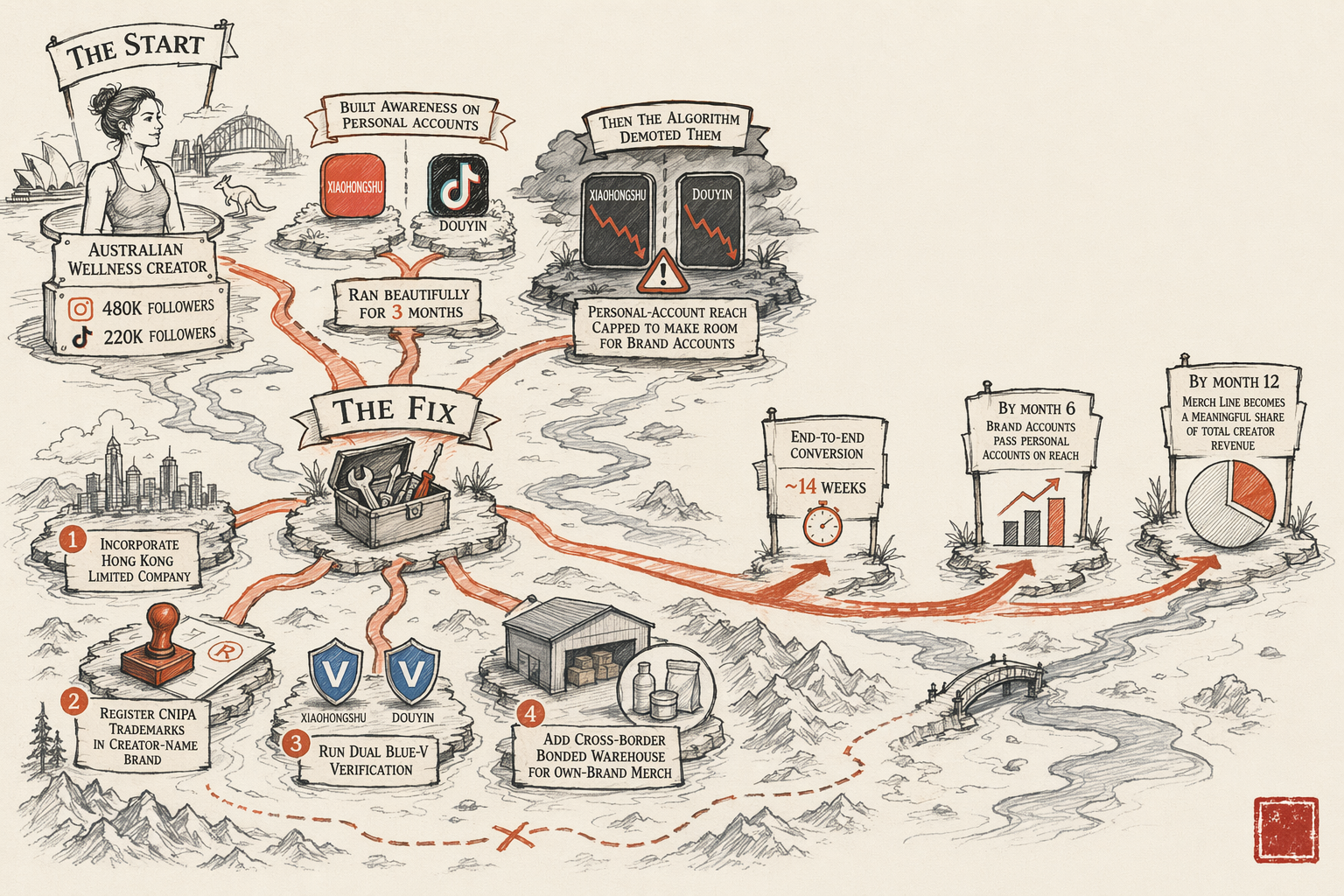
An Australian wellness creator — yoga, breathwork, nutrition, the broader wellness category — had built an audience of around 480,000 on Instagram and 220,000 on TikTok over five years. Mainland Chinese awareness had grown organically through a combination of fan re-posts on Xiaohongshu, a few visiting friends' Douyin stitches, and the wellness-vertical's natural cross-pollination between platforms. The creator's manager had set up personal accounts on Xiaohongshu and Douyin around the start of the year, posted consistently for the first 90 days, and watched both accounts grow nicely — and then visibly stall in month four.
The stall was not a content problem. The creator continued posting the same cadence, the same content quality, and the same engagement patterns from the audience that did see the posts. What changed was the algorithm. On both Xiaohongshu and Douyin, personal accounts hit a ceiling that brand accounts do not. The platforms have made an explicit product decision to favor commercial-classified accounts in feed distribution above a certain follower size, because brand accounts generate platform revenue (ad buys, livestream commissions, e-commerce fees) and personal accounts generally do not. The creator's manager called in week 16 of the personal-account run, looking for the path to brand-account status. This case study covers what we did. Names, exact follower counts, and identifying detail are removed.
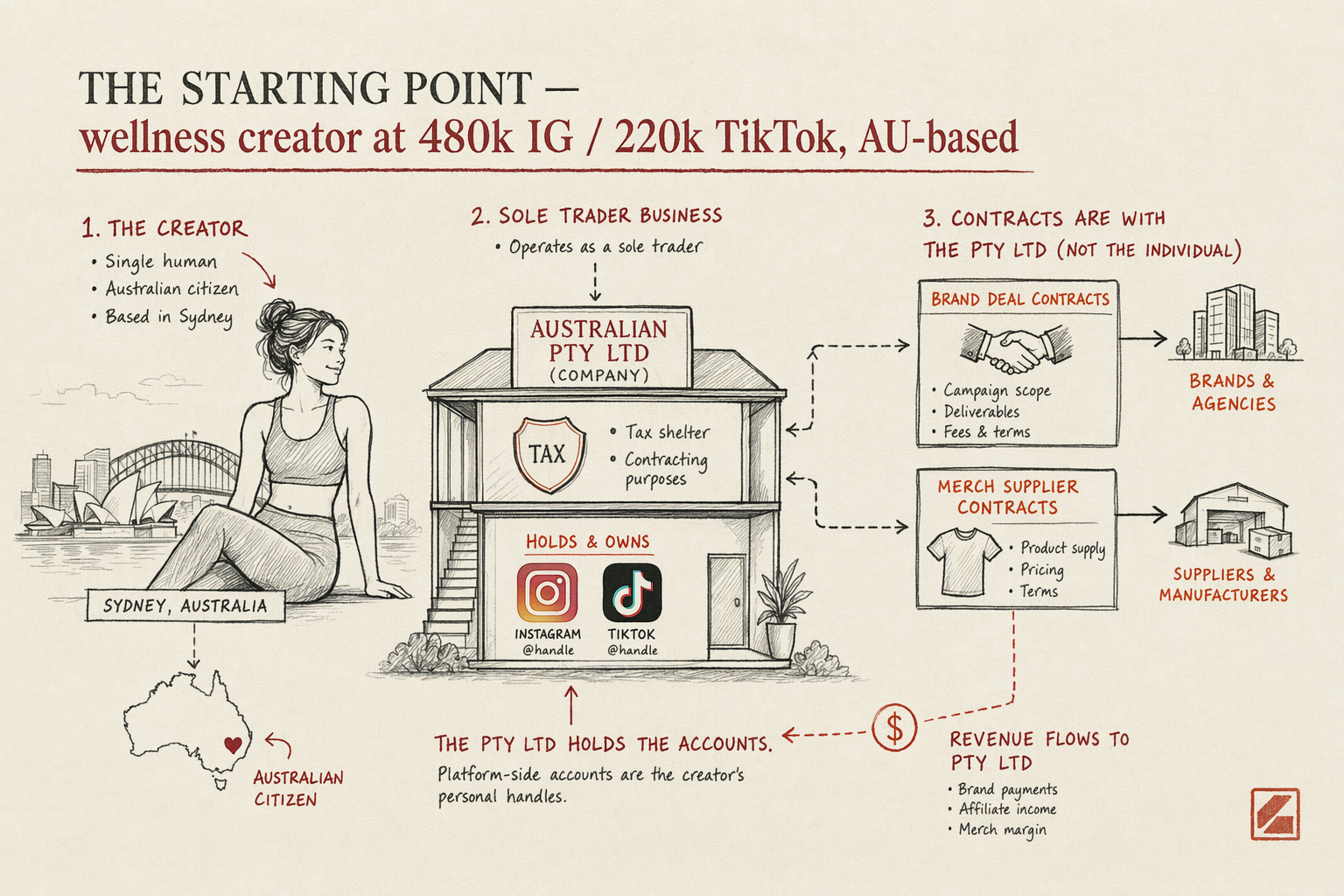
The starting point — wellness creator at 480k IG / 220k TikTok, AU-based
The creator was a single human, Australian-citizen, based in Sydney, operating as a sole-trader business with an Australian Pty Ltd company for tax-shelter and contracting purposes. The Pty Ltd held the IG and TikTok accounts (the platform-side accounts were the creator's personal handles, but the brand-deal contracts and the merch supplier contracts ran through the Pty Ltd). Annual revenue from brand deals, affiliate income, and a small course business sat in the mid-six-figures AUD. A merch line had been on the roadmap for two years but had not launched — the operational complexity of cross-border merch fulfillment from Australia had been the blocker.
The team supporting the creator was small. The creator handled all on-camera content and direct social engagement. The manager handled brand deals, scheduling, and operational coordination. A part-time editor handled video post-production. A part-time community manager handled DM responses on Instagram and TikTok. None of the team spoke Mandarin. The Xiaohongshu and Douyin presence was operating on captions translated through a third-party service, with the manager doing the in-platform interactions through DeepL-assisted reading.
The mainland accounts themselves were doing well on raw metrics. Xiaohongshu had passed 80,000 followers, Douyin had passed 45,000, and engagement rates on the early posts had been strong — Xiaohongshu's wellness category is one of the most engaged on the platform, and the creator's content style mapped cleanly onto the platform's preferred format. The problem was not engagement. The problem was that posts that would have reached 200,000+ viewers in the first 30 days were now reaching 30,000-50,000 of the same content, and follower growth had flattened despite continued posting.
The manager's working hypothesis when she called was that the content quality had degraded or the algorithm had changed. Neither was quite right. The actual driver was the personal-account ceiling that both platforms have built into their distribution model.
The blocker — personal accounts plateaued after 90 days of algorithm demotion
Both Xiaohongshu (小红书) and Douyin (抖音) operate a two-tier account-distribution model. Personal accounts (个人账号) are the default tier — open to any user, simple to set up, with full posting and engagement features. Brand or enterprise accounts (品牌号 on Xiaohongshu, 企业号 / 蓝V on Douyin) are the commercial tier — gated behind verification, require a registered legal entity holding a relevant trademark, carry higher platform fees, and unlock commercial features like external link-out, e-commerce integration, ad buying, and brand-deal certification.
The distribution-model difference is the part that creators discover the hard way. Personal accounts at small scale (under a few thousand followers) get reasonable algorithmic distribution because they are not competing with brand-account spend. Personal accounts at meaningful scale (tens of thousands of followers, especially with consistent posting and high engagement) start hitting visibility caps — the algorithm starts conserving feed space for brand-account content that the platform is monetizing. The cap is not advertised as a cap; it is a quiet demotion that creators experience as “the algorithm changed against me.”
The creator's Xiaohongshu account had hit the cap somewhere around 50,000 followers and was visibly demoted by 80,000. The Douyin account hit it earlier and harder — Douyin's algorithm is more aggressive in conserving feed for commercial accounts, and personal accounts past about 30,000 followers start seeing reach drop materially. Both accounts were operating under the cap when the manager called. Both would continue to operate under the cap as long as they remained personal accounts.
The path out is brand-account conversion or replacement. Brand accounts on both platforms require, at minimum: a registered legal entity (Hong Kong Ltd, US LLC, UK Ltd, mainland Chinese entity, or in some cases Australian Pty Ltd), a trademark certificate or filing receipt for the brand name being used, brand-authorization documentation linking the entity to the trademark, identity documentation for the legal representative or authorized operator, and platform-specific verification fees. Personal-account conversion to brand-account, where available, follows roughly the same documentation requirements; the operational difference is whether the existing handle and follower base carry over (Xiaohongshu yes, Douyin no).
The creator had none of these in mainland-Chinese-platform-friendly format. The Australian Pty Ltd was not impossible to use, but the Australian-document apostille chain takes longer to process and Australian-trademark records do not give the creator any standing in mainland Chinese trademark law. The HK Ltd plus CNIPA filing combination would.
What we ruled out — keeping personal accounts and waiting it out
Three options got ruled out.
Keep personal accounts and wait it out. This was the do-nothing option. The cost was visible: continued slow follower growth, declining reach per post, an audience that would gradually consolidate around the brand accounts of other creators in the same wellness vertical (most of whom had already converted), and a merch line that could never launch because personal accounts cannot run e-commerce integrations on either platform. The do-nothing option was, in practice, a decision to stop growing in the mainland market. The creator and the manager did not want that.
One thing worth noting: some creators do choose this option deliberately when their home-market revenue is healthy and the mainland market is not strategically important. That is a defensible choice. For this creator, the mainland audience was already over 100,000 across both platforms, the engagement was strong, and the merch line was a meaningful future revenue lever. The strategic calculation pointed clearly the other way.
Convert the existing Australian Pty Ltd into the brand entity. The Pty Ltd was already operating, the creator was already a director of it, and using the existing entity would have avoided the cost of setting up a new entity. We ruled this out for two reasons. First, the document set required for Xiaohongshu and Douyin brand-account verification is one the platforms see more cleanly in HK Ltd format than in Australian Pty Ltd format — apostille chains are longer and the platform-side reviewers take more time. Second, the Australian Pty Ltd was the creator's home-market business entity, and putting the mainland operations inside it would have entangled the mainland operations (cross-border merch, mainland trademark, platform-side liability) with the home-market business in ways the creator's Australian accountant flagged as suboptimal for tax and risk-segregation reasons. A clean separation through a dedicated HK Ltd was preferable.
Set up a mainland WFOE for the creator brand. This is the option some agencies push because it produces the most fee. It was wrong for this creator. A WFOE would have committed mainland operating overhead — tax filings, social-insurance registration, an active legal representative — for an operation that does not need any of those. The cross-border bonded-warehouse merch model and the platform-side brand accounts do not require a mainland entity. A WFOE would have added cost without unlocking any additional capability the creator actually wanted. Maybe in 3-5 years, if the creator scales meaningfully into the mainland market with mainland staff and mainland-domestic merch operations, the WFOE conversation comes back. Not now.
The actual fix — HK-Ltd brand entity, CNIPA Class-35 filing, dual blue-V
The structure had four layered components, each unlocking the next.
Component one — Hong Kong limited company as the dedicated mainland-market brand entity. The HK Ltd was incorporated above the existing Australian Pty Ltd, with the Pty Ltd as the operating shareholder and the HK Ltd as a wholly-owned subsidiary. The HK Ltd was scoped specifically as the mainland-Chinese-market brand-holding vehicle — it owns the mainland-market trademark portfolio, holds the platform-side brand accounts, holds the cross-border merch fulfillment contracts, and contracts for the mainland-side localization team. Setup was under €3,000 all-in including the HK formation, the bilingual brand name plate, the apostille chain on the certificate of incorporation, and the bank-account introduction.
Component two — CNIPA filings in Class 35 (advertising and brand-promotion services) and Class 41 (entertainment and education services). For a creator brand, the two trademark classes that matter are Class 35 (which covers commercial brand-promotion activity, including the kind of brand-deal monetization the creator was already doing) and Class 41 (which covers entertainment, online content, and education services — the actual content the creator produces). Class 3 (cosmetics) and Class 25 (apparel) became relevant later when the merch line was scoped. For the brand-account-verification phase, Class 35 alone was sufficient. The Class 35 filing receipt arrived in five weeks and was the document the platforms accepted at verification. The full certificates landed 14-18 months later through the standard CNIPA timeline.
Before filing, we ran the trademark-squatting scan against the creator-name brand. The register was clean — no senior marks held by third parties on the creator's name in the relevant classes. The defensive filings could go through cleanly. Had the register not been clean, we would have run the same kind of cancellation-action sequence the EU skincare brand needed in their case study, but it was not necessary here. The trademark-squatting scanner covers the pre-filing diagnostic.
Component three — dual blue-V verification on Xiaohongshu and Douyin. Xiaohongshu brand-account verification (品牌号 / 专业号) requires the entity's business license, the trademark filing receipt or certificate, brand-authorization documentation linking entity to brand, the operator's identity documents, and the platform-side verification fee. The Xiaohongshu personal account was eligible for in-place conversion to a brand account because the creator-name handle had not been claimed in the brand-account namespace by anyone else — the conversion preserved the existing 80,000+ follower base and the post history. Conversion completed in three weeks from application.
Douyin blue-V verification (蓝V认证 / 企业号) requires a similar document set plus Douyin's specific brand-account verification fee. Douyin does not currently offer in-place personal-to-brand conversion — a fresh brand account had to be created in the creator-name brand namespace, separate from the personal account. The personal account was deprecated over a 60-day window with a pinned-post redirect to the new blue-V account and a coordinated content push announcing the channel migration. Roughly 70-75% of the personal account's follower base migrated to the new blue-V account over the migration window. The remaining 25-30% did not migrate, but the new blue-V account picked up incremental followers from the broader algorithm-uncapped distribution that more than offset the non-migrators inside the first 90 days.
Component four — cross-border bonded warehouse for the own-brand merch line. With the brand entity, trademark, and blue-V verifications all in place, the merch line could finally launch. The creator's existing Australian merch supplier (a small private-label wellness-product manufacturer) shipped a bulk inventory order to a bonded warehouse in Hangzhou. The bonded-warehouse operator handled per-parcel customs clearance, per-parcel logistics fulfillment, and per-parcel returns processing. The merch SKUs went live on the Xiaohongshu shop integration linked to the brand account, with a smaller selection live on the Douyin shop. The cross-border-bonded-warehouse model meant the creator did not need an NMPA filing for the wellness-supplement SKUs (NMPA registration applies to domestic mainland-store sales; cross-border bonded-warehouse sales are individual cross-border purchases). That alone saved 12-18 months on the merch launch.
The result — re-acceleration on both platforms, content-to-commerce conversion
The 14-week implementation timeline ran roughly:
- Weeks 1-3: HK Ltd incorporation, bank introductions, apostille chain on the corporate documents.
- Weeks 2-7: CNIPA Class 35 and Class 41 filings lodged. Trademark-squatting scan completed. Filing receipts in week 5 and 6.
- Weeks 6-9: Xiaohongshu brand-account conversion application and platform-side verification. Conversion complete in week 9 with follower base preserved.
- Weeks 7-11: Douyin blue-V account creation, verification, and personal-account migration content push. New blue-V account at full functionality in week 10. Migration push ran weeks 10-14.
- Weeks 10-14: Bonded warehouse onboarding, initial inventory shipment, platform-side shop integrations. First merch order processed in week 14.
First-year results on the new structure: the Xiaohongshu account, post-conversion, recovered its reach inside the first 30 days as the algorithm reclassified it from capped-personal to uncapped-brand. By month six the brand account had passed 200,000 followers — well above where the personal account had plateaued. Engagement rates held strong through the conversion and the brand-account commercial features (external link-out, shop integration, brand-deal certification) unlocked monetization paths the personal account could not have run.
The Douyin blue-V account grew from zero on day one to roughly 140,000 followers by month 12. The migration from the personal Douyin account contributed the first 50,000 or so; the remaining 90,000 came from organic algorithmic distribution that the blue-V account got and the personal account would not have. The personal Douyin account is still technically live but has not been posted to in 10 months; followers there have largely migrated and the account effectively went into archive.
The merch line ran modestly in the first six months as the creator and the manager built the content-to-commerce conversion playbook. By month 12 the merch line contributed mid-five-figures USD of monthly revenue, with margin profile that compared favorably to the brand-deal income the creator was running in parallel. The merch line also created a new content category — product-focused content that the creator's existing audience engaged with strongly and that did not require new content production capacity beyond the creator's standard cadence.
Brand-deal revenue in the mainland market increased materially. Mainland brands routinely require a verified blue-V or brand account before placing budget with a creator — the personal-account era had effectively excluded the creator from most of the mainland brand-deal market, and the verification opened that channel. By month 12 mainland brand-deal revenue was running at parity with the creator's combined IG and TikTok brand-deal revenue, despite the mainland audience still being smaller than the home-market audience.
The lesson for the next foreign creator reading this
If you are a foreign creator with growing mainland Chinese audience traction on Xiaohongshu or Douyin (or both), the generalizable lesson runs to four points.
One — the personal-account ceiling is real and not a temporary algorithm change. If you have hit a plateau on Xiaohongshu or Douyin with content that previously grew well and engagement that is still healthy, you are almost certainly hitting the personal-account distribution cap. The cap is structural — it is the platform's business model, not a content problem. Trying to break through with more content or different content does not work. The fix is brand-account conversion.
Two — HK Ltd is the standard creator-brand entity for the mainland market. An HK Ltd costs under €3,000 to set up, carries €4,000-7,000 of annual operating cost if you keep it lean, and gives you a clean platform-side document chain plus a trademark-portfolio holder. For a creator at meaningful scale ($100k+ annual creator-business revenue), this layer pays for itself inside the first year of unlocked brand-account monetization. The HK gateway analysis covers when the HK layer is worth it and when it is not.
Three — file your trademarks early. The mainland-Chinese trademark register operates first-to-file. If you have a meaningful audience on the platforms but no CNIPA filings, you are exposed to a squatter registering your creator-name brand and either blocking your brand-account application or demanding a payment to release the mark. The cost of CNIPA filings in two classes is under $2,000 in agent fees and government charges. Run it before you need it.
Four — bonded-warehouse cross-border is the merch-launch path for foreign creators. Unless your merch category is genuinely incompatible with the cross-border model (food products, cosmetics with claims that require NMPA filing, regulated medical devices), the bonded-warehouse approach is faster, cheaper, and lower-regulatory than any mainland-domestic route. You stay on your home-country supply chain, you avoid NMPA timelines, you skip the mainland-distributor stack. The trade-off is that you can never run domestic live commerce at scale through this model — when you reach that scale, the structure conversation comes back.
What we would do differently next time
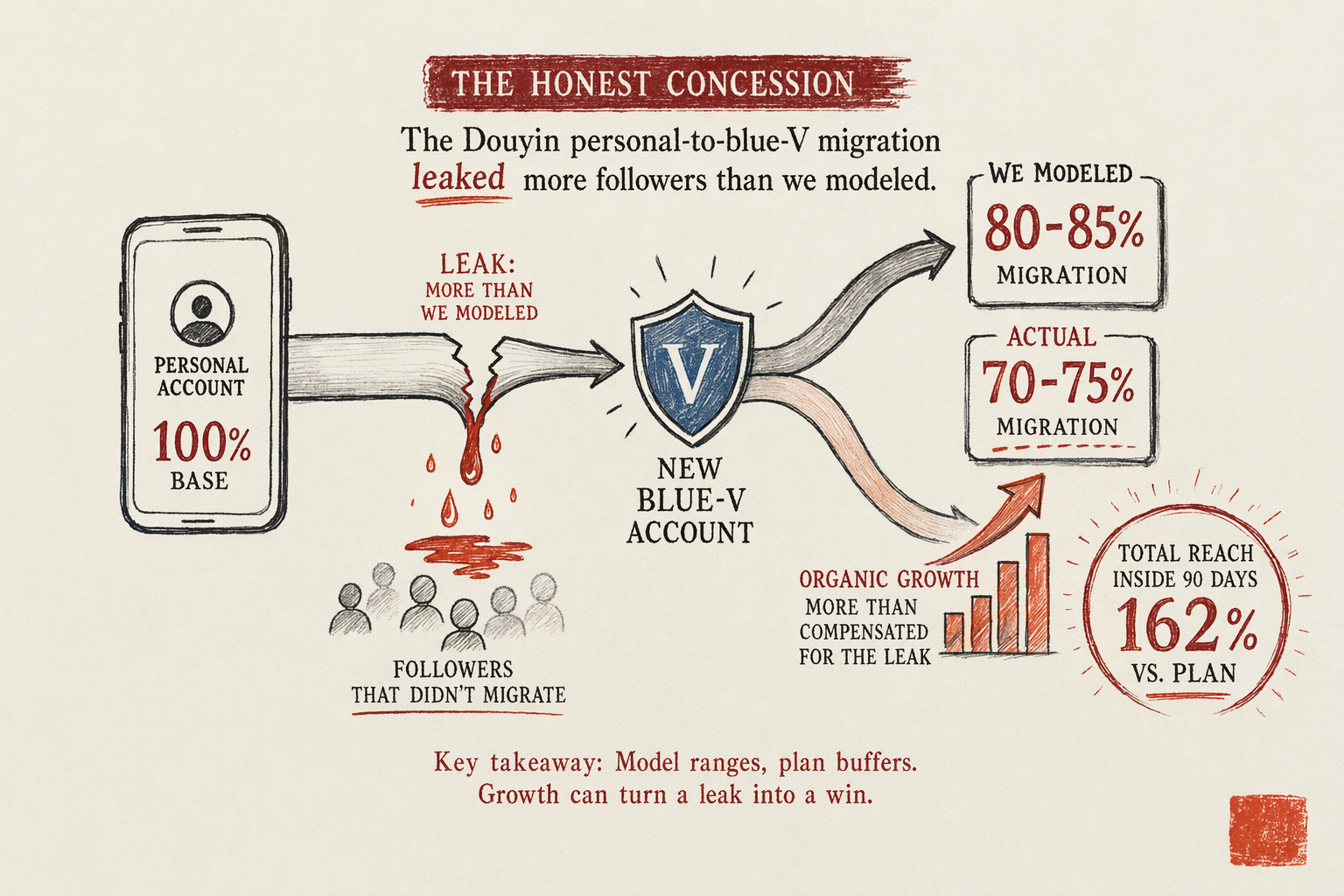
The honest concession: the Douyin personal-to-blue-V migration leaked more followers than we modeled. We had budgeted 80-85% migration of the personal-account base. Actual migration sat at 70-75%, which was acceptable but not what we projected. The new blue-V account's organic growth more than compensated for the leak — total reach inside 90 days was higher than the personal account would have managed — but the leak itself was real.
What we would do differently: run the migration over a longer window with denser cross-channel content, rather than the 60-day window we used. Douyin's algorithm rewards consistency, and a 60-day migration is short enough that the personal-account followers who only check the app every few weeks miss the redirect content entirely. A 90-120 day migration window with one redirect-content post per week, plus periodic mentions in the personal-account content even after the primary push, would have captured another 5-10% of the personal-account base. The cost is extending the deprecation period for the personal account. The benefit is preserving more of the audience that the creator already had.
The second honest concession: we underestimated the localization-team requirement for the Chinese-language content. Translation alone is not localization — caption translation through a service was getting the basic content across, but the content was visibly translation-flavored to Mandarin-native viewers, and the comment-section engagement was thinner than the metrics on Mandarin-native creators in the same category. By month six the creator had brought on a dedicated Mandarin-native content collaborator (part-time, based in mainland China, working as a contractor through the HK Ltd) who handled caption-writing, comment engagement, and trend-aware content suggestions. That changed the engagement profile materially.
What we would do differently: budget the localization team into the first-year plan from week one, not add it in month seven after the gap becomes visible. The cost is modest (low five figures per year for a part-time contractor), and the impact on engagement quality is large. Localization is not optional for foreign creators on Chinese platforms; it is the line between a creator who is “visiting” and a creator who is “present.”
RELATED READING
Compare this engagement's HK-Ltd-without-WFOE pattern to the EU skincare brand's Tmall Global launch — different vertical, same structural family. For the broader vertical view see the creators and influencers industry page. To stress-test your creator-brand against the mainland trademark register, run the trademark-squatting scanner before you start filings.