The full TLD set foreign brands actually consider
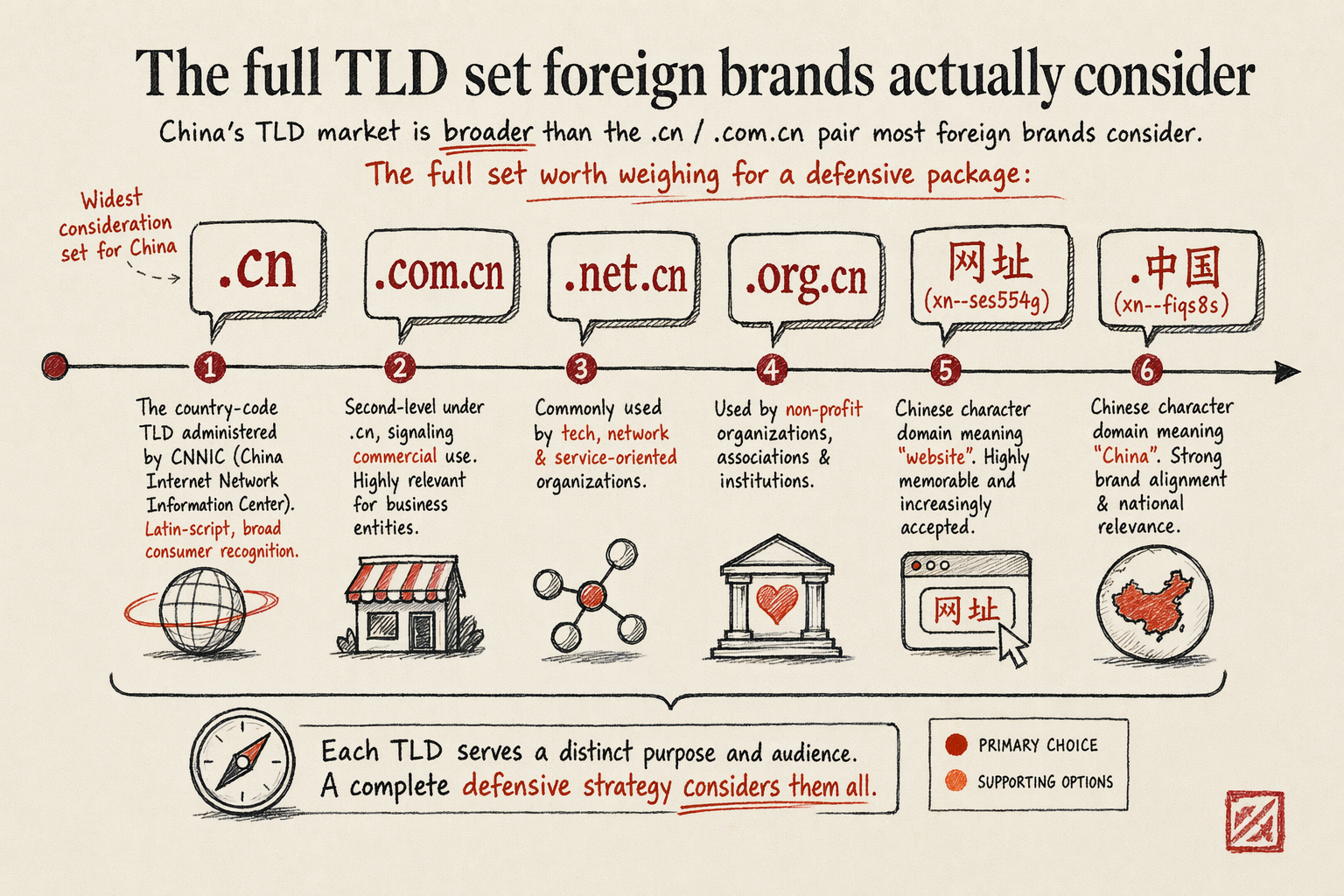
China's top-level domain (TLD) market is broader than the .cn / .com.cn pair most foreign brands consider. The full set worth weighing for a defensive package:
- .cn — The country-code TLD administered by CNNIC (China Internet Network Information Center). Latin-script, broad consumer recognition.
- .com.cn — Second-level under .cn, signaling commercial use. Latin-script.
- .net.cn — Second-level under .cn, signaling network or infrastructure. Latin-script.
- .org.cn — Second-level under .cn, signaling non-profit or organization. Latin-script.
- .gov.cn — Reserved for government entities, not available to commercial registrants.
- .中国 — Internationalized Domain Name (IDN), the Chinese-character version of .cn. Useful for defensive purposes.
- .网址 — A non-CNNIC Chinese-character TLD operated by Knet (Knet International). Means "web address". Niche.
- .公司, .网络 — Other Chinese-character TLDs from Knet and other registries. Means "company" and "network" respectively. Marginal utility.
- City-level .cn extensions (.sh.cn, .bj.cn, .gd.cn, etc.) — Theoretically available for some major regions, but rarely used in commercial practice and generally not worth defensive registration.
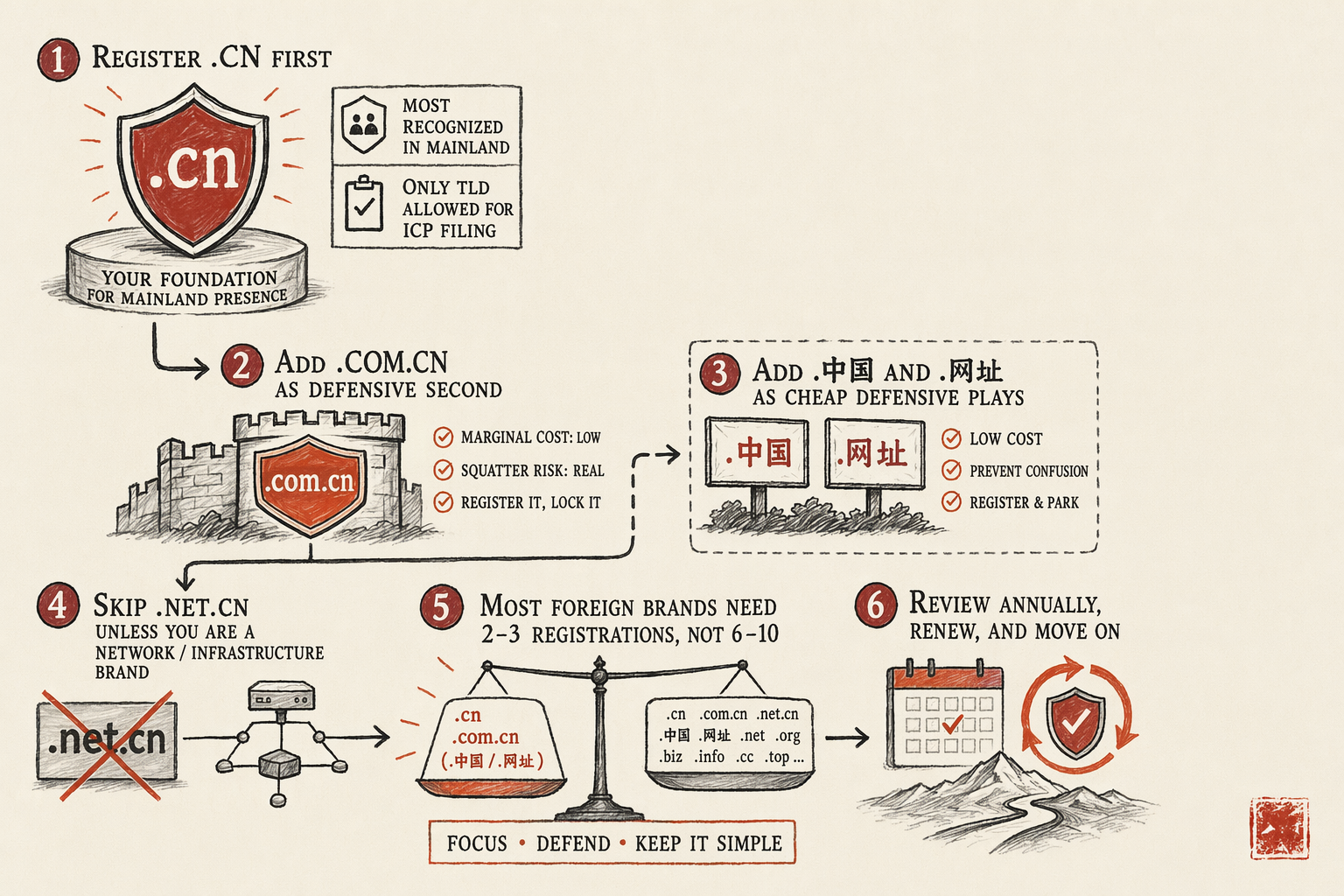
For a typical foreign brand the practical decision set narrows to three slots: .cn (primary), .com.cn (defensive secondary), and one Chinese-character variant (.中国, defensive). Beyond those three the cost-benefit favors skipping unless the brand has a specific industry rationale (a network company might want .net.cn) or a specific squatter risk (a brand with active confusion-marketing exposure might add .网址).
.cn — most-trafficked, broadest recognition
The .cn top-level domain is the workhorse. It is the most-recognized China-specific TLD among consumers, the only one most search engines treat as primary China geographic signal, and the required form for ICP filings under MIIT regulations. If you register only one Chinese TLD, this is it.
Recognition: a .cn domain reads to mainland consumers as a Chinese brand or a foreign brand with a Chinese presence. The reverse — a foreign brand operating in China on a .com only — is fine for brand-search traffic from English-language sources but loses against Chinese-language SEO and against the perception that the brand has "shown up" in the local market.
ICP filing eligibility: ICP (Internet Content Provider) 备案 (filing) under MIIT regulations requires the domain to be either a .cn / .com.cn / .net.cn / .org.cn under CNNIC management, or a generic TLD (.com, .net, .org, .biz, .info, .me) whose WHOIS resolves cleanly through the CNNIC-approved registrar chain. In practice, .cn is the simplest path through ICP. A .com filing through a mainland hosting provider is achievable but generally takes longer at the MIIT review stage because the WHOIS authentication chain is more complex.
Operational rules: .cn registrations require CNNIC real-name verification (see foreign-entity documents for CNNIC real-name) within 15 days of registration or the domain enters a frozen state. WHOIS information is visible in CNNIC's registry; foreign-entity registrants are listed by entity name and country, with personal data partially redacted.
Annual fees: $15-$40 per year through major registrars, depending on the registrar's verification-handling overhead. Wholesale CNNIC fee is roughly $4-$8.
.com.cn — corporate signaling
The .com.cn second-level under .cn was designed to signal commercial use, mirroring the global .com convention. In practice the signaling difference between .cn and .com.cn is muted — Chinese consumers do not strongly prefer one over the other — and the operational mechanics are essentially identical. CNNIC real-name verification applies, ICP filing is allowed, registrar costs are similar.
The case for registering .com.cn alongside .cn is mostly defensive. Squatters target .com.cn when the matching .cn is held by the real brand because:
- It is the next-most-obvious alternate URL a consumer would type.
- It is functionally equivalent to .cn for resolution purposes, so a squatter can run a knockoff site without registering the harder-to-defend .cn.
- It is cheap to acquire and easy to maintain, lowering the squatter's cost basis.
A foreign brand that registers .cn and leaves .com.cn open has a non-trivial squat risk over 24-36 months. The cost of closing that risk is roughly $15-$40/year. The math almost always favors registering both.
The exception is brands with low Chinese-market exposure and a global .com that dominates brand search. For a brand whose Chinese-language activity is essentially nil and whose .cn registration is itself purely defensive, adding .com.cn doubles the defensive footprint at a small but non-zero cost. Some brands skip and accept the residual risk.
Chinese-character (.中国, .网址) — niche but cheap defensive plays
Chinese-character TLDs were introduced to allow URLs entirely in Chinese script. .中国 (literally "China") is administered by CNNIC; .网址 ("web address") and a small set of others (.公司, .网络) are administered by Knet and other registries outside CNNIC.
The honest assessment of these TLDs:
- Search engine support is partial. Baidu indexes .中国 cleanly but global engines (Google, Bing) historically had inconsistent IDN handling, and some China-specific search engines treat .网址 as a lower-trust signal.
- Keyboard input is awkward. Typing a URL in Chinese characters requires switching IME (Input Method Editor) modes mid-URL, which most users avoid. Direct-type traffic to Chinese-character URLs is small.
- Browser display rendering varies. Some browsers render .中国 in Chinese; others convert to Punycode (xn--fiqs8s) in the address bar, which looks suspicious to users and lowers click-through.
- Email is rarely supported. Most email systems cannot route to addresses ending in Chinese-character TLDs reliably.
Direct utility for foreign brands is therefore low. The defensive utility is real but bounded. Registering yourbrand.中国 for roughly $15-$30/year prevents a squatter from using it to run confusion-marketing or to phish consumers who guess at a Chinese-script URL. The same logic applies to .网址 at roughly the same price. Beyond those two, the additional Chinese-character TLDs (.公司, .网络, .手机) add cost without meaningfully closing the residual confusion-marketing risk.
The reasonable defensive package for a brand worried about Chinese-character squat risk is .中国 only. Add .网址 if the brand has had any history of consumer confusion or if a specific squatter has been observed using the matching Knet TLDs against other brands.
Picking 1-3 TLDs without registering 10
The decision framework most foreign brands should follow:
- If China is a strategic market and you will eventually host content there: register .cn (primary) + .com.cn (defensive). Skip .中国 unless you have specific confusion-marketing exposure. Skip everything else. Two registrations, $30-$80/year total.
- If China is a defensive priority but not yet operational: register .cn (defensive) + .com.cn (defensive) + .中国 (defensive). Park them all at the registrar's default DNS or point them at your global .com via 301 redirect. Three registrations, $45-$110/year total.
- If you have a name with high squatter appeal (luxury, consumer electronics, popular B2C brand): add .net.cn and .org.cn defensively, plus the pinyin equivalent of the brand name across .cn / .com.cn / .中国. Five to seven registrations, $80-$200/year total. The pinyin defense is detailed in defensive domain registration for Chinese brands.
- If you have an established mainland operation: the primary .cn / .com.cn pair plus a Chinese-character variant. Add city-level .cn extensions (.sh.cn for Shanghai-focused, .bj.cn for Beijing-focused) only if the brand has a city-specific marketing angle. Three to five registrations.
What to avoid: the "register every variant" pitch. Some registrars market a 20-domain China defensive package at $400-$800/year. The marginal defensive value of the 8th through 20th registration is essentially zero, and the renewal exposure compounds. A trim 3-domain package backed by active gazette monitoring closes 95% of real squatter risk at one-fifth the cost.
For consolidated registrar choice, the major mainland-friendly registrars (Aliyun, eName, Xinnet, GoDaddy China through their Chinese registrar partnership) all handle the documentary verification reasonably well; GoDaddy global without the China partnership is functional but slower at the verification step. Pick one registrar for all your .cn-family registrations to avoid having to renew across multiple portals and to keep WHOIS, real-name, and ICP filings synchronized through one provider's interface.