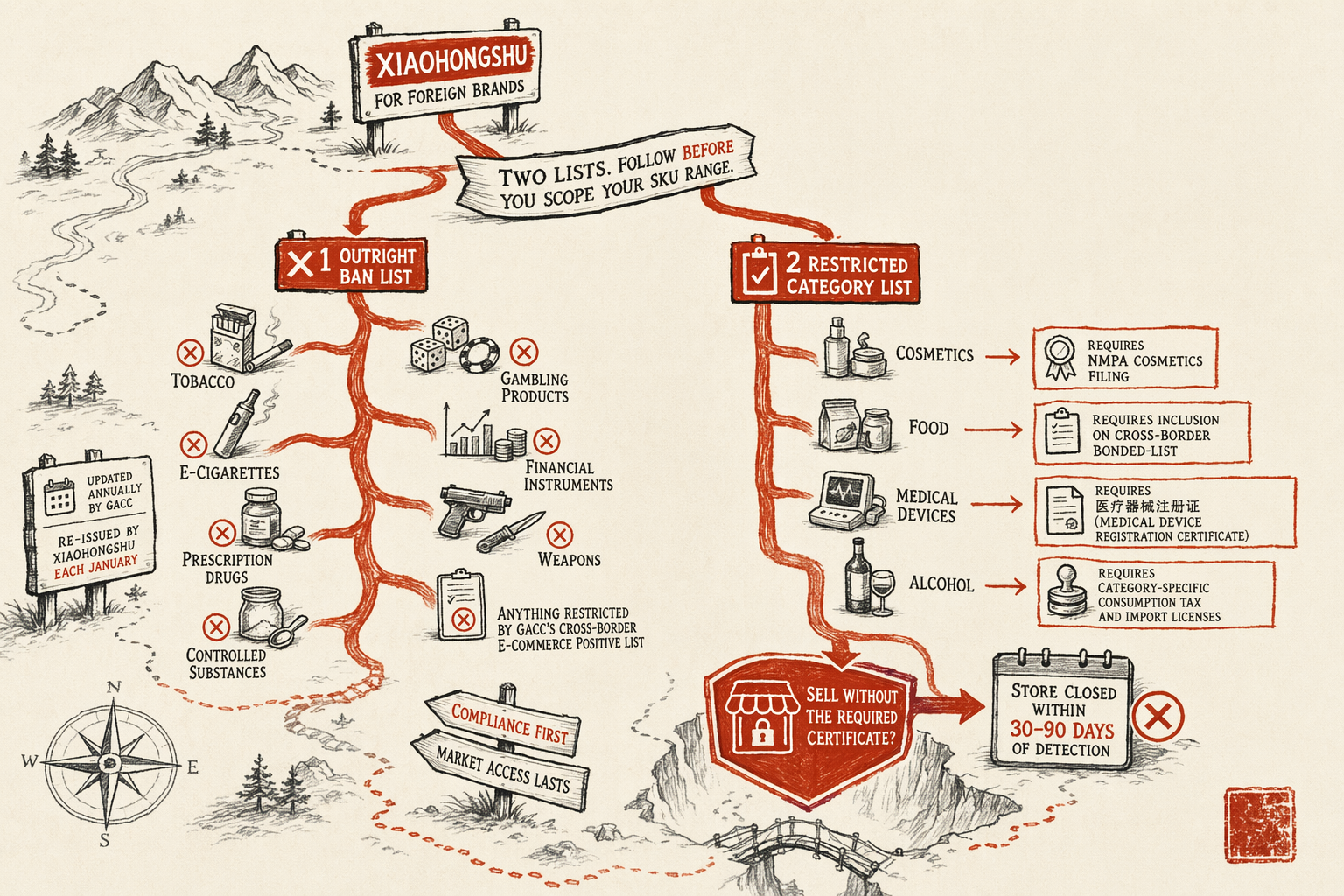
The most expensive mistake foreign brands make on Xiaohongshu is investing in launch — trademark, brand account, content production, KOC roster — before checking whether their product category is actually allowed on the platform. Some categories are flat banned. Some are allowed but require Chinese-issued certificates that take 6-18 months to obtain. The brand finds out only when the store application bounces or, worse, when the store is closed mid-operation for a category they had been selling under the assumption it was permitted.
This article catalogues the two lists every foreign brand needs to read before scoping their Xiaohongshu strategy: the outright ban list (products you cannot sell at any time, under any structure) and the restricted-category list (products you can sell but only with specific Chinese certifications). Both lists are updated annually by Chinese regulators and re-published by the platform. The version in this article is current as of early 2026; check the platform's official rules page for any mid-year amendments before committing to a launch.
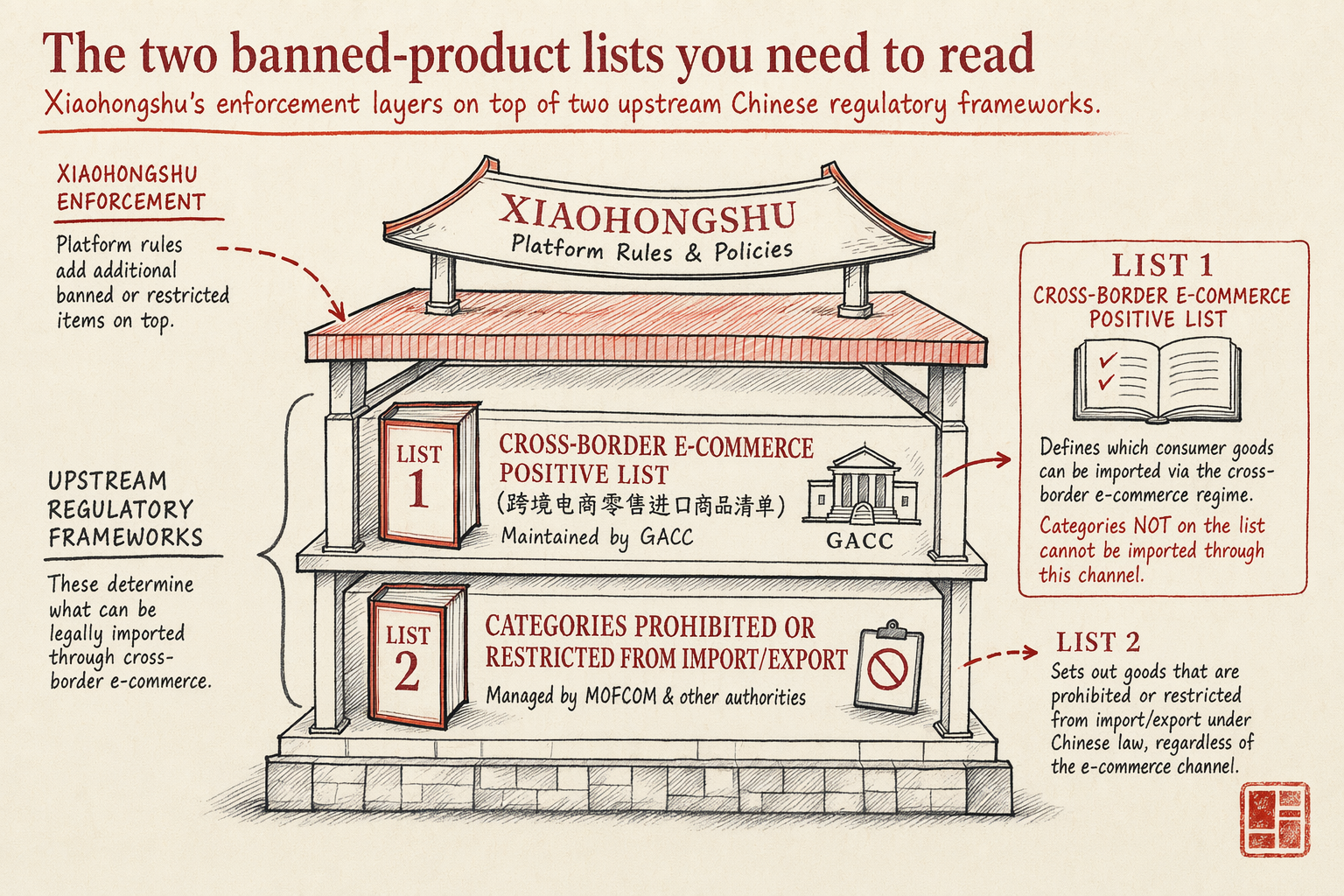
The two banned-product lists you need to read
Xiaohongshu's enforcement layers on top of two upstream Chinese regulatory frameworks. The first is the cross-border e-commerce positive list (跨境电商零售进口商品清单) maintained by GACC (General Administration of Customs of China). The list defines what consumer goods can be imported via the cross-border e-commerce regime — categories not on the list cannot move through the bonded-warehouse channel. The list runs to roughly 1,300 product categories at 8-digit HS-code granularity and is re-issued every 1-2 years.
The second is Xiaohongshu's own merchant standards, which layer additional platform-specific rules on top of the GACC list. Some categories that GACC permits on the cross-border list are nevertheless restricted on Xiaohongshu — typically because the platform's content audience skews young or because the category has historically generated heavy moderation work.
The two lists intersect to produce the actual ruleset for any given foreign brand. If GACC bans you, Xiaohongshu cannot help. If GACC permits you but Xiaohongshu restricts you, you can still sell — but on a different platform or with a different fulfillment route (the domestic-store path, see cross-border vs domestic store).
You can read the GACC positive list at the General Administration of Customs' bilingual portal. Xiaohongshu's merchant standards are published in Chinese-only on their merchant centre. Both lists are dense regulatory documents; we summarise the most-asked categories below.
Outright bans — products you can never sell
Categories that are banned across both the GACC cross-border positive list and Xiaohongshu's platform rules, in 2026:
- Tobacco products. All forms — cigarettes, cigars, pipe tobacco, smokeless tobacco. Banned across all Chinese e-commerce platforms by the State Tobacco Monopoly Administration. No exceptions.
- E-cigarettes and vaping products. Banned from cross-border e-commerce since the 2022 regulatory tightening. Domestic e-cigarette sales require a separate license under the State Tobacco Monopoly Administration that foreign brands almost never qualify for.
- Prescription pharmaceuticals. Anything classified as 处方药 (prescription medication) under NMPA's drug schedule cannot be sold on Xiaohongshu, cross-border or domestic. The platform is consumer-discovery; pharmacy commerce runs on Alibaba Health, JD Health, and Dingxiang Doctor.
- Controlled substances. Any substance scheduled under China's narcotics or precursor-chemicals regime. CBD/hemp products are restricted in a complex pattern — full CBD is banned, hemp-seed-oil with no detectable CBD is allowed in cosmetics under separate filings.
- Gambling products and instruments. Lottery tickets, sports-betting paraphernalia, casino chips, poker sets above a certain regulatory threshold.
- Financial instruments. Securities, investment funds, insurance products. Financial-services advertising is regulated separately by CSRC (China Securities Regulatory Commission) and CBIRC (China Banking and Insurance Regulatory Commission).
- Weapons, ammunition, military equipment. Banned regardless of category. Replica weapons that exceed certain dimensional thresholds also fall under this ban.
- Cultural-heritage items. Antiques over 100 years, archaeological artifacts, religious objects from protected sites. Export-controlled by China; you cannot import them either.
- Living animals and plants. All live animals, all live plants (except a small whitelist of cut flowers via permitted entry channels). Pet food is allowed; live pets are not.
- Used consumer goods. Resale, refurbished electronics, second-hand luxury goods. The cross-border regime is designed for new-product retail; used-goods imports require a different customs treatment.
- Counterfeit and grey-market goods. Any product whose authenticity chain cannot be verified back to the brand owner. The platform's brand-protection team aggressively removes flagged items.
The bans apply to cross-border and domestic stores equally. There is no legitimate way to sell these categories on Xiaohongshu through any structure.
Restricted categories needing licenses
Categories you can sell but only with the right Chinese-issued certificate:
- Cosmetics. Cross-border: NMPA simplified cosmetics filing (化妆品备案 under the cross-border regime). Domestic: full NMPA cosmetics filing or, for special-purpose cosmetics like sunscreen, the heavier 特殊化妆品注册. Cosmetics with regulated actives (vitamin C above 5%, retinol, alpha-hydroxy acids above certain concentrations) require additional ingredient-specific documentation.
- Food and beverage. Cross-border: inclusion on the GACC cross-border food positive list. Some sub-categories (dairy, meat, infant formula) require additional certification from the country of origin. Domestic: food production license (食品生产许可证) plus food business license (食品经营许可证) held by the operating entity, plus product-level food filing.
- Health supplements (保健食品). Cross-border: cross-border bonded inclusion, NMPA health-food registration (or notification for vitamins and minerals via the simplified track). Domestic: full NMPA health-food registration, which takes 12-30 months. Foreign brands rarely complete the domestic route for supplements; cross-border is the practical channel.
- Medical devices. Cross-border bonded: medical device registration certificate (医疗器械注册证) issued by NMPA for Class II and Class III devices, or filing for Class I. Domestic: full NMPA medical device registration, which requires Chinese clinical data for Class II/III. Class I devices (low-risk: bandages, basic thermometers) are easier; Class II and III take 18-36 months.
- Alcohol. Cross-border: GACC cross-border alcohol category permission, country-of-origin certificate, and consumption-tax pre-payment. Domestic: full alcohol distribution license (酒类流通许可证) and consumption-tax compliance. Spirits face additional category-specific licensing.
- Children's products. Toys require CCC certification (China Compulsory Certification, the Chinese product-safety regime). Children's clothing and bedding face category-specific textile safety filings. Children's skincare and food require the heavier sub-category cosmetics or food filings.
- Electronics with wireless transmission. Anything with Bluetooth, Wi-Fi, or cellular requires China SRRC (State Radio Regulation Commission) type approval, plus CCC certification for the consumer-electronics product class.
- Pet food. Cross-border bonded inclusion plus country-of-origin animal-health certificate. Heavily restricted by category — wet food easier than dry, mainstream protein sources easier than novel proteins.
The certification cost and timeline range from RMB 5,000 / 2 months (a single simple Class I medical device) to RMB 250,000+ / 30 months (a full domestic NMPA cosmetics registration for a special-purpose product). Budget for both the cash and the calendar before committing to a launch.
Grey zones and the algorithm's actual enforcement
The grey zones are categories that are technically allowed but where the platform's content moderation, algorithm suppression, or sporadic enforcement makes operating economics unattractive. The patterns we have seen repeatedly:
- CBD-adjacent cosmetics. Hemp-seed-oil cosmetics with zero CBD are technically allowed but get suppressed almost as if they were banned, because the algorithm pattern-matches on "hemp" and "cannabis" related terminology. Workable but reach is heavily capped.
- Sex-positive personal care. Lubricants, intimate-wash products, anything in the adult-personal-care category. Technically allowed under cosmetics filing but content suppression on the marketing side makes meaningful organic reach nearly impossible. Better channels exist (JD's adult-personal-care section).
- Sports nutrition with performance claims. Pre-workout, post-workout, recovery supplements. Allowed under the supplement category but performance claims ("30% more strength," "faster recovery") trigger the suppressed-content categories. See suppressed content categories for the rewriting patterns.
- Weight-management products. Meal replacements, fat-burners, appetite-suppressants. Technically allowed if not making medical claims, but the algorithm caps reach so heavily that the channel is structurally unprofitable.
- Religious or culturally-sensitive items. Religious jewelry, devotional objects, items associated with specific religious practice. Allowed but moderation is inconsistent.
Enforcement timing is the other variable to model. Xiaohongshu's enforcement team operates in bursts — the platform runs periodic compliance sweeps, typically quarterly, that catch up on the long tail of borderline merchandise. A grey-zone product can run for 6-12 months without issue and then get pulled in a sweep. Build the launch plan around what the platform allows in good standing, not what slips through in the gaps.
How the ban list changes year-to-year
Both upstream lists shift annually, and Xiaohongshu re-publishes its consolidated merchant standards in January each year. The pattern of changes since 2020:
- Cross-border positive list adds. GACC has steadily added categories — most recently extending to a wider range of pet food, more cosmetic-ingredient variants, and a few specific medical-device sub-classes. The trend is gradual liberalisation within the cross-border framework.
- E-commerce platform-specific tightenings. Xiaohongshu has tightened steadily on supplements, children's products, and medical-adjacent cosmetics. The 2024 update was particularly strict on supplements; the 2025 update added requirements around children's-product certification.
- Re-classifications between cross-border and domestic. Categories occasionally migrate. Sunscreen moved from cross-border-allowed to domestic-NMPA-required in 2023; certain niacinamide-heavy SKUs moved into the regulated-actives category in 2024.
- Mid-year amendments via platform notice. The platform issues mid-year merchant notices when GACC publishes interim updates. These are easy to miss; subscribe to the platform's merchant-centre announcement feed and check monthly.
The honest mitigation pattern: before scoping any meaningful Xiaohongshu launch, run the SKU range against the current Xiaohongshu merchant standards and the current GACC positive list. Re-run the check every January as part of annual planning. Build in a contingency SKU plan for categories at risk of being tightened. For the Xiaohongshu brand-setup workflow that includes the regulatory checks, see the Xiaohongshu brand setup playbook.
In plain English
If you only read one paragraph: Xiaohongshu enforces two product lists for foreign brands. The first is the outright ban list — tobacco, e-cigarettes, prescription drugs, controlled substances, gambling products, financial instruments, weapons, and anything restricted by GACC's cross-border e-commerce positive list. The second is the restricted-category list, which requires Chinese-issued certificates before you can sell: cosmetics need NMPA (National Medical Products Administration) cosmetics filing, food needs inclusion on the cross-border bonded-list, medical devices need 医疗器械注册证 (medical device registration certificate), alcohol carries category-specific consumption tax and import licenses. Selling without the required certificate gets your store closed within 30-90 days of detection. The ban list is updated annually by GACC and re-issued by Xiaohongshu each January. Read both lists before you scope your SKU range, not after.
Related
7 min read
Xiaohongshu Brand Account Setup, Step by Step
专业号 vs 个人号, trademark requirement, cross-border e-commerce linkage, KOL/KOC collaboration tools, banned categories.
6 min read
How to Choose an ICP Sponsor for Your Domain
Picking an ICP sponsor — entity-tied filings, sponsor fee ranges, support quality, what happens when a sponsor disappears.