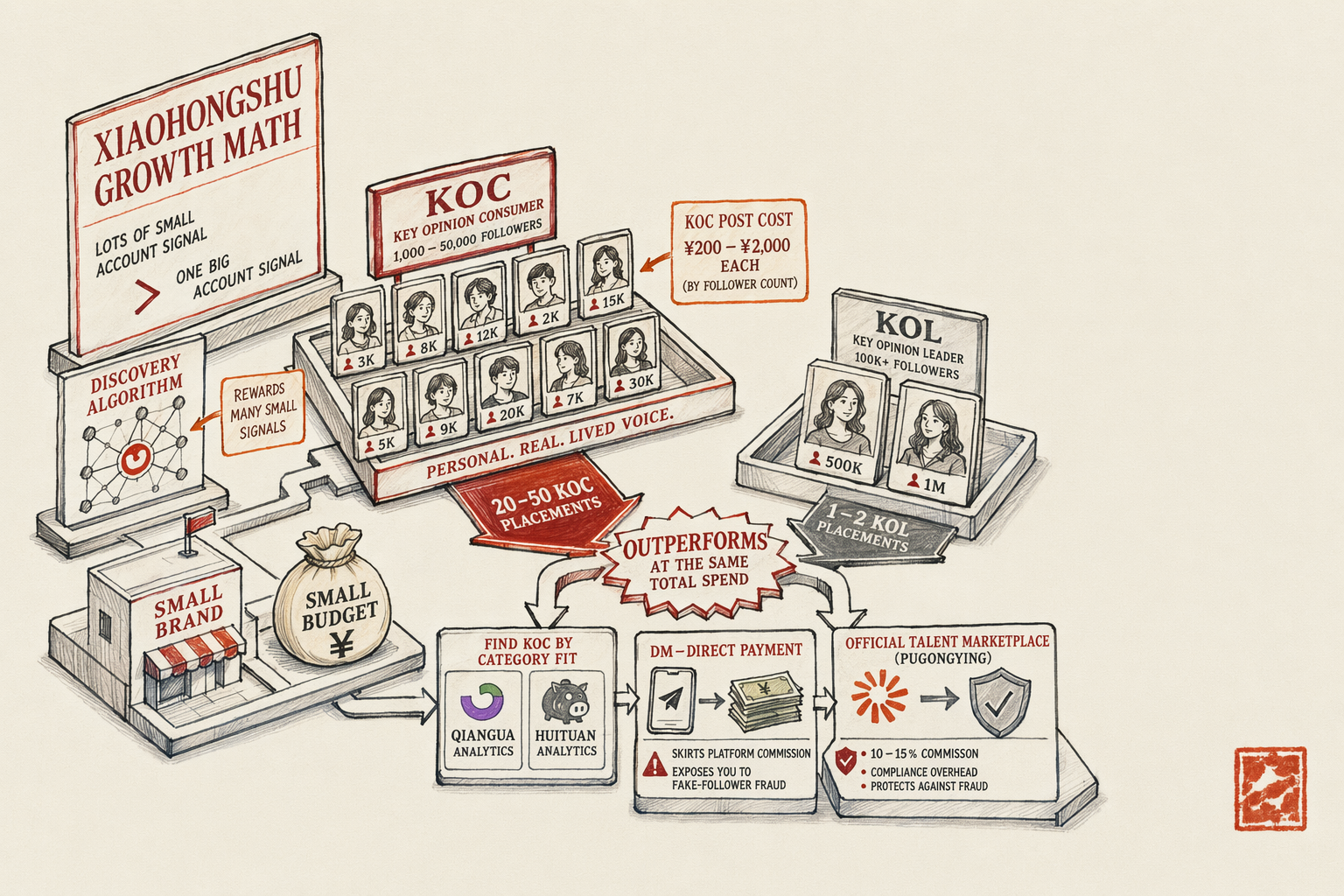
Foreign brands trying to enter Xiaohongshu often start by trying to identify a top-tier KOL (Key Opinion Leader) — somebody with hundreds of thousands of followers in the right vertical — and pay them tens of thousands of yuan for a single sponsored post. This is the wrong instinct. Xiaohongshu's recommendation algorithm rewards breadth of authentic-feeling signal over the size of any single voice, and the brands that win on the platform mostly run dense KOC (Key Opinion Consumer, 关键意见消费者) campaigns at small unit costs and high volume.
This article walks the math, the discovery and outreach mechanics, the budget tiers that actually produce reach, the content formats that translate for foreign brands, and how to measure when there is no clean attribution. The whole piece assumes a $500-3,000 per month working budget, which is the band where the KOC approach beats KOL by the widest margin.
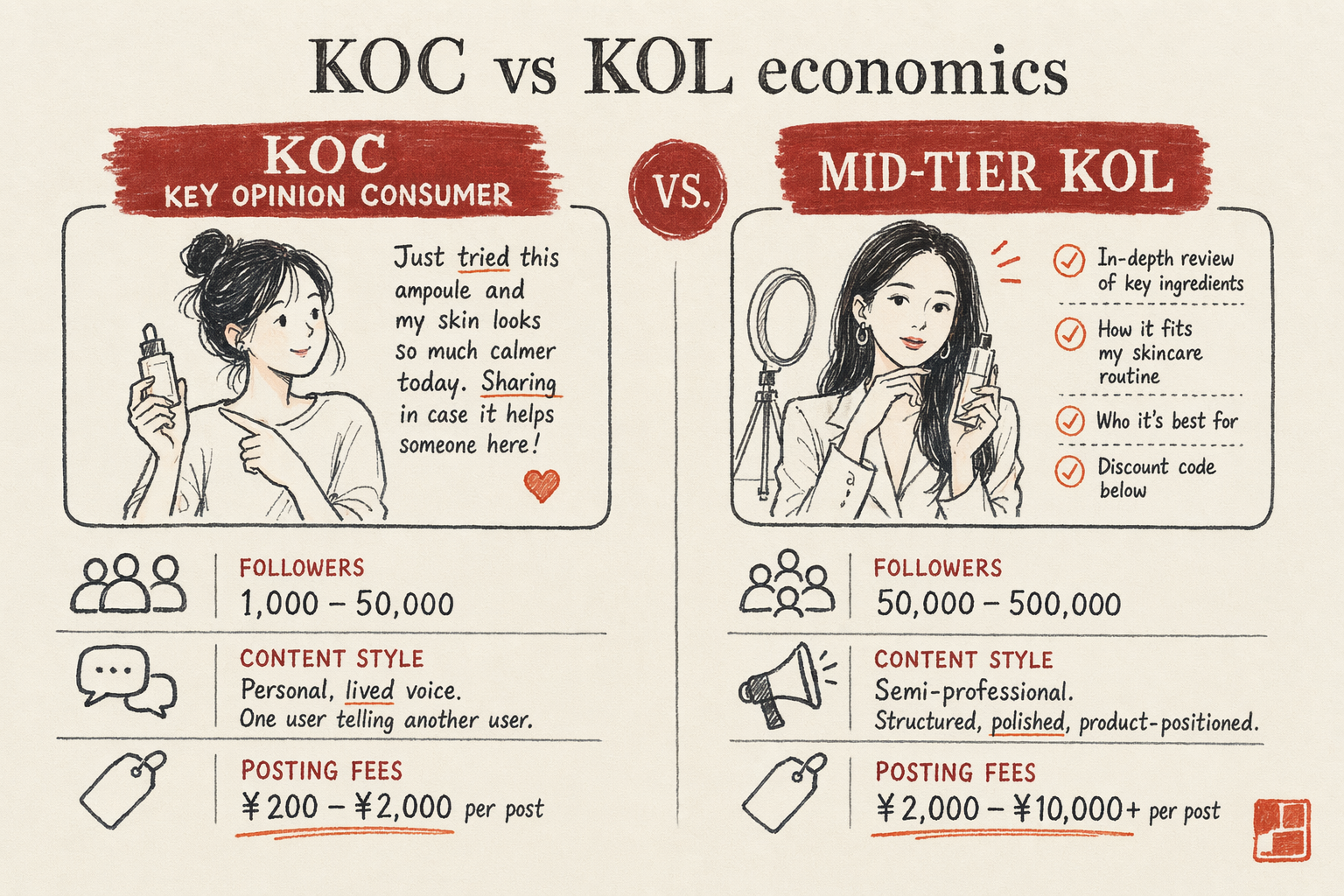
KOC vs KOL economics
The labels are not standardised, but the working definitions on Xiaohongshu in 2026 are:
- KOC (Key Opinion Consumer): 1,000-50,000 followers, posts in personal lived voice, content reads as one user telling another user about a product they tried, rather than as an ad. Posting fees ¥200-2,000 per post.
- Mid-tier KOL: 50,000-500,000 followers, semi-professional, often a focused vertical (skincare reviewer, foodie, home-decor curator). Posting fees ¥3,000-25,000.
- Top-tier KOL: 500,000+ followers, professional creator, often signed to an agency. Posting fees ¥30,000-300,000+.
The Xiaohongshu algorithm cares about velocity and breadth of engagement signal in the first 24-48 hours after a post goes live. A KOL post gets a single concentrated burst — many likes and comments quickly from an established audience. A campaign that buys 20 KOC posts at the same total spend gets 20 concentrated bursts distributed across the day, each one independently signaling to the algorithm that the topic is engaging. The algorithm reads the latter as broader cultural relevance and amplifies the topic into discovery feeds; the former gets read as a sponsored push and is partially throttled.
The math gets sharper when you look at per-impression cost. A top KOL might charge ¥80,000 for a post that lands 800,000 impressions on day one — ¥100 per thousand impressions. A KOC charging ¥500 might land 8,000 impressions on day one — ¥62.50 per thousand. The KOC's per-impression rate is better, the audience signal is more native, and the discovery-feed pickup is meaningfully higher.
The official talent marketplace vs DM-direct
There are two channels for booking KOC posts:
- Xiaohongshu's official talent marketplace (蒲公英, Dandelion). Built into the platform, brands post briefs, KOC apply or are matched, payment runs through the platform with a 10-15% commission, content review is handled by the platform. Compliance-safe and fraud-protected. Slightly slower turnaround (creators take 2-7 days to respond to briefs).
- DM-direct. Brand identifies a KOC, DMs them, negotiates a price directly, pays them externally (typically WeChat transfer or bank wire), creator publishes without platform involvement. Faster, no commission, but exposes you to fake-follower fraud, content compliance risk, and platform-level enforcement if Xiaohongshu's bots detect the off-platform commercial arrangement.
The honest case for each:
- Use Dandelion for the first 30-50 KOC posts of any new campaign. The fraud protection alone justifies the commission. Once you have working creator relationships, you have data on which creators actually move metrics versus which ones inflate their stats.
- DM-direct works for ongoing relationships with creators you have already verified through Dandelion. Once a creator has shown they have real engagement, switching them to DM-direct saves you the platform commission for ongoing collaborations.
- Never DM-direct a creator you have not vetted. Fake-follower fraud on Xiaohongshu is rampant — the standard tactic is to buy 10,000 follower bots from a Taobao shop for ¥100 and then charge brands ¥800 for what looks like a 10k-follower KOC placement.
Creator-discovery tools — 千瓜 (Qiangua), 灰豚 (Huituan), 新红 (Xinhong) — let you filter by follower count, category, recent post engagement rates, and audience demographics. Qiangua is the dominant analytics player. A subscription runs roughly ¥1,500-3,500 per month and pays for itself in fraud detection alone on the first three or four campaigns.
Budget tiers and realistic reach by tier
Realistic 2026 budget tiers and the reach they consistently produce, across cosmetics / lifestyle / food-and-beverage categories where the KOC model works best:
- ¥3,500-7,000 / month (~$500-$1,000 USD). 8-15 KOC placements at the low end of the price band (¥300-500 each). Reach: 80,000-200,000 total impressions, 200-800 store-page visits, 5-30 first-time orders if pricing and product fit are tight. This is the discovery-and-iteration tier — you are learning what content angles work, not yet at the volume where you scale.
- ¥7,000-15,000 / month (~$1,000-$2,000 USD). 15-30 KOC placements with a few in the ¥800-1,500 band. Reach: 200,000-600,000 impressions, 800-2,500 store-page visits, 30-100 first-time orders. The discovery feed starts picking up your branded hashtag and serving it to non-engaged users.
- ¥15,000-25,000 / month (~$2,000-$3,500 USD). 30-50 KOC placements + 1-2 mid-tier KOL (¥3,000-8,000 each) to anchor brand recall. Reach: 500,000-1,500,000 impressions, 2,500-8,000 visits, 100-400 first-time orders. Discovery momentum compounds — paid KOC content starts driving organic UGC (User-Generated Content) follow-on.
- ¥25,000+ / month. Mixed KOC + KOL with planned content waves around commercial events (618, Double 11, Chinese New Year). Above this tier the analysis is brand-specific and the math is different.
The numbers assume working content. Posts that trigger one of the suppression categories (see the suppressed-content categories guide) drop reach by 50-90%. Budget for an editorial-review pass on every brief before the creator publishes.
Content-format choices that travel for foreign brands
The formats foreign brands consistently get traction with on Xiaohongshu, in order of typical engagement rate:
- Personal-experience posts (亲测) with before-and-after photos. The dominant format on the platform. A KOC photographs themselves trying the product over 4-14 days, posts a multi-image carousel with the journey and their honest take. Engagement rates 4-12% on a fitted audience.
- Routine-integration posts. A KOC shows the product fitting into their daily routine alongside other unrelated products. Reads as native, signals broad fit, escapes single-product suppression.
- Comparison posts (without naming specific competing brands). A KOC compares two formulations or two SKUs from the same brand — "product A vs product B for [need]." Naming competing brands triggers suppression; comparing within your own range does not.
- Educational deep-dives. A KOC explains the science behind the product, ingredient by ingredient, with sources. Reaches a smaller but heavily-converting audience.
- Behind-the-scenes brand-origin content. A KOC visits your overseas factory or talks to the founder. Hard to scale but produces unusually strong trust signals when it lands.
- Short video (vs static carousel). Xiaohongshu's algorithm has shifted to favouring video. Posts with 15-60 second video content reach roughly 1.4-2.1x further than static carousels with similar engagement rates. KOC video adds ¥200-500 to the per-post fee.
Formats that do not work for foreign brands:
- Direct product-shot reviews. Reads as ad, gets demoted.
- Branded hashtag campaigns where 30 KOC use the exact same caption. The duplicate-content detector catches this.
- Heavy promotional discount mentions. Suppressed under the off-platform purchase trigger.
Measuring KOC ROI without attribution
The single hardest part of running a small-budget Xiaohongshu campaign is that there is no clean attribution. Most Xiaohongshu traffic does not click through to your owned site — buyers see the post, search your brand inside Xiaohongshu, find your store, and purchase there. Last-click attribution catches roughly 10-20% of the actual KOC-driven conversion.
The measurement frame we use across brokered engagements:
- Branded search volume in the Xiaohongshu app. Track searches for your brand name inside the platform week-over-week. The lift one week after a KOC wave is the cleanest signal of working content.
- Store-page traffic in the Xiaohongshu seller back-end. Your store's analytics dashboard shows visitor counts and source. Spikes in "non-attributed" traffic the day of and day after a KOC post are real reach.
- First-time-buyer rate. Track the percentage of orders that are from new buyers (no prior order history). KOC campaigns should drive new-buyer rate above 60-75%; if it's lower, the campaign is reaching existing followers, not discovery-feed users.
- Cost-per-impression at the campaign level. Sum all KOC placement fees, divide by total impression count across all posts (visible in the Dandelion campaign report or, for DM-direct, in each creator's post analytics screenshot). Target ¥30-80 CPM (cost per thousand impressions). Above ¥100 CPM suggests creator fraud or category mismatch.
- UGC follow-on rate. The downstream signal of working KOC content is unpaid posts mentioning your brand from creators you did not pay. Track this as a leading indicator of brand-momentum.
For the brand setup and verification prerequisites, see the Xiaohongshu brand setup playbook. For a cosmetics-specific deep dive into KOC and platform mechanics, see the cosmetic brands industry page.
In plain English
If you only read one paragraph: Xiaohongshu's growth math runs on KOC (Key Opinion Consumer, 关键意见消费者) — micro-influencers with 1,000-50,000 followers who post in a personal, lived voice rather than a paid-ad voice. KOC posts cost ¥200-2,000 each depending on follower count. At a small-brand budget, 20-50 KOC placements consistently outperform 1-2 KOL (Key Opinion Leader) placements at the same total spend, because the discovery algorithm rewards lots of small-account signal more than it rewards one big-account signal. Use the 千瓜 (Qiangua) or 灰豚 (Huituan) analytics platforms to identify KOC by category fit. DM-direct payment skirts platform commission but exposes you to fake-follower fraud. The official talent marketplace (蒲公英) takes 10-15% commission and adds compliance overhead but protects against fraud.