—
Time to launch
Mike's running benchmarks
—
Y1 cost band
Mike's running benchmarks
—
Outcome metric
Mike's running benchmarks
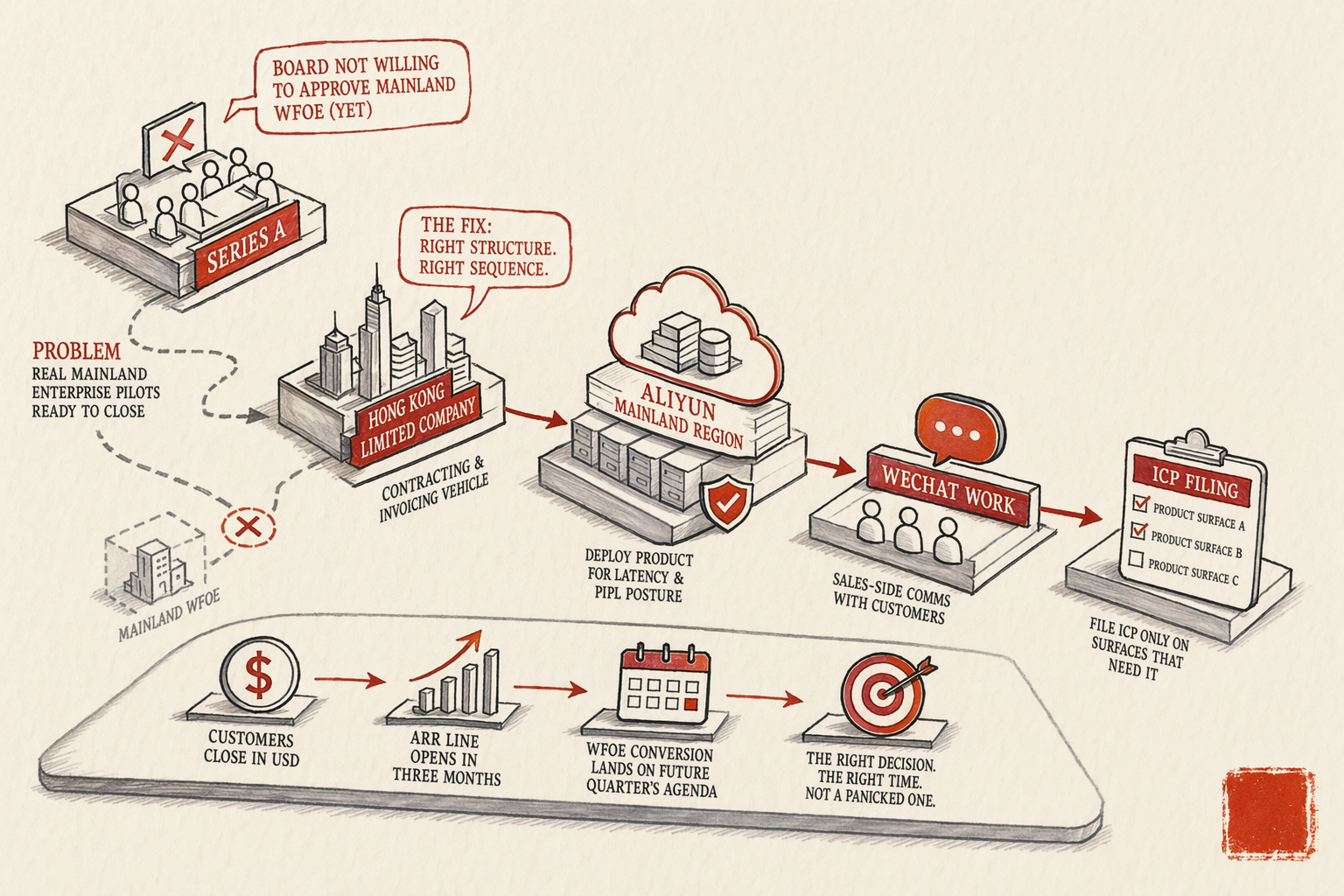
A Series-A B2B SaaS company at the $8M ARR (Annual Recurring Revenue) range had run five mainland-Chinese enterprise pilots over six months and was ready to convert several of them into paid contracts. The blocker was not product, not pricing, not customer interest. It was structural: the customers wanted invoices they could process inside mainland procurement systems, and the company's board did not want to approve a WFOE (Wholly Foreign-Owned Enterprise, the 100%-foreign-owned mainland legal entity) inside the Series A-to-B fundraising window.
This case study covers what the company looked like when they reached out, the specific reason the WFOE was off the table even though it would have solved the problem the customers were raising, the structure we landed on instead, and what changed for the business over the first 12 months of having that structure in place. Names, industry sub-category, and exact revenue numbers are removed — the structural pattern is not.
The starting point — Series-A B2B SaaS, $8M ARR, mainland enterprise pilots ready
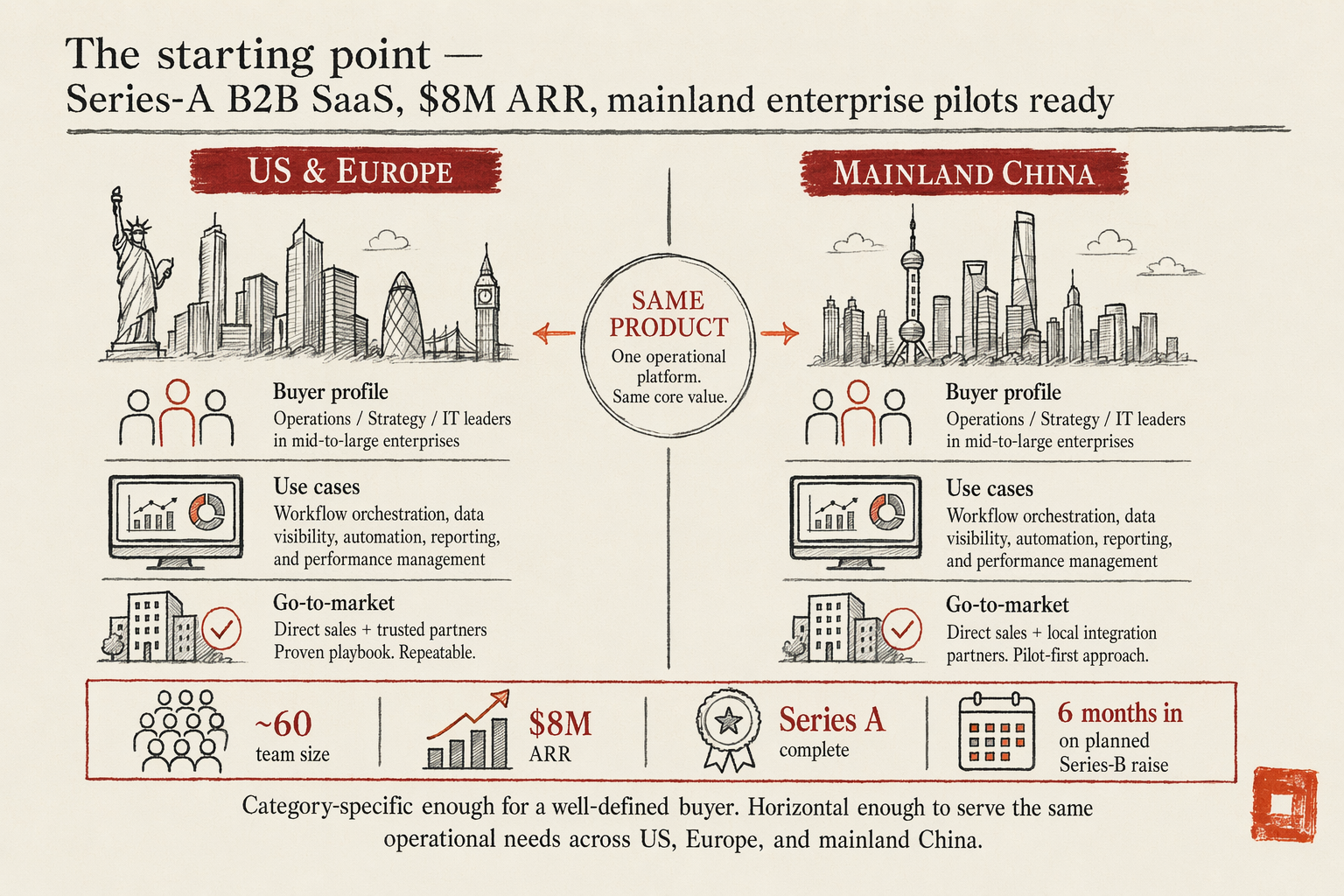
The company was a roughly 60-person B2B SaaS at $8M ARR, US-based, Series A complete, six months into a planned Series-B raise. The product was a category-specific operational tool — vertical-focused enough that the buyer profile was well-defined, horizontal enough that the same product worked for the mainland customer set as for the US and Europe customer base. The mainland buyer profile was large enterprise, typically multinational subsidiaries of US or European parent companies with mainland operations, plus a smaller subset of Chinese-domiciled enterprises with international footprint. Total addressable buyer pool in the mainland sat at a couple of hundred named accounts.
The sales motion was already running. Two enterprise account executives had been targeting mainland accounts for about a year, plus a sales engineer who spoke Mandarin and a customer-success manager. None were based in the mainland — the AEs were in Singapore and Hong Kong, the SE and CSM were in the US. The pilots were running on the company's US infrastructure, which meant noticeable latency for mainland users, occasional connectivity hiccups during cross-border traffic events, and no answer to the procurement question about data residency. None of those had killed pilots, but they had slowed them.
What killed the close-to-paid conversion was the invoicing question. Two of the five pilots were ready to sign. Their procurement teams had asked: can we pay you in RMB to a mainland account, can you issue a fapiao (the VAT-special-invoice that mainland B2B AP teams require for cost recognition), and is the contracting entity recognized inside mainland law. The company's answer to each of those was no, because the contracting entity was a US Delaware corp, the only payment account was USD-denominated in the US, and there was no mainland legal entity to issue a fapiao. The procurement teams escalated. The deals stalled.
The blocker — board would not approve a WFOE, customers wanted RMB invoicing
The straightforward answer to the customer's invoicing question is to incorporate a WFOE in the mainland, get it registered as a general taxpayer (一般纳税人), open RMB business accounts, register the fapiao printer, and start issuing local invoices. That is a 16-24 week project end-to-end, costs $30-80k in setup and first-year operating overhead, and produces real entity exposure — a legal representative with personal liability, ongoing tax and bookkeeping obligations, social-insurance registration for any mainland staff, real-estate registration for the office.
The board, with the Series-B fundraise active, did not want to approve any of that. The reasons they cited, in board-meeting-minutes language: the mainland operation was unproven beyond the pilot stage; the WFOE would commit operating overhead that would show up in the burn rate on the diligence dataroom; if the mainland market validation did not pan out, unwinding a WFOE is materially harder and slower than not having one; and the Series-B lead was reading geopolitical risk into mainland operating exposure for portfolio companies in the sector. None of these were objectively wrong. They were the legitimate concerns of a board running a fundraise.
The customers, meanwhile, were not asking for a WFOE specifically. They were asking for three concrete things. One — a contract a mainland procurement team could process. Two — an invoice their AP team could pay against. Three — assurance that the product they were buying would deliver acceptable latency and data-handling for their mainland end users. The WFOE was one way to meet those three. It was not the only way.
The challenge framed cleanly: deliver the three concrete things the customers were asking for, without committing the operating exposure the board would not approve. Preserve the option to do the WFOE later, when the board's concerns had resolved or the data had built the case.
What we ruled out — full WFOE on day one, and pure-offshore wait-and-see
Two obvious options got ruled out fast.
Full WFOE on day one was the option a less-experienced advisor would have pushed. It solves the invoicing question. It also commits to the operating model the board was rejecting. Pushing the board to approve a WFOE during a live Series-B fundraise was not strategically wise even if the operational case was strong — the right time for that conversation is post-close, with proof points in the mainland deal flow that justify the investment. We told the founder that.
Pure-offshore wait-and-see was the option a less-engaged advisor would have suggested — keep the US Delaware as the only contracting entity, tell the customers no, let the pilots churn, revisit in 12 months. This protects the burn rate at the cost of losing the customers who are ready to close right now. Mainland enterprise software buyers do not infinitely wait — they have budget cycles, they have internal champions whose political capital depletes if a deal stalls, they have competitor vendors hovering. Pure wait-and-see was, in practice, a decision to walk away from the immediate revenue and the customer relationships that came with it. We told the founder that too.
The structure space between “full WFOE” and “pure offshore” turned out to be wider than the company had realized. Hong Kong as a contracting and banking entity, an EOR (Employer of Record) for mainland sales presence without staffing a mainland entity, Aliyun's mainland region for product latency and PIPL posture, WeChat Work for customer-facing communication, and selective ICP (Internet Content Provider) filing on the product surfaces that needed mainland hosting — these stacked to deliver functionally most of what a WFOE delivered for the customers' specific asks, at a fraction of the operating commitment.
The actual fix — HK invoicing, WeChat Work, Aliyun region, selective ICP
The structure had four layers, deployed in sequence so each one resolved the corresponding customer concern.
Layer one — Hong Kong limited company as the contracting and invoicing entity. The HK Ltd was incorporated above the US Delaware parent, with the US parent as 100% shareholder and the HK Ltd as the dedicated regional contracting vehicle. The HK Ltd opened HKD and USD accounts at a legacy HK bank and a virtual bank, with the legacy bank intended for customer settlement and the virtual bank for operating expenses. The HK Ltd issued USD-denominated SaaS service invoices to mainland customers, with payment via cross-border wire from the customer's USD account or via a cross-border payment provider that handled the customer-side RMB-to-USD conversion. Mainland customer AP teams accepted the USD invoice format because the underlying service was offshore-delivered SaaS — the procurement category they were classifying it under was “international software service,” not “domestic vendor.”
Layer two — WeChat Work for customer-facing communication. The mainland enterprise buyer profile uses WeChat (specifically the WeChat Work enterprise variant, 企业微信) as the default customer-success and sales-side communication channel. Email is acknowledged for formal deliverables — contracts, invoices, incident reports — but day-to-day account management lives in WeChat Work. The company set up a WeChat Work tenant on the HK Ltd, integrated it with their existing customer-success CRM, and onboarded the AEs and CSMs to use it as the mainland-customer channel of record. The customers experienced the company as a vendor who responded in their preferred channel, which materially shifted the relationship feel even though no other operational change was visible to them.
Layer three — Aliyun mainland region for product latency and PIPL posture. The product had a clear separation between the data-plane (where customer-tenant data lives) and the control-plane (where the company's internal admin, billing, telemetry lives). The mainland-customer data-plane workloads moved to an Aliyun China region — a Beijing primary and a Shanghai secondary for redundancy. The control-plane stayed on the company's existing US infrastructure. This achieved two things at once: latency for mainland end users dropped from cross-Pacific-typical 180-280ms to sub-50ms, and the customer's procurement team could check the “mainland data residency” box that they had been asking about. The PIPL posture work — appointing a PIPL representative, publishing a Chinese-language privacy policy, executing Standard Contracts for cross-border transfer of any control-plane data — was the parallel workstream that made the data-residency claim defensible.
Layer four — selective ICP filing on the product surfaces that needed mainland hosting. The customer-facing product UI for mainland users got a chinese-language landing surface hosted on Aliyun, which required ICP 备案 (filing). The filing was sponsored under Aliyun's umbrella using the HK Ltd's downstream entity through a partner mainland sponsor — not a WFOE, but a sponsor-tier ICP that is structurally available to overseas operators through Aliyun's enterprise programs. The product surfaces that did not require mainland hosting (the marketing site, the documentation site, the support knowledge base) stayed on the global infrastructure and did not need filing. The ICP scope was deliberately narrow to keep the filing footprint clean.
The total operating commitment of this stack ran a small fraction of what a full WFOE would have cost. HK setup and annual carry under €10k. Aliyun region operating cost was usage-based, in the low five figures USD per year at the pilot volume. WeChat Work was effectively free to set up. ICP sponsor fees and PIPL representative were under $5k all-in for setup and first-year carry. Total first-year structural cost was inside the budget the board had pre-approved for “regional commercial development” that did not require a new operating entity vote.
The 14-week implementation timeline
From green-light on the structure to all four layers operational, the project ran roughly 14 weeks.
- Weeks 1-2: HK Ltd incorporation. Company secretary and registered office on contract. Initial HKD and USD bank accounts opened (virtual bank account in week 1, legacy bank account in week 4 — the legacy bank ran on its standard intake timeline).
- Weeks 2-5: WeChat Work tenant provisioning, integration with the customer-success CRM, AE and CSM onboarding. The longest single piece of this was the WeChat Work mainland enterprise verification, which sat at 8 business days for the platform-side review.
- Weeks 3-9: Aliyun mainland-region deployment of the data-plane workloads. The engineering work to make the data-plane region-aware was the bulk of this — splitting the customer-tenant data store, deploying the read replicas, configuring the cross-region failover. The Aliyun account opening itself was sub-two-weeks; the engineering took the time.
- Weeks 6-11: ICP sponsor selection and 备案 filing through Aliyun's enterprise sponsor program. Filing receipt in week 9, full filing approval in week 11. The 30-day PSB (Public Security Bureau) sub-filing followed approval and was handled by the sponsor under their bundled fee.
- Weeks 4-14: PIPL representative engagement, Chinese-language privacy policy drafted and reviewed by mainland counsel, Standard Contracts for cross-border transfer executed for the control-plane traffic. This ran in parallel and concluded with the last document signature in week 14.
- Weeks 12-14: Two stalled pilot contracts re-engaged. Procurement reviewed the new HK invoicing structure, the Aliyun data-plane attestation, and the PIPL posture documentation. Both contracts moved to signature in week 14 and the first invoices issued the same week.
The longest critical path was the Aliyun data-plane re-architecture, which was engineering work rather than regulatory work. The regulatory path was actually faster than the engineering path on this project, which is unusual.
The result — closed pilot conversions, ARR line opened, optionality preserved
The two pilots that had stalled on the invoicing question closed within four weeks of the new structure being operational. Three more pilots that were earlier in the cycle converted over the following nine months. Inside 12 months from go-live, the mainland customer count sat at 14 paid enterprise accounts, with mainland-attributable ARR contributing high single-digit percentages of total company ARR — a meaningful line item, not yet a dominant one.
The customer-side experience trended positive. Latency complaints disappeared after the Aliyun region went live. The WeChat Work integration was specifically called out by two customers in their renewal conversations as the difference between this vendor and the previous-vendor experience. The PIPL posture documentation was used in two procurement security reviews and passed both. The HK invoicing was a non-issue for every customer that closed under it — the procurement teams treated it as standard offshore-SaaS contracting.
The board-side experience was equally important. The Series-B closed during this period with the mainland-presence story positioned in the diligence pack as “measured market presence with optionality preserved” — which was accurate. The mainland operating cost was visible in the burn rate but at a size that did not concern the lead investor. After the Series-B closed, the WFOE conversion became a different conversation: not a panicked “we need this to ship,” but a measured “the customer pipeline now justifies the operating commitment.” The conversion was approved in a subsequent quarter, scoped to a Shanghai trading-services WFOE specifically intended to enable RMB-denominated invoicing and the fapiao issuance that a growing subset of customers were now requesting. The HK Ltd stayed in place as the holding and offshore-contracting entity.
The lesson for the next SaaS founder reading this
If you are a B2B SaaS founder with mainland enterprise pilots in flight and you are not sure how to structure the China presence, the generalizable lesson runs to four points.
One — your customers are asking specific operational questions, not a structural one. When a mainland procurement team says “we need a Chinese entity to contract with,” they often mean “we need a contract we can process, an invoice we can pay, and a vendor relationship that maps to our internal categories.” That is solvable in multiple ways. Map the specific asks before you commit to the WFOE answer.
Two — the structure space between “full WFOE” and “pure offshore” is wide and underused. Hong Kong contracting, EOR for sales presence, Aliyun for product latency, WeChat Work for comms, selective ICP for product surfaces — these layer into a real operating posture without the WFOE commitment. For a SaaS at Series-A-to-B scale this is often the right answer for the first 12-24 months.
Three — preserve optionality during fundraising. Operating commitments that go into the dataroom during a fundraise carry weight that they would not carry in a normal quarter. A WFOE on the burn rate during diligence is read by a lead investor as a decision that has already been made. A measured-presence stack on the burn rate is read as optionality. Both are accurate; the second is strategically friendlier during a raise.
Four — the WFOE is the right answer eventually, not necessarily first. When the customer pipeline crosses the line where a meaningful share of buyers wants RMB invoicing or fapiao, the WFOE moves from premature to right. Set the threshold deliberately and revisit it quarterly. Most SaaS companies that we have walked through this cross the threshold somewhere between $1M and $5M of mainland-attributable ARR. Yours may be different.
What we would do differently next time
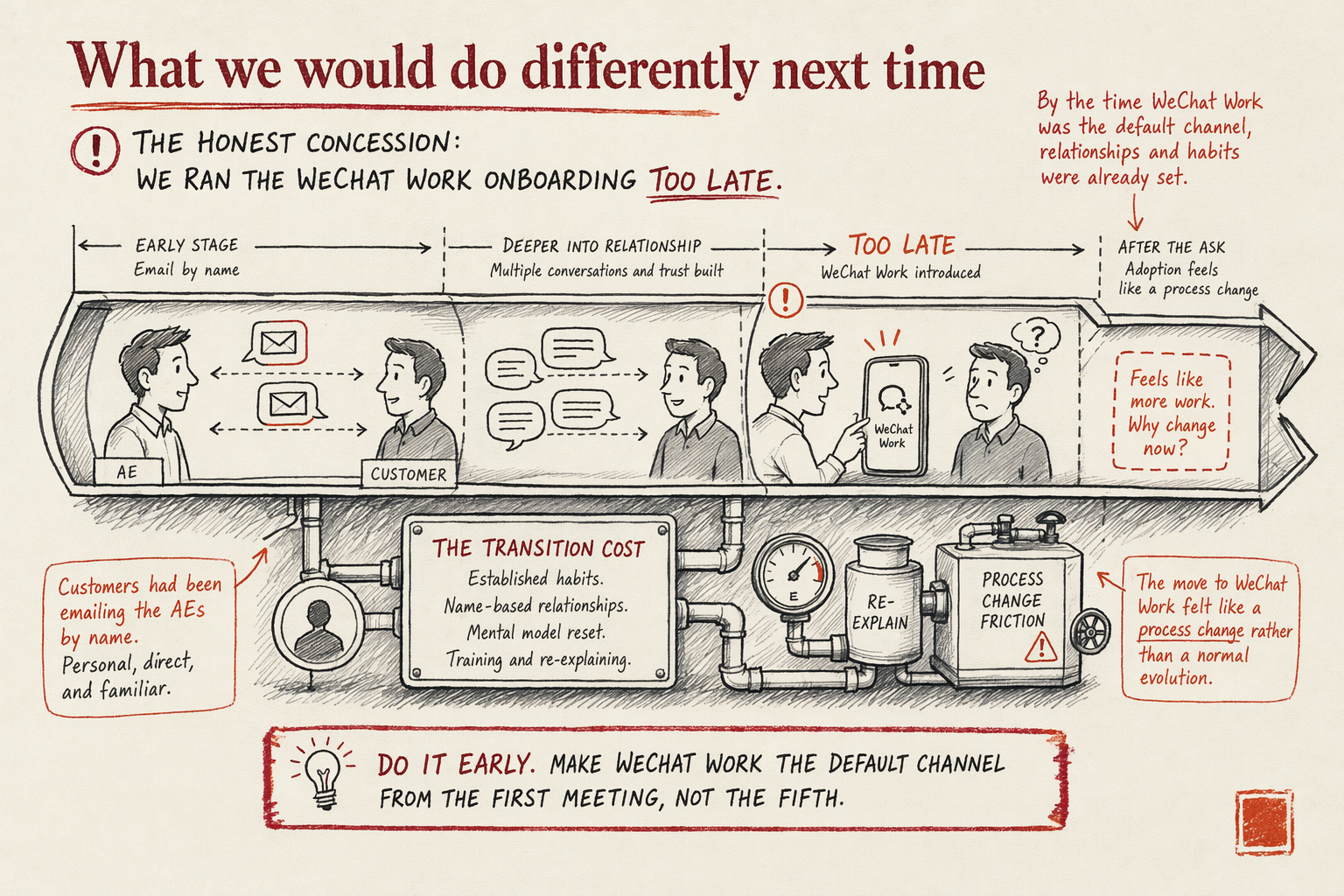
The honest concession: we ran the WeChat Work onboarding too late. The AEs were already several conversations into each customer relationship before WeChat Work was the default channel, which meant a transition cost — the customers had been emailing the AEs by name, and the move to WeChat Work felt to them like a process change rather than a normalization. The customers absorbed it cleanly, but two of them said in retrospect that they would have preferred WeChat Work from the first sales meeting.
What we would do differently: stand up WeChat Work in week one of the structure project, not week three. The platform-side verification has the 8-business-day delay that we knew about, and the integration with the customer-success CRM is straightforward. The cost of doing it first is low. The benefit is that every customer relationship enters the channel the customer prefers from the first conversation.
The second honest concession: the Aliyun data-plane region selection was a Beijing-primary, Shanghai-secondary configuration that worked operationally but was not optimal for the customer geography. The customer base ended up skewing more toward Shanghai and the south, and Beijing as the write-primary meant the company's Shanghai customers experienced slightly higher write latency than they would have with Shanghai as primary. Re-architecting after the fact was non-trivial — the second-time-around recommendation is to pick the primary region based on customer-base geography rather than on the engineering team's default preference. For a southern-skewed buyer base, Shanghai or Shenzhen primary is the right call. For a northern-skewed buyer base, Beijing primary works. Read the customer geography before the engineers default to their preferred region.
RELATED READING
For the other end of the structural decision — when the WFOE actually becomes the right answer — see the German manufacturer's Rep-Office-to-WFOE conversion. For the broader SaaS-vertical view see the SaaS industry page. To stress-test your own structure decision against your numbers, run the expansion-budget estimator.