—
Time to launch
Mike's running benchmarks
—
Y1 cost band
Mike's running benchmarks
—
Outcome metric
Mike's running benchmarks
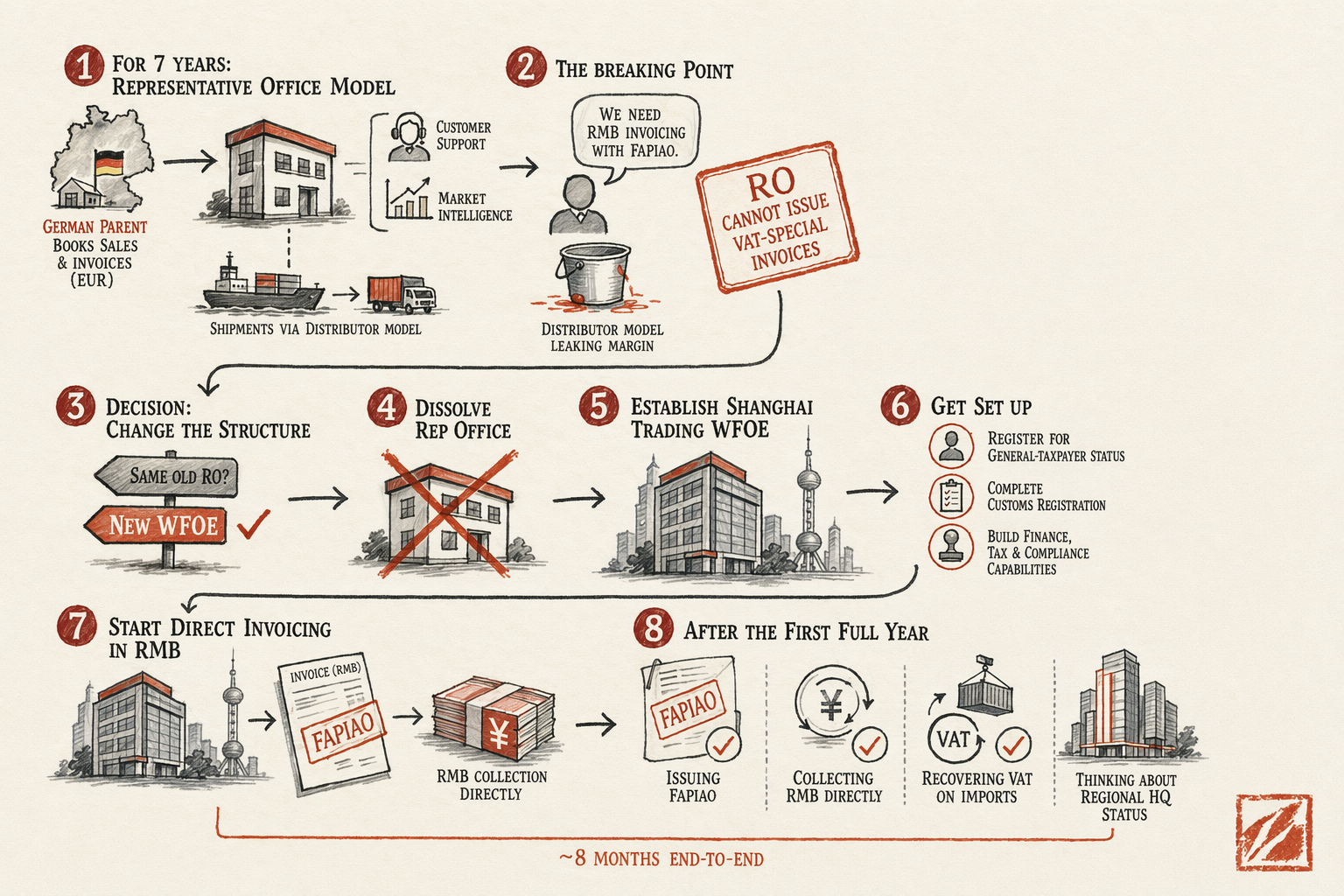
A €18M-revenue German precision-parts manufacturer had been running a mainland Chinese presence for seven years through a Representative Office (代表处, the lightest foreign-invested vehicle in PRC law). The RO was doing exactly what ROs are scoped to do: customer liaison, market intelligence, parent-company representation, and pre-sales engineering support. Sales themselves were booked through the German parent and fulfilled on an arms-length distributor model with two mainland distributors handling logistics, fapiao issuance, and customer-side credit.
That worked for seven years. It stopped working in the eighth, when the company's largest mainland customer escalated to senior management with a procurement-policy change: from the start of the next fiscal year, the customer's AP team would only process invoices that were RMB-denominated, fapiao-issued, and from a contracting party recognized inside mainland tax law. The distributor model could provide that on paper, but the distributors had also been quietly increasing their margin take, and the customer's procurement team had pushed back on the distributors' pricing. The path to keeping the account was direct invoicing. ROs cannot issue fapiao. The structural conversation had to happen.
This case study covers what the company looked like at the start of the conversion, what we ruled out, the specific sequence of dissolving the RO while standing up a trading WFOE in parallel, the general-taxpayer and customs-registration workstreams that followed, and what changed for the business across the first 18 months of the new structure. Names, exact revenue numbers, and identifying detail are removed.
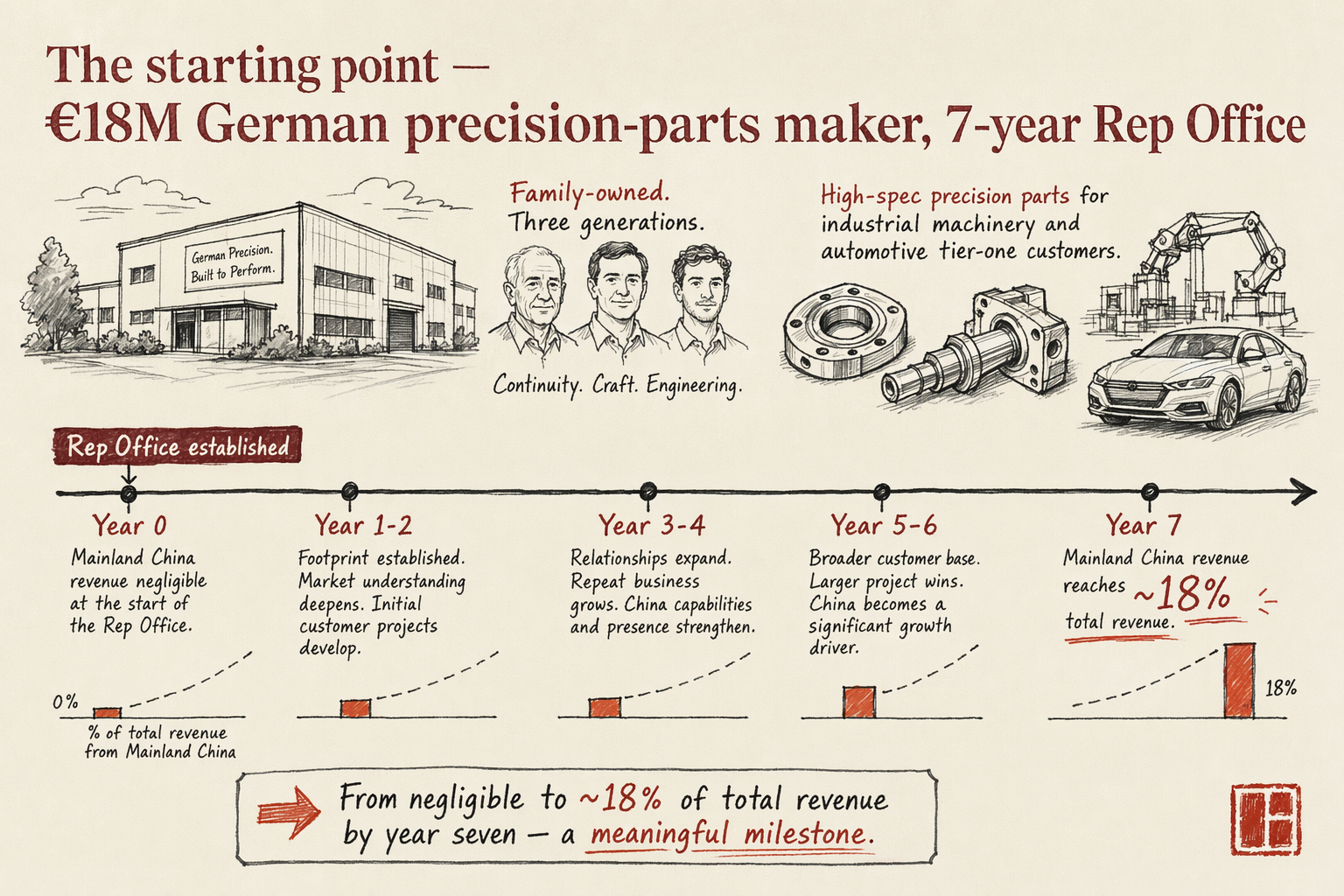
The starting point — €18M German precision-parts maker, 7-year Rep Office
The company was a roughly €18M annual-revenue German precision-parts manufacturer, family-owned across three generations, producing high-spec components for industrial-machinery and automotive-tier-one customers. Mainland Chinese revenue had grown from negligible at the start of the RO to roughly 18% of total revenue by year seven — a meaningful line item but not yet a majority dependency. The mainland customer base consisted of a small number of large industrial buyers, all multinationals with mainland subsidiaries that procured through their local procurement organizations. Order sizes were large, lead times were long, and customer relationships were measured in years not quarters.
The mainland operation looked like this: a Representative Office registered in Shanghai with seven staff (three customer-facing engineers, two field service technicians, one office manager, one finance liaison). The office issued no invoices, made no sales, and ran on the standard RO 20%-expense-markup imputed-profit basis for PRC tax — meaning the local tax authority treated 20% of the office's monthly expenses as imputed profit and collected CIT (Corporate Income Tax) and surcharges on that figure. Annual carry was in the low-six-figures EUR all-in including the salaries, social-insurance contributions, office lease, and tax. The RO was modestly cash-negative every year, treated by the parent as a business-development investment.
Sales themselves ran through one of two mainland distributors, both of whom held wholesale-distribution licenses, issued fapiao to the end customers, and remitted payment back to the German parent on net-60 terms after their distributor margin. The distributor margin had crept from 8% at the start of the relationship to 14% by year seven. The customer pricing on shelf had crept too, in ways that the German parent was not always informed about until quarterly business reviews. The relationship with the distributors was professional but tense.
The trigger event, when it came, was the customer's procurement-policy change. The top customer's mainland CFO had standardized that all suppliers must invoice the customer's mainland entity directly in RMB with VAT-special fapiao, eliminating the distributor markup that the customer's procurement team had been quietly subsidizing. The customer offered the German parent two options: either you arrange direct invoicing through your own mainland entity inside six months, or we move this volume to a competitor who already has direct invoicing capability. There was no third option.
The blocker — top customer demanded RMB fapiao, Rep Office could not issue one
The blocker was a regulatory hard line, not a soft preference. Representative Offices in mainland China cannot issue fapiao. The reason is structural — ROs are not registered as VAT taxpayers because they are not legally permitted to conduct sales activity. The PRC tax system treats fapiao issuance as proof of a VAT-creating transaction; an entity that is not in the VAT chain cannot, by definition, issue VAT-creating documents. The same regulatory principle that limits ROs to liaison and research is the principle that prevents them from issuing the invoices the customer was asking for.
This was not new information. The RO had been operating under this constraint for seven years. What was new was that the constraint had become commercially binding. The distributor model had been the workaround — distributors are VAT taxpayers, can issue fapiao, can sit in the contracting chain between the German parent and the mainland end customer. The customer's policy change explicitly closed that workaround for this account, and the company knew that other customers were likely to follow within 12-24 months.
The company's first instinct, like most, was to ask whether there was a way to issue fapiao through the RO without dissolving it. There is not. The PRC tax administration has progressively tightened RO compliance through the late 2010s and 2020s — the historical workarounds (treating the RO as a buying-back vehicle, using the RO's accounts for partial settlement, layering a service-contract structure between the parent and the RO) have all been closed off or are now actively audited. Attempting any of them in 2026 is more legal risk than the conversion is.
The second instinct was to ask whether the conversion timeline could fit inside the customer's six-month window. The answer, with experienced execution, was: tightly. The minimum realistic conversion timeline is 7-9 months from decision to first RMB invoice issued. The customer was offered a realistic schedule with the structure-change milestones visible. They agreed to it because the alternative for them was finding a new supplier of the same precision-parts category, which is harder than waiting nine months.
What we ruled out — keep the RO and route invoices through a distributor
Three obvious options got ruled out fast.
Keep the RO indefinitely and accept the distributor model. This was the do-nothing option. The cost was visible: lose the top customer at the end of their six-month window, accept that other customers would follow within 12-24 months, watch the mainland revenue line collapse from 18% to single-digit percentages over two years. The German board took this option off the table inside the first internal discussion.
Switch to a single large distributor on a master-agreement basis. This would have consolidated the two existing distributors into one larger relationship with a better-defined margin floor, more transparent customer-side pricing, and a stronger contractual posture for the parent. It would have solved the distributor-margin-creep problem. It would not have solved the customer's policy change, because the customer's policy was specifically against the distributor model at any margin. So this option failed the primary requirement.
Stand up a manufacturing WFOE rather than a trading WFOE. The pitch from one of the consulting firms the company had spoken to early in the process was to build a mainland manufacturing facility to capture additional margin, reduce import-duty exposure, and qualify for various manufacturing-investment incentives. We ruled this out for three reasons. First, the customer demand was not yet at a scale that justified the capital commitment for a manufacturing facility. Second, the precision-machining capability the parts required was concentrated in the German parent's existing equipment and would have taken multiple years to replicate in a new mainland facility. Third, the conversion question was urgent — the customer had a six-month timeline. A trading WFOE could be operational inside that window. A manufacturing WFOE could not.
The structure decision came back cleanly: a trading WFOE registered in Shanghai, with import-export scope and customs registration, configured to receive shipments from the German parent and resell into the mainland market with VAT-special fapiao. The RO would be dissolved in parallel.
The actual fix — RO dissolution in parallel with WFOE registration
The conversion plan had two parallel tracks plus a sequence of post-WFOE workstreams. Running the RO dissolution and the WFOE registration in parallel was the key — sequencing them would have meant a months-long gap where the company had no mainland entity at all, which would have broken the work permits of the existing staff and forced an awkward customer-relationship pause.
Track A — Rep Office dissolution. RO dissolution in mainland China follows a defined sequence: notification of the relevant authorities, final tax filings and tax-clearance certificate, customs deregistration, foreign-exchange deregistration with SAFE (State Administration of Foreign Exchange), bank-account closure, and finally the AIC (Administration for Industry and Commerce, the corporate registry, formally SAMR — State Administration for Market Regulation — since 2018) deregistration. The total elapsed time runs 4-6 months minimum, of which the tax-clearance certificate is the longest-pole item — the tax authority's clearance process is not compressible. The dissolution started in week 1 of the project.
Track B — Trading WFOE registration. The WFOE was scoped as a Shanghai-domiciled limited-liability company with registered capital appropriate to the business volume (a working capital number, not an oversized number — see the article on realistic WFOE registered capital for 2026). Business scope was “wholesale, import and export of precision mechanical parts and related industrial components,” aligned to the customs-coding categories that the parts would ship under. The German parent was the 100% shareholder. The legal representative was a German-national director of the parent, with an in-person Shanghai visit scheduled for the chop-pickup and bank-account-opening steps that require physical presence. Registration was completed in 12 weeks, which is a reasonable timeline for a Shanghai WFOE in this scope when the documentation is clean.
Bridge — staff continuity through EOR. The seven existing RO staff held work permits sponsored by the RO. When the RO dissolution began the work-permit chain became fragile — work permits cannot be transferred between entities, they have to be cancelled and reapplied. To avoid a gap, the existing staff were transitioned to an EOR (Employer of Record) for a defined window between the RO's tax-clearance phase and the new WFOE being able to sponsor work permits in its own name. The EOR carried the employment relationship, social-insurance contributions, and work-permit sponsorship for roughly three weeks. The staff experienced no operational change — same desks, same managers, same projects, different paychecks.
The WFOE went live operationally before the RO finished dissolving. From the moment the WFOE had its business license (week 12) it could open RMB bank accounts; from the moment those bank accounts were live (around week 14-15) it could receive capital injections from the German parent; from the moment the chops were carved and registered (week 16) it could sign contracts in its own name. The first customer-facing conversations about the new contracting entity happened in week 16. Internal handover from the RO to the WFOE on customer accounts was complete by week 20. The RO finished dissolving around week 22-24.
General-taxpayer status, customs registration, and the import license
A WFOE business license is not, by itself, enough to issue fapiao or to import goods. Two further workstreams had to land before the new entity could function as the customer was demanding.
General-taxpayer status. Newly registered companies in mainland China default to small-scale taxpayer (小规模纳税人) status, which has a simpler VAT regime but a lower VAT rate, no input-VAT credit mechanism, and a cap on the size of the VAT-special invoices that can be issued. For a precision-parts trading business that imports finished goods, small-scale taxpayer status is a non-starter — the imported goods carry input VAT that needs to be credited against output VAT to recover, and the customer's procurement category required the 13% rate that general-taxpayer status provides. The application for general-taxpayer status was lodged in week 16 (immediately after the WFOE had its business license and bank accounts) and approved in week 22. The general-taxpayer vs small-scale comparison covers the detailed trade-off.
Customs registration. An importing entity in mainland China must be registered with Customs (海关) under a customs-registration certificate, separately from its AIC and tax registrations. The application requires the business license, the legal representative's identity documents, a declaration of the goods categories that will be imported with the relevant HS codes (Harmonized System codes — the international goods classification system), and a designated customs-declaration agent. The HS-code classification for precision parts is non-trivial — the company worked with their customs declarant to map the parts catalog to the correct HS codes, because customs misclassification carries penalties that can compound across multiple shipments. Customs registration was approved in week 24.
Import-export operating right (进出口经营权). Separate from customs registration, the WFOE needed to register the import-export operating right with the Ministry of Commerce (MOFCOM, 商务部) through the local commerce-bureau filing. This is a relatively administrative filing for a properly-scoped trading WFOE, but it is a distinct step. Filed in week 18, approved in week 26.
Foreign-exchange registration. SAFE registration of the WFOE's foreign-exchange capital account, which is required before any inbound foreign capital can be converted to RMB and used in the business. Filed alongside the bank-account opening, completed by week 17.
By week 26-28, the WFOE was structurally complete. It had a business license, a tax-administration registration, general-taxpayer VAT status, a customs-registration certificate, import-export operating right registration, a foreign-exchange-registered capital account, RMB and USD bank accounts, registered company chops, and seven employees on its own work permits transitioned out of the EOR. The first shipment of parts under the new WFOE cleared customs and was sold to the top customer with a RMB-denominated VAT-special fapiao in week 30. That fapiao was the entire point of the project.
The result — RMB revenue line opened, VAT refund recovery, regional HQ plan
First-year results, with the caveat that one company's numbers do not generalize:
The top customer's volume migrated to the new WFOE on schedule. The procurement team confirmed the structure cleared their internal review, and the first three quarters of invoices were processed without escalation. The relationship with this customer measurably improved — direct contracting removed a layer of communication friction that the distributor model had been creating, and joint engineering planning sessions that had been quarterly moved to monthly.
Two of the next four customers requested similar direct-invoicing transitions over the first 12 months on the new structure. Both transitions were inside the WFOE's capability and added incrementally to the mainland direct revenue line. By the end of year one on the new structure, direct invoicing covered roughly 60% of mainland revenue, with the remaining 40% still flowing through one of the original distributors on legacy customer relationships that were on multi-year contracts.
The VAT-refund mechanics worked as planned. The general-taxpayer WFOE collected 13% output VAT on domestic sales, paid 13% input VAT on imports, and claimed the input-VAT credit. On months where imports temporarily exceeded sales the excess input VAT accrued as a credit balance carried forward; on net-export months (which were rare given the trading model) the credit could flow to cash refund. The annualized net VAT recovery on this business, principally through the carryforward netting against output VAT, was material — low-six-figures EUR per year. That recovery had been entirely captured by the distributors under the previous structure.
The RO dissolution completed on schedule. Final tax clearance and AIC deregistration landed at month 11. The seven RO staff fully transitioned to the WFOE work permits by month 9. The temporary EOR window cost roughly €18k all-in, which was the cleanest possible cost of avoiding a gap.
On the strategic side, the conversation about regional headquarters status (which carries CIT-rate advantages and other incentives at certain volume thresholds) became live for the first time. The company is not at that scale yet, but the trading WFOE is now the structure that could potentially graduate to regional-HQ status in 3-5 years if mainland revenue continues to grow. That optionality did not exist under the RO model.
The lesson for the next industrial founder reading this
If you are running a foreign industrial-products business with a mainland Representative Office and you are starting to feel pressure on the distributor model or the fapiao question, the generalizable lesson runs to four points.
One — the RO model has a natural ceiling, and you cannot push through it. ROs are scoped for liaison and representation, not sales. The moment your customers want direct invoicing or your distributor relationships start leaking margin, the RO has done its job and the structure conversation has to start. Trying to push the RO past its scope (through service-contract overlays, partial settlement workarounds, or other historical techniques) is more legal risk than it is worth in 2026.
Two — RO-to-WFOE conversion is a parallel-track project, not a sequential one. Dissolving the RO before standing up the WFOE creates a gap in the entity chain that breaks work permits, customer contracts, and operational continuity. Running both tracks in parallel — with an EOR bridge for the 2-4 week window when neither entity can sponsor work permits cleanly — is the structure that preserves continuity. The conversion mechanics article covers the parallel-track sequencing in detail.
Three — general-taxpayer status and customs registration are separate workstreams that have to be sequenced after the WFOE goes live. Founders sometimes treat “WFOE registration” as a single project and are surprised when the WFOE has a business license but cannot yet issue 13%-VAT fapiao or import goods. Plan for the post-license sequence: general-taxpayer application, customs registration, import-export operating right, foreign-exchange capital-account registration. Each is administrative but each takes weeks, and together they extend the “structurally complete” date by 8-12 weeks beyond the business-license date.
Four — the customer's deadline is real but negotiable on schedule, not on direction. Major industrial customers who demand direct-invoicing transitions are usually negotiable on the timeline if you can show them a credible schedule with structure-change milestones visible. They want to know the change is happening and on what dates. They are not usually willing to extend the deadline indefinitely. The conversation that works is “here is the 8-month plan, here are the milestones, here is when we will be ready for first fapiao” — not “we will get to this when we get to this.”
What we would do differently next time
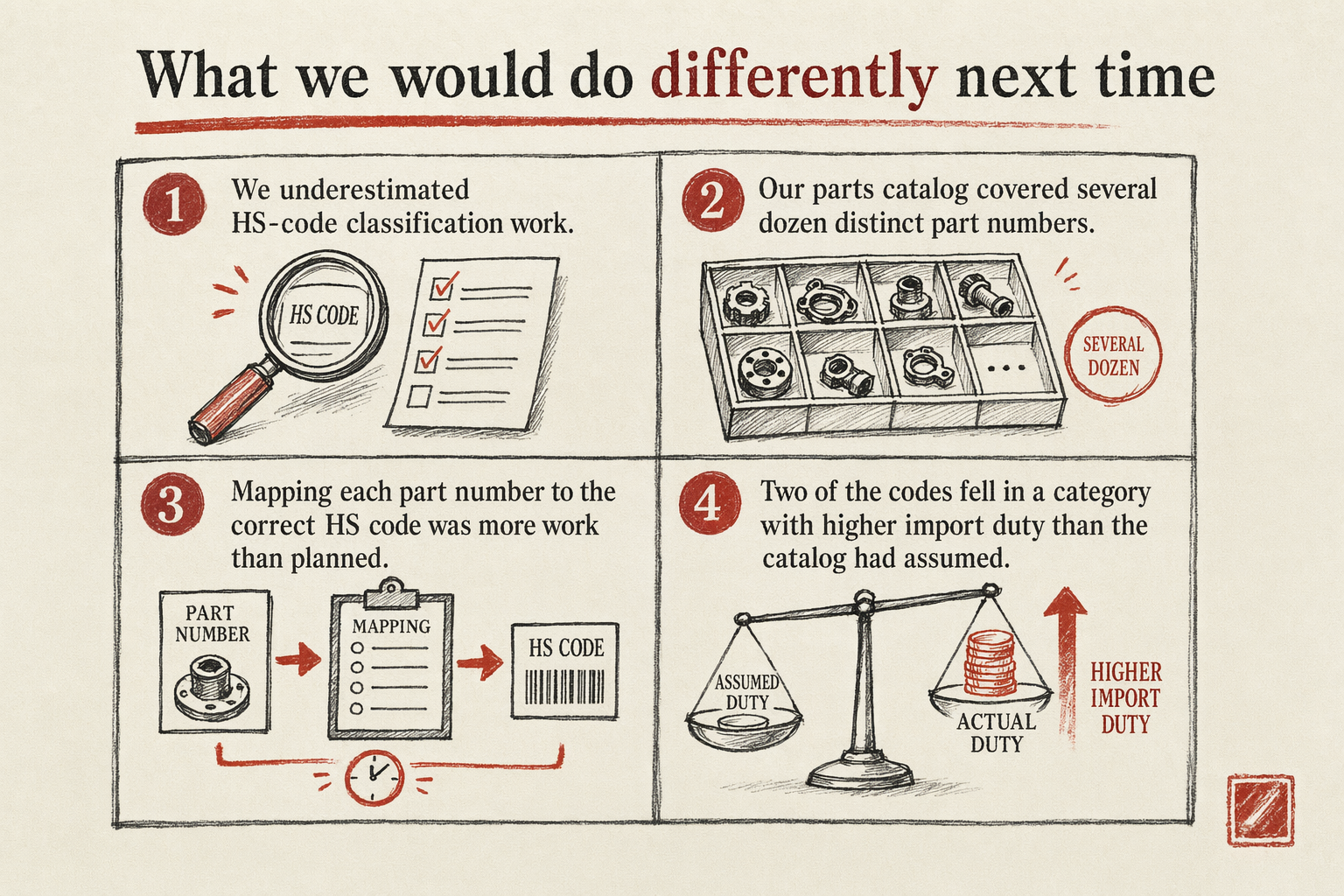
The honest concession: we underestimated the HS-code classification work. The company's parts catalog covered several dozen distinct part numbers, and mapping each to the correct customs HS code was more work than the project plan budgeted. Two of the codes turned out to fall in a category that carried higher import duty than the catalog had assumed, which compressed the gross margin on those specific parts. The classification was technically defensible — the parts genuinely belonged in those codes — but the parent's commercial team had not flagged the duty differential in the original pricing model.
What we would do differently: run the HS-code classification analysis at the project-start phase, not after customs registration. The classification can be done from the catalog and the technical drawings before the WFOE exists. The duty implications can be modeled into the commercial planning in week 2 rather than week 26. The classification still has to be filed at customs registration, but having the answers earlier gives the commercial team a chance to adjust pricing or to evaluate whether any parts should be sourced or finished differently to land in a lower-duty code.
The second honest concession: the EOR window was tighter than ideal. We ran the EOR for three weeks, which worked, but the staff and their managers experienced two weeks of paycheck-and-benefits process change that they did not need to. Running the EOR for six weeks rather than three would have been more expensive (low five figures EUR difference) but operationally cleaner — the staff would have moved to the EOR on a single transition, lived there during the work-permit reapplication phase, and moved to the new WFOE on a single second transition. Trying to minimize the EOR window introduced two transitions for the staff that one slightly longer EOR window would have collapsed to one.
What we would do differently: budget the EOR for 6-8 weeks rather than 3-4, and treat the EOR as a clean phase with a single entry and a single exit rather than as a bridge that is squeezed as small as possible. The staff experience is better and the cost differential is modest.
RELATED READING
For the other end of the structure-decision spectrum — when a WFOE would have been the wrong answer — see the US SaaS case study. For the broader vertical view see the industrial-manufacturers industry page. To model the conversion cost against your own numbers, run the expansion-budget estimator.