Industry view
China Market Entry for Beauty and Cosmetic Brands
NMPA filing realities, cross-border bonded-warehouse on Tmall Global and Xiaohongshu, ingredient restrictions, trademark-first sequencing.
Email Mike—
Y1 cost band
Mike's running benchmarks
—
Time to first revenue
Mike's running benchmarks
—
Common pivot at month 12
Mike's running benchmarks
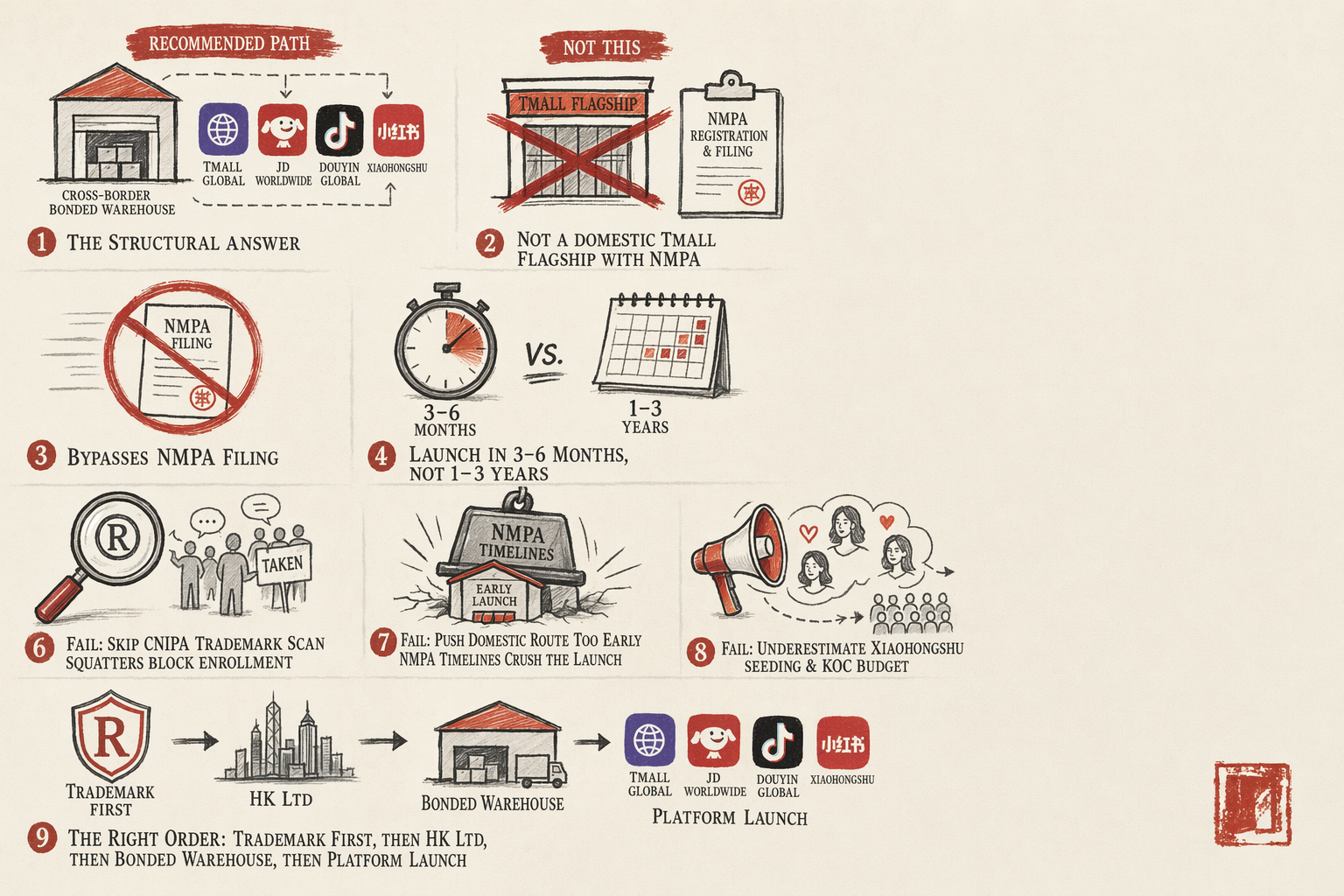
Beauty and cosmetic brands face the most stakes-loaded mainland China entry of any consumer category. The buyer market is enormous and quality-aware. Xiaohongshu (小红书) has become the dominant beauty-discovery platform globally, not just in China — Western brands routinely see meaningful unprompted Xiaohongshu mentions before they have any official mainland presence. Daigou (代购, personal-shopper) volume can build a brand's mainland awareness to the point that the brand owner has no choice but to engage formally because the daigou are capturing the margin that should belong to the brand. And the regulatory layer specifically targeting cosmetics — NMPA registration, ingredient restrictions, claim-language enforcement, the CNIPA Class-3 trademark register where squatters concentrate heavily — is materially heavier than for SaaS, manufacturers, or creators.
The fortunate part: the cross-border bonded-warehouse model is purpose-built for foreign cosmetic brands. Tmall Global, JD Worldwide, Douyin Global, and Xiaohongshu's cross-border channels collectively give foreign brands a way to launch into the mainland market without an NMPA filing, without a mainland WFOE, and without graduating to domestic distribution until the brand has earned the demand to justify it. This page walks through what beauty brands actually need, the regulatory layer that determines the path, the entity-structure pattern that fits most launches, the rejection-and-stall patterns we see at enrollment, and the realistic timeline and budget for a sequenced cross-border launch.
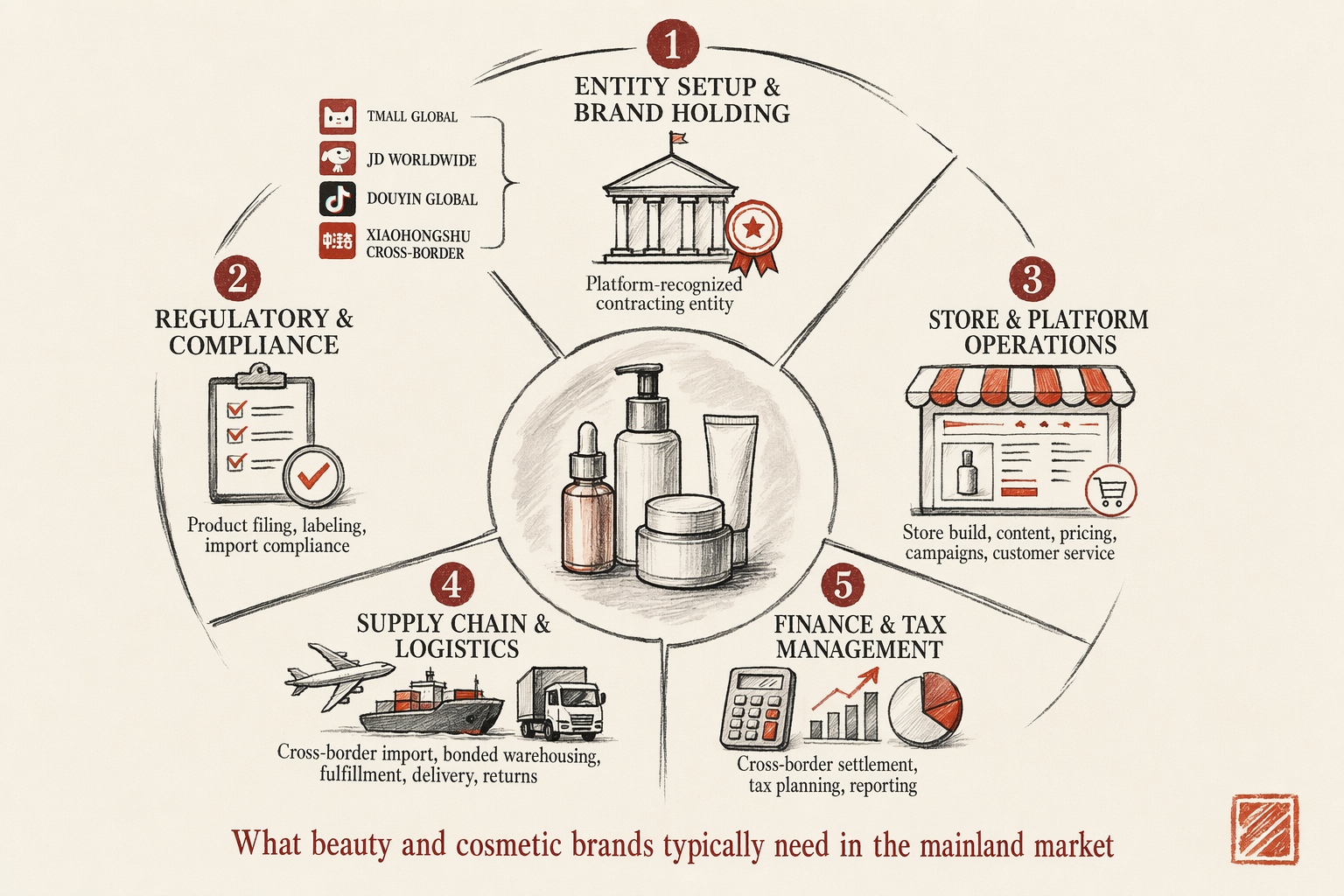
What beauty and cosmetic brands typically need in the mainland market
The operational ask from a cosmetic-brand mainland launch tends to cluster into five categories.
One — a contracting and brand-holding entity that platform reviewers recognize. Tmall Global, JD Worldwide, Douyin Global, and Xiaohongshu cross-border platforms all run enrollment-level entity reviews. They accept overseas operating companies in principle, but the document chain runs cleaner with a Hong Kong limited company as the dedicated brand entity. The HK Ltd holds the mainland-market trademark portfolio, signs the brand-authorization chain that flows to the Tmall Partner (TP), and provides bilingual brand-name plates that map to platform-side transliteration norms.
Two — a cleared CNIPA trademark register in Class 3 and Class 35. Class 3 covers cosmetics, perfumes, and personal-care products. Class 35 covers retail and brand-promotion services. Both are routinely targeted by trademark squatters on Western beauty brands, sometimes pre-emptively before the brand has any mainland presence. The CNIPA pre-launch scan is the single most important diagnostic in the launch plan — a squatter holding the senior Class-3 mark on your brand will block Tmall Global enrollment until the cancellation action lands or the defensive filings achieve sufficient sub-class coverage. The trademark-squatting scanner is the cheap version of this check.
Three — a working relationship with a Tmall Partner (TP) or equivalent platform operator. Foreign brands rarely operate Tmall Global storefronts directly. The standard model is a Tmall Partner — an accredited third-party operating agency that handles store setup, customer service, photography, platform-side operations, and the day-to-day relationship with platform reviewers. TPs specialize by category (beauty TPs are distinct from electronics TPs and from food TPs) and have working relationships with the platform-side reviewers who handle specific categories. TP selection is a strategic decision, not a vendor decision. Comparable arrangements exist on JD Worldwide (POP partners) and Douyin Global (DP partners).
Four — a bonded-warehouse fulfillment arrangement. The cross-border model requires bulk inventory positioned in a mainland bonded zone (Hangzhou, Ningbo, Zhengzhou, Chongqing, and several others operate cross-border bonded zones with the appropriate customs scaffolding). The bonded-warehouse operator handles per-parcel customs clearance, per-parcel logistics fulfillment, and per-parcel returns processing. Bonded-warehouse fees typically run 4-7% of GMV depending on volume and SKU mix; cross-border duty per parcel is paid by the consumer at checkout, not absorbed by the brand.
Five — Xiaohongshu seeding budget and KOC engagement. Xiaohongshu is the discovery engine for beauty in mainland China. The platform's algorithm rewards content-first engagement over paid-ad-first conversion. The launch math that works is: paid KOC (Key Opinion Consumer) seeding to land the brand inside the platform's relevant content categories, organic-content team to produce platform-native content from the brand account, and selective KOL (Key Opinion Leader) partnerships for amplification. Budgeting for Xiaohongshu seeding from launch month one is non-optional — beauty brands that try to enter Tmall Global without a Xiaohongshu content layer typically see flat conversion from platform traffic. The Xiaohongshu brand setup topic covers the operational playbook.
The vertical's specific regulatory layer — NMPA, ingredient restrictions, special-cosmetic claims
Cosmetics is one of the most regulated foreign-brand verticals in mainland China. Three regulatory layers sit on top of the generic entity and IP work.
NMPA (National Medical Products Administration) registration and filing. NMPA is the mainland-Chinese authority for cosmetics regulation (renamed and restructured from CFDA in 2018). Cosmetic products sold through mainland-domestic distribution channels must complete an NMPA registration (for special-purpose cosmetics) or filing (for general cosmetics). General cosmetics filing is a notification-based process: submit the formula, safety assessment, ingredient declarations, and supporting documents; the filing takes typically 6-18 months to clear, and the product can then be sold through mainland-domestic stores. Special-purpose cosmetics (whitening, anti-aging, sunscreen, hair-growth, hair-removal, deodorant) require active registration with safety testing, which runs 12-30 months and is materially more expensive — formula testing, animal testing where still required, and clinical-efficacy substantiation for the specific claim.
The critical structural point: NMPA registration applies to mainland-domestic distribution. Cross-border bonded-warehouse sales on Tmall Global, JD Worldwide, Douyin Global, and Xiaohongshu cross-border channels do not require NMPA filing, because the goods are technically individual cross-border purchases by the consumer, not mainland-domestic sales by the brand. This single regulatory gap is the structural reason cross-border is the default first-stage market entry for foreign beauty brands — it lets you launch in months rather than years.
Ingredient restrictions. The Inventory of Existing Cosmetic Ingredients in China (IECIC) is the list of ingredients that can be used in cosmetics distributed in mainland China. New ingredients (not on IECIC) require a separate new-ingredient registration that runs 1-3 years and is expensive. The Cosmetic Restricted Ingredient list specifies maximum-concentration limits for certain ingredients (some preservatives, certain UV filters, some pigments). The Cosmetic Prohibited Ingredient list specifies ingredients that cannot be used at all (hydroquinone, retinoic acid for cosmetic use, certain peptides, some heavy-metal-content compounds). Prohibited ingredients are prohibited regardless of channel — cross-border bonded-warehouse sales do not give you a pass on prohibited substances. Reformulate before you launch if your formulation includes anything on the prohibited list.
Claim-language enforcement. Mainland Chinese cosmetic-advertising law restricts the claims you can make in product copy and marketing. Medical-condition-treatment claims are prohibited for cosmetics (you cannot claim a product treats acne, eczema, or any medical condition — that would re-classify the product as a drug). Whitening, anti-aging, and sunscreen claims require special-purpose cosmetic registration if the product is sold domestically, and may be regulated even on cross-border channels if the platform enforces the rule (Tmall Global routinely does for the largest categories). Generic efficacy claims (“hydrating,” “brightening,” “refreshing”) are generally fine. Specific outcome claims (“reduces wrinkles by 50%,” “clears acne in 7 days”) typically are not. Build your copy library with the platform-side claim rules in mind; rewriting after a platform-side rejection costs time.
Typical entity-structure pick — HK Ltd plus cross-border bonded warehouse
The default structure for first-time cosmetic-brand mainland market entry runs three components.
Component one — a Hong Kong limited company as the dedicated mainland-market brand entity. The HK Ltd holds the mainland trademark portfolio (CNIPA Class 3, Class 35, and any adjacent classes the product mix triggers), holds the platform-side brand-authorization chain that flows to the Tmall Partner, holds the cross-border bonded-warehouse contracts, and provides the bilingual brand-name plate that platform reviewers expect. The HK Ltd is the natural home for the mainland-market operations; the brand's home-country operating company stays clean for home-market business. Setup cost runs under €3,000 all-in; annual carry €4,000-7,000 for a lean entity.
Component two — a Tmall Partner (or equivalent) operating relationship. The TP is the day-to-day operating arm of the mainland brand presence. TP selection criteria: category specialization (beauty TPs versus generalist TPs), reference base (recent comparable launches), fee structure (some TPs run on flat retainer plus percentage-of-GMV, others on pure percentage), and platform-reviewer relationship quality. Brief candidate TPs on your situation (including any prior platform rejections), ask for two reference calls with recent cosmetic-brand launches they have handled, and run an actual selection process rather than going with the first TP your trademark agent introduces. The TP fee model is negotiable.
Component three — bonded-warehouse fulfillment arrangement. Bonded-warehouse operator selection is partly geographic (which mainland city makes sense based on the platform's preferred fulfillment partners and your customer-base geography) and partly capability-based (some operators specialize in beauty, others in apparel, others in electronics). Hangzhou and Ningbo are the most common beauty bonded-warehouse choices because of platform-side integrations with Tmall and the regional concentration of beauty fulfillment expertise. Bonded-warehouse fees, as noted, typically run 4-7% of GMV; per-parcel duty is consumer-side.
What is explicitly not in this default structure: no WFOE, no mainland-domestic Tmall flagship, no NMPA registration. Each of those is appropriate at a different stage. The WFOE conversation becomes relevant when the brand has built mainland-domestic-distribution ambitions (department-store counters, beauty-specialty retailers). The mainland Tmall flagship becomes relevant when cross-border GMV exceeds the threshold where the bonded-warehouse markup is materially compressing margin. The NMPA registration becomes relevant alongside the domestic-store plan. None of these are day-one decisions.
Common rejection patterns specific to cosmetics
The rejection and stall patterns specific to cosmetic-brand mainland launches cluster around three themes.
Pattern one — trademark squatter blocking platform enrollment. The single most common stall pattern. A third party holds the senior CNIPA Class-3 mark on the brand name (sometimes from years before the brand had any mainland intent), and the platform-side trademark gate rejects the application until the trademark situation is resolved. The fix is the pre-launch scan and the defensive-filing-plus-cancellation-action sequence, which is exactly what the EU skincare case study walks through. The faster you run the scan, the faster you can either confirm a clean register or start the cancellation work. Brands that skip the scan and discover the squatter at platform enrollment lose 6-12 weeks of launch time minimum.
Pattern two — ingredient on the prohibited or restricted list. The brand's formulation includes an ingredient that the platform-side product-information audit flags as prohibited or restricted, and the listing is rejected. This is more common than brands expect, particularly for skincare brands using actives that are over-the-counter in the home market but prescription-restricted in mainland China (the retinoic-acid example is the classic case). The fix is to reformulate or remove the SKU from the mainland launch. Reformulating for the mainland market is a multi-quarter project; removing the SKU is faster but compresses the launch product line. Run the ingredient compliance audit before you ship the bulk inventory to the bonded warehouse.
Pattern three — claim-language failure on product copy or marketing. The product copy or marketing makes a claim that the platform-side reviewers flag as either medical (re-classifying the product as a drug, which is not the listing category) or as a special-purpose claim without supporting registration (whitening, anti-aging, sunscreen). The listing is rejected or held pending claim-language revisions. The fix is to build the copy library with mainland-claim rules in mind from the start; the rewrite-after-rejection path is functional but slow. Many TPs will pre-screen claim language as part of their pre-enrollment service; ask for this explicitly.
Pattern four — bonded-warehouse classification mismatch. The cross-border bonded-warehouse model has specific customs categories and HS-code mappings. A product that is mis-classified at the bonded-warehouse intake — either because the category does not match the SKU or because the duty calculation is off — can be held in customs review or pushed back to the consumer with a duty surprise. The fix is to work with the bonded-warehouse operator's customs declarant to pre-map the SKUs to the correct HS codes before the first bulk shipment ships. This is administrative and not difficult, but it has to happen before the inventory crosses the border.
The bundled engagement — sequence, indicative budget, realistic timeline
For a foreign beauty or cosmetic brand with home-market revenue in the $5M-50M range entering the mainland Chinese market through cross-border, the bundled engagement covers these sequenced workstreams.
Phase one — diligence and entity setup (weeks 1-6). CNIPA trademark scan in Class 3, Class 35, and adjacent classes. Ingredient compliance audit against IECIC, restricted-ingredient list, and prohibited-ingredient list. HK Ltd incorporation. CNIPA defensive filings in cleared classes; cancellation-action prep if a squatter is identified. HK bank-account introductions.
Phase two — platform partner selection (weeks 4-10). Tmall Partner shortlist (3-5 candidates), candidate briefings, reference calls with recent comparable launches, selection, engagement-letter execution. Parallel: same process for Xiaohongshu operator partner if applicable. Bonded-warehouse operator selection (typically 2-3 candidates evaluated).
Phase three — content and operational preparation (weeks 8-14). Product photography localized for mainland platform norms (Xiaohongshu and Tmall photography conventions differ from Western beauty-brand photography in specific ways). Product copy localization and claim-language compliance review. Brand-authorization documentation chain prepared from HK Ltd downstream. Xiaohongshu seed-content plan and initial KOC engagement.
Phase four — enrollment and launch (weeks 12-18). Tmall Global enrollment submission with the new structure. JD Worldwide and Douyin Global enrollment in parallel if multi-platform launch. Xiaohongshu brand account verification. Bonded-warehouse inventory positioning. Store-build phase. Live to consumers in week 16-20 depending on platform-side review pace.
Indicative budget band: For a beauty-brand launch of this profile, the first-year structural budget runs $40,000-120,000 all-in, before any inventory or paid-media spend. Breakdown: HK Ltd setup and first-year carry $8,000-15,000; CNIPA filings across 2-3 classes $1,500-5,000; cancellation-action work if needed $5,000-15,000; Tmall Partner setup fees and first-year minimum commitments $10,000-40,000; photography and copy localization $8,000-25,000; bonded-warehouse onboarding $3,000-10,000; Xiaohongshu seed-content and initial KOC engagement $5,000-25,000. Inventory and paid-media spend are separate budget categories.
Realistic timeline: 14-20 weeks for a clean engagement with no trademark complications. If a squatter is present and the cancellation-action sequence runs, the launch window may extend by 6-12 weeks while the defensive filings are lodged and the receipt that the platforms accept arrives. Plan for 18 weeks; deliver in 14-26 depending on trademark status. To model the budget against your specific situation, run the expansion-budget estimator.
Case study match — how the EU skincare brand cleared Tmall Global enrollment
The structure pattern on this page is what the EU skincare brand case study walks through end-to-end. An €8M-GMV EU skincare brand had been rejected three times on Tmall Global over a single quarter — trademark gap, document mismatch, wrong store-type election. The fix was a Hong Kong limited company above the EU operating entity, CNIPA defensive filings in Class 3 and Class 35 plus a parallel three-year non-use cancellation action against the squatter, a working Tmall Partner relationship after a real selection process, and a clean resubmitted enrollment package. The submission cleared review on the first attempt under the new structure. The brand launched on Tmall Global inside 14 weeks and crossed mid-seven-figures RMB GMV in the first 12 months.
The case study covers the three specific reasons the earlier attempts failed, the full-WFOE path that some agencies would have pushed and why we ruled it out, the four-component structure that worked, and an honest concession about what we would do differently next time (commission a deeper use-evidence investigation against the squatter's mark before filing the cancellation, and stand up the Xiaohongshu content layer earlier in the launch plan). If your beauty brand is sitting on a stalled Tmall Global enrollment or planning a fresh launch, the case study reads as the operational playbook.
Working in this industry?
Tell us your constraints — we'll reply with the partner firm and filing sequence that fits this niche.
Frequently asked questions
Do I need NMPA filing before I can sell on Tmall Global?
Not for cross-border bonded-warehouse sales — NMPA filing is required for domestic-store distribution. Cross-border on Tmall Global, Xiaohongshu, and Douyin Global lets you sell while NMPA filing is in progress, which buys you 12-18 months of market validation.
How long does CNIPA Class 3 cosmetics trademark take?
Filing receipt in 4-6 weeks (usable for Tmall enrollment). Full certificate in 14-18 months. Most foreign cosmetic brands launch on receipt and wait for the certificate.
Which ingredients are restricted for foreign cosmetic brands?
Heavily restricted: hydroquinone, retinoic acid, certain peptides, prescription-grade actives. Less obvious: high-percentage vitamin C, certain fragrances, some preservatives. NMPA maintains the official restricted-ingredient list — check before formulating for the market.
Do you have a relevant case study?
Yes — the case-studies index lists four anonymized engagements across DTC, SaaS, industrial, and creator personas.
Or skip the form
Book a call with Mike
30 minutes, Zoom or Tencent Meeting. No discovery-call gauntlet.