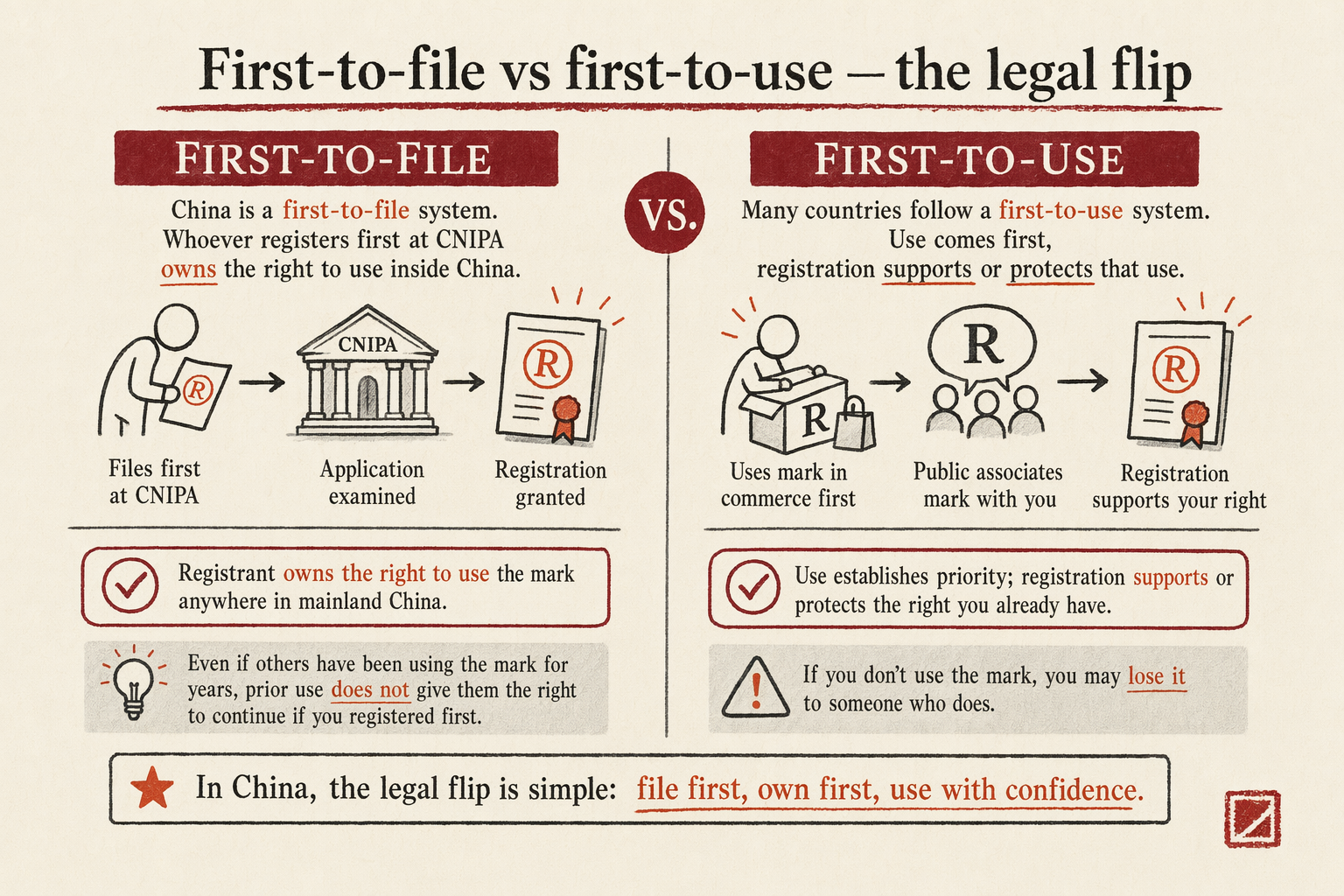
First-to-file vs first-to-use — the legal flip
China's Trademark Law of the People's Republic of China (last comprehensively revised in 2019, with the fifth amendment under CNIPA (China National Intellectual Property Administration) consultation through 2024) is a first-to-file system. Whoever registers a mark first at CNIPA owns the right to use it inside mainland China, regardless of how long anyone else has used the name elsewhere. This is the inverse of the US, where common-law trademark rights attach to use rather than registration.
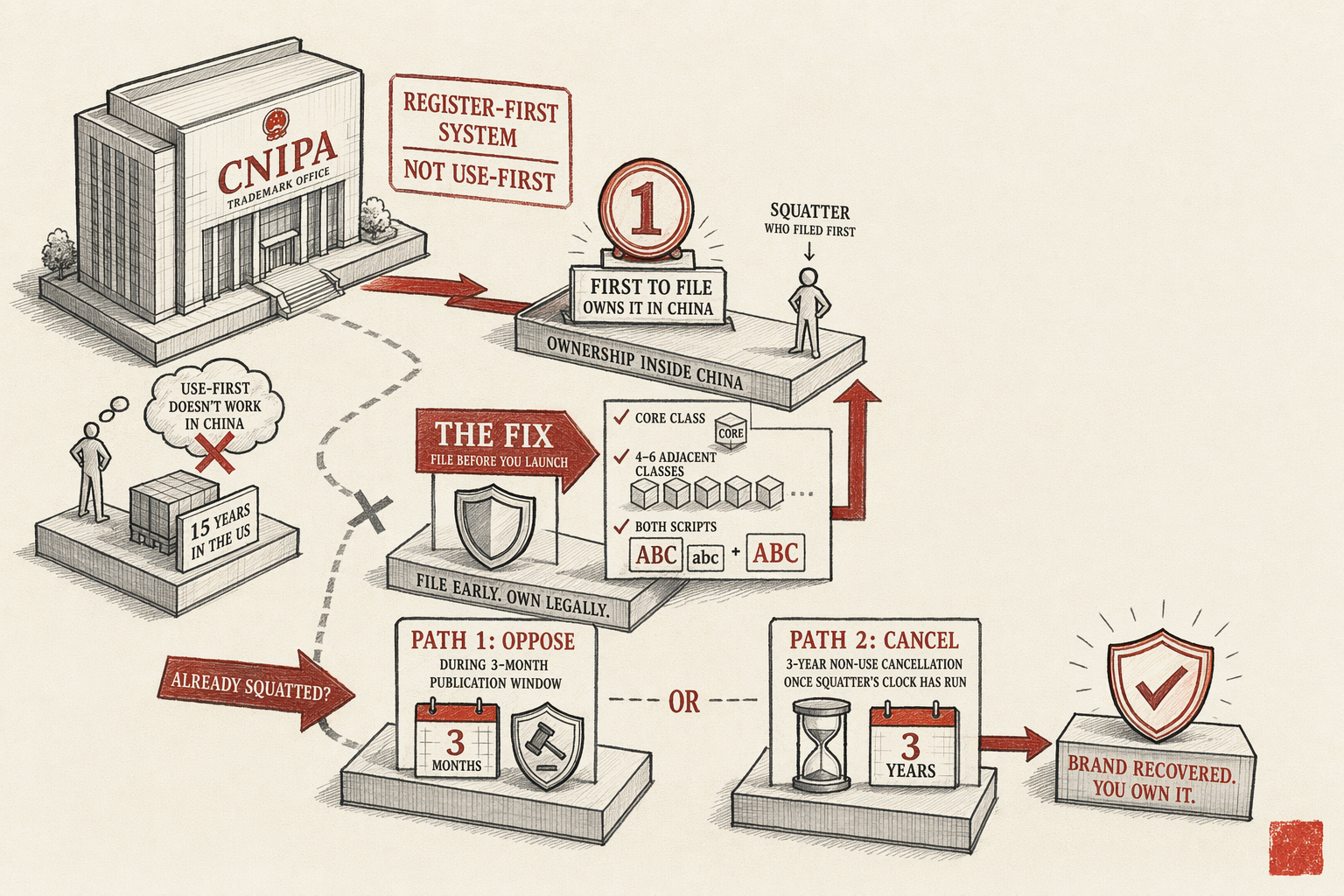
The practical consequence: a small office in Shenzhen can register your fifteen-year-old US brand at CNIPA for roughly $1,500 in official + agent fees, hold the certificate, and either sit on it for resale or block your entry into Tmall, JD, WeChat, Xiaohongshu, and the customs declarations that name an importer with that mark. The Trademark Office does not check whether the applicant is the real-world owner of the brand. It checks whether anyone else has already registered the identical or confusingly similar mark in the same Nice class.
The only exception that comes up regularly is the well-known-mark doctrine under Articles 13 and 14 of the law. Marks recognized as well-known by CNIPA or by a People's Court can claim protection across classes and against later filers. The bar is high — roughly 200 marks worldwide have been recognized to date — and the recognition usually arrives after years of paid litigation. It is not a strategy. It is what happens to a handful of luxury and automotive brands as a byproduct of decades of enforcement.
Why your US/EU registration doesn't help in China
US Patent and Trademark Office registrations, EU Intellectual Property Office (EUIPO) registrations, and standalone country registrations across every other jurisdiction are not admissible as a defense in a Chinese trademark dispute. CNIPA's examiners do not consult foreign registries before granting a mark. The system is closed to inputs that did not pass through CNIPA's own filing process.
The Madrid Protocol — the international filing system administered by WIPO — is the one bridge that works, but only if you actively designated China on the application. A standard US registration with no Madrid extension to China is, at CNIPA, the same as having no registration at all.
Foreign use evidence is also weak in CNIPA opposition or invalidation proceedings. Sales receipts from your US storefront, screenshots from your Shopify dashboard, and even press coverage in Western media count for little against a squatter who has held a Chinese registration for two years and shows even modest in-China activity. The evidentiary burden is on you to prove that you used the mark in China before the squatter filed, not that you used it abroad. If you have not yet sold or marketed in mainland China, your foreign use record is rhetorically interesting and legally near-empty.
How squatters identify foreign brands to target
Trademark squatting in China is not a random search problem. It is a watch-list business. The main signals on which professional squatters identify the next round of targets:
- Alibaba, Taobao, and 1688 listings. The moment your products appear on a Chinese marketplace — even as cross-border consignment via Tmall Global — your name is visible to bots that monitor new listings and cross-reference against the CNIPA registry. A brand new to a marketplace, unregistered at CNIPA, is the most-watched target.
- US and EU trademark filings under consumer-goods classes. CNIPA-watching squatters subscribe to USPTO and EUIPO filing feeds for Class 3 (cosmetics), Class 5 (supplements), Class 9 (software, electronics), Class 25 (apparel), and Class 30 (food). A US filing in Class 3 with no mirrored CNIPA filing is a near-perfect tell that the brand will need the mark inside China within 12-24 months.
- Press releases mentioning a China launch. Bloomberg, Reuters, and trade-press feeds covering "Brand X to enter China" or "Brand Y signs Tmall agreement" produce a list of filings to pre-empt within weeks.
- Investor announcements and Series-A press. Funded brands signal expansion. Squatters file before the brand's lawyers can.
To make this concrete: imagine an EU skincare brand opens a Tmall Global flagship store on 5 March. A Shenzhen squatter notices the listing on 10 March, files 特斯卡 in CNIPA Class 3 on 18 March, and receives the substantive examination acceptance on 22 May. By the time the EU brand applies for WeChat OA verification in August, the squatter holds the Class 3 mark, demands $40,000 for transfer, and points the brand at either a 12-month opposition that the brand will probably lose or an 18-month non-use cancellation that requires waiting out the 3-year clock anyway. The brand cannot launch on Tmall in the meantime.
The 4-step defense to file before launch
The defense is unglamorous and works. Foreign brands that complete it before any visible China activity rarely face a squatting event.
- Run a CNIPA pre-clearance search across Classes 1-45. The trademark squatting scanner on this site queries the CNIPA registry by English name, pinyin transliteration, and likely Chinese-character variants. The output is a per-class status: free, partially blocked, identical match held. Run it before you choose a name, not after you have shipped product to Shanghai.
- File the English mark plus a Chinese-character mark plus pinyin. Three filings, not one. The English mark protects against Latin-script squats, the Chinese-character mark protects against the form local consumers will actually type into Taobao, and the pinyin protects against alternate romanizations. Total fees: roughly $5,000-$8,000 across the three filings in five classes.
- Cover the core class plus 4-6 adjacent defensive classes. Don't file in all 45 — overkill at $50,000+. File in your core class (the one that maps to your product) plus the retail/online-sale class (Class 35), the relevant packaging or material class, and the 2-4 classes that any reasonable consumer extension might require. Class selection is detailed in defensive filing across all 45 Nice classes.
- File 6-12 months before your first visible activity. CNIPA substantive examination runs roughly 4-9 months. A mark filed today is provisionally protected from the filing date, but you cannot enforce until publication and registration. Filing before your first Tmall listing, before your first Chinese press release, before your first WeChat OA application is the only configuration that reliably prevents a squat.
What to do if you've already been squatted
If a squatter has already filed your mark, the remedies break into four categories. Each has a different cost band, success rate, and timeline.
Opposition during the 3-month publication window. If the squatter's mark is in the 3-month publication phase (the window between preliminary approval and registration), you can file an opposition with CNIPA. Realistic success rate for a foreign brand with documented prior use elsewhere: 25-40%. Cost band: $1,500-$5,000 per opposition. Full mechanics are in opposing a squatted trademark.
Three-year non-use cancellation. Once the squatter's mark has been registered for three years, you can petition CNIPA to cancel it on grounds that the registrant has not actually used the mark. The burden flips to the squatter to prove use, which most cannot. Realistic success rate: 50-70%. Timeline: 12-18 months. Full mechanics are in three-year non-use cancellation procedure.
Negotiated purchase. The fastest route. A professional squatter will name a price — typically $10,000-$80,000 for a single-class mark. For brands that need to launch within 6 months, paying the squatter and then filing defensively across remaining classes is often cheaper than a 12-18-month cancellation fight. Document the chain of assignment carefully; a sloppy assignment can be voided later.
Invalidation on bad-faith grounds. Articles 4, 13, and 44 of the Trademark Law allow CNIPA to invalidate marks filed in bad faith. The 2019 revision strengthened this route. Realistic success rate when the squatter has a documented portfolio of similar squats: 40-60%. Cost band: $4,000-$15,000.
None of these are fast. The fastest path back to a Tmall storefront for a squatted brand is usually negotiated purchase plus defensive refiling of every class the squatter does not yet hold, while a non-use cancellation runs in parallel on the squatted mark.