How a .cn domain gets hijacked in the first place
Most .cn domain hijackings against foreign brands fall into one of five patterns. Recognizing the pattern is the first step toward picking the right recovery route.
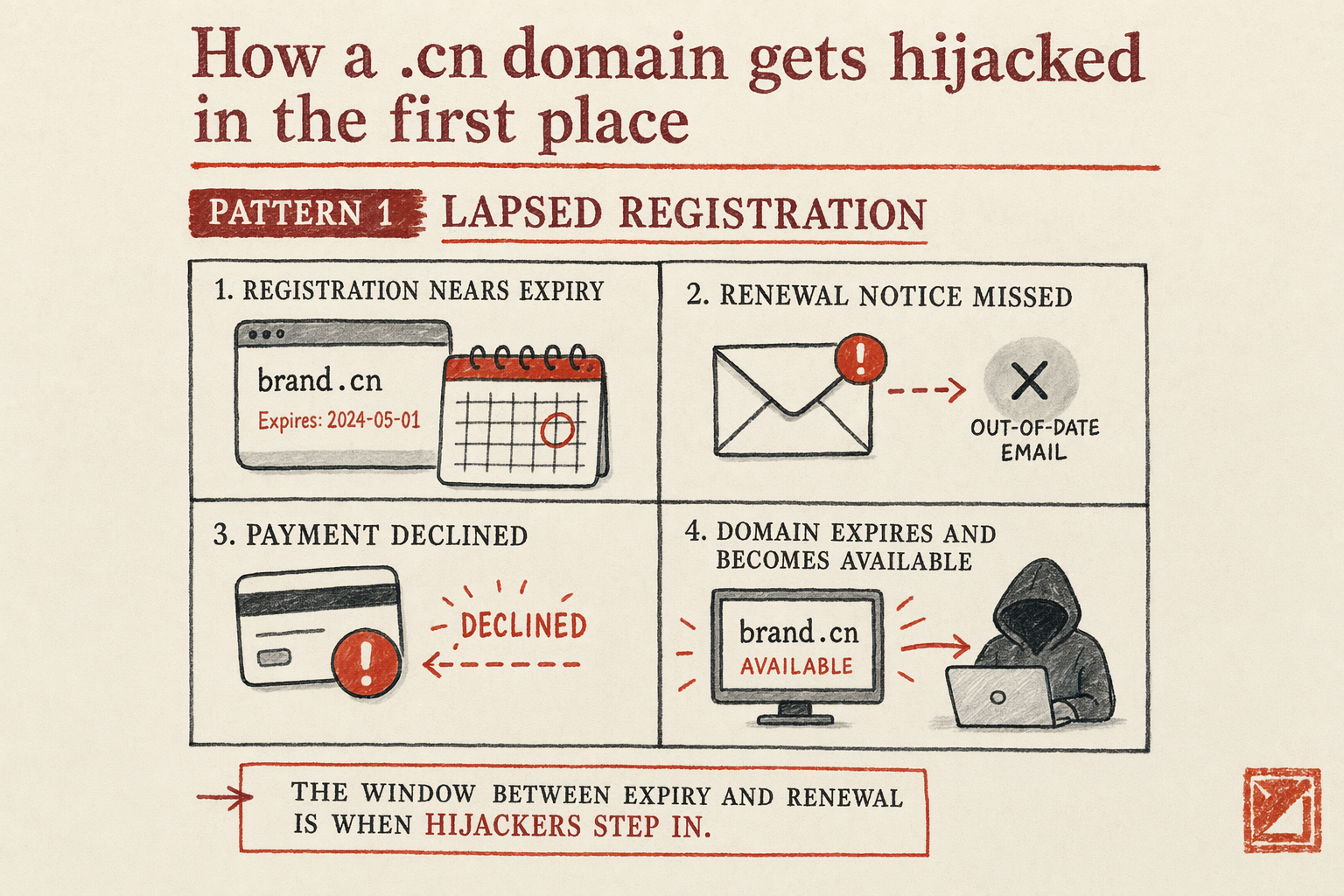
Pattern 1: lapsed registration. The brand let the .cn registration expire — usually because the renewal notice went to an out-of-date email address or the credit card on file declined. The domain dropped, a squatter picked it up at auction or via a backorder service, and the brand discovered the loss when traffic broke. This is the most-common cause and the most-recoverable through registrar escalation.
Pattern 2: account takeover. The brand's registrar account was compromised, the domain was transferred to a new registrant, and the squatter completed CNNIC real-name verification under their own documents before the brand noticed. Recovery here turns on the documentary chain of evidence — registrar log of the unauthorized access, brand's documentation of the legitimate registration, often a police report.
Pattern 3: pre-launch squat. The brand never registered .cn (or registered late) and a squatter filed first. This is technically not "hijacking" because the brand had no prior registration to lose, but it presents identically to the brand. Recovery routes are CNDRP and the trademark-back-channel.
Pattern 4: post-CNIPA squat. The brand registered the Chinese trademark but not the matching .cn domain, and a squatter filed the domain after seeing the CNIPA publication. The trademark holding is strong evidence for CNDRP.
Pattern 5: insider takeover. A former employee, distributor, or partner who registered the domain in their personal name on the brand's behalf later refuses to transfer. This is documented in registrar records and can sometimes be resolved through registrar action with a registration history showing the brand's actual ownership intent, but often requires CNDRP or a People's Court action.
CNNIC dispute process
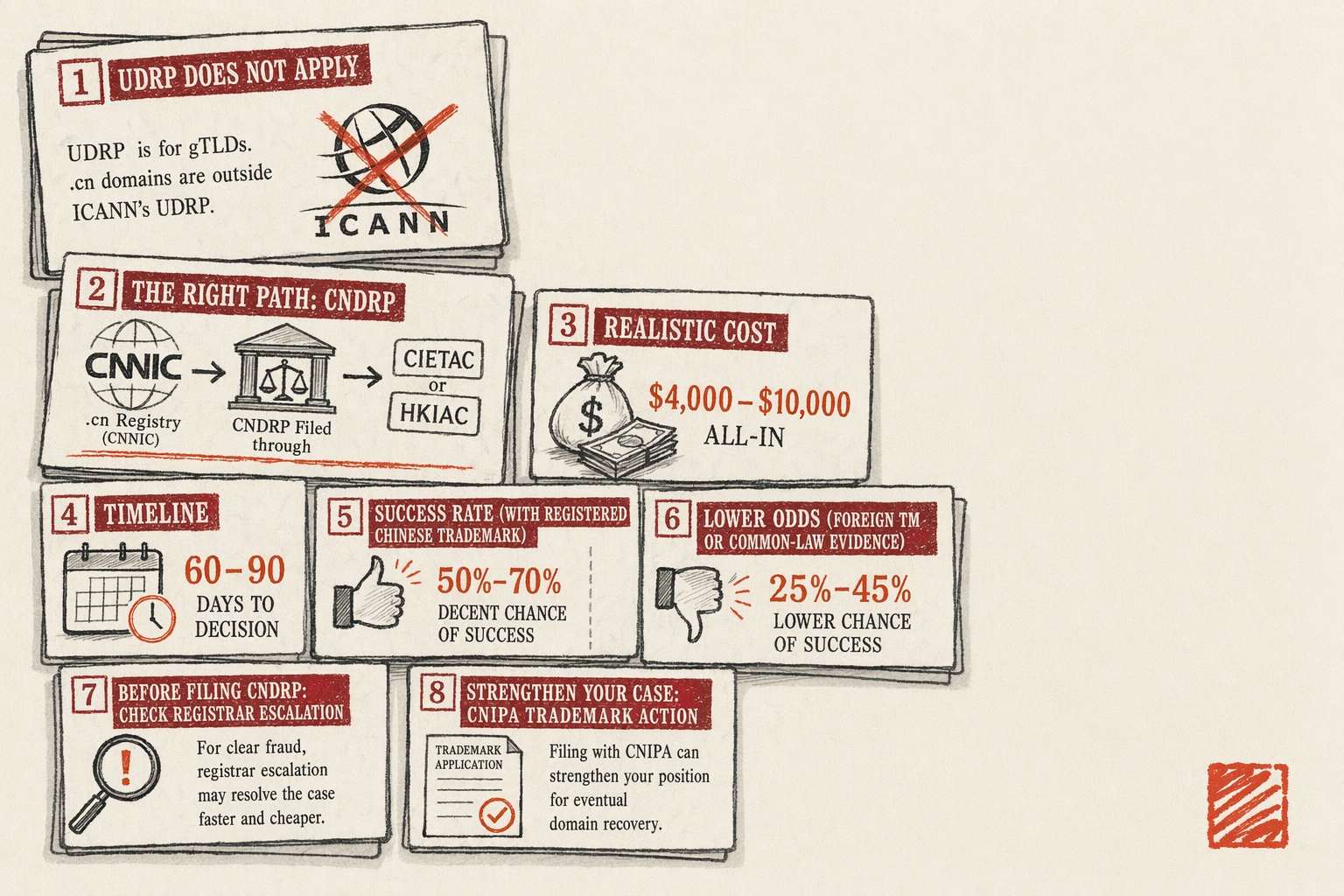
The CNNIC Domain Name Dispute Resolution Policy (CNDRP) is the formal arbitration framework for .cn and .中国 disputes. It is the rough analogue of ICANN's UDRP for generic TLDs, but with mainland-specific procedural rules and Chinese-jurisdiction panels.
The CNDRP procedure:
- File a complaint with an accredited dispute resolution center, primarily CIETAC (China International Economic and Trade Arbitration Commission) or HKIAC (Hong Kong International Arbitration Centre). The complaint identifies the disputed domain, the complainant's rights, and the three CNDRP grounds.
- Three grounds must be established (CNDRP Article 8): (a) the disputed domain is identical or confusingly similar to a name in which the complainant has rights, (b) the registrant has no rights or legitimate interests in the domain, (c) the registrant's registration or use of the domain is in bad faith.
- The center serves the registrant who has 20 days to file a response.
- Panel appointment. A single panelist or a three-panelist tribunal is appointed depending on the complaint and any election by the parties.
- Decision. The panel issues a decision typically within 14 days of appointment, after reviewing the complaint, response, and supplementary submissions if any.
- Implementation. If the complainant prevails, CNNIC instructs the registrar to transfer the domain. Implementation typically completes within 10-15 days after the decision becomes final.
Total timeline from complaint filing to domain transfer: 60-90 days for standard cases, 45-60 days for expedited cases through CIETAC's expedited procedure. Total cost: $4,000-$10,000 for a typical single-domain case.
The CNDRP decision is final and not subject to appeal within the system. The unsuccessful party can pursue parallel relief through the People's Courts under PRC civil procedure, but in practice this is rare for individual-domain disputes because the litigation cost is materially higher than the CNDRP fee structure.
Registrar escalation when documents support you
Before filing CNDRP, check whether registrar escalation can resolve the case. Registrar escalation is faster (days to weeks rather than months) and cheaper (typically $0-$500 in handling fees rather than $4,000-$10,000) when it works. It works in a specific subset of cases.
Cases registrars will usually resolve:
- Clear fraud or account takeover. Registrar logs show unauthorized access, the brand has documented its prior ownership, and the transfer or new registration falls outside the registrar's terms of service. Most major registrars (Aliyun, eName, Xinnet, GoDaddy China) will reverse clearly fraudulent transfers when the evidence is overwhelming.
- Renewal-grace recovery. If the registration recently lapsed and the brand acts within the grace period (5-30 days depending on the registrar), recovery is usually a billing event rather than a dispute. The lapsed domain enters a redemption window where the prior registrant can reclaim it for an elevated fee ($75-$200) before it goes to public auction.
- Real-name verification failure that benefits the brand. If the squatter's CNNIC real-name verification has not completed or has been rejected, the domain enters a frozen state that the registrar can resolve in the brand's favor with documentary evidence of the brand's rights.
Cases registrars will not resolve:
- Disputes over rights to the name. If the squatter has a colorable claim (a matching trademark, a documented use, an apparent business interest), the registrar will decline and refer to CNDRP.
- Disputes involving conflicting documents. If both parties have plausible documentation, the registrar's compliance team will not adjudicate between competing claims and will refer to CNDRP.
- Disputes outside the registrar's terms. If the squatter's registration was procedurally clean (the squatter registered an available domain, completed CNNIC real-name verification cleanly, paid the fee), the registrar has no terms-of-service basis to intervene.
The cost-effective sequence is: try registrar escalation first if the case appears to fall in the resolvable category; file CNDRP if registrar escalation fails or the case clearly falls in the unresolvable category. Don't sequence in the reverse order (CNDRP first then registrar) because the CNDRP filing fees are non-refundable even when the underlying dispute could have been resolved through the registrar.
Trademark-back-channel route
The trademark-back-channel is the strategy of pursuing CNIPA action against the squatter's matching trademark (if any) in parallel with or ahead of the domain dispute. This works when the squatter has registered both the .cn domain and the matching Chinese trademark, which is the common pattern for sophisticated squatters who plan to maximize their position.
The mechanics:
- Identify whether the squatter holds a matching trademark. Search CNIPA's registry for the squatter's name and for the domain's textual form. A squatter who holds both registrations is set up for a strong CNDRP defense.
- File CNIPA action against the trademark. Depending on the timing, this is either opposition (during the 3-month publication window), invalidation (post-registration adversarial), or three-year non-use cancellation. The route depends on how long the squatter has held the mark and what evidence supports your case. Full procedural detail in opposing a squatted trademark and three-year non-use cancellation procedure.
- Time the CNDRP filing. If the trademark action is likely to succeed in 12-18 months, filing CNDRP after the trademark action has prevailed gives the panel stronger evidence and reduces the squatter's defensive position. Some brands file both in parallel; some wait for the CNIPA decision.
- Use the CNIPA outcome in the CNDRP filing. CNDRP panels weigh registered trademark ownership heavily. A CNIPA decision invalidating the squatter's mark removes a key defensive claim and shifts the panel's analysis toward the legitimate brand.
The trademark-back-channel adds 12-18 months to the recovery timeline but materially improves CNDRP odds, especially when foreign-brand evidence is otherwise thin. For brands with strong foreign trademark and weak Chinese trademark, this route is often the difference between a 30% CNDRP success rate and a 65% CNDRP success rate.
When recovery isn't worth it
Not every hijacked .cn domain is worth recovering. The economic test is the cost of recovery against the actual operational value of the domain plus the residual defensive value of keeping the squatter from using it.
Recovery is usually worth pursuing when:
- The brand has an existing or planned mainland operation that needs the .cn for ICP filing and consumer traffic.
- The squatter is actively using the domain in a way that confuses consumers or damages the brand.
- The domain matches the brand's primary CNIPA-registered trademark in the same form.
- The squatter's holding the domain has a documented commercial pattern (running a knockoff site, redirecting to a competitor, parking with paid ads).
Recovery is usually not worth pursuing when:
- The brand has no Chinese-market operations and the domain is purely a long-tail defensive concern. The CNDRP cost (~$5,000) plus 60-90 days of attention is usually more expensive than the residual risk.
- The squatter's domain is sitting unused or pointed at a placeholder, with no active confusion-marketing.
- The brand has the primary .cn but a peripheral variant (one of the city-level .cn extensions, a Knet TLD like .网址) was squatted. Most peripheral variants do not warrant CNDRP cost.
- The squatter has cleanly completed CNNIC real-name verification, holds a colorable rights claim, and offers a transfer price below the CNDRP cost. In that case, negotiated purchase is the cheaper path.
The decision logic is the same as it is for trademark squats: cost of recovery vs cost of waiting vs cost of negotiated purchase. For a brand with a strong China operation the recovery math usually favors fighting; for a brand with thin Chinese exposure the math usually favors defensive registration on the remaining open variants plus active monitoring, with negotiated purchase as a fallback if the squatter ever becomes commercially active.
Related
7 min read
Registering a .cn Domain as a Foreign Entity
.cn vs .com.cn vs 中国, CNNIC real-name verification, foreign-entity documents, registrar choice, and defensive registration.
6 min read
How to Choose an ICP Sponsor for Your Domain
Picking an ICP sponsor — entity-tied filings, sponsor fee ranges, support quality, what happens when a sponsor disappears.